Alberti: Renaissance Man with David Marsh




The Medieval Podcast uses affiliate links
Episode 324
If you’re going to be a writer, it’s best to find yourself in a place where there’s plenty to write about, and fifteenth-century Italy was definitely one of those places. For a young member of the powerful Alberti family, it was the perfect place to study everything from law, to theology, to architecture, and to write it all down to educate - and to entertain. This week, Danièle speaks with David Marsh about Leon Battista Alberti's life and writing, in and around the great figures of fifteenth-century Italy.
-
Danièle Cybulskie:
Hi, everyone, and welcome to episode 324 of The Medieval Podcast. I'm your host, Danièle Cybulskie.
If you're going to be a writer, it's best to find yourself in a place where there's plenty to write about. And fifteenth-century Italy was definitely one of those places. For a young member of the powerful Alberti family, it was the perfect place to study everything from law, to theology, to architecture, and to write it all down to educate – and to entertain.
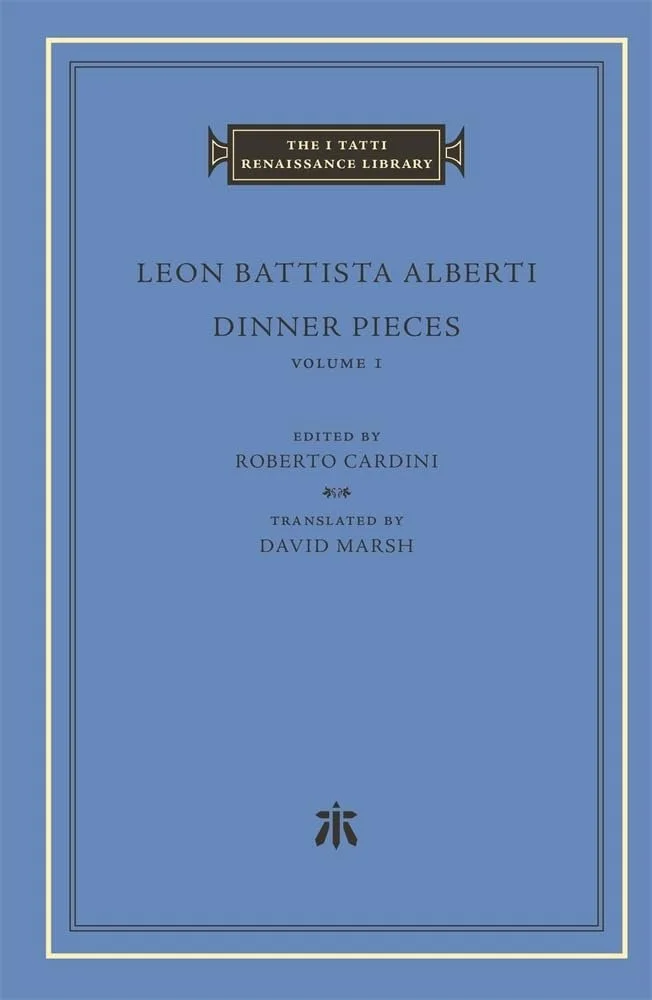
This week, I spoke with Dr. David Marsh about the life and times of Leon Battista Alberti. David is Professor Emeritus at Rutgers University and the author of many books, including The Quattrocentro Dialogue, Studies on Alberti and Petrarch, and Giannozzo: The Life of a Florentine Humanist. His new book is his two volume revised translation of Alberti's Dinner Pieces, edited by Dr. Roberto Cardini. Our conversation on Alberti's life and writing in and around the great figures of fifteenth-century Italy is coming up right after this.
Well, welcome, David, to talk about Alberti and the Dinner Pieces. It's so nice to meet you. We're already having a good chat, but it's time to turn on the recording. Welcome to the podcast.
David Marsh:
I'm very happy to be here.
Danièle Cybulskie:
So, when we're talking about this particular work and we're talking about Alberti, tell us who he is and when he is. For the people who have never come across his work before.
David Marsh:
Okay. Leon Battista Alberti is often considered the most important universal man of the Renaissance. We have to try to include women, but at this point, we'll talk about men. And he is the most important one in what's called the early Italian Renaissance, which we generally say is from 1400 to 1450.
In the next generation, born in 1453, along comes a person called Leonardo. And he comes from a small town called Vinci. So, we call him Leonardo da Vinci. Da Vinci is not his last name. Sorry, Dan Brown, but okay, we'll go with that.
However, before da Vinci, there's Alberti. And Alberti does more amazing things than Leonardo, including he invents the category of what we would call the Renaissance man because he wrote a little autobiography of himself which survived. It's written in the third person. So, it said Alberti did this and Alberti did that. He was this and that. He could do anything he wanted. He could throw a coin and hit the ceiling of the cathedral. He could jump over a horse standing with his feet together, just jumping from like that. He threw the javelin. He overcame his dislike of garlic by forcing himself - by forcing himself to eat the stuff. And he dabbled in… and he gave musicians advice they could profit from. And he learned a lot about architecture, which then he became very important, for he's got several monuments in Florence. If you go to Florence, you'll see churches by Alberti. You'll see the facade of Santa Maria Novella.
He wrote this autobiography in the third person, talking about him. So, he did that. He did that. So, for centuries, people thought, oh, this is by a friend of Alberti. And it's so easy for people to make one mistake, and everyone follows the mistake. And finally someone said, wait a minute. The way this person writes, the style is the same as Alberti's other writing. Oh, and he wrote in the third person.
Is that a problem? No, because if you go back to antiquity, you say, well, let's think about someone who wrote an autobiography. Well, there was Julius Caesar, wrote all about the wars in Gaul, and it's all in the third person. Caesar came and saw and conquered: third person. But who's writing this? Well, guess who? That wasn't… He wasn't the first one.
The first one was actually Greek, a famous Greek from Athens. His name was Xenophon. He studied with Socrates. Socrates fell afoul of the authorities, who were tyrants at that point, and Xenophon thought he should get out of town. There was a movement to help out the younger brother of the king of Persia, and a bunch of Greeks, a bunch – ten thousand, joined the army and went up there, and their leader was killed in a sneaky dinner ambush. And all of a sudden, the Greeks had to get home. So, they came home, and Xenophon, who was sort of a lieutenant in the organization, helped get them - take them six thousand miles back through enemy territory. Well, it all got written up. We call it the Anabasis, which literally means going into the country, not just coming back. And it starts in book four. “There was in the ranks a certain Xenophon of Athens…” and he tells you about Xenophon in the third person.
So, this is what Alberti did. And other people did this later. Gianbattista Vico, Italian guy. Education of Henry Adams is in the third person. So, once you understand that, you say the autobiography is an autobiography. It just says, “he did that”, but change the pronoun if you want.
So, Alberti says he was versatile. He uses this word in Latin, versatilis, which is not a common word, but it means could turn to anything he wanted. It's about turning to one subject to another, and that's what Alberti did. So, he wrote a little thing about himself.
Now, what happened? Who was the Alberti? Alberti was from a very big, very important family from Florence, Italy. Florence is, of course, in central Tuscany, the northern part of Italy. The north of Italy, north of Rome, in the late Middle Ages was developing free communes. They were little cities. Often, they had an alliance, nominal alliance, either to the pope or the emperor. And as soon as they were angry at one or the other, they exchanged the alliance. But they were basically free, independent, and they were largely mercantile. They depended on trade. They were run by a group that we might call the Chamber of Commerce. Florence was no exception. It was a big organization. They met in what's called the Palazzo Vecchio, the old palace. Why is it old? Because they built a new one called the Pitti Palace later on in the Renaissance.
So, Alberti come from a big family, big banking family, very, very wealthy. His grandfather, whose name was Benedict Benedetto, was one of the wealthiest men in Florence. But he had some pretensions. He got himself a knighthood. He was very popular with the rabble. And some of the other wealthy banking families didn't like that. So, they said… Well, what happened? All families would end up Romeo and Juliet style. If you think about that, that's another town and another… But this… The idea that rival Italian families would go after each other. Again, we all think this comes out of Mario Puzo and The Godfather, but it was already there in the Renaissance.
And the other families that didn't like the Alberti finally said, enough of this, and they began to exile. This was the common form of punishment. Rather than condemn someone to be hanged or burned, you just simply… [It] meant that you gave them exile. And the exile could be five to ten miles. Machiavelli got himself exiled for a while. He had to stay twelve miles away from Florence. Any closer, they'll arrest you and you're in trouble. Any further away, you're okay. So, the Alberti bank dispersed.
Now what happened? It was a big bank all over Europe. So when Benedetto and various other… And they only exiled the men, the adult men of the family, those were the powerful people. The women weren't going to be a threat. So, sometimes the women stayed behind, as Dante's wife did, and they helped to run some of the business, but not too much of it.
So, the Alberti family then disperses. Benedetto has several children. One of them is named Lawrence – Lorenzo – and he... Where did they go? They have banks. They have banks in Rome. They have banks in Genoa, they have banks in Venice, they have a bank in Bruges in Flanders, they have a bank in London, they have connections to Constantinople. So, Lorenzo, this son of Benedetto, goes to Genoa and there he has an affair with a Genoese woman. And he has two sons whose names are Carlo and Battista. Ah, “Baptist”. We say Baptist. Oh, yes. St. John the Baptist is the patron saint of Florence. Feast day, June 24th. Big fireworks every year in Florence. Oh, he's also a patron saint of Genoa. So being named Baptist didn't mean it was specifically a Florentine name.
However, the two sons, Carlo and Baptista, were never legitimated by their father. There were ways of doing this in Renaissance, medieval Italy, whatever you want to call it at this point, around 1400. It was simple to do, but his father never legitimized him. The point is that after he had these two illegitimate kids, he then got engaged to a Florentine woman. And you can imagine the Florentine woman didn't want those little brats, Carlo and Battista, anywhere near her family or her estate. They never had children, but he, for some reason… I think, mama-in-law, stopped the whole process, so they didn't get legitimized.
So, Alberti is raised with his brother, first in Genoa, then he's sent off to school in Padua, near Venice, where there's a very good Latin school. And Latin is the key language of instruction. Until the eighteenth century, Latin was the basic language of medicine, science and law. And if you didn't speak Latin, at least in a kind of broken way, you couldn't do it. You couldn't read the books, you couldn't write the books. This is what people did. So, Alberti grows up learning Latin. He speaks Italian - Ah, but what kind of Italian? Maybe he learned Tuscan from his dad, but maybe he learned some Genoese things. Maybe he had a slight Venetian accent. Who knows?
It's not until the 1420s – this is now, forty years after Benedicta was exiled – that the city of Florence finally revokes the exile. And the people of the Alberti family can now come back. And so, they begin to come back and set up. They never really get back to their position, they never get to the important height of banking power that they had, largely because when they come back in the 1420s, this rival bank, the Medici bank, the bank that works with the pope, is establishing its power. And its power is now going to be transferred behind the scenes into making sure that only Medici candidates get put into office, get elected, are even considered for election. And the whole thing is controlled by the grand old man of the family, whose name is Cosimo. And Cosimo de Medici is going to rule in Florence from 1434 to 1464, when he dies. For thirty years, he's going to be in control. So, all the other things that happened in Florence at that point, you have to always look out for the Medici family. And the Alberti aren't great friends of the Medici family.
But more important, Alberti – Battista, his name is still Battista; he gives himself a name later – Battista is very ambitious. After he goes to the basic Latin school (he's now in his mid-teens) he's sent to law school. And the most prestigious law school, probably the oldest anywhere in Europe, is in Bologna. You went to university for professional training in those days, and the three professional disciplines would be law, medicine and theology. And those were the places you went. If you wanted law, you went to Bologna. If you wanted medicine in Italy, you'd go to Salerno. If you wanted medicine, Salerno, law in Bologna and theology could be a number of places, including Paris. Paris was, of course, a very famous place, and it was no problem for these people, Italians or French or whatever, to move around. They all spoke a kind of an generalized Latin that got them through.
And so, Alberti went and studied law in Bologna. He probably didn't like it much. And meanwhile, he and his brother were supposed to inherit money that their father had given them. But some of his cousins got hold of the paperwork and they apparently took some of the money and ran. And Alberti tells us this in his autobiography, that he and his brother ended up having a difficult time.
Meanwhile, there's another important thing to think about, which is that Alberti… we say this is the early Italian Renaissance. Well, everything comes from something else. There was almost always some model or impetus somewhere. Alberti was born in 1404, and the greatest man of the preceding century, in what we call humanism, or the Renaissance of culture, was a guy named Petrarch: Francesco Petrarca. He was born in 1304, and his dad, who was exiled – oh, his dad was exiled – along with Dante in 1305 or 6. So, he grew up away from native Florence, and then he went to the south of France, and he went to law school in Bologna, where he didn't like it because he wanted to be a writer.
So, a hundred years later, here's Alberti, and he's the same thing. He's born in exile, his father makes him go to law school, and he doesn't like it, but he's got no other choice. So, he goes and he gets a double degree, which is canon and civil law – church law and secular law. And now what do you do with your legal training? Well, in those days, a good place to go... And this was true. Why was Petrarch in the south of France? Because his father was a notary. He was essentially… He had secretarial Latin skills. And where were the big jobs? Well, the papacy had just moved to Avignon in the south of France. So, Petrarch's dad went because they needed people to run their multinational corporation, the Vatican: the Roman Church.
Alberti now looks around and he makes connections, and he's going to get himself a job with the Vatican Church. At the same time, he's in Bologna, he meets some people. Oh, some of the people… The first Pope to come back to Italy after all of the problems that they had was Martin V. When he came back to Rome, the Romans didn't want him, so he had to leave for a while. He was staying in Bologna when Alberti was there, a teenager. He was there with Martin V, had his little papal choir. Oh, who's there? It was a guy named Guillaume DuFay, the musician who's going to write the anthem for Florence in 11 years, was hanging around. Oh, and Alberti had an uncle who was a bishop in Bologna, Alberto. So, he had an in with things.
Anyhow, he got himself a job. And then the ban on Florence letting people in – the Albertis –was lifted. And so, Alberti headed for Florence. He got there. We know he was there by 1429. He's twenty-five years old. He's got his law degree and his canon law degree, and he gets a job with the papal curia, as it's called. It's the papal court. It's the secretaries that travel with the pope. The pope has to give him a special dispensation because he's an illegitimate person. But he gets that and he starts to work for the pope. And this is the best kind of job you could get, partly because that pope is not going to be always in Rome.
So, the Pope ends up coming to Florence, and Alberti, then, is in Florence. He's now not legitimated, but he's got his proper job and his family is there. He starts to write, and he's now… he does… he begins to be versatile. He's not only interested in writing in Latin, which is the language of polite letters, and he writes brilliant Latin things. This is when we get to the Dinner Pieces. Most of them are in Latin, but he translated some into Italian.
People who don't know about Italy, don't know that it's a very fragmented place. And so, when Italian, the national language, was coming out, everybody had a different dialect. And it was a really hard thing to know. Oh, but there was a unifier in all this, and everyone's heard of the unifier. His name was Dante. And Dante, being from Florence, wrote the most amazing poem ever written and in Italian, such that after that everyone said, I think that kind of Italian works. And Petrarch then came on his in his footsteps, and Petrarch wrote love poetry. Petrarch wrote mostly in Latin, but he did write beautiful love poetry. And he also showed that this Tuscan Italian was the best thing for writing. So, at this point, Tuscan Italian, the way people speak in Florence, becomes the standard of… of the language. And other people… If you come from Milan, if you come from Rome, if you come from Sicily, when you start to write in Italian, you're going to probably inflect things differently, use more words that are Tuscan, and it becomes essentially the basis of the language, which happened in other places. German was kind of a big mess of dialects and things. And then Luther comes along, and when someone gives you a Bible you're going to read every day, guess where your language is, you've got now a center. You can go the way people could go read Dante or Petrarch or Boccaccio and see what's going on.
So, there's Alberti, he gets into Florence, he hits Florence, he hits the ground running, because we have, at that point, the artistic revolution going on. That is the most amazing thing. Turn of the century, we had Ghiberti getting the contract for the doors on the Baptistery. The Baptistery, of course, is The Baptistery of St. John the Baptist, who happens to be the patron saint of the city. So that's the central monument. People thought it was an ancient monument, not twelfth century, but okay. Ghiberti beats out another guy, another goldsmith named Brunelleschi, who decides he's going to become an architect, and does and begins to reform Renaissance architecture by adopting not so much Greek forms as Roman forms. The circular arch is the most important thing. Before Brunelleschi, the Gothic people loved sharp things that went as high as possible. So pointed arches were all the rage. When your building got too big and was going to fall and blow apart at the side, you put buttresses up on it and kept it going higher. We're not going to do that anymore. We use the half circle arch. It supports itself. That's what the ancient aqueducts and bridges that still stand were built with. That's what the Romans did. That's what Brunelleschi does. So, Brunelleschi.
Oh, but, oh, sculpture. There's a guy named Donatello who is doing the most amazing sculpting in marble or in other stone or casting statues. He does semi... I mean, hot pictures of David triumphing over Goliath, you know, a kind of a naked young guy who just chopped a giant's head off. This is exciting stuff, people.
Oh, and there's one other guy, very important, perhaps the most important person who doesn't live long. And his name was Thomas, but we call him Masaccio, which is a nickname for Tommaso – Tomasaccio – has introduced into painting... He's picked up where Giotto left off about a century before. He's taken Giotto's style of rendering situations, telling stories and rendering emotion. But he now realizes you want to have depth. Giotto does mostly frescoes, hardly anything on canvas or panel. Masaccio does a little bit more of that, but he's also doing frescoes, but he wants the frescoes to have depth. And so, he begins to develop this system we call perspective, or we call vanishing point perspective, in which everything in the frame… You're quite literally thinking of your picture or your surface as a frame, as a mesh, a gauze that's been laid over viewing a scene, and you've plotted that scene from where you stand, and you set the point level with the eye of the beholder, and you work out from that. So, you have a horizon, things above it and below it, things further away, of course, get smaller, and you figure out how to do that. Well, Masaccio is doing that, and people are beginning to think, wow, this is great.
Now he doesn't live too long. But that's the kind of thing that Alberti comes and sees. And Alberti is so extraordinarily versatile that as soon as he gets interested in something, he starts to write about it. And he does at least... Well, he does five or six different technical treatises, but the first thing that he does is to write a treatise on painting. This is contemporary, roughly 1435-36, with the completion of the cathedral in Florence and the big consecration that they have there to celebrate Brunelleschi's achievement. But he writes a treatise on painting, and since the people who paint will not speak Latin because they didn't go to university, he translates it into Italian, and he dedicates that Italian version to Brunelleschi. And he mentions in his preface, Masaccio, Ghiberti, Brunelleschi, and Donatello. Those are the four that have made the whole new work. He identifies them right away. He knows exactly who the people are, right? So, he does that, and that's a very big thing.
A little while later, he starts writing things in Italian. And he realizes, when I write Italian, I don't feel as if I sound like a Tuscan, like a Florentine. So, he gets some people from Florence, native speakers, and they help him. They say, well, here, you know, you've got this word. No, we wouldn't use that word, or we'd use a different way of saying it. And this goes on in Italian literature until the 1800s, when Manzoni tries to write a big novel. But he's from Milan. He has to get people to help him figure out – oh, no, we don't talk that way in Florence. We don't say things that you people say in Milan. But Alberti's doing that.
And some people… Apparently he wrote a whole series of books, dialogues in four books on the family, which celebrate his family, except that most of his family, when they were coming back, would go back into banking, and they didn't want to read this stuff. They didn't care about somebody trying to sound like ancient Romans having his family discussion about, how do you educate your children? So, they weren't too interested. But some other people said, you're wasting your time with that language. Latin is the only eternal language. Latin has a thing called the grammar. In effect, in the Middle Ages, when you said grammatica, which meant grammar, it often just meant Latin, because Latin was a language with the rules all set forth. The vocabulary was pretty much set forth. And Alberti says, oh, okay, if all we do… all we need to make Italian a language is vocabulary or rather a grammar, I'll do it. And so, he wrote the first grammar of Italian, and he explains how the sounds go, he explains how you write the letters, then he explains the various tenses. He explains all kinds of things about the language. And he even gives us tenses, like the optative mood, or “would that God had punished”. It doesn't exist in Italian, but it's a Latin idea. So, he even puts that in, you know, that you can have one of these, “oh, if only...” And that's a mood called optative in class. But he gives... He says, there. And so now Italian has a grammar, therefore, now Italian is a real language. And he also says, we can do things in Italian that you people did. You know, what did the Romans do? The Romans went around speaking Latin. So, they wrote in Latin. We go around speaking Italian. Let's write in Italian.
And he holds a contest in the cathedral after the consecration, a poetry contest, in which he submits a thing. For example, he submits a poem with no rhyme. It's written in hexameters, which is a classical way of doing things that the Greeks and Romans perfected. And now he says, we can do that in Italian. And again, in the 19th century, Italian poets like Carducci said, let's do that. But in 1400, that was a crazy, revolutionary thing to do.
And we have to remember that Italian was not yet quite an established language. The one thing that became a very important text all over Europe was Boccaccio's Decameron. Because Boccaccio's Decameron's got stories in it you could understand. If you didn't even know anything about where Prato is or what the bishop of Spoleto cared about. You could still read the story and get a good laugh. But Boccaccio, well, if people wanted it, then they started to translate it. It got translated into French and into English and into Spanish and so on, because that was the easy way.
So, Boccaccio and his Decameron take the Italian stories places, but it doesn't really take the Italian language anywhere, whereas Alberti and some of his other people then begin to use it. And by the end of the century, by the 1500s, when you have someone who's from Florence who has something to say to the world, named Niccol Machiavelli, he writes in Italian because that's his language. At the same time, he still thinks the way an academic would, and he puts his titles in the book we call The Prince. The titles of the little chapters are all in Latin. They all say things like, Quo modo res publica, gubernandes sin: “How Republics should be governed”. Just because that was the way you took notes. You went to a class, you took notes in Latin. So, he uses that little bit. Okay?
So, okay, he's there now. Alberti is there. He latches onto the arts that are emerging, painting in particular, and he explains how to do perspective painting. Here's a man who's never painted yet, but he's now telling painters how to do it. He wants to write in Italian. He knows Italian has been used successfully by various people, but it doesn't have a grammar. So, he writes the grammar. He's then interested in all sorts of other things. But somehow, in his spare time, working for the pope, at one point, a cardinal says, I'd like you to write a saint's life. And he gives him some obscure saint who was martyred at age 15. Very unlikely story. The sources are all messy, and Alberti writes it up. But you can tell his heart is not in this. This is just not the sort of thing he wanted to do.
But at the same time, he's been in Bologna. Bologna is a student town. It’s a university town, huge amount... And what do students do? Well, obviously they go out and carouse, you know, wine and wench and all that stuff. But they obviously tell stories. And later on in the Renaissance, we have people out, oh, I'm going to tell you about a story. Oh, here in Bologna, Bologna is a great place for stories because you have priests and you have professors and you have students. That's a great mix.
So, Alberti begins, for some reason, to think about writing literature. And the first thing he thinks of is he likes plays. People are just discovering Roman plays because if you want to learn Latin, the best thing to do is read Roman – well, what we have are two poets we call comic poets, writers of comedy. We have a guy named Plautus, lived around two hundred years before the common era, and we have something like, oh, I think it's eighteen plays by him. They're not all complete, but mostly. And it's wonderful because it's spoken Latin and yet it's in metered. So, he elevates the language. Then you have about fifty, sixty years after him, a man we call Terence, whose… only seven plays survived by Terence. But again, it's language from early on, when Rome was still a republic, no emperors, and very pure and expressive kind of thing. It's in metrical composition, but it's very, very clear. And Alberti was obviously inspired by that because it said, here's the way people talk in ancient Rome. We can learn how they said things. You know, if this is… You take the Rosetta Stone, Latin 101, and it says, hey, dude, how's it going? What's happening? And they would tell you how to do quidaegis. You know, you learn all this stuff.
So, Alberti wanted to write a play. And he did write a play while he was in law school. He was about twenty. And he gave it funny allegorical figures with Greek names, because that was very common. Greek names were very common in ancient Rome. Most people, educated people in ancient Rome spoke Greek the way most educated people in nineteenth-century London or Boston spoke French. It was the language of high culture.
So, he wrote this kind of allegorical thing. It's about a virtuous, young – Oh, dear. Here's another form of autobiography. You create a hero who's trying to win the beautiful maiden, but there's a rich guy who beats you up because he's rich and you're not. At any rate, the young guy will win and so on. But it's kind of stiff and it's odd because at that point, people didn't even understand how ancient comedy was written in metre. So, he wrote it in kind of approximate prose. But you could see he was absorbing all kinds of varieties. This was the kind of Latin you didn't – weren't – taught this at school. You weren't supposed to be writing play scenes in school. You were supposed to be writing declamations, orations, or possibly some poems on traditional subjects, like why Latin is important or something.
But that got him started thinking. And as he began to think about it, he began to write short little works of fiction. And apparently, he would circulate these among friends that he knew in the papal court, probably, probably now, some newfound people, some newfound friends in Florence.
It seems early on he must have met the Florentine chancellor who was Leonardo Bruni. Bruni was thirty years older, very powerful, important, very wealthy man, unlike Alberti. And he translated all kinds of important Greek texts. He translated the most important things by Plato and Aristotle. And he wrote a history of Florence, which got him a permanent tax exemption, a financial break. And when he was buried in Santa Croce, the Basilica of the Holy Cross, Santa Croce, his tomb became the beginning of what became the sort of Westminster Abbey of Italy. It was the first one. After that, anyone important was supposed to be buried there, whether they got the body or not. So, Machiavelli's there, Galileo much later. People, famous people. But the first big monument, and it was to Bruni, with Latin on it, and with an effigy of Bruni lying there with a laurel wreath on his head like a poet, and he's clutching to his bosom a large bound volume manuscript – though not printed, manuscript, no printing yet – which was his History of Florence. So, this is a monument to him, but a monument to him as the historian of Florence. So, he's a very important person.
And along comes Alberti, who's genetically a Florentine, but culturally maybe not so much. And apparently Alberti didn't receive a great welcome from a lot of his members of his family, and apparently did not receive a great welcome from Leonardo Bruni, but he still thought, ah... And he says around 1440, he's been in Florence now for only a dozen years at most, “I began to collect my little dinner pieces into books so that people could more easily read them.” Now he invents a word, intercenalis, which means during dinner. Someone thought it meant between dinners. No, it doesn't mean… A cena is a dinner, but intercena means during the dinner. And the idea was there's something entertaining, as people are… You know, we all sit down at a banquet and we can have music, we might have dancing, we might have something. We might have someone read. If you're in a convent, you might hear someone just be reading scripture to you. That happens. That happened to me for a reason I'll explain, I hope, in a minute.
So, he started collecting these things and he began to put them together, and we don't know what happened. And then by 1443 or 4, the pope finally went back to Rome. Things had cooled off. The pope was not welcome in Rome. The first two popes to go back to Rome were not welcome there. He finally went back there, and Alberti more or less lost his contact with Florence. But around the…
It's before he does that that then he dedicates various books. And we think that eventually we have books. We have a book, 7, 7, 8, 9, 10, 11. And we have books 1, 2, 3, 4, and we don't know where 5 and 6 are, and we don't know which got renumbered. And we have books, we don't... We have a very long dialogue that we don't know where it would have gone and what happened. So, he never came out with a definitive form again.
This is pre-printing. Printing is invented in Germany around 1450. That is Gutenberg. The whole thing gets to Italy in 1465. A couple of Germans come down with the equipment, with the printing press and set up shop outside Rome and begin to print. But Alberti hears about this and mentions it in a late work about composing codes... But he doesn't… He's not there to say, oh, I've got to get in on this and start publishing. So ,he's pre printing, like most of these other people. We need things to be copied.
At any rate, he collects this and that, and what we have now is kind of a mix. First thing to say: what… what do you mean Book 11? If you're a classical person, and this goes for classical music too, you do tens or twelves. I'm sorry, you do fives and sixes and tens and twelves, you do that. You don't eleven. Well, there's a precedent. There's a very famous... It's the only so-called Roman novel to survive from antiquity by Apuleius. It's called The Golden Ass, about a guy who turns into a donkey. It's in eleven books. And Alberti knows this guy and likes him. So I… maybe he thought that was good. Where 5 and 6 went, we don't know. But we have all these things.
And then what Alberti does is take some of these things, his books, and put them together, let's say eight or ten of them, not five or six. Not quite the classical number. The first book is dedicated to a physician who's also kind of a scientist, because in those days you knew about the natural world, physics, as well as the physical world of medicine. And so, Book One is to him, and it's a very friendly thing. Book Two is to Leonardo Bruni. And, oh, he gets a little dagger out there and he sticks Bruni a couple times. Very important, very wealthy man. And Alberti basically says, you know, we can't all be as eloquent and have the wealth, the wealth of your eloquence, all that wealth. And he… All the pieces in Book Two are about wealth. And the last one in Book Two is a tribute to his grandfather Benedetto, who died. He'd gone, he'd been exiled, he went on a pilgrimage to the Holy Land. He was coming back. He's on the island of Rhodes in Greece and he dies. And as he's dying, he gives a testament to his children and says that all my wealth is not important. What is really important is your personal worth. And he gives a sort of stoic speech and he comes out as a great hero. Okay, that's Benedetto Alberti.
Oh, let's go back to Mr. Leonardo Bruni, dedicatee of the second book. He wrote the history of Florence and of course he talked about the Alberti getting themselves kicked out in Book Nine and he's talking about a time of sedition, tumult and uprising. And Benedict of the Alberti family was one of the worst, who was so egregiously seditious and revolutionary that he had to be driven out of the Republic. Here comes Alberti: “I think you might like to read this, Leonardo. This talks about my grandfather, whom you so much admire. “And he didn't, of course, at any rate.
So, the wonderful thing with Alberti, he's an outsider. He's illegitimate, he's not happy. He also must have been unhappy in love because he's mostly misogynistic. This is a terrible thing. Full disclosure: he's not kind to women, mostly. I think a lot of it is following commonplaces of the literary tradition. But it's not really to his credit for someone as inventive and as intelligent as he was to take a dim view of women.
At any rate, another book, Book Four, is dedicated to a friend who's also his papal secretary, Poggio. And there's a little less tension about things than there is with Leonardo.
But you go through the whole collection – and again, it survived. It was very hard to find. By 1500, there was a priest in Florence who admired Alberti, who had died 30 years before and had left Florence basically never to return. But he tried to collect things. He tried to find these pieces. He knew they were out and he could hardly assemble them to publish them because he was putting together Latin works by Alberti. He couldn't find these things. Then we knew there were certain bits and pieces. Finally, a manuscript showed up in Oxford, had been collected by a guy in Bologna, and it had been written after Alberti's death by only 10 years. And that's a famous Oxford manuscript, which is big fat thing. And it had all kinds of works by Alberti – not just these dinner pieces, but it was the main source. So, in 1890, a scholar published an edition with this book. Big problem. The guy who read it was the Oxford… Guess what? The head of the Bodleian Library, named George Parker, was not really good with reading Italian manuscripts. And it's a pretty good manuscript, but it's kind of old fashioned, what's called notarial script. And George Parker made a whole bunch of mistakes. And then the Italian guy corrected it sight unseen and added more mistakes. So, it got worse. And so, when this came out in 1890, it was a pretty bumpy text. And you didn't know whether Alberti was incompetent or just sloppy or mostly his editors were.
Okay. That was sort of in 1890. That was what people knew about Alberti's dispersed collection until in 1964… there's a monastery or a convent in Pistoia, which is only 45 minutes away from Florence. It's a Dominican convent. And there was a Dominican monk there named Salvatore Camporeale, whom I got to meet later in Florence; a very good friend who was an, interestingly, Marxist Dominican. And he was living in this convent and he came across a thing in the convent library that was a printed book with a manuscript piece stitched into it. And so, he unfolded the manuscript and started looking at it and thought, oh, this looks like a Renaissance thing. He was writing a thesis at that point with a guy named Garin – G-A-R-I-N – who was the top Renaissance scholar in Italy at that point, teaching in Pisa. And he took it to Garin and Garin said, oh, my God, it's Alberti's Intercenales – a new copy with new texts.
So, Garin transcribed it and published it right away. And everyone began to go crazy because now we found out that something that Ariosto does in his Orlando Furioso comes out of Alberti. There's something in a painting by Dosso Dossi, “Jupiter Painting Butterflies”. What? That's from Alberti. All these new things came out of Alberti.
So, in 1964 we got a new second dose. It almost doubled the amount of these pieces, and it gave us a different numbering for some of the pieces. And so all of these things fell together.
And I decided at one point I should go look at that manuscript as I had the Oxford one. So, I got up one morning and went down and got on a train. It was very quiet and I got to Pistoia and I thought, oh, it's seven in the morning. Maybe get a coffee, make up breakfast. Everything was closed, so I trudged up and I asked… okay, the convent, okay, San Domenico, it's up there. Okay, I get there, I ring the bell and I explain I’m a young American scholar and wanted to look at this manuscript. They said, oh, come in, come in. They said, would you like a coffee? I said, yeah, I can't find it. Oh, it's a national strike today. I thought, national strike. Nothing works but the railroad. So, I took a train to Pistoia, not knowing that the only thing that worked in Italy that day was the train to Pistoia.
So, the monks came in and the brought me a coffee and they showed me the manuscript. And then after a little while, the guy came out, said, would you care to join us for lunch? Here's a starving graduate student. You ask any starving graduate student that question in any language whatsoever, you know what the answer – Yes, most willingly.
So, I had lunch with… with the monks of San Domenico and they don't talk, they eat. Food kept coming around and there was one reading scripture and there was course upon course upon course. I understood what Boccaccio talks about when he's got these monks that are kind of big, because this was the party midday meal. They saved my life. And I went back very pleased to be reading Alberti at that point. Now, I had two, two coffees at the end, courtesy of the Roman… the Roman Church. So, I'm very...
Danièle Cybulskie:
Yeah. Well, you mentioned that in the monastic context, people are reading, and it's usually one person and they're just reading. But the Dinner Pieces by Alberti are so different because they seem like – not all of them, but many of them – seem like a dialogue that requires performance. So, do you have the impression that these would have been performed by a couple of people?
David Marsh:
We don't know an awful lot about reading habits, especially in… vernacular reading habits. One clue to what you're asking is that Alberti translated, as he did, his treatise on painting, he put it also into Italian, so that someone like Brunelleschi – maybe Brunelleschi couldn't even read, but someone could read him the thing in Italian. And he'd say, okay, he'd understand.
Two of these pieces get translated. One is a tale of shipwreck. We don't know much about Alberti going down to – where would it be… Livorno or Pisa? – and getting on a boat and going. We don't know that he traveled. We don't think he even went to France. I mean, he seems to have been very much just in Italy, maybe as far south as Naples and as far north as... Maybe not even Venice, I'm not sure. Certainly Bologna. And he was raised near Venice in general.
But he translates this piece on shipwreck because it's in part based on some stories in Boccaccio. Boccaccio loves that. You know, he's talking about this. You go over there, and then you’re shipwrecked, and then the pirates pick you up, and then they sell you over here, and then someone else picks you up, and then... And eventually maybe you come back and now you marry the man and he thinks you're a virgin. And actually, you have a long story…
So, he translated that one. And the… another one that he translated from one of the Medici family, one of Cosimo's sons, is called “A Debate on Marriage”, in which three sons all talk about how they deal with… Well, the first two talk about how they deal with wives. The first one with a wife who is cheating and he's going to repress her. The other one with a wife who's going to cheat, but he's going to let her do it because he can't control. And the third is one I choose not to marry. “That's my approach to marriage, is to abstain.”
But he translated that one into Italian, too, and it's a very strange work because, of course, it's not terribly fair to women. But then you could say, well, that's maybe the attitude. But who was reading… You know, Boccaccio early on in the Decameron to jump back a century, says he's writing in part for women. Men can do all these things in life. They can go hunting and riding and hawking, and women are stuck at home. And so, if they can have some entertainment from a story, that's a good thing. And I'm... And Boccaccio obviously, was a great lover of women in that sense. And so, Boccaccio maybe is trying to make this stuff more available, but we don't know too much at that point.
We do know later on, some court poets in Florence, Pulci, or in Ferrara, Boiardo and Ariosto, we know they would get up and read their stuff for the court. And the court was a place where women had a voice. Unlike the papal court, the curia, there's no women there. Most of the Renaissance dialogues I talked about in my first book are all men talking. But you get to the court society and the Book of the Courtier by Castiglione, written in Italian, and the women are in charge of leading the conversation and thinking. And that's the next step. That High Renaissance opens up, I think, society and allows women in who should have been there before.
At any rate, where were these people? They're supposed to... He said that should be read over dinner and drinks, but we don't know that specifically. He could say, oh, you know, they're going to have a party next week. They're having a party at the Medici palace, and maybe someone would like to read this piece that I wrote. It's very hard to know where he got this impulse inspiration to start writing fictions. And sometimes the fictions go in a direction that shows that he'd been reading Roman comedy, so that people say, ha, ha. And they do. In Roman comedy, most of the stage directions are in fact... or… They have to be built into the text. They didn't really write stage directions. So, in comes the servant, the slave, whose name is Davos. And he says, ah, ecce crepitutsforas. He says, oh, I hear a door creaking over there, which is to say, stage left, enter… you know, and then in comes the old man. And… And it's – all the stuff that led to commedia dell’arte is already there in ancient Roman. So, you set up a thing where you basically have three entrances, one central and two lateral. And then every time, oh, but I hear someone coming! Oh, who is this that I see? Okay, Alberti does that in a lot of his dialogues, because that was part of stage directions in Roman comedy and also in ancient dialogues.
Someone, a guy named Lucian, who was a Greek writer, would go around and read his stuff, and he obviously had to dramatize it. It was a little bit like, you know, as if Dickens were to go around and make dialogues out of Martin Chuzzlewit or... But he, you know, so Heracles says… He says, oh, Diogenes the Cynic. How are you? And so, everyone would get addressed in a good vocative. Like… to let everyone know who this person is. And then we, of course, we all know from a school reading what Diogenes the Cynic is like. And so, he will behave accordingly. Hercules will do certain things and bear certain things. He has to be accoutered in the proper Herculean fashion.
Anyhow, back to Alberti. He does all of these different kinds of jokes and things. He's bitter a lot of the time. There's one dialogue which is called “The Deceased”. The longest one. We don't know where it – which book it was supposed to be. It could have been all of Book Five or Six. But essentially you have a man who dies. And then after his death, he comes back. He's a spirit, he says. He flies back. He's up on the rooftop. He's looking through the window, and he finds his gardener making love to his wife. And he finds his kinsmen coming in looking for money in the library, tearing up his books that he's worked all his life. And the things… His manuscripts are being... They found some ointment. They want to start wrapping it in his manuscripts. You know, it's like taking your Bible and tearing it up to wrap fish and take it. And it's a terrible thing where this guy sees his whole life was false. The sermon about him after death was completely wrong. And then finally, he had a store of money that he hid near a little aqueduct at the back of his property. And his bad, evil neighbor comes in and actually finds that and steals the gold. The pot of gold is stolen. So, that's a kind of a comic trait, but... But it's very bitter. And Alberti is constantly...
The problem everyone had was this. We all want to think cliches and the word Renaissance – or Renaissance, which usually, even with the French spelling, the English give it that pronunciation – we say, oh, Alberti, he's versatile, so he's the Renaissance man. But we all know that the Renaissance man has to be optimistic and believe he can triumph. No, we don't. The Renaissance man was too smart for that. The Renaissance man knew how bad the world could be. He knew how bad things could be in his own life, where he had great talents and they would not be recognized. So, Renaissance man means Renaissance pessimist as much as it means optimist.
And Alberti is constantly balancing these two things because he went on, after he returned to Rome, he went on to do two very large projects in Latin. He did a number of dialogues. Mostly he stopped really writing Italian things after he was out of Florence. I think in part, he couldn't ask his friend Lorenzo, hey, was this what… How would we say it that way? But when he got to Rome, he did two big projects. One was what we would call a novel called Momus, who is the god, the classical god of mockery. And it's all about Jupiter trying to remake the world and everyone, everything falling apart, things… just crazy things. The gods get scared and they all pretend to be themselves in a theater, they pretend to be statues, and some old drunk comes in and pisses on two of them. You know, life is like that. If they don't know you're Jupiter, they don't respect you.
So, that's a very strange thing. But that might have disappeared, but suddenly it cropped up, and two people, two separate publishers, published it in Rome in 1520, so a century after, or fifty years after Alberti's death. But the more important thing that had started with that treatise on painting came to the greatest fruition when Alberti wrote about architecture. Because everywhere he went in Italy, he looked at Roman architecture. And I've traveled a lot, and when you see a Roman aqueduct or a bridge, or you can go to Spain or the south of France, and you see the traffic is still going over this bridge two thousand years later. You know, that arch works – that the Romans knew how to build things. They had incredible things.
And Alberti studied and collected, and he not only collected experiences and probably took measurements – did take measurements. He tells about proportions of a door, a Roman door, but he also collected things that he could get from classical literature. And classical literature is now opening up to Petrarch. A hundred years before him, everything was in Latin. We didn't do Greek. Now we know Greek. And Alberti knows a lot of Greek. And if he doesn't, he's got friends who know Greek. We have people, Greeks, who have come to Italy. 1453 is the doomsday of Constantinople. That's when the Turks, on May 29, take over Constantinople, which is now Istanbul. That's the modern name. They have superior artillery, and they can blow a hole in a ten-foot wall and they can take over. The Greeks did not wait till May 28, 1453, to pack their bags. They knew for about forty or fifty years that this was probably going to happen. And they hoped someone would come and get them. They hoped when they met – they met after the consecration of Florence Cathedral – a couple years later, they had a council in which the Greek church tried to join the Roman Church so they could all have a new crusade and help out. Well, the people back in Greece didn't like Western theology and they repudiated the whole thing, which you might say was stupid, because they needed help. But the Turks overran more than just – the Turks almost took Vienna, for God's sake. So, the Turks were not to be turned back. And meanwhile, the rest of the century after that date, popes trying to call a crusade and not succeeding.
But Alberti did have access to Greek works as well as Latin works, as well as his own experience, as well as this and that. And he compiled ten books. There we go. There's the magic there. It's a classical number. Ten books on architecture which survived, and they were in Florence. And after his death, and after the death of Cosimo de Medici – who may not have been a great fan, we don't know – people in Florence knew that Alberti had done works. He largely had commissions from a man named Giovanni Rucellai, very wealthy Florentine. So, he did the facade for Santa Maria Novella, he did a little work for Rucellai here and there. He did projects outside of Rome, including a beautiful basilica, St Andrew in Mantua, which is one of the greatest churches – it's the church that says, here's what the Vatican, what St. Peter's will look like in thirty years. It'll be bigger, but it'll be this thing. It would be this Roman vault, huge bath structure. Alberti thought the Roman baths were the biggest buildings they built. That's big. They needed the biggest building for baths, they needed more... Our big churches need that. It has to look like a Roman bath. Don't worry about what the Romans did with it. For us, it's a church.
So, he wrote this book on architecture and in Italy after his death, people looked around and finally, the greatest scholar of all Italians at that point, the guy we called Poliziano, and he'd come to Florence as a young man and became a tutor to the Medici family. He was a brilliant poet in Italian, but also in Latin and also in Greek. He wrote notes about classical literature. He read and remembered everything. He only lived to be forty, but on his way up, in his thirties, he said, we got to publish this book by Alberti. He's our man. So, he edited this book and published it in Florence in 1485. Alberti's been dead thirteen years. The books on architecture. And in his preface, Poliziano says, I can't believe all of the things that Alberti knows. He's the most learned person. There's another man in the curia at the same time, a guy named Biondo, writing about monuments in Rome and geography and history, and amassing huge amounts of stuff. But Alberti's book, books on architecture, the ten books on architecture, are the most amazing compilation. There are still some places where he had… He left a little blank in the manuscript [so] he could go look that up. He thought it was in Herodotus, but he wasn't sure. So, absolutely amazing thing.
So, that monument stands, the churches and other things that he did in Florence and Rome and in Mantua and in Ferrara and in Rimini. You'd have to start – look up Alberti. You know, you can find all these. All of these things stand. But of his works, his Latin works, most of them disappear, then they begin to come back or they get translated into Italian a hundred years after his death. But the books on architecture come out in 1485. And this is a very big important thing, because those books on architecture serve architects for two hundred, two hundred-fifty years. People in France copy and rewrite Alberti.
The next generation, of course, the big generation, is mid-century. Palladio not only designs things, he also writes books. And of course, he bases a lot on what he knows. They're all working from Vitruvius, an ancient text. But Alberti goes beyond Vitruvius, and Palladio then wants to go beyond that. And pretty soon, if you want to know what happens to all of this stuff. Our founding fathers were great classicists, and Thomas Jefferson had various French and other editions of Palladio's architecture. Because like Alberti, he thought, I'm versatile. I could write a Declaration of Independence, and I can design my own villa. And I'll tell you what, I'll give it an Italian name. How does that sound? The Little Mountain: Monticello. I don't know how he pronounced it as a Southerner, might have been “Montisello”. But that comes straight out from my American perspective. I see a bridge that leads from the first Renaissance man, Alberti, to perhaps the last American Renaissance man, Thomas Jefferson, in the sort of extraordinary tapestry of things that they attempted and accomplished and did better than most people.
And it's an extraordinary... It's an extraordinary journey to think some people, everyone's going to think, oh, this is all old hat. Why would we want to know about this? The most famous cartoon in the world, probably for me at least, was a New Yorker cover which showed a picture of – in the foreground, we have Manhattan and Broadway, and then we have the Hudson river, and then there's Chicago, and then there's California, and then there's the Pacific Ocean. Way in the back, there's something. Japan, I think. So, everything that Americans know is basically right here in their front yard or backyard at their feet, and all that other stuff is way out there. So, they don't know. Some people don't know whether we have photographs of Lincoln, but do we have photographs of Napoleon? How do we know about these other…? We lose perspective. Everything is about what happened last week. It's a culture where it's disposable. And obviously the merchandisers have to make us think that. That McDonald's now has a new kind of sandwich for a limited time, and you can join the club and you get rewards, but you forget that something happened before all this, before 1955 and Ray Kroc. We had a country and there were other countries, and every country had its own traditions, for better or for worse. And we had traditions which were starting to lose sight of because we have this now. We're getting the blitz. It's called post-Disney stress syndrome of… everything is magic. It's all magic. If you buy the right toy for the kid, it's magic. No, it's not. It's expensive. It's a payoff. But this is getting away from Alberti.
But what Alberti achieved came close to oblivion, which possibly was what some people would, you know, some people would have thought what he was doing was not worth doing. And yet it's now an important legacy. And of course, there is, as we call it in academia, we call it… There is an Alberti Industry. We don't punch cards and, you know, do sort of Modern Times things like Chaplin, with gears and so on. But there is an industry where we participate. And in fact, in April, I go to Vienna to meet some of the usual suspects, and we'll talk about this usual suspect – Alberti – and the many things that he did, which are still worth reviewing and learning from.
Danièle Cybulskie:
Yeah, well, I mean, we've run out of time, but I think that you wrapped this up perfectly for me, where you've bridged those six hundred years between then and now, and talked about the way in which learning about all these things and sharing that knowledge is so important – something that we need to recognize medieval people really wanted to do: gather that information and pay it forward. So, I think we owe it to them to go back and look at it. So, thank you –
David Marsh:
It's also striking to me that if you go back seven hundred years, we have a really strange theocratic society. It's really hard to feel much connection. We want to think that the Renaissance gave us… It did give us a lot of things. It gave us banking, double entry accounting, it gave us architectural forms that got to be solid and classical, like any 1920s bank. And things that we could say, okay, we're… Enough of that, let's break the mold. But it still gave us an opportunity to explore things the way Alberti explored things. Starting, in a sense, from scratch, but using our own capabilities, our own native gifts, and to come up with new creations to be creative about things. And I think if the only creation we can get is the latest TikTok/Spotify product, we're losing because we're not involved in that.
Danièle Cybulskie:
Yeah. There is so much more to learn, and I hope that people will keep reading books as a way [overlapping speech] to learn and I hope that they definitely will read your book –
David Marsh:
– There are still, yes, many, many books. I mentioned the Ross King wrote a book called Brunelleschi's Dome. If you wanted to get an idea of this world and Alberti was there, that would be a place to start because it's about something visual and you can still... It's still there. Now, they may tell you what sandwich to buy two blocks away in Florence, but the cathedral is still there. And with or without the sandwich, it still is an important thing from which you can benefit.
Danièle Cybulskie:
Yes, absolutely. Well, thank [overlapping speech] you so much, David, for coming on –
David Marsh:
Okay, well thank-you, Danièle. It’s been a pleasure.
Danièle Cybulskie:
– and telling us about Alberti.
David Marsh:
Bye. Bye.
Danièle Cybulskie:
To find out more about David's work, you can visit his faculty page at Rutgers University. His new two volume book is Leon Battista Alberti: Dinner Pieces.
Since I'm now sharing with you a little bit of medieval wisdom, or a saying, at the end of each episode, I figured this week it would be appropriate to pull one from Alberti's Dinner Pieces. There's a lot of good advice in the Dinner Pieces and a lot of cynical jokes. This little snippet is a bit of both: some good advice and some cynicism.
In a section called “The Oracle”, people bring gifts to a statue of the god Apollo to ask for advice or a blessing. One man called Libripeta says, “Be gracious, Apollo, I pray. I bring these books as an offering. I wish to seem a man of letters.” To which Apollo gives good advice: “Become one by reading night and day. Earn the praise of others. If they don't praise you, praise others.” But Libripeta isn't satisfied with this. He says, “That bores me. I would rather seem than be.” To which Apollo replies, “Then be a detractor of all men of letters.” In other words, if you want to seem smart but you're lazy, all you have to do is criticize smart people instead.
For more of Apollo's wit and wisdom, along with other fables and a whole lot of entertaining stories, check out David Marsh's translation of Alberti's Dinner Pieces.
Thank you to all of you for supporting this podcast by letting the ads roll, sharing episodes with your friends, and definitely by becoming patrons on Patreon.com. Without your patronage, this podcast would just not be possible. So, thank-you to everyone who's already getting in the groove with the new Patreon, where you can find some written articles by yours truly ,and some thoughts on the new trailer for The Death of Robin Hood. And now I've extended early listening to everyone from the $4.99 tier and up so you can listen to the podcast on your Monday morning commute instead of having to wait until Thursday. To find out more or to try seven days free on Patreon, please check out the new patreon.com/themedievalpodcast
For the show notes on this episode, a transcript, and a whole collection of past books featured on The Medieval Podcast, please visit medievalpodcast.com. You can find me Danielle Cybulsky on social media @5minmedievalist or Five-Minute Medievalist.
Our music is by Christian Overton.
Thanks for listening and have yourself a wonderful day.