Romanos the Melodist with Thomas Arentzen
Episode 323
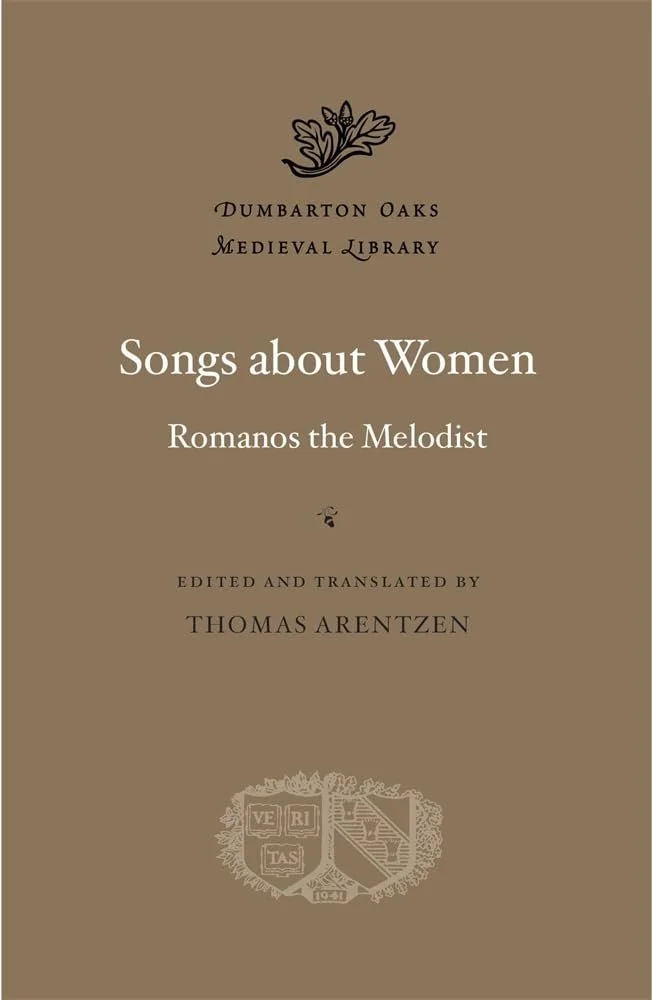
Songs have a way of making us see and feel things unlike other forms of writing, which is why so many of us treasure the words of lyricists. And when it comes to early Christianity, no songs were more treasured and influential than those of Romanos. This week, Danièle speaks with Thomas Arentzen about the life and works of Romanos the Melodist, why his work is so important to the history of Christianity, and how this legendary lyricist wrote about women.



Buy the Book




The Medieval Podcast uses affiliate links.
Transcript
If someone were to stop you on the street and ask you to recite a line from your favorite poem, I think many of us might struggle for a moment. But if we were asked the lyrics to our favorite song, it'd be no problem at all. Songs have a way of making us see and feel things unlike other forms of writing, which is why so many of us treasure the words of lyricists. As Bernie wrote and Elton sang, “sad songs say so much”. And when it comes to early Christianity, no songs were more treasured and influential than those of Romanos.
This week, I spoke with Dr. Thomas Arentzen about the life and works of Romanos the Melodist. Thomas is a visiting research fellow at Lund University, the author of The Virgin in Song: Mary and the Poetry of Romanos the Melodist, and the co-author of Byzantine Tree Life: Christianity and the Arboreal Imagination. His latest book is Songs About Women, a selection of Romanos the Melodist’s work, which he edited and translated. Our conversation on who Romanos was, why his work is so important to the history of Christianity, and how this legendary lyricist wrote about women, is coming up right after this.
Welcome, Thomas, to talk about Romanos the Melodist. This is exciting for me because we don't usually talk about music on the podcast, and it's so nice to meet you. Welcome to the podcast.
Thomas Arentzen: Thank you so much. I'm really looking forward to this conversation.
Danièle Cybulskie: Me too. Okay, so when we're talking about this particular person, what time and place are we talking about?
Thomas Arentzen: We're talking about the Late Ancient world. So, Romanos was born in the fifth century, probably in Syria. That's what scholars think. And he was probably even a Syriac speaker in his childhood. So, he came from the city that is today called Homs in Syria, and he spent his youth in Beirut. And then in the early 6th century, he traveled to or moved to Constantinople, the city that is today Istanbul, and which was of course in that time, the most important political center of the Roman Empire and the Christian world. So that's where he lived his adult life, and that's where he wrote all his poetry.
Danièle Cybulskie: We don't have a sense at all of what brought him to Constantinople or anything like that, do we?
Thomas Arentzen: Not really. But of course you can kind of ask what brings people to the big cities today? And why do people want to go to New York or Cairo for that matter? I don't know. That's the only thing we know. I mean, there might be kind of a pull towards an interesting place where things happen. He was clearly a young talent, and I don't know how much of that talent he could develop in the place he grew up. That's my only guess. It's not really much more than a guess.
Danièle Cybulskie: Which brings me to the question, when you have just the barest details about this person, where do you look to find as many biographical details as you can? Because I think there's a lot of people who listen to the podcast and they're like, how do you even find out? Where do you begin to find out biographical details about someone like this?
Thomas Arentzen: There is very little biographical details about him. And that's true, of course, for many people in Late Ancient/medieval and medieval worlds. In this case, we have a few short prose texts from church manuals, you know, because he was later considered a saint. So, there's, like, short paragraphs about who he was, but those were written much later. And then we also have poems or songs that were written about him as a saint, and even people who wrote poetry praising him because he became this big name at the kind of outset of the Byzantine Christian world. So, he's always, later in the Byzantine world, remembered as the kind of the father of Christian poetry. But all of these things are late sources, and there's no archaeological sources, so we don't really know a lot. But we have his poetry. And of course, based on the poetry, you can kind of get a sense of what this person was. Although it's true, I think, for all artists that you don't necessarily put all of yourself into… Into your wotk. Or maybe you do, but maybe… but it's not necessarily the private self. You know, you… You put some kind of professional self into it. So, it's part of the… the mystery, when you work on authors from this period, that there's a limit to how much you really know.
Danièle Cybulskie: Yes, I was thinking about what could be a sort of contemporary example, and it's almost like a song about a singer, like somebody who's singing about the Beatles, and you're trying to figure out everything you could possibly know about the Beatles from someone else's song. It’s a difficult task, you know, not one that I envy and probably why I don't work in the same period that you do.
Thomas Arentzen: But I'm not really, you know, I mean, the biographical part is not my main focus, though. I mean, I'm mostly interested in his poetry. And, you know, as with many authors, their works are often more interesting than their lives. Even some authors are even kind of bad people, you know, in their biographical life, but they can write, still write really wonderful works of literature. So, that's really my focus.
Danièle Cybulskie: Right. I do want to get to all of that stuff in just a second, but I want to come back around to the biography just for a minute, because I think this is something that you set up in your book as well, that the context in which he's writing is really important. So, he arrives in Constantinople and starts writing these Christian lyrics. We're calling them poetry now, but they're - I think, from what you said, that the implication is that they are all sung. So, what's the context in which he's writing? He's showing up in Constantinople at this particular cultural moment - what's going on around him?
Thomas Arentzen: There's two ways, I think, to answer that. There's the legend about that, and then there's the more historically-oriented version. I can give you the legend also, because it's quite important in the reception of Romanos.
According to the legend, he was a young man with no talent whatsoever in singing or writing poetry. And he goes to a Marian church for Christmas, Christmas Eve. And then in the night, he kind of falls asleep outside the church or in the church - there's different versions. And then the Virgin Mary appears to him and gives him a scroll - book scroll. And she says, “swallow this.” And he swallows this piece of writing. And all of a sudden he turns into a sweet, singing poet who has both a wonderful voice and a wonderful pen. And so he immediately goes up on the ambon, which is this platform in the middle of the church where in those days people would sing. And he sung his now famous Christmas hymn just from the inspiration that he got from the scroll eaten out of the hand of the Virgin Mary. That's the legendary version of how he became such a gifted songwriter.
In more kind of historical context terms, we don't know exactly. But he arrived in Constantinople in the beginning of the 6th century, and there was a church complex in what today is called the Kalendarhane Mosque, in central Istanbul. And it seems that that place is what used to be called the Kairo district, where Kairos of Panopoulos, an intellectual, a poet, had created the city's first Marian church. So, at this Marian church there was a kind of a group of singers, it seems, that had created a kind of a poetic and intellectual milieu. And Romanos got attached to that group. And that's where he settled down, and that's where he had his career. We don't know, really, a lot about these things. And, you know, it's all based on these very brief textual sources, but that seems to be the place. And there's some kind of connection, I think, between the fact that he settled at this important Marian church and the legend about the Virgin Mary, and also the fact that he wrote a lot of his poetry about the Virgin Mary. I've written a whole book about this called The Virgin in Song, where I kind of trace the Marian character in Romanos. So, I think this place becomes very important. And it's in a time when Constantinople is growing to be a kind of a Christian city, because when Constantine legalized Christianity, Constantinople wasn't really a very much of a Christian city. But Justinian in the 6th century, he was really trying to make it into a Christian city and a Christian empire, and he was building churches all over. And so that's the kind of world that Romanos moved into. And he became one of the people who helped construct a kind of a Christian culture in the sixth century.
Danièle Cybulskie: Well, I think it's interesting to think about the people who are writing at this moment in history, because as we go through our lives, obviously we can't be thinking about everything all the time. And there are things that we take for granted, I think, and some of those things are that these hymns and songs about Christianity, for example, have just always… they've always been there. And so, it takes some effort to think back, and - somebody must have written these at some point. So, it's interesting to think about the people who are in this community actively starting to build the things that will become the hymns that we know later, or people use later. And so, thinking about this group of people and their mission to start spreading the word through song, it's a really interesting sort of image, I think: people who are working together to create this.
Thomas Arentzen: So, yeah, I mean, just want to add to that that today, many people might feel that writing hymns and songs is a very typical thing for, you know, Christian communities. You know, whether you're Evangelical or Orthodox or Catholic, you have… you sing all these Christian carols and hymns all the time. But in fact, in the early church, writing hymns was something very controversial and not very common at all in the earliest part of the Christian world. But in this phase in the late 5th and early 6th century, this whole thing turned around. And all of a sudden we had an explosion of hymnography that became more and more accepted. It's happened before, too, but it's in this period that it really gets into the center of the Christian world and is not contested anymore, I think.
Danièle Cybulskie: Well, as somebody who's done a lot of studying about this, why do you think this is? Do you think this is because people were trying to establish Christianity and therefore were pretty concerned with its seriousness or its solemnity? Because this is something that you've pointed out about Romanos we'll get into in a second, where he's not always formal. So, do you think that has to do with, like, the way that they're establishing it, or - what is it that people were suspicious of when it comes to music in the church?
Thomas Arentzen: It's a very good question. I think there was a… in many circles, some kind of conservatism. Many places people thought that, you know, we have the Psalter of the Bible and that should be enough for us, and we don't need all these new hymns. But already in the 4th century, Ephrem had started writing hymns in Syriac. And so there were various forms of attempts, but some parts, I think, especially in the west, it was very conservative about this, and they didn't really want to have these kinds of innovative, newly composed things. But I… I mean, one of the things with Romanos is there's very little solemnity. I mean, this is bordering on entertainment and also pedagogy. I mean, it… It's a... It's songs that are meant to entertain and to teach and engage. You know, it also kind of speaks to people's emotions. So, even though he was in an intellectual milieu, these are not intellectual or mystical songs. They're much more popular songs, I would say.
Danièle Cybulskie: Yes. And I love this because it really gets at - even though this is probably what we call antiquity or the ancient world - it really speaks to the way that people are thinking about religion in the Middle Ages proper. Like, the Middle Ages, where we're talking about - maybe the center of it, where people are experiencing religion in ways that are not always solemn. I'm thinking, of course, about plays, for example, where people are swearing in the middle of a play, which is maybe not what we expect when we're looking at something of a religious nature. But this is something that we can see in Romanos's work as you're talking about this sort of, like, earthiness, this very humanness. So, I think it's something that is definitely - would be definitely relatable for people who came across his work in the Middle Ages, which is why you're here today.
Thomas Arentzen: And in the West, we have, of course, all the plays in the medieval times, but in Byzantium, plays, at least religious plays didn't really exist, as far as we know. And there's been much debate about whether these songs by Romanos were some kind of staged forms of dramas. I don't think they were, but they certainly have a lot of the dramatic aspects to them. And he uses also dramatic vocabulary. So, it is a form of drama, but not the kind of staged drama, but drama in a kind of storytelling form.
Danièle Cybulskie: Yeah. And he's written enough stuff that you could write an entire book about just his Marian songs. And then you've collected together this particular… particular book you've called Songs About Women. And you've said in the book that this is about a third of his songs. Why did you bring these ones together?
Thomas Arentzen: That's a very good question.
Danièle Cybulskie: Thank you.
Thomas Arentzen: Not that your other questions were bad, either. It's something, you know, that struck me as - I've worked on the… I've worked on Romanos’ corpus for a long time already, many, many years. And it's something that struck me that there's so many female characters in his work. And for anyone who has studied early Christianity, one of the things that's always been problematic is we have a relatively poor representation of women in early Christianity. We have hardly any female authors, although there are a few, but very, very few. And then we have also way too few texts about women, although there are more than texts by women. So, both in classrooms and in research, people have been eager to try to understand the role of women in the early Christian world. And so, it just kind of occurred to me that maybe it's important to bring forth these songs so that people can pay more attention to them and study them as ideas about women in late ancient Christianity. Of course, I'm well aware that the women in these works are not real women. They are literary characters. But they give us some kind of ideas about what women might be expected to do or not expected to do in this period. So, they… at least they form a kind of script of what perhaps Christian women were expected to… how they were expected to behave. And I hope we can go into it a little bit more because it's so fascinating, the richness of female characters in his work. It's quite extraordinary. And I think that's why it just felt to me like I needed to get this across to the world, in a way.
Danièle Cybulskie: Yeah. Well, I mean, if you can collect together a third of his songs that involve women, that's a pretty good ratio for the time. But I also feel like it's important to pull out Christianity in terms of women, and Byzantium because it's, I mean, Constantinople, named after Constantine, and it feels like his mother is a very important part of his story of Christianity and that whole - I don't want to say house of cards, but that whole structure of Christianity in Constantinople has women at the heart of it in a way that is very interesting and textured. I think maybe we shouldn't forget about that. And so, to have this sort of your book and the songs that you've pulled out added to that texture, the way we think about it, I think is really important. So, yeah, let's get into the richness of the characters here. Is there anything you want to say about women in Byzantium, now that I've brought it up before we get there?
Thomas Arentzen: Well, I mean, we do have some, also, some female poets whose work we actually have. So that's very interesting, too. I mean, we have empresses who wrote poetry, and then we have a few women who wrote hymnography. The most famous one is Kassia, who lived in the 9th century and wrote several hymns, some of which are still in use in churches today. So that's, of course, also very interesting there. You really can get the sense of the female voice, I guess. But Romanos is, in many senses, more vivid. And he's even in stories that you would normally expect to be… You know, the story about Abraham sacrificing Isaac, it's a story from the Old Testament. It's also, in Islamic tradition. It's this very difficult story about a father having to sacrifice his son. And it's God tells him to do this. In Romanos, this also becomes kind of a debate between the married couple, Sarah and Abraham. So, he pulls Sarah into the discussion: “Are you really going to sacrifice our son? What on earth are you doing?” And Abraham becomes this kind of blind faith person who's… It's like he's only thinking about God in an unhealthy way. And Sarah comes to represent a much more kind of, well, you know, we should respect God, but this is crazy, you know. So, it's not just... I think that he introduces these female characters that are expected. I mean, the Virgin Mary might... People might say she's expected to be there, but you don't need, traditionally, Sarah in the story about Abraham and Isaac, but he does these things. So, it also becomes a story about maternal issues and about marital relationships, you know. And so, there's some things here that are really quite extraordinary, I think.
Danièle Cybulskie: Yes. Well, that is the one that really jumped out at me, as well. The story of Abraham, Isaac and Sarah, because, as you say, she doesn't play a huge role in this. But Romanos is taking the time to take the perspective of this woman who didn't think she was going to have children. She finally has a child in her old age. And then there is a sense of her interiority, which you never find - never, rarely ever find medieval stuff about women. And she is very vivid in that she says to Abraham, like, “if you're going to kill our son, you're going to have to kill me first, because this is not happening.” Eventually she comes around. But, like, that's very real.
Thomas Arentzen: And I think that that point about interiority is very important. My friend and colleague Derek Krueger has written a lot on the interiority of the characters, especially in Romanos. And there's so much of that, that kind of inner dialogue with oneself. You know, “should I really do this?” That's something very fascinating and makes, of course, the characters much more complex.
Danièle Cybulskie: Yeah. And I think it's also an invitation for people to maybe feel welcome in Christianity, even though they have doubts, even though they are worried about things. Like, creating this sort of, like, human space where you can think about, like, “what would I do in this situation? I would have some doubts. I would have some questions.” For Abraham, it feels almost like it's welcoming in a way that maybe just saying, “and then they did it and it was fine,” wouldn't be. You know what I'm saying?
Thomas Arentzen: Yeah, yeah. No, you're totally right. And I also think it's almost difficult for us to understand how little people knew of some of these stories. I mean, today, I think in many countries, maybe less so here in Scandinavia now, but in many countries in Europe and America, people have grown up with Bible stories. So that, you know, even though you're not a practicing Christian, you know all about Abraham and Isaac. Many people in the 6th century, they hadn't grown up in Christianity. Some people were, you know, baptized in their old - or in their adult years. Some people weren't even baptized. Some people maybe had parents who were the first to be baptized. I mean, so they came from a culture that didn't have this as something that everyone knew in the same way, because it's so easy for us to think that, you know, in the early church, everyone was really, like, devout, and they knew their Bible. There wasn't even a Bible. I mean, nobody had a Bible. So, I think, you know, what Romanos is trying to do, among other things, is to tell these stories in ways that made sense… sense to people. So, maybe they don't make sense to us in the same way, because we have other ideas about what it means to be male or female or about being a child or something. But we can… we can learn a lot from what he thought relevant to his audience, I think.
Danièle Cybulskie: Yes. Well, one of the other ones that jumped out at me was Adam and Eve, especially having worked in the Middle Ages for a while. There is a way in which Eve is always portrayed where she's… For one, she's seduced by Satan. Like, there seems to be a sexual element there often when people are talking about Eve. And then, she's almost malicious in, like, she's trying to drag Adam down so she's not there by herself. And so, it was really interesting reading - and maybe this is something that jumped out while you were translating this - but it says in Romanos’ work that Satan comes to Eve as a friend or a relative. And this was like… It really jumped out at me, considering the context. But the thing that the criticism that he has about Eve is not even that she tries this apple, but that she doesn't check to see if it actually makes her godlike before she gives it to Adam… It's like a criticism. Like, “you should probably check to see if you are a God first before you pass it on.”
Thomas Arentzen: I don't even know how you check that. I mean, it's -
Danièle Cybulskie: Yeah, like, maybe you should just be sure before you give it to Adam. And I just… Like, that's very relatable as well. Like, “why didn’t she just, like, ask herself some trivia questions about the universe or something before she did that?” But it just feels like this is a person who took the time to really sort of sit with characters as characters and then sort of bring them out - figure out, like, what's my motivation here? You know what I mean?
Thomas Arentzen: Yeah, yeah. I think in many ways that's what Romanos does in his whole corpus is trying to get into the heads of the different characters that he knows from the Bible or from other saints’ lives or something, and to see their motivations and see why did they act this way? And then he kind of creates a story around that, because especially in the biblical world, you have a lot of stories that are very short and you don't always understand, like, why the heck did you do that? You know? And then he creates his own stories around that.
But when you mention Adam and Eve, there's… One of my favorites is the Christmas hymn, which I sometimes call “Christmas in Hell”, because this one is not based on any biblical story. It's just… Mary has just given Birth to Christ. And she's singing a lullaby to him. And when she's singing this lullaby, Adam and Eve who are down in Hades, in the realm of the dead, sort of asleep, because that's kind of what you do, I think, in Hades, like, you're… You're in a kind of a slumber. And then her singing awakens them, and they kind of hear this weird singing. And especially Eve wakes up, and she is so, like, taken with the voice of Mary. And then she tries to, like, shake Adam to, like, “wake up. Do you hear this thing?” And he's… He's like, “no, please let me sleep.” You know? And she's like, “but don't you… Don't you see this? This is our salvation here”, you know? And he says, “no, I've listened to women's voices before. It's... It's not a good thing for me”, you know? And so, there's this kind of quarreling between this grumpy old guy waking up and this... this more kind of naive Eve, who's actually… In a lot of traditional Christian storytelling, she's the bad gal because she listens. You know. But in this story, it's all turned around. She becomes the hero. She listens to Mary. And then Adam becomes this kind of bad guy who doesn't really want… He's just grumpy, and he doesn't really want to listen, you know? And it's a funny way how he kind of turns these things around in very charming ways, I would say.
Danièle Cybulskie: Yeah. Because it could be so straightforward, as you're saying, and especially when we're thinking about how people might have interacted with their faith. They might be just looking at things like flat icons or something like that. And it can be hard to picture what the interiority of these people are. What is their motivation? So, having them come to life through these songs, I think is really valuable. And one thing that we haven't mentioned is the structure of the songs. You talk a lot about the structure within the book. It's pretty technical, for people who are interested in metric stuff and musical stuff. But what's really relevant here is that there is refrain so that people are invited to sing along with it. So, they're really brought along on this journey with Adam being grumpy, you know, down in Hades, they're brought along on this and… and encouraged to participate.
Thomas Arentzen: Yeah, you're right that this is a bit technical, the things that I write about this in the book. But the short story is that these are fairly long songs that have a story, a storyline, usually, which is usually also very dramatic. And there's people discussing back and forth. And so, it's an exciting tale, usually, and it could be in, like, twenty or thirty stanzas. And we think that there must have been a soloist to perform this. And then the people standing around the congregation or the audience would participate in, as you say, in the refrains. So that, in a way, the whole congregation was singing along and participating in the performance of the story. In a way, yeah.
Danièle Cybulskie: And when I think about that, sometimes that refrain becomes part of what the characters are saying. So, they're actually taking on these characters in ways that are very interesting. And, I mean, not something that I came across very much, that I can think of, when I was going to church as a kid. It wasn't about taking on the thoughts of a character so much as it is in Romanos’ work, which I think is so interesting.
Thomas Arentzen: Yeah, I've written an article about refrains in Romanos because, as you point out, they are very complex, and they sometimes make the audience or the congregation participate verbally in the interiority or the voice of a character. And sometimes they do the opposite, or sometimes they even participate in the kind of voice of a bad guy in the story. It's a very complex form of storytelling that I think is quite unique. We have a lot of refrain songs from this period, but most of the refrains are more simple in the sense that they are, you know, “hallelujah” or something like that, which becomes more of an outcry. But in Romanos, the refrains are integrated into the storytelling in a. In a different way. So, exclaiming the - or singing the refrain means somehow participating in the story that one is listening to. So, that makes it also quite special, I think.
Danièle Cybulskie: Yeah, I would totally agree with you there. And I can see why you fell in love with his work. So, as somebody who has spent a lot of time on Romanos, especially in the Virgin Mary, she obviously appears in this book. What do you want to say about the way that he wrote her? Because we're talking about understanding a character, their motivations, their thoughts. What... What did you notice when you were looking at the way that he was writing about Mary? Because often she is a very flat character. So, tell us about what you found when you were looking at the way he wrote her.
Thomas Arentzen: Yeah, I think your keyword here, flat character is… is important because I think up until Romanos, she is a mostly flat character. And it's really, at least if we're looking at the… the Greek Christian tradition, which is the more hegemonic, or central, Christian tradition in this period, she is kind of an anonymous person up until the 6th century. But with Romanos, she becomes a very complex and round character. He portrays her as a very powerful person, someone that is the prime witness to Christ and to the Gospel, to the resurrection. It's even said some places that there's this fun discussion about how she could know so much about Christ being able to perform miracles, even in Cana, because it says in the Gospel of John that the miracle in Cana is his first miracle. So, how was she able to ask him to do the miracle of turning water into wine? How did she even know that that's possible for him to do? And then Mary says, you know, “I have known this person since he was a baby. I even carried him in my belly. John, the author of the Gospel, didn't know him that well, nor did the other authors of the Gospels. I have known him all my life.” And, I mean, it's very clever and nuanced in a way. But Mary is also a person who is scared about seeing her son being crucified. Romanos writes the first ever story about Mary mournful at the cross, which becomes a kind of a trope in Christian tradition later. But this appears first in Romanos. So, for Romanos, she is, in a way, everywhere in the Christian gospel. And she has a very strong voice. So, you know, so it can be heard even in the underworld. And she's likened to a swallow and she's called, like, a vine. So, she's kind of also affiliated with several of the species of the natural world also.
Danièle Cybulskie: I think what you're saying is so important, the fact that she's establishing herself as an authority figure on Jesus, which, you know, seems intuitive in that that's his mother. But establishing herself as an authority on him more than the gospel writers is a pretty big. It's a pretty big statement to be making. Yeah.
Thomas Arentzen: And she says, you know, in this second Nativity hymn, “I rule the world because I have you in my arms.” So, she's the grand ruler of the entire universe. So, she's become a very powerful person. And she's also the one then who's able to bring Adam and Eve back to life. So, there's a lot of strength in her, but also emotions. I mean, she's not a cold, kind of heavenly authority figure. She's also someone who breastfeeds Jesus. So, she kind of moves on a lot of different levels. She's very complex. Yes.
Danièle Cybulskie: Well, I mean, I think if I hadn't already read this book and been sold on this, I would be sold on this by your description because… because I think that you're absolutely right. There is a real complexity and warmth and thought that goes into all of these hymns. And so, I hope that people will read your book and then read your other book and really get to know Romanos as an author - and especially people who are interested in early Christianity. So, thank-you so much for being here and telling us all about him because it's been a real pleasure for me and I really appreciate it.
Thomas Arentzen: Thank-you so much for having me. I mean, I always enjoy talking about Romanos because I think he's such a wonderful writer and poet. So, thank you so much for including me in your show.
Danièle Cybulskie: To find out more about Thomas's work, you can visit his faculty page at Lund University. His new book is Songs About Women: Romanos the Melodist.
As I mentioned last week, I'm starting this new phase of the podcast by ending each episode with a little bit of medieval wisdom left behind mind for us to follow. This little nugget comes from Jamie Kreiner's book How to Focus, which is an edited translation of John Cassian's Collationes. In it, Cassian is trying to figure out how to become a better monk because he's frustrated by his own human frailties. Definitely relatable, especially in January.
Cassian records one of the sages he speaks to, a man called Abraham, who gives some familiar advice that is as wise as it is timeless. Abraham says, “you'll influence the next generation more powerfully if you teach not by the dead sound of words, but by your own living example, backed up by the advice of the best and most ancient elders.” It's not always easy, but it's true. If you'd like to hear more about the wisdom Cassian collected, check out episode 236, How to Focus Like a Monk with Jamie Kreiner.
Thank-you to all of you for supporting this podcast by letting the ads play, sharing episodes with your friends, and definitely by becoming patrons on patreon.com. Without the patronage of listeners like you, this podcast would just not be possible. So, thanks to everyone who's already checked out the new tiers on Patreon, read my article there on The Trotula, and watched my video with some pretty cool book recommendations. If you're on the top two tiers, maybe you're already enjoying one more awesome perk by listening to this episode a few days early.
This week's Patreon article is all about Thomas’ and my favourite of Romanos’ songs from Songs about Women, so you can check that out. I'll be dropping new written articles every Wednesday on Patreon. To find out more or to try 7 days free, please check out the new URL patreon.com/themedievalpodcast.
For the show notes on this episode, a transcript, and a whole collection of past books featured on The Medieval Podcast, please visit medievalpodcast.com. You can find me, Danièle Cybulskie on social media @5MinMedievalist or Five-Minute Medievalist.
Our music is by Christian Overton.
Thanks for listening and have yourself an amazing day.