A Medieval Law for Noncombatants with James Houlihan



The Medieval Podcast uses affiliate links
Episode 358
While there was more violence in the medieval world than there is today on the whole, much of that was in the context of warfare. And even in medieval warfare, there were many people who felt the need for limits. This week, Danièle speaks with James Houlihan about medieval perspectives on warfare, attitudes towards noncombatants, and the steps one Abbot of Iona took to protect the innocent.
-
Danièle Cybulskie:
Hi, everyone, and welcome to episode 358 of The Medieval Podcast. I’m your host, Danièle Cybulskie.
A common idea about the Middle Ages is that it was super violent, and everybody liked it that way. While there was more violence than there is today on the whole, much of that was in the context of warfare. And even in medieval warfare, there were many people who felt the need for limits. In the eighth century, a group of Irish elites gathered together in Bírr to agree to a new law to protect non-combatants.
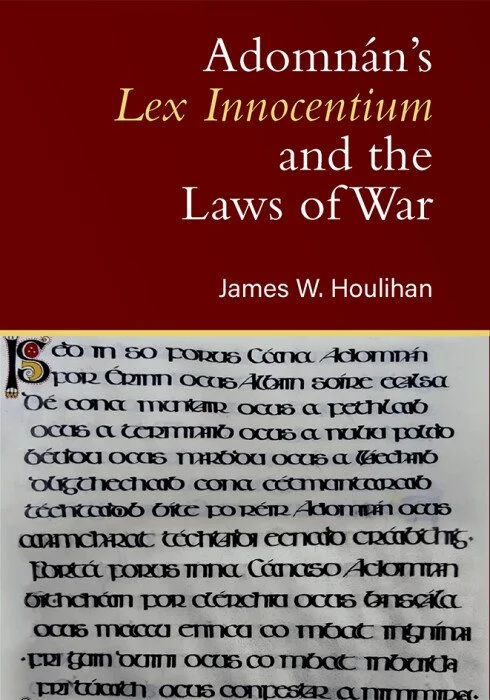
This week, I spoke with Dr. James Houlihan about Adomnán’s Lex Innocenitum. After decades practicing law in Ireland, himself, Jim turned all his attention to working on this incredible Irish source text. The result is his new book Adomnán's Lex Innocentium and the Laws of War. Our conversation on medieval perspectives on warfare, attitudes towards non-combatants, and the steps one Abbot of Iona took to protect the innocent is coming up right after this.
Well, welcome, Jim, to talk about Adomnán’s Law. I have to pronounce this correctly from now on. It's so nice to meet you, especially as somebody who has spent a lifetime studying the law and now has turned to medieval studies. Welcome to The Medieval Podcast.
Jim Houlihan:
Yes, thank you. That is it, actually. I practiced as a solicitor here for forty-five years, but was very lucky to have the chance, when I retired, to go back to university and concentrate on this particular law.
Danièle Cybulskie:
Yes, and you were just telling me before we turned on the microphones that this law had you by the throat for so long that this is the reason that you went to graduate school, right?
Jim Houlihan:
Absolutely, yes. Because the law – well, first of all, of course, it was enacted in my hometown, where I'm sitting now, way back in 697 AD, and relatively little study done on it. So, I just wanted to produce a reasonably authoritative work about it, really. That was the idea.
Danièle Cybulskie:
Yes. And I think that this was worth it. It was worth all those years at graduate school, because I think that this work tells us so much about not only what's going on in Ireland at this time, but also people's attitudes towards noncombatants. So, what we're going to be talking about in a minute is an abbot working towards a law for basically how to treat noncombatants. But let's bring it back to where you begin your book, which is the ancient world, because we know that the ancient laws really had an influence on the Middle Ages. So, walk us back to how people were thinking about war in the ancient world.
Jim Houlihan:
Basically, I wanted to sort of situate our law in the overall context of laws for the protection of innocents. I'll call them innocents. And so, I had a quick look at Greece, I had a quick look at Rome, and all that sort of thing. Then, onto the early Christian scene, where after the Roman Empire became Christian, there was quite a lot of controversy, because some argued that Christians should be pacifists – total pacifists. And that became very impractical when the armies had to go out and defend the empire, which were being attacked from all around. So, St. Augustine was probably the… the main thinker behind how Christians viewed war and whether it was not sinful to kill in certain circumstances.
Danièle Cybulskie:
Mmhmm.
Jim Houlihan:
And the church, for quite some time, way back – maybe church councils up to the sixth century – insisted on killing being sinful. But Augustine worked around that and came up with the idea of fair law; a fair war; a reasonable war; a just war. And from then on, and down through the centuries, this was always the concentration of the churches and the authorities: whether a war was just or not, to the extent, ultimately, that if you thought you had a just cause, you could really do anything because the perceived justness of your cause overrode everything else. And so, therefore, there was very, very little concentration on what was proper behaviour when you are fighting, what was acceptable behaviour. So, nowadays, they divide it into jus ad bellum and jus in bello. Jus ad bellum is the right to go to war, and in bello is what is right to do in war. So, that is why this law dating from 697 – which is exclusively a jus in bello law, what is correct and what's acceptable in a warlike situation – was so unique. Quite remarkable, really. Because looking at Christianity at that time, it wasn't concentrating on that at all. And it took quite some time before they got around to doing it.
Danièle Cybulskie:
Well, it takes some thinking, and anyone who's dipped a toe in the Middle Ages knows that the churchmen did a lot of thinking. And part of it – one of the things that you mentioned in the book – is that the New Testament – Jesus's words on this – they're not very instructive as to what you should be doing. Should you be killing people? Is it okay? And who counts as being okay under these circumstances, right?
Jim Houlihan:
Yes, absolutely. Jesus sort of left the question somewhat open. You know, he didn't condemn the soldier or whatever for his life's occupation, which would've been fighting, and killing, and all that sort of thing. So, therefore, there was a lot of scope for argument after he was gone. That's the way it happened.
Danièle Cybulskie:
Well, and as you say, everyone looks back to Augustine for the idea of just war. What is possible? What is just? And he's coming out of the Roman tradition where, you know, it's okay to enslave people if they're in the way. It's okay to lead people towards the glory of the Roman Empire, things like that. So, this is where Augustine is coming from. And as you say in the book, he doesn't have a solid idea of what just war is from the beginning. He has to work with it a little bit, right?
Jim Houlihan:
Very much so. I mean, he was reacting to the circumstances that he found himself in, which changed from time to time. And at one stage, he was totally confident of the new Christian world and the emperor. And then when he found that the Roman Empire was under real threat – in fact, Rome was occupied by the Huns or whatever during his lifetime – and then it was a question of survival, really. And in the context of saving civilization, he would have seen it and said, well, what were you allowed to do? And he would have taken the view that, of course, a properly authorized war, and a properly conducted war, was just, and it wasn't sinful to kill in those circumstances. But he was thinking – naturally enough, I suppose – about the motivation of the individual. And if the individual's motivation was good, well, then his war was okay. But he wasn't concerning himself about the victims of war. He did make passing references to the horrors of war. He was aware of all that, but obviously, his main function was to instruct the faithful, giving them some idea of when were they committing sin, and when were they not committing sin. What was permissible, really. So, that was his approach, which was very different from Adomnán's approach. I think it has to be made very clear that Adomnán would have known Augustine's thinking well, because we know from the books that were available to him in Iona, for instance, and all that, they were very advanced in the Irish Church relative to some of the nearby countries at that time.
Danièle Cybulskie:
Yes. Who shall remain nameless.
Jim Houlihan:
Indeed. Well, they were coming away from what they call the barbarian invasions, and that sort of thing. So, we never had that, and we were always very civilized people. But obviously, there was a need for his law. So, therefore, I mean, he was – I don't know whether you want me to get into it now, but – I mean, he was uniquely concerned about the innocent victims of war.
Danièle Cybulskie:
Mmhmm.
Jim Houlihan:
There's nobody in history that I could see with that same sort of concern. And there's a tradition that he must have got this from a personal experience. There's no way that he could have been so aware and conscious of the victims of war if he hasn't had some sort of personal experience. And there is a sort of a story told of him attending the aftermath of a battle. And this now is not real history. It's a tradition. But it just gives you an idea of where he may have sort of got his inspiration from. I'll just read. This is when he came on this battle. And all he saw on the battlefield— “of all they saw on the battlefield, they saw nothing which they found more touching or more wretched than the head of a woman lying in one place, And her body in another, and her infant on the breast of her corpse. There was a stream of milk on one of his cheeks and a stream of blood on the other cheek.” Now, that's all very, maybe a bit over the top. It gives you an idea of where Adomnán was coming from. He had a really genuine empathy with the victims, and the innocent victims of war.
Danièle Cybulskie:
Yes. Well, you've brought up Ireland and you’ve brought up conflict, so let's head there. Tell us what is going on in Ireland at this moment, because as you're saying, you don't need a law for innocents unless there is a reason to protect them. So, what's going on in Ireland in the seventh century?
Jim Houlihan:
Well, the sources don't tell us much about the actual killing of innocents in the local wars and all that sort of thing. There are one or two incidents mentioned and all that. But obviously, in general, it was a very warlike society, probably similar to most contemporary societies. So, there were battles, and there was – we're told about sieges, and battles, and slaughters, and all of this sort of thing. Obviously, innocents must have been really endangered, and that is why Adomnán went to such trouble to introduce his law and win acceptance for it from all the leading people in Ireland at his time. So, that's that aspect of it. But Ireland was, relatively speaking, quite advanced. And the people who were just emerging from the barbarian wars looked to Ireland as a place to find the real truth about their existence, in other words, Christianity. One little other little extract for you here.
Danièle Cybulskie:
Sure.
Jim Houlihan:
If I can. The English historian Bede, tells us that the Irish welcomed all these people coming here for learning, and gave them books, and taught them – and fed them, actually. So, they were particularly welcomed, and this was where they looked to find that sort of information.
Danièle Cybulskie:
Yes. Yes, the Irish are well known for their scholarship at this time. And I think anybody who looks backwards towards the manuscripts that still exist – they can see how beautiful things were, how organized in comparison to everything else. And you were talking in the book a little bit about how it's still settling out at this moment between a bunch of lesser lords and kings to – trying to unify a little bit. Is that about right?
Jim Houlihan:
Not so much, I don't think, at this particular time. There were over a hundred kings in Ireland. The whole structure of society was based around them and your relationship with them. They were at the top of the pile, and lesser people on the way down. And everybody had an honour price, which was relative to the king's honour price.
Danièle Cybulskie:
Mmhmm.
Jim Houlihan:
And that – the laws used that. If a king was killed, well, his compensation would be much higher than if an ordinary person was killed. This was the very basis of Irish law at the time. But one of the things – revolutionary things – that Adomnán did in his law was that he got rid of that for the purposes of his particular law, so that a woman who normally would have half the honour price of her husband – so if she was killed, that's what would have to be paid – was put on the same level as a free man. And that was quite obviously revolutionary at the time. And that's why subsequently, later on, Adomnán came to be seen as the man who saved the women of Ireland.
Danièle Cybulskie:
Yes, which is a little bit strange when you think about it, because he's, first of all, living in a monastic community, and secondly, living in a monastic community that is far – geographically – from Ireland, but of course, culturally very connected. So, let's talk about Adomnán. What do we know about him?
Jim Houlihan:
Well, he was Abbot of Iona. He was kin of a very important family, the northern Uí Néill Cenél Conaill family, who produced kings of Ireland. And by coincidence, the king of Ireland at that particular time was his fourth cousin. So, he was aristocratic, I suppose you could say. But he also was a man of great learning, and he wrote a number of books. His Life of St. Columba was really important work and told us an awful lot about Columba, but also a lot about – of Adomnán, and his thought processes and that. And he was a man that had a broader perspective on life, maybe, than a lot of his contemporaries. And in fact, I will quote this one, if I may. The historian Jonathon M. Wooding's description of him as, quote, “one of the leading churchmen in these islands,” – that is Ireland and Britain – “in the first millennium.” Not just of his time or anything like that, but in the first millennium. And this is a highly respected historian's view. And then he went on to say, “and in the wide reception of his writings, and their enduring quality, Adomnán approaches the authority of a father of the church.” So, he was a very exceptional person, really.
Danièle Cybulskie:
Well, I mean, you don't get to be Abbot of Iona, of all places, by being just a regular dude, right? So, here we are, he's Abbot of Iona. And in the book, you mentioned that he's traveled into Northumbria, and he's traveled into Ireland, and stuff. What brings him to your hometown to work on these rules? Why, at this time, is he bringing brought there – or brings himself there?
Jim Houlihan:
Well, he wanted to get the support of all of the leading figures in the Irish world of that time for this law. And this… Bírr is in the center of Ireland, and it is convenient, obviously, for people to travel to. So, that's one of the reasons why he picked it, and it's on the border of Munster and the Uí Néill territory. It's very close to where Connacht commences. It's only a few kilometers from there, and also Leinster. So, that, I'd say, was why he particularly went there. There's another reason also, but – he was very well disposed to the monastic community in Bírr, which was founded by St. Brendan of Bírr, because he tells stories – Adomnán tells stories in his Life of St. Columba – of two incidents involving St. Brendan of Bírr. One was when Columba was in big trouble and they had a synod or whatever, and they were all going to excommunicate him for, the book says, rather minor matters, but I don't know what they were, in fact. But anyway, the only one that stood up to welcome him coming in to join the synod was Brendan of Bírr. And Brendan of Bírr explained to the others that he could see Columba coming along with a light shining around him and all that sort of thing. So, he could see that he was a holy man. And the others eventually accepted that. So, he was well disposed to Bírr, as well.
Danièle Cybulskie:
Yes.
Jim Houlihan:
And these things matter. These things actually matter.
Danièle Cybulskie:
Yes. Yes. Especially, I mean, Adomnán being a biographer of Columba – he's a super fan of Columba – so, any friend of Columba's is a friend of his, right?
Jim Houlihan:
Yeah, absolutely.
Danièle Cybulskie:
So, as the Abbot of Iona, he has huge clout. And as a relative of kings, he has huge clout, as well. So, do you imagine that he was successful in bringing people together here at this meeting? Do you get the impression that a lot of actual important people showed up? It wasn't just him and three other monks.
Jim Houlihan:
It's actually quite remarkable that, in the surviving texts, we have a list of all those who guaranteed the law. And it is likely that most of them were actually here in Bírr, because they lived in a face-to-face society, and that's the way they operated, and they had these assemblies. So, we have forty clerics headed by the Abbot of Armagh, which was the primary see, and then all the others around – very important monasteries. They all came here to say, yes, we agree with this law. And then we have Loingsech macc Óengusa, the High King of Ireland, and the kings – the provincial kings – and a total of fifty other kings – laypeople – and they came. And in fact, one of the guarantors is the King of the Picts in Scotland, and another king of Scottish Dál Riata – both are in Scotland. So, it's just, when you think about it, an amazing achievement by this man, Adomnán. And they weren't just coming to make any old law, but they were making a law about caring for the innocent victims of war. So, it's a wonderful story. That's what I was just thinking to myself. I mean, this is a real good news story, you know?
Danièle Cybulskie:
Yes –
Jim Houlihan:
– only its’ not new.
Danièle Cybulskie:
Yes. And as you say – it's not new anymore – but as you say, no one else is bothering to actually write these things down. And you do mention in the book at certain points something I think is very true, which is just because it's not written down doesn't mean people found this okay – acceptable – that people were being killed in war. But no one was actually codifying it until this point. So, Adomnán's brought everyone together. What do the laws say? What does he propose? And what is agreed in this?
Jim Houlihan:
Yes. Well, surviving texts of the law… You have to try and work out when such and such a portion of it was written. And so, working out what was likely to have been the sections that were really coming straight from Adomnán, what we have is, first of all, a section where he lays out what he's going to do, just like the preamble to a modern piece of legislation. Usually, it says what it intends. And then, what he was doing. He said, this is a law for clerics – of course, he would have put first – but then for women and for young men up to the age when they reach manhood, because they had relatively little protection under the existing law. And this gave them maximum protection. I mean, the maximum fines. The penalties were fines. So, he goes down then to each of these, with a separate section for it, and deals with each of them. It's not just the killing, but then he deals with, you know, if they suffer a relatively mild blow, right up to manslaughter, or losing a limb. He goes through the whole thing in great detail. He also – the law appoints judges. It wasn't just a token thing. It gets into the nitty-gritty of how it’s to work. And so, the judges, and he deals with sureties, or what we would call sureties now – pledges to be given – and the time scale from the initial offense to when judgment and when the fines are to be paid and all this sort – so, it goes into great detail. And it's a very interesting document, obviously, coming as it does from over 1,300 years ago.
Danièle Cybulskie:
Yes. And for people who haven't yet read your book, when you're talking about minor details, you're talking about things like – I think it's, like, a white strike, or white slap, or something, where it's there for a second and then it's gone. That has one fee, and then another one that leaves a bruise.
Jim Houlihan:
Absolutely. Yes, that sort of thing. How it all operated in practice, of course, is another story.
Danièle Cybulskie:
Yes, I'm going to ask you those questions in a second. But yeah. There's a difference between hair pulling and something that needs suturing, I think it says. So, all of these things laid out. And one of the things I found kind of surprising, but I suppose it makes total sense – you have everyone together, and you're trying to work these things out – is it also addresses things like accidental death – something we might call workplace accident – or death through animals. And these also incur penalties.
Jim Houlihan:
Yes, that is a little bit of a peculiarity. And it is a bit difficult to understand. And that it has been suggested that these things were covered so as to try and anticipate excuses, or that sort of thing. So, I don't know. You see, there's a lot about it that we don't know. It's not simple. I think, as I mentioned in the book, I mean, law of its nature is not simple. And modern law, we need a lawyer to understand it. Explain it to us. I mean, a law of 1,300 years ago with the different mindsets, and – obviously it is not easy. But the one thing that is quite simple is that there are constants, and the constants are killing and war, and they are as constant and as real today as they were then. And that's what we have to remember, really.
Danièle Cybulskie:
Yes. Well, there's one more thing that I wanted to bring out that is not related to killing – we'll get back to the killing in a second – in that, well, it is about accidental death or what might look like an accident. As you're saying, there might be some plausible deniability there. And that is people who are cognitively impaired are also in this law saying if they are killed, then there is still a fine to be paid to their caregivers. And in a society where we so often hear people are being dismissed if they are not, you know, quote unquote perfect in all their facilities – or, faculties – then I think it's important to see people being represented as still worthwhile members of the community, because I think this is much more prevalent than people might think.
Jim Houlihan:
Absolutely. It's really the humanity –
Danièle Cybulskie:
Yes.
Jim Houlihan:
– of Adomnán that appeals because he saw these things. And of course, he wanted to make sure that his law didn't discourage people from looking after the disabled, and the mentally affected people. So, he specifically puts in a clause to say that the penalties in that case should go to them.
Danièle Cybulskie:
Mmhmm.
Jim Houlihan:
A part… a part, anyway. So, he comes across as a very, very human person.
Danièle Cybulskie:
Yes. Yes. Making sure that everybody is remembered. And then the other thing that I thought was really interesting, as well, is – and this isn't exclusive, I think you said in the book, it's not exclusive to Adomnán's thinking, but bystanders are expected to intervene, especially in a killing. And if they don't intervene, then there are penalties for this.
Jim Houlihan:
Yes. That's in the old customary law – Irish customary law. That was one section. And there were different levels of bystanders. There were the ones that just happened to be passing by, and then there were the ones that were almost encouraging, etc., etc. But it was expected – you see, you were living in a society where nearly all males of full age were warriors, or soldiers, or whatever, and they would be expected to intervene. But that particular old law says – quite naturally, really – that people who are not armed, who are women or clerics, who can't intervene, they have no obligation to do that. The significance of that in the book, really, is that this was before Adomnán' law. So, in customary law, the innocent was to that extent recognized as well, which you could draw on. Yeah.
Danièle Cybulskie:
Yes. It was a really striking section of the book because it mentions – I mean, we have aiding and abetting now, but this talks about people who are culpable in bystander situations where they are escorting or exulting. I think that's a really striking word.
Jim Houlihan:
Absolutely. Egging on, I suppose. Yeah.
Danièle Cybulskie:
Yes. Yes. And I don't know that we have anything too similar when it comes to crimes nowadays, but I think that if you are there and you are exulting, I think it's fair that you get punished.
Jim Houlihan:
Indeed. Yeah.
Danièle Cybulskie:
Right. Okay. So, when we're talking about most of these punishments, most of them are fines, as we're saying. You have to pledge something if you're going to guarantee someone. But one of the really interesting punishments is that if a woman is involved in certain crimes, she gets tossed out in a boat with one oar. Tell us about this.
Jim Houlihan:
Yeah, this is interesting. I mean, this is a case of, I suppose you could call it, positive discrimination in favour of women. There's a lot of argument nowadays about positive discrimination in favour of people who are not so, we'll say, well off, or whatever. But this is a case where a man in that situation – well, the full fine would have to be paid, or he could face death penalty, or whatever. And the woman, obviously, in this particular situation, nobody was going to pay, or nobody in her particular circumstances was going to pay the fine. So, therefore, she had to pay the penalty herself. But the penalty was that she'd be put in a boat. She – I think she must… possibly gets a pot of gruel with her –
Danièle Cybulskie:
Yes!
Jim Houlihan:
– as well, and one paddle, and is set out to sea, and then it's left in the hands of God. And that… that was important. God decided and determined her fate, then.
Danièle Cybulskie:
Yeah. Well, we were talking a few weeks ago about medieval romance, and there's always women being put to sea. And I wonder if this is maybe where it came from, this tradition of – at least on the books – that you would put someone out to sea. And, as you've mentioned in your book, we don't know that these things actually happened as they're laid out, but it is definitely an interesting punishment.
Jim Houlihan:
Yes. And the attitude towards women, that they merit special provisions, we'll say, and can't just be treated the same way as men in some respects, in some instances.
Danièle Cybulskie:
Yes. So, one of the questions that you asked within the book is, did this actually work? Because as you mentioned right at the beginning of the book, in the introduction, that things like the International Court – it doesn't have a lot of teeth. We all have to sort of agree to abide by its rules. And in the same way, does this one have a lot of ability to actually be implemented? So, you asked the question: did it work? What do you think?
Jim Houlihan:
That's an impossible question, really, to answer. We can't answer that, unfortunately. And the reason being that the sources don't tell us anything. Now, normally our sources are, we say, the annals or something like that. But for some reason or other, the annals, even before this law, made very little mention of innocents. And after, that continued to be the case. And also, the court cases weren't used as precedents, where the judgments weren't recorded, or anything else like that. So, we don't actually know. Now, I think I point out one way back – or at least right up to 900-and-whatever – 14, or sometime like that – there is a death recorded in the Annals of a Bishop of Derry, but also as part of his titles at the time was that he was a Steward of the Law of Adomnán. So, there must – it must have had some meaning. To what extent? Maybe in that part of Ireland where Adomnán – you know, the tradition of Adomnán – might have lasted longer than in other parts, but it's unlikely that it would be recorded in the annals – that particular title – if it was totally meaningless. So, we don't really know.
Danièle Cybulskie:
Yes. And one of the things that happened is they got together, they created a law, and then the Vikings arrived, and arrived, and arrived. And so, it's all well and good to create your laws – and then to have it completely disrupted… it makes it difficult to enact them.
Jim Houlihan:
Yes, it does. Obviously, the implementation of the law required all sorts of players to be involved – the judges, the sureties – and you needed a settled society to implement all that in full. So, that obviously must have been very disruptive.
Danièle Cybulskie:
Yes. And we don't know – as you're saying – we don't know the practical implementation. But you gestured earlier at the fact that people refer to this law again and again, so what was the afterlife of Adomnán's law?
Jim Houlihan:
Yes, it crops up here and there being mentioned. And there's a poem or something from relatively shortly after the law – maybe 130 years or so after – where Adomnán is credited with being the savior of the women of the Gael, sort of thing. And then later, around the year 1000, it appears that the monastery of Raphoe in County Donegal sort of took possession of the law, and they sought to milk it for all it was worth, actually. It's as simple as that. They wanted to make it – that is, part of the text, which is, we know, wasn't part of the original text, if you know what I mean. So, that's excluded, but it does tell us that the law was still being actively promoted at that time. And then, of course, the two texts – surviving texts – one of them from between 1400 and 1500. So, somebody went to the trouble of copying it out then at that time. And the other one is really very interesting because this man, Mícheál Ó Cléirigh, who was a Franciscan brother, and after the Battle of Kinsale, and after the collapse, really, of Gaelic Ireland, his superiors realized that a lot of the written heritage was disappearing. So, he was sent back to gather up as much as he could and make copies of it. And one of the copies he managed to make was of the text of that law, which was a wonderful thing. And I think I mentioned there, as well, that we have a letter that he wrote to his superiors telling them that he had the copy of the law and that he was going to hold on to it for a short time before he sent it on to them, because he wanted to talk to Flann Mac Aodhagáin, who was a local lawyer. In fact, his law school was only a few miles from where I am here now. Lawyer family down through the centuries, but again, dying – dying out, nearly overcome at this stage. But still, it's quite sort of remarkable to think that almost a thousand years after a law was written, that two lawyers should meet to discuss the finer points of its terms. I think I mentioned the book as remarkable legal consultation as you could find in jurisprudence.
Danièle Cybulskie:
Yes. I want to come back around to that in a second, but I just wanted to remark about the monastery that you were talking about that was milking this law. It was basically almost a protection racket. It's like, this law will protect you ladies as long as you keep donating to our monastery.
Jim Houlihan:
Exactly. Well, that's very much – that was Raphoe. But I suppose, again, you could argue that the fact that they were able to point to the law as a source of protection for women, and if all knew that women were no longer being protected, well, they're not going to raise so much money on that. So, there must have been some credibility for the law at that time.
Danièle Cybulskie:
Yes.
Jim Houlihan:
That's around the year 1000, or so.
Danièle Cybulskie:
Yes. And I think the last thing that I want to mention here is that this idea of women having the same sort of fines payable for their killing in whatever circumstances – it's revolutionary, not only for Ireland at this moment, but for a lot of Europe at this moment, if not all of Europe at this moment, right?
Jim Houlihan:
Yes, very much so. The same fine was payable for women. There is a tradition that Adomnán faced a lot of opposition. Again, the addition to the text that came three hundred years afterwards, or whatever it is, refers to Adomnán having a lot of trouble persuading other leaders, and some of them are quoted as saying, I'm certainly not going to agree to women getting this, or women getting that. But it's a little bit like nowadays with the far-right movement against positive discrimination in favour of various groups of people. And they're the equivalent to those who are objecting to Adomnán bringing in his law for women, as I see it.
Danièle Cybulskie:
Yes, there are always people who are on the side of progress – forward movement – and more equality, even in the seventh century.
Jim Houlihan:
Absolutely. Absolutely.
Danièle Cybulskie:
Yes. This is one of the reasons I was happy to read your book. So, as we come to the end of our time, I want to ask you, as a professional in a completely different field before you came to this one, what would you want to say to people about whether it's worth looking back to these laws? We were talking about a meeting between lawyers talking about jurisprudence. Why is this so important to you?
Jim Houlihan:
Yeah, well, I mean, when I wrote the book – it was published in 2020. And I think I do refer to various terrible things that were going on in the world at that time. Since then, it has become really, tragically, topical. And I think that our children and our grandchildren will look back on this particular age now as an age of genocides.
Danièle Cybulskie:
Mmhmm.
Jim Houlihan:
I mean, we see what's happening in Palestine and in Sudan, and it's absolutely unbelievably horrible things happening – innocents being slaughtered – and what are we doing about it? Well, I think I can make some small, tiny contribution by just telling people that 1,300 years ago, this man, Adomnán, took up that challenge and worked really hard to get it passed. And I think it's a lesson for all of us now.
Danièle Cybulskie:
Yes, I think you're right. I think you're right. Against all opposition, we have this abbot trying to make change, and if he can do it, we can do it.
Jim Houlihan:
Absolutely.
Danièle Cybulskie:
Thank you so much, Jim, for being on here and telling us all about it. It's been an absolute pleasure.
Jim Houlihan:
Thank-you. I'm absolutely delighted to have had the opportunity.
Danièle Cybulskie:
To find out more about Jim’s work, you can visit his book’s page on the Four Courts Press website. His new book is Adomnán's Lex Innocentium and the Laws of War.
For today’s quote, I want to take us back a little further than the Middle Ages to a text that medieval people admired, enjoyed, and recopied: Cicero’s De Finibus. In Book III, when Cicero is discussing our human nature, he says this: “each one of us is a part of this universe; from which it is a natural consequence that we should prefer the common advantage to our own.” Even in Cicero’s day, I think people could sometimes get caught up in their own heads and forget to care enough about other people. In the light of our common history and some of the AI news this week, this is a good reminder for us all: “each one of us is a part of this universe [and] we should prefer the common advantage.” This translation is by H. Rackham.
Thank-you, as ever, for being part of my universe, and supporting this podcast by sharing, letting the ads play, rocking your sweet medieval merch, and becoming patrons on Patreon. Patrons can listen ad-free and get each episode in time for the Monday commute. And patrons also get my undying gratitude because it’s patronage that makes this work possible. To find out more, or to become a patron, please visit patreon.com/themedievalpodcast
For the show notes on this episode, a transcript, a list of the books featured on The Medieval Podcast, and more, please visit medievalpodcast.com. You can find me, Danièle Cybulskie, on social media @5MinMedievalist.
Our music is by Christian Overton.
Thanks for listening, and have yourself a fantastic day.