Africa and the Middle Ages with D. Vance Smith




The Medieval Podcast uses affiliate links
Episode 326
Despite its vast cultural, spiritual, and material wealth, medieval Africa has too often been sidelined in the study of the Middle Ages. Or it's been peppered with asterisks to explain why its history is different, odd, or otherwise somehow “doesn't count”. Fortunately, the tide seems to be turning. But how did we get here? And how did people outside of Africa view its peoples and kingdoms during the Middle Ages? This week, Danièle speaks with D. Vance Smith about medieval European ideas of Africa, the long shadow cast by the fall of Carthage, and how Medieval Studies itself contributed to colonization.
-
Danièle Cybulskie:
Hi, everyone, and welcome to episode 326 of The Medieval Podcast. I'm your host, Danièle Cybulskie.
Despite its vast cultural, spiritual, and material wealth, medieval Africa has too often been sidelined in the study of the Middle Ages. Or it's been peppered with asterisks to explain why its history is different, odd, or otherwise somehow “doesn't count”. Fortunately, the tide seems to be turning. But how did we get here? And how did people outside of Africa view its peoples and kingdoms within the Middle Ages itself?
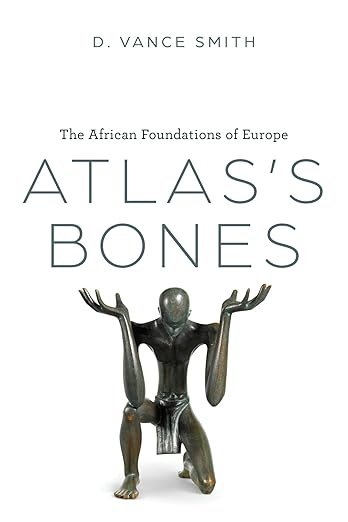
This week I spoke with Dr. D. Vance Smith about Medieval Studies and Africa. Vance is professor of English and the former Director of Medieval Studies at Princeton University, as well as being the author of several books, including Arts of Dying: Literature and Finitude in Medieval England and Arts of Possession: The Middle English Household Imaginary, his new book is Atlas’s Bones: The African Foundation of Europe. Our conversation on medieval European ideas of Africa, the long shadow cast by the fall of Carthage, and how Medieval Studies itself contributed to colonization is coming up right after this.
Well, welcome, Vance, to talk about your new book on Africa, medieval studies and all of these things, how they tangle up together. It is an absolutely wonderful book and it is such a pleasure to meet you. So, welcome to the podcast.
Vance Smith:
Thank you for having me.
Danièle Cybulskie:
This is a book that is just so dense with information. I think it should be required reading for all of us in our field for reasons that we'll talk about in a second. But I think that my first question has to be, why did you call it Atlas's Bones?
Vance Smith:
Well, the short answer is the press wanted something that was a little catchy, and I always have a great deal coming up with titles, but in this case, it sort of hit me as an epiphany. Atlas's Bones is a title that sort of, for me, summons up much of the argument of the book. If you've read all of it, you may know this, but the thing about much of this African material is that people have read it for… for millennia, but they sort of forget or don't notice that some of these crucial events and people and myths are situated in Africa. In Atlas's case, he was a giant who Ovid wrote about who happened to live in West Africa, in Morocco, and he was transformed into a giant when he looked at the head of the Medusa, which Perseus had held up. And Ovid describes how his bones turned into rocks and those rocks turned into a mountain, which Ovid says is the Atlas Mountains. So, this westernmost chain of mountains in Africa goes back to classical mythology.
The other part I liked about that is that the notion of bones coming from Africa conjures up – or touches on – one of the most horrific historical events involving Africa: the Middle Passage. And my second epigraph takes a passage from Derek Walcott's “Omeros”, which is a retelling of the myth of The Odyssey in terms of the Middle Passage. And he talks about the bones of the people in the Middle Passage becoming coral and summoning up contradictions. And I love that passage because so much of this book – or the history of Africa – is full of contradictions.
Danièle Cybulskie:
Absolutely. And I think it's important – we were talking about this just before we came on air – to mention that this book was sort of, as I was saying to you before, sort of an inevitability for you. It was coming for you. You had to write this book, in some cases; it just didn't let you go. Do you want to tell people how you came to write this book?
Vance Smith:
Well, in a strange way, it's kind of autobiographical. I grew up in Africa. I was born there. And my parents were anti-apartheid activists in both South Africa and Zimbabwe. And they’re very insistent that we live as much like the rest of the people – that is to say, the non-Europeans, the non-whites – as we could. So, I grew up very much with sort of mindset of an African, of my friends, and the people I respected and admired, and who in some ways raised me. I was the only white kid, the only European, in my high school in Kenya. And I've remained very close to those classmates. We're about to have our – I won't say the number, but – an important reunion this following weekend in Nairobi. But somehow, I became a medievalist of Western Europe. I love the material. It's fascinating. I still do love it. And people kept asking me, how did you get from one to the other? And I wasn't sure. But at one point I realized that I had always been fascinated by the history of the Africa that I grew up in, of South Africa, Zimbabwe, and Kenya. And I realized that so much of what I was interested in was actually medieval, or it corresponded to the moment of the European Middle Ages. The big exhibit is the amazing ruins of Great Zimbabwe, in Zimbabwe, which gives the country its name and which was a major gold-producing site. They traded with China. And it's likely that a lot of the gold from Great Zimbabwe made its way to Europe. And some of the gold leaf you see in high medieval manuscripts may have come from Zimbabwe. So, I thought, oh, wow, these things really do go together. What if I were to think about the things that I know as a medievalist from the vantage point of Africa. What else was going on in Africa? What if I were to think of, say, Augustine as an African? And for me, that was revelatory. I kept finding more and more like that. Things just sort of presented themselves to me.
Danièle Cybulskie:
Yes. Yeah. And it feels as if there is an inevitability to your writing this because of those reasons.
Just out of my own curiosity, Luke Pepera was on the podcast last year talking about his book Motherland, and he was talking about… growing up in Ghana, he didn't learn a lot about history – the history of his own country, the history of the continent. And that was something that he thinks is changing. So, I just wanted to ask you out of my own curiosity, what did you learn, or did you learn much about the history of Kenya in high school, when you were going to high school there?
Vance Smith:
Yeah, that's a good and very important question. The longer version of it is that my school was originally founded for the sons of white settlers as an alternative to sending them to England to, you know, Eton and Cambridge. So, it was a school that had high pretensions for the cultivation of people who were going to lead the British Empire. But after independence, it became a Kenyan government school. And just a few years before I went there, the national curriculum became Afrocentric. So, if I'd been there a few years earlier, we would have read Shakespeare, I would have learned Latin. In many ways, it would have been sort of hermetically sealed: a bubble of Europeanness in Africa. But we did two years of African history in high school, so I did learn some. But now, looking back at it, I realized that it was inadequate in some ways, although it was very conventional – a very conventional history of Africa. It began with a story of the migration of so-called “tribes” into the areas in which they're frozen with the advent of colonialism. And in that sense, it was a narrative that fed very much into the narratives of the first ethnographers who arrived in Africa, and colonial administrators. And then we leapt to the late era of colonialism and the structuring of countries by colonialism, and imperialism, and then independence. And I realized sort of belatedly that what's missing is the Middle Ages: that in-between time. So, that's a gap that I very much wanted to fill to give a fuller account of where people came from or what their history is, what it would mean to think outside of those conventional narratives of migration and colonialism.
Danièle Cybulskie:
Yes. Well, one of the things that I think that you're gesturing at here is that when people talk about history, and especially when people – I'm thinking about sort of Victorian medievalists – especially when they talk about the history of Africa, any of the good things that happen are because there was a shared cultural heritage that also went to Europe and that is why anything good happens in Africa. So, can you tell us a little bit about the structure of that thinking?
Vance Smith:
Well, it's even worse than that. A lot of Africanists who think historically cite infamous remarks by Hegel who infamously said Africa has no history, and he has various reasons for that… geography… but really it's mostly race and a very deep-seated, ontological kind of racism. That idea persisted for quite a long time.
Another infamous quotation is by the Oxford historian Hugh Trevor Roper, who gave a lecture in which he said Africa has no history. Maybe someday it will, but it doesn't yet, which is a shocking thing for an historian to say. So, you know, one thing that is important to do is to fill that gap, to say, no, there was a lot of history in Africa. And more than that, African history impinges on, it informs, it's deeply involved with European history as well.
Danièle Cybulskie:
Yes, absolutely. I mean, it seems obvious, but it is obviously taking a lot of work to work back all of these preconceived notions. And Medieval Studies really has a lot to answer for there, which is one of the things that you do say in the book as well. Do you want to get into that now or should we save that for later?
Vance Smith:
We can get into that now because it's something that was startling to me and it's kind of a smoking gun in the way that history is treated, the way that people are treated, the way that modern countries have been formed in post-independent Africa.
There were two offices that were primarily responsible for the British colonization of Africa: the Foreign Office and the Colonial Office. And they very much cultivated and wanted to attract the intellectual and cultural elite of Britain. But the way they did that was to look primarily at Oxford, and then a bit at Cambridge, but above all for students who had studied modern history at Oxford, which is not the modern history we think of. It's called modern just because it wasn't classical history or the greats. It's newer than that. But it was essentially, and I'd say centrally, medieval constitutional history. And that was the very core of the curriculum.
As it happens, in those days, from about the 1880s on, the medievalists who taught constitutional history at Oxford were very much the people who ran the place – who ran Oxford. That was the department that got all the resources, that, in our terms, would get the attention from deans, and fundraisers. And in particular Balliol College, which had three or four of these very eminent people. The tutors at Balliol and at other places were essentially talent scouts for the Colonial and the Foreign Offices. And they sent the very best of the students who studied modern history – medieval constitutional law – out to the colonies to work as administrators. And I have found not just a through line, but a very deep structure to land law, to laws of possession, to laws of use in the colonies, that is essentially English law up to about 1280, which – for modern history – was the high water mark. That's when English law was perfected.
So, in fundamental ways, post-independent African countries are founded on medieval constitutional law. And there are numerous ways in which that that tracks. One of my Covid projects, in fact, was to try to find textbooks on medieval constitutional history – English constitutional history – that were owned by some of these administrators. And I found five or six with marginalia. And that too connects this undergraduate curriculum with the implementation of medieval law in these colonies.
Danièle Cybulskie:
Yeah, well, and to get even more specific for our listeners, thirteenth-century England is when you have the Statute of Merton that's saying, hey, we can take this stuff – if you're not using this land, then we can take it because we're going to use it better. And also, thirteenth-century England is when the conquest of Wales is happening. So, when we're thinking about this in terms of how these laws might be applied, maybe it's clearer to say, like, these are the points that we're talking about – and you do make this very explicit in the book. So, tell us a little bit about how you found the Statute of Merton stuff happening; being applied to Africa in these colonies.
Vance Smith:
Yeah, that was… that was quite an extraordinary thing. A project that's adjacent to this book is a second book that I'm writing on the modern wildlife conservation industry. And in Kenya and other places, it is an industry. There are these vast areas that are basically private-owned, that are cordoned off to preserve and to protect wildlife. That's the essential story. And that's not a bad thing – to protect wildlife. But the way that it happens is by a practice that's called fortress conservation. The borders of these reserves are patrolled by semi-militarized groups. The people who once lived there are excluded. They can't range their cattle to follow the rains like they used to.
But behind that is the Statute of Merton, which as you said, enables people with power and with clout to take over land that they regard as having been waste for three years; not being used properly. And that's a very kind of hazy, numinous standard to use. But that was exactly the standard that was used when land was set aside for European settlers in British colonies, in settler colonies. And that is rooted in very, very flimsy pieces of evidence.
There were several hearings about land which essentially are trying to decide how much land could be, or should be, set aside for Europeans and what the bare minimum of land to sustain the African population was. And the testimony included this one man who traveled about a hundred miles south from where he was posted to Nairobi to testify before one of these commissions. And he said as he was passing through a district which wasn't even his own district – he wasn't responsible for it – he said, well, I was driving through Thika and I didn't see very many people. There didn't seem to be much cultivation. And I think that one piece of testimony was crucial in setting aside that land for cultivation and for European use. Today, that land is owned by Dole Pineapple, and it's still a pineapple plantation. And all of that goes back to moments like this where somebody made a passing observation and said, this land isn't being used. We should put it to good use.
Danièle Cybulskie:
And it's astonishing that people will be pointing back that far – to the thirteenth century – for saying this is okay to do. But it is very much picking and choosing what you use. And as you say, the people are being taught at Oxford about medieval constitutional law, so it tracks that this is what they're going to fall back on, because… you know, it's sort of the same way people will look back to the Magna Carta, like: because it's very old, we can lean on it, which is questionable at the very least.
Vance Smith:
Yeah, well, the Magna Carta also got deployed in the story of settler colonialism because fairly soon there developed a kind of tension between the settlers themselves and the government, which is to say the Crown, who had an overall interest in the country and its productivity, where the interest of the settlers was much more individual, a little more local. They wanted their ranches to be profitable. They wanted to replicate as much as possible the old-style baronial life. And many of these settlers were English aristocrats. And so fairly early on, there developed a tension that reminded them precisely of the tension between the barons and King John, which led to the Magna Carta. And the Magna Carta was cited again and again in meetings and in publicity, in accounts of how the white settlers wanted some independence from the Crown to use the lands in whatever way they saw fit.
Danièle Cybulskie:
It's very convenient – when you think about the way that the Magna Carta has been lionized – to put yourself in the position of the barons who are heroes of the story. You know. This is all sarcasm. For people who can't tell, maybe reading the transcript. This is all sarcasm. This is all big air quotes.
Vance Smith:
Good to point out.
Danièle Cybulskie:
Okay, I do want to draw us back further in time. One of my favourite… sort of… concepts for a chapter, which you execute very beautifully, is Egypt as the exception. And I think this is so important because I think that the way people talk about Egypt today, you almost have to really consciously continue to place Egypt in Africa because people are always shifting it around. So, tell us a little bit about how Egypt is the exception.
Vance Smith:
Yeah, well, in history it's been extremely unstable. But even at this moment, I start the book essentially with a joke that Egypt is not in Africa except for every two years when the African Cup is held. And it's convenient for Egypt, which usually has a good team, to describe itself as part of the continent, but the rest of the time it's much more fraught.
I started to think about that question, actually, when I gave a very early version of one of these chapters at a university, and it happened to be about Alexandrian literature. And the very first question was a very hostile question about Egypt. This person said – I can almost quote it verbatim – nobody in the Middle Ages thought that Egypt was in Africa, so everything you've said needs to be re-examined. And I hadn't really thought about that squarely. And I thought, is that true, though? And I went off and read widely in medieval and classical geographical writing, and it turns out that Egypt slides all over the place.
The earliest descriptions of its location in Herodotus, and a bit later in Diodorus Siculus, do say that it's part of Africa. Diodorus says, in fact, that Egypt was colonized by Ethiopians. And even further, the land of Egypt is soil from Ethiopia. And they're quite clear about that. But all the way through the High Middle Ages, there are people who say Egypt is in Africa. But it does slide around a bit.
And I thought about that quite a while and I thought, why is it so important? Why are people so invested in where Africa is? And I think there are two reasons for that. One of them is, and I think this is probably the most direct answer, is Frantz Fanon's answer that the reason that North Africa and the Mereb is separated from Sub-Saharan Africa is because of race. That was it for Fanon. And I think that is by and large true.
The other reason is related to this, but it's a bit less clear. In the Enlightenment, philosophers like Hegel thought of Egypt as a kind of problem in the history of the development of civilization; or, in Hegel's case, of philosophy. Hegel has this narrative that civilization essentially started in China and moved its way westward, like the passage of the sun to Europe. And for him, there was a series of nice, neat stages. When he got to Egypt, it was more complicated. You clearly had to talk about Egypt because it was an important locus of civilization at the time, and people knew that. They never forgot that. But even Hegel recognized that there are distinctive African elements in Egyptian civilization. And he has a sort of series of short circuits and meltdowns when he tries to account for that. It's an extraordinary moment in his history of philosophy. So, I ended up beginning the book with a chapter about Egypt, rather than being a corollary, because I thought that there are so many of the reasons that people have not thought about Africa as being historically important that are a real live question still with Egypt.
Danièle Cybulskie:
Yes. Well, one of the things I enjoyed about the book is that you don't allow people to get away with this slipperiness. You really make explicit this double-speak, the way that people are making these arguments, because it really needs to be made explicit in a lot of cases. So, I wanted to ask you, do you think that part of the reason that we're sort of still thinking about Egypt as being slippery – is it the Middle East? Is it Africa? – do you think that this has something to do with the way that we teach and learn about the Crusades, in that the Crusades sort of bleed into Egypt, and so maybe that – that becomes part of a crusader narrative that keeps it sort of in flux?
Vance Smith:
Yeah, I think that's very much the case. And crusader narratives themselves – that is, the chronicles – tell that story, essentially. Egypt and, well, even Africa as far west as Tunis – there was a crusade that took place outside of Tunis – were kind of assimilated into the sort of general group of heretics and/or Muslims; of people that are othered. And they… They fit into a sort of general category of otherness in these narratives. That is what they say. And that's more or less the narrative that we medievalists, I think, picked up.
But there are other accounts that differ from that, not least of which are accounts in Arabic which unfortunately, I… I can't read, and I would love to, but there's more and more great work that is coming out in English that tells that more complicated story.
But, I mean, it's true that Africans generally are kind of lumped in with these other people. In Malory, when Arthur invades Europe and goes to war against Rome, the Roman army includes a bunch of othered people, what medieval people in general called Saracens. They included Africans and Libyans, and they're listed quite explicitly there. But even in the era of the crusades, Africans are described and even recognized by some narratives in more complex terms and in terms that relate their history and even their religion to European history and religion.
Danièle Cybulskie:
Well, this is a really important point that you're making. Because we started this conversation talking about colonization. And there is a real need, if you're going to be a colonizer, to “other” the people that you're colonizing. That… that's how the project works. But this isn't how everyone in the medieval world saw Africa, or the kingdoms, or the religions there. So, can you tell us more about what you saw in the research that you did about the medieval perspective on these African kingdoms?
Vance Smith:
Well, the medieval perspective is also rooted in the classical perspective, and in what we think, or what people say. And people who, let's say, celebrate European culture as a distinctive sort of bootstrapped development, as something that developed on the European continent, which includes Greece. In those accounts, in Greek literature and in Roman literature, Africa is profoundly important. Homer, in both The Iliad and The Odyssey, for example, begins with accounts of the gods going off to feast with the Ethiopians, because they're with the Ethiopians, who know how to treat the gods. They're pious. They know how to give good sacrifices. They give good feasts. Because of that, the action of The Iliad and The Odyssey doesn't start… The Greeks are sitting around waiting for the gods to come back to this Greek world, which is full of people who are fractious, belligerent, and jealous, utterly unlike the Africans.
But the story that surprised me the most was the story of Alexander the Great, who, when he conquered Egypt and founded Alexandria, immediately traveled several hundred kilometres into the Libyan desert, into Africa, to the shrine of the god Ammon, who was involved in Egypt, but was also regarded as an African god. And the oracle of Ammon said, well, you will go out and conquer the world. Go and do that. And Alexander said, great. That kind of tracks with my ambition. Thank you. And Amon said, oh, one more thing. You're my real son. Philip is just an alibi. He's an interloper. You are the son of an African god. So, Alexander started his career of world dominance as the son of an African god.
And through the Middle Ages, that sort of fundamental respect or acknowledgement of Africa's importance shows up in surprising ways. There are a number of those to talk about. One of my favourites, because it's surprising, is that Geoffrey of Monmouth, in his History of the Kings of Britain – which is in some ways sort of the fundamental account of history for the English and for the British, at least – goes to great lengths to say that when Brutus, who founded Britain, was making his way there, he stopped on the African coast and pillaged it and then went on. So, that's sort of setting up for something like a punchline. Pages and pages, hundreds of lines later, it turns out that when Arthur's father had won a victory, he wanted to commemorate everyone. And he asked Merlin what to do. And Merlin said, oh, I know of some really cool stones and that are in Ireland. They were brought here by African giants, and Merlin levitates them and they became Stonehenge. A little later than that, the Saxons are helped to defeat the Normans by an African king, Gormand, who comes all the way there. What was striking about that – I mean, there are clear examples – but what was striking about that is that this thread has been there, and as far as I know, wasn't really commented on – that whole trajectory in Geoffrey of Monmouth.
Danièle Cybulskie:
Yeah, what's interesting about this that's coming up for me as you're speaking is that maybe it's the actual ordinariness of contact with Africa or with African kingdoms; the ordinariness of it is what made it not something that people commented on to the point at which they had to construct an idea of it. I'm kind of like making thoughts as I'm speaking right now, so maybe I'm not making a lot of sense, but maybe it's like the very ordinariness of it that made people not make comments. I don't know.
Vance Smith:
Yeah, I think that's true. Geoffrey Chaucer, who is very indebted to Petrarch and to a commentary by Macrobius on a dream that the conqueror of Carthage had, mentions a number of times Africa. His knight travels to Africa, but he also has Scipio Africanus, who defeated Carthage – actually, also Scipio Africanus's grandfather, who totally, confusingly, is also called Scipio Africanus, the Elder – he shows up as an important guide at the beginning of a dream vision. And Chaucer doesn't comment on it. He says, oh, isn't it strange that I have this figure who conquered Africa in this poem. It's sort of accepted as a given. But that's also because Africa is kind of lodged in the memory of Europeans. But above all, Carthage as an important site for, in some ways the beginning of European history.
It's important because, well, the Romans conquered Carthage and at one point it was a toss up about whether the Mediterranean world was going to be Roman or Carthaginian. And the Romans were quite afraid of that. As many people know, Hannibal came quite close to the walls of Rome. So, history could have been very different. And that was a deep-seated trauma for Romans that sort of reverberated through the Middle Ages.
I realized fairly early on that one of the foundational epics, European epic, Virgil's Aeneid, begins in Africa. The first four books are a story of how Aeneas, who was fleeing the destruction of Troy, landed in Africa and met Dido, the queen of Carthage and fell in love. And if it hadn't been for the intervention of Venus, then Aeneas would have stayed and we'd be living in a Punic world instead of a Latin world. And I think Virgil is still in some ways kind of shaken by what had happened 160 years before him; what a close thing it was that Rome almost never happened.
Danièle Cybulskie:
Well, I think that again, you're making a super important point right here. And I mean Carthage looms large throughout the book, but it's not looked down upon. And maybe this is a way that it has sort of slid, because it's talked about in Roman terms, so it sort of slides into talking about Rome rather than talking about Africa. But it isn't denigrated. Carthage is always sort of a shining city, a worthy adversary for Rome.
Vance Smith:
Yeah, that's right. It's certainly true for Augustine who writes a lot about Carthage. And in my book, I raise the possibility that when Augustine writes about the fall of Rome, he's really also thinking about the fall of Carthage and what that meant. That was the first kind of historical catastrophe.
But yeah, talking about how when people begin to think about Africa, they also think about Rome. The most stunning and in some ways moving and slightly hilarious example for me is the story of Francis Petrarch, who most people know essentially invented our form of love poetry: love is a battle, love is contradictory, love is a torment. But he thought that the greatest work he'd ever written was his epic called “Africa”, which was about the Second Punic War. And on the basis of that he maneuvered to have himself crowned the first poet laureate since the classical era in Rome on Easter Sunday. But it is very deeply about Africa. Not just Carthage, but someone called Syphax who was an ally of the Romans, who also opposed them. And an emissary is sent to talk to Syphax. Syphax's palace is one of the most extraordinary structures that I know of in medieval literature. It has a depiction of the mosaic on the ceiling. Everything is gold. Petrarch describes the mosaic as an ekphrasis, describing a picture that is longer – a hundred-some lines longer – than Virgil's description of Aeneas's shield. So, when Petrarch thinks about Africa, he's thinking about Africa as a place that in some ways is more magnificent than his Rome, which in the Middle Ages was essentially a large cow town, an over-extracted, decayed city. It was Africa that was a more civilized place, that was actually a model for his poetry. In a dialogue he has with Augustine, he says that truth has her palace on the Atlas Mountains.
Danièle Cybulskie:
Yes. Well, I mean, this maybe not coincidentally is the same time as Mansa Musa is moving around, and has the most gold ever known in the world. This is a time when it would be ridiculous to denigrate Africa on the basis of – I don't know – what it's missing, because obviously it has everything.
Vance Smith:
Yeah, that is so true. Yeah. The story of Mansa Musa wasn't very widely known just a few years ago, twenty… twenty years ago. But there's been a wave of very, very good work on recuperating the sophistication of African trade networks in the Middle Ages and of African cultures and African civilizations. I think the landmark work was Henry Louis Gates's African Civilizations. But there's been a lot of other work that is reminding us of how sophisticated and powerful and wealthy Africa was. Some people may have seen an exhibition. It started at Northwestern and went to Toronto, I think, called Caravans of Gold. It was a gorgeous exhibition that talked about how so much of the wealth and culture of Africa made its way across the Sahel into Europe.
Danièle Cybulskie:
Yes. I was lucky enough to see that exhibition and I did an episode with [the] curators. I definitely remember mentioning it because it was so spectacular seeing these artifacts put together, as you mentioned in your book, that often that pilgrimage hadn't been put together as in like pieces of what people might have seen or produced at that time. So, having that collection together was very worthwhile.
Vance Smith:
Yeah. And it's… I know, in an unfortunate way, that the foregrounding of that knowledge, the recuperation of that knowledge has caused a kind of meltdown among people who were invested in keeping Africa remote and backward. I wrote a public-facing piece that was partly about that. And for, oh, a couple of years I got irate, infuriated pieces from people who in some cases were self-avowed white supremacists. And their argument was, essentially, how do we know that Mansa Musa was that wealthy? How do we quantify his wealth? And the point is, I don't know if we can, but it had a quantifiable, obvious, manifest effect on the economy of Europe. Famously, the price of gold in Cairo was depressed for years after Mansa Musa made his way through on the way to Mecca.
Danièle Cybulskie:
Yes. Yeah. Well, I mean, there's so many ways to refute that, not the least of which is Mansa Musa's investment in – the library at Timbuktu, I think, is something we talked about – Luke Pepera and I talked about, because we were focused mostly on Mansa Musa in our conversation. But I do want to come back around because you're bringing up a point that you alluded to briefly earlier that I think is worth digging into for another minute. And that is that… that sort of division between the northern parts of Africa and Sub-Saharan Africa, and you're gesturing at this being a line that Fanon says is to do with race. So, can you unpack this for us a little bit? Because I do think that this is related to medieval studies. What is meant by this?
Vance Smith:
Well, colonialism in Africa is deeply founded and justified by race. The idea is that Africans – and colonists were very explicit about this – people of color, Black people in Africa were undeveloped, uncivilized; they were backward. And what they settled on, in effect, they asked the question, how backward? The answer was, well, probably medieval backward. They're sort of stuck at the moment that corresponds in our history to the Middle Ages.
Danièle Cybulskie:
Kind of in the sense that people use “medieval” as an insult right now.
Vance Smith:
Yeah, exactly. That's precisely it. So, the idea was that Africans were equated with the Middle Ages. They were, as you say, backward. But there are a number of really inconvenient sites and inconvenient moments for that narrative. And in my book, I talk about what's perhaps the most inconvenient: the ruins of Great Zimbabwe, which, as I said earlier, was the center of an important gold distribution network. It was fabulously wealthy and the remnants of it are all across southern Africa. Great Zimbabwe itself is a magnificent structure with a tower and a complex on top of a hill that was from fairly early on in its European discovery called the Acropolis, which tells you something about how important it was in the imagination. But the problem was Europeans couldn't reconcile the sophistication of that complex with the Middle Ages. There was all kinds of evidence that it was medieval, but Europeans went to extraordinary lengths to imagine otherwise. And I have several accounts of that. One of them was that it was built by people fleeing the destruction of Carthage when Scipio Africanus the Younger destroyed it. The most incredible, though, was one that was floated by one of the most eminent sociologists who worked in Africa, a man called Leo Frobenius, who, as it happens, was also a friend of some of the most important people behind the independence movements in Africa. But his theory was that Great Zimbabwe was founded by refugees from Atlantis, which is even more incredible. But Europeans just could not accept that Zimbabwe was medieval. In fact, in Ian Smith's regime, the Rhodesian Front, his... his party made an official policy that Zimbabwe was not medieval, that we didn't really know who built it. It was mysterious. That mysteriousness became part of the marketing of Rhodesia in those days as a tourist destination, that sort of unknowable, exotic Africa.
Danièle Cybulskie:
Yes. I'm just laughing because it reminds me of people who have real trouble wrestling with – as we were talking about – Egypt being part of Africa, and so it must be aliens that built the pyramids. Like, it's the same sort of weird mental gymnastics that people have to do to fit a narrative into their concept – sort of confirm what they believe is true, which is wild. I mean, one of the things I love about history is working with my preconceived notions and undoing them and learning new things. I mean, so the alien thing is always quite incredible to me.
We're coming to the end of our time. And so, as somebody who has put this work in, and obviously a lot of thought into the legacy of early medieval studies and the way that that has influenced both geopolitics and also the way that medieval studies exist today, what would you say to people within our field about the… the way we think about and talk about these sort of early concepts within our field?
Vance Smith:
Yeah, that's an excellent question. First of all, and I hope everybody… this should be best practice for historians and medievalists: put everything you read under question. See if there's something that troubles you even slightly and even in passing, and look into that, if you can. Think about other possible narratives. One of the things that I discovered, I mean, I sort of knew this, and I think, again, every historian knows this, is that a tremendous amount of what we inherit as scholarly knowledge is secondary knowledge. It's knowledge that derives from a group of scholars – or very often from one particular scholar who didn't know everything. He didn't know some sources, or they were invested in a particular idea and they didn't look any further than that. And I think simply going back and looking at the first appearance of an idea in scholarly literature is worth doing because very often there's a more complicated story behind that.
Danièle Cybulskie:
Yes, I think that's so true, as you say, beyond our field to everything. Question everything. And so, that was advice that I was hoping that you would bring forward for people within our field. For the people who are outside of our field – say the people who read your public-facing article and are feeling uncomfortable with ideas – where do you think that they should look as a good place to start learning about the medieval history of Africa? Do you have some good resources that you just love and want to share?
Vance Smith:
Yeah, as I said, in the last few years there have been a number of excellent books and studies that have come out. I think perhaps the best place to begin would be a book by Frances Fauvelle, F-A-U-V-E-L-L-E called The Golden Rhinoceros, which is a series of short chapters about the importance the sophistication of medieval African civilizations. It's really one of the first places that has put together scholarly, archaeological, and historical work. It's very readable. It has a number of great illustrations in it, and I recommend it highly. That's a very good place to start. And Henry Louis Gates's African Civilizations, which is probably about fifteen years old now. And it hasn't been outdated. It's just that we know even more in just fifteen years than the series brought forward.
Danièle Cybulskie:
Yes. And I think that that is wonderful and so exciting. What's so exciting about our field at this moment is that there are just doors and windows opening everywhere so that we can learn more things. And I absolutely love that. But I do think your book is a good place to start, especially for people who are in our field, because of the care that you take to dismantle these ideas and to really shine a light on the way that people have been talking about Africa, and African nations, and African kingdoms – especially since the Middle Ages, but into antiquity. So, thank you so much, Vance. It's just been so wonderful talking to you. Thanks for being here.
Vance Smith:
Thank you. This has been very enjoyable.
Danièle Cybulskie:
To find out more about Vance's work, you can visit his website at dvancesmith.com his new book is Atlas’s Bones: The African Foundation of Europe.
One of the reasons I wanted to discuss the connection between medieval studies and colonization with Vance today is because, as historians, I think it's always good to know the legacy that we're working with. Because, to paraphrase the great Maya Angelou, when we know better, we can do better. So, in that spirit, I'm reminded of some advice that comes from The Ancren Rule, which was a rule created for anchorites, or holy hermits. The passage talks about the things that anchorites can do to keep themselves busy, and there are lots of options, but the bottom line is: “be always doing something from which good may come.” That is, no matter what our circumstances, or what may have come before, we can choose what to do next, and we should choose to do good.
The Ancren Rule is a really interesting text and an out of copyright edition by James Morton is readily available on Google Books.
Thank you to all of you for supporting this podcast, whether it's letting the ads roll on through, sharing your favourite episodes, or becoming patrons on Patreon.com. This Friday, January 30th at 1:00pm Eastern, I'm doing my first live Ask Me Anything video, including some reviews of medieval novels that I've been reading lately. So, if you’ve got a question for me, go ahead and drop it on Patreon and I'll see you there. To find out more, please check out patreon.com/themedievalpodcast.
For the show notes on this episode, a transcript, and a huge collection of the books featured on The Medieval Podcast, please visit medievalpodcast.com. You can find me, Danièle Cybulskie, on social media @5MinMedievalist or Five-Minute Medievalist.
Our music is by Christian Overton.
Thanks for listening and have yourself a fantastic day.