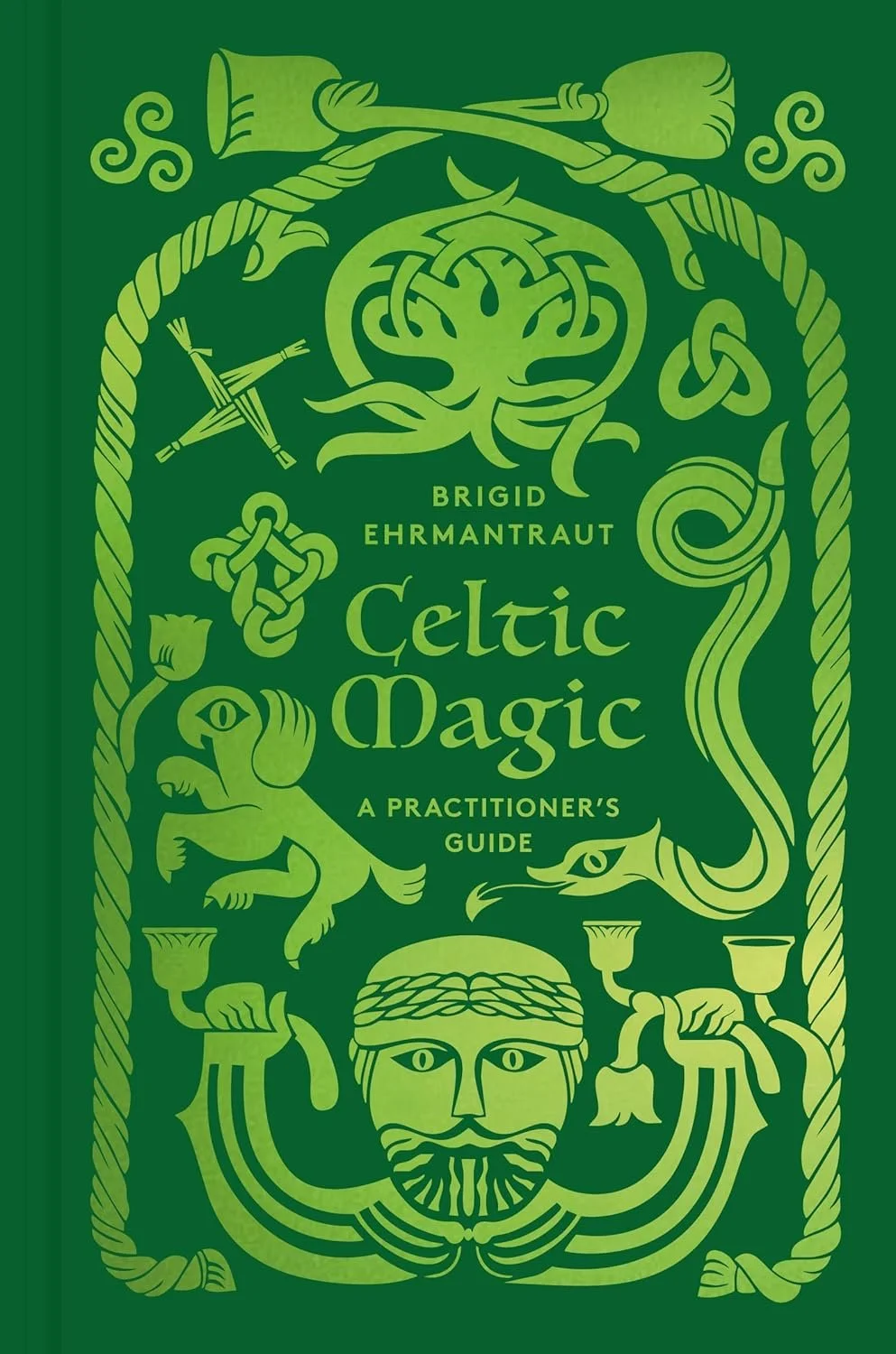
Celtic Magic with Brigid Ehrmantraut



The Medieval Podcast uses affiliate links
Episode 342
Have you ever wanted to put a curse on someone? How about ask a river goddess for some healing? Or maybe speak a charm that’ll make your life better? If so, today’s episode is for you. This week, Danièle speaks with Brigid Ehrmantraut about Celtic magic, druidic haircuts, and what Celtic curses have to do with The Lord of the Rings..
-
Danièle Cybulskie:
Hi, everyone, and welcome to episode 342 of The Medieval Podcast. I’m your host, Danièle Cybulskie.
Have you ever wanted to put a curse on someone? How about ask a river goddess for some healing? Or maybe speak a charm that’ll make your life better? If so, today’s episode is for you.
This week, I spoke with Dr. Brigid Ehrmantraut about Celtic magic. Brigid is an Associate Lecturer in Latin and in the History of the British Isles at the University of St. Andrews, as well as being the author of Classical Myth in Medieval Ireland. Her new book is Celtic Magic: A Practitioner’s Guide. Our conversation on what we know about Celtic magic, druidic haircuts, and what Celtic curses have to do with The Lord of the Rings is coming up right after this.
Well, welcome, Brigid. It is so nice to meet you, and your book is lovely. So, welcome to the podcast.
Brigid Ehrmantraut:
Thank-you very much.
Danièle Cybulskie:
So, your book is ambitiously called Celtic Magic: A Practitioner's Guide. Okay, so at the beginning – this is something that you do in the book as well – we have to figure out what is Celtic and what is magic. What are we talking about here?
Brigid Ehrmantraut:
Indeed. Easier said than done. I joke that people will buy it for the flashy cover and the fun title, and then you'll read the introduction and realize why none of this is necessarily Celtic or magic.
Danièle Cybulskie:
But it's a fun book. It's a great book.
Brigid Ehrmantraut:
Start with Celtic. Generally, academically, Celtic – at least in linguistic studies, medieval history studies of the classical world – refers to the language family; the Celtic languages. So, modern Celtic languages: Irish, Gaelic, Welsh, Cornish, Breton, Manx. Obviously, there are many Celtic languages that are no longer spoken today. So, the medieval forms of all of these, and then a set of Celtic languages spoken in continental Europe, including Gaulish – so, the people Caesar is fighting in Gallic wars – some languages up in northern Spain, some languages that migrate into Anatolia, some languages in North Italy, as well. So, kind of a broad sort of central Western European language group. In the book, I use it pretty much exclusively to refer to speakers of these languages or texts written in these languages, or written in an environment where these languages are being used. So, some of the texts I talk about are actually in Latin, but, you know, it's Latin as being used in the monastery in medieval Ireland, or it's Latin because it's Roman Gaul, and you're speaking both Gaulish and Latin in this environment. So, I'm not necessarily making any statements of ethnic identity or any statements of material cultural identity. And I think it's really worth keeping in mind that the period that the book covers – so, antiquity through the Middle Ages – most speakers of Celtic languages don't know that they share linguistic similarity with other speakers of Celtic languages. So, somebody who speaks medieval Irish probably doesn't know their language is more closely related to Welsh than it is to Latin, for instance, much less that it's more closely related to, you know, ancient Gaulish than it is to, you know, English next door. So, that's, that's the linguistic definition I'm using. I'm aware archaeologists treat this differently, art historians treat this differently. Obviously, modern people who identify as members of Celtic nations or speakers of Celtic languages might treat this differently, but that's the kind of limited academic setup.
Danièle Cybulskie:
Yeah, well, you have to start somewhere. And language is such an important part – as we'll get into – about magic. Okay, so when we're talking about magic, what are we talking about?
Brigid Ehrmantraut:
Excellent question. Magic. Once you try to define it, you end up with definitions that are so broad they could refer to anything. So, in the book itself, I use the Oxford English Dictionary definition and kind of work with it from there. So, the OED defines magic as “the use of ritual activities or observances which are intended to influence the course of events or to manipulate the natural world, usually involving the use of an occult or secret body of knowledge.” I mean, by, by that definition, using a particularly hard-to-use printer that you have to read the manual for counts as magic. Right?
Danièle Cybulskie:
It feels like magic.
Brigid Ehrmantraut:
You might do it regularly. It's intended to influence the course of events. You want to print out whatever it is, and it's occult or secret because no one can figure out how to get the office printer to work ever. So, you, you could, you know, reduce it to something very mundane. But I'm working loosely with this definition. So, things that are envisioned by their practitioners, or by modern scholars, to have some kind of ritual, performative aspect. They're supposed to accomplish something in the world perhaps that wouldn't necessarily happen on its own. And often, but not always, they involve some kind of… some kind of secret or occult knowledge or an appeal to some kind of supernatural force. And I'm very aware that, especially in the second half of the book, when you're dealing with Christianity, this is not necessarily a separate frame of reference for most practitioners of magic within Celtic-speaking areas as they're using for religion. Right? This is one and the same. This is just a different angle on what you already believe about Christianity, and about God and nature. You know, the saint works the miracle because God allows them to. Is this really magic? We might debate that as a modern scholar, but I think the worldview of most of the people involved at this period sees this as part of the same fundamental world and the same way in which nature happens and religion happens.
Danièle Cybulskie:
Yes, Well, I think that the printer example is a good one, because you read saints’ lives, for example, and they're like, oh, I found the cheese that was lost. You know, it's a miracle. We were talking about St. Brendan last week, and one of the miracles was they found their shoes. Somebody found their shoes that have been lost. So, you know, the printer example works absolutely well. You've brought up something interesting and I'd just like to dig into it a little bit more. So, you're talking about magic and Christianity. How do these things possibly go together? Do they go together? Or do we have witch burnings everywhere?
Brigid Ehrmantraut:
Good question. So, that's in part why I cut off with the Middle Ages. There is one very early Irish witch trial in the first quarter of the fourteenth century that gets mentioned towards the end. So, don't worry, there's a little bit of witchcraft. But generally, as I said, I don't think that these are incompatible belief systems. Some people during this period probably do see some things as that's a little bit too far out, or this is more orthodox. But, for example, a lot of the medical charms and protective prayers that I talk about in the medieval part of the book invoke the saints, or invoke God, or invoke various biblical characters. There's one called the Caput Christi charm or the Christ's Head charm that you find in manuscripts all over medieval Europe, in addition to manuscripts produced by speakers of Celtic languages, and it features a lot of here's a biblical character, and I'm going to associate them with a particular body part and they're going to take care of this body part. And it might be a saint, it might be an Old Testament character. So, that's very much happening in the same context. Some of the medical recipes you find in medieval medical collections as well will say things like, well, here's the herbs you should grind up, and this is where you should put them on the body. Also, say your paternoster three times, right? You know, they're going together. There's what we might view as kind of a scientific medical approach. There's the ritual. I'm going to smear this across my forehead. And then there's the and I'm going to appeal to a higher power in this case by saying Our Father.
Danièle Cybulskie:
Yes. I know that there are a lot of people in medieval studies who… who come across something and then it's so difficult to label this – is it a charm or is it a prayer? Because it's a bit of both.
Brigid Ehrmantraut:
Yeah, absolutely. And I think fundamentally, this isn't different from the ancient material either. So, from the pre-Christian material, if you're looking at things like Roman Britain or Gaul or the classical world, the ancient Mediterranean. Right? Magic is one way in which you access the divine or you affect nature in the way that you want things to happen. But it's... it's not incompatible with, you know, going to whatever the local feast is, or worshipping the gods that we have a temple to in town, or making sacrifices to the Roman emperor or anything like that. It's part of the same world.
Danièle Cybulskie:
Yes, exactly. And that is, in fact, where you start the book. You start the book actually at the Cathedral of Notre Dame. Tell us… tell us what is found at the cathedral.
Brigid Ehrmantraut:
Yes. So, in 1711, they're rebuilding the crypt underneath Notre Dame and doing some excavations and moving around some of the bishop's tombs. And they dig into what used to be the old protective wall around the older city from late antiquity, in about the third or fourth century. And the blocks that have been – and rubble – that has been used to make up this protective wall which now forms the foundations of the cathedral, contains a lot of random blocks and monuments that were sitting around… around the river edge in the Roman settlement of Lutetia, now modern Paris. And one of these is an artifact that we call the Pillar of the Boatman today, because it was set up by a guild of merchants who plied their wares on boats. This was kind of a navigators’ merchants’ guild. And it contains a number of block faces that show different gods, either one at a time or in collections. Some of these are identifiable Roman gods: Jove, Jupiter, Vulcan's on there, Fortuna's on there, Castor and Pollux are on there. So, good set of Roman gods, Greco-Roman gods. It also has a bunch of local Gaulish gods on it. And the great thing about it is most of the blocks have labels with people's names. For the Roman gods, this isn't quite as important. There's a lot of both epigraphic inscriptions and dedications to these gods by name. And there's a lot of images of the gods that you can find around the ancient world. For the Gaulish ones, though, this is the only place, in some cases, where these gods are mentioned, or the only place where you have visual iconography associated with a particular, named god. One of the most exciting ones that people really like on this pillar is Cernunnos, who's this character who normally appears as a guy sitting. And he's got antlers, and he's usually wearing a torque – so, one of those big, chunky, Iron Age necklaces – or he has them hanging off his antlers. And his name means something having to do with horn, and okay, he's got antlers. That makes sense. And some people have gotten really excited and gone: every single horned god figure from Iron Age Europe has got to be this Cernunnos guy. And made comparisons to artifacts from very far afield, like the Gundestrup Cauldron, which, although it is now in Denmark, art historians think it's probably from Scythia or somewhere like that, originally. So, may or may not actually be Celtic. But people get really excited and say, oh, this must be the same god. And in some cases it might be the same god, and in some cases it might be independent innovation. But this is the only place you've got the name and the picture going together for this guy. So, that's why it's super, super useful. And it also has a dedication to the Roman emperor Tiberius. So, you have a date for it – or date range – which we almost never have for ancient Celtic inscriptions.
Danièle Cybulskie:
Yeah, it's the type of thing where you're like, wait, wait – this is real, right? Is not a forgery, for real? Because, like you say, you almost never get a date that you could work with. It's amazing. Well, starting with this blend of Celtic or Gaulish gods and Roman gods, maybe this is a good place to say that a lot of what people have relied on about what's happening in Gaul – with the Celtic people there – is back to Julius Caesar. Why should we not really trust Caesar on Gaul?
Brigid Ehrmantraut:
There are a couple of reasons. Reason number one: Caesar is trying to justify his prolonged campaigns fighting the Gauls. And one of the ways he's doing that is by sending his memoirs back home to people in Rome and describing how barbaric the Gauls are, and why they need to keep fighting them, and why he needs to keep his military powers and his standing army in Gaul – which of course ends up going poorly for the Roman Senate. I think anyone who's writing primarily to justify prolonging a military conflict or trying to dehumanize their enemies primarily… probably not your best source for what they're actually doing. So, that's one reason you might be… be a bit suspect. Some of what Caesar reports is at least partly archaeologically verifiable. So, some of the places where he says they have religious enclosures and bury various spoils from battles or bones of the dead have been excavated in various bits of France, more or less where he says they're happening, and do look something like he describes. So, you don't… you don't know if people are necessarily behaving the same way, but at least the material evidence looks similar. Not everything he says has good material support. So, I don't think anyone has ever conclusively found evidence that they do the burning prisoners alive in a wicker man sacrifice. Although, again, how you'd know that's what they were doing and not just some kind of cremation is perhaps hard to tell. So, in that respect, he's not always the most reliable writer. There's another important thing to consider here, too, though, which is that these tropes of what barbarians do, or Celts do, or non-Romans do circulate in classical texts. And you can see them kind of intertextually moving between texts. And a lot of them are postulated to go back to an author called Posidonius, who's a Greek writer. Posidonius' writings don't survive intact, so we can't say, oh yes, Posidonius definitely said all of these things for sure, but they're quoted or summarized in later writers. And so this, this kind of body of material, either directly by Posidonius – or at least drawing on these common tropes associated with Posidonius – has been labelled the Posidonian tradition by classicists. And it basically means that these are a set of things you would use to describe barbarians in this part of the world, or you would use to describe Celtic speakers, or you would use to describe people in… in Gaul. So, in that respect, there's some amount of literary trope going on here, too.
Danièle Cybulskie:
Yes.
Brigid Ehrmantraut:
And then finally, Caesar doesn't have a modern understanding of languages. And indeed, the way in which languages map onto culture is never entirely clear cut. So, when Caesar's talking about somebody in Gaul, are they speaking Gaulish? Some of them have Gaulish names. Great. Sometimes he's talking about people in Germania. Are they speaking Gaulish? Are they speaking some form of Germanic language? Bit unclear. So, you're also not 100% sure he's actually talking about Celtic speakers per se, or however you want to divine Celticity.
Danièle Cybulskie:
Well, anytime you see something that says human sacrifice or cannibalism, I mean, that's the moment to get your antennae up and be like, well, let's look into the evidence. What can we find? And unfortunately, it's so far back that it's difficult to find. I'm sure the day that someone finds something that says we definitely burn people in a wicker effigy, that would be a good day.
Brigid Ehrmantraut:
Very exciting day. I think you see this with bog bodies, too. Like, many bog bodies are clearly violently killed throughout Europe more generally. But even if we just think about the ones in Britain and Ireland in this context, and you could say, okay, this person has been ritually sacrificed and that might be what's going on. But how, just from the archaeology alone, you can tell that it's some kind of religious sacrifice as opposed to a murder victim or, or just a legal execution – again, you might have some evidence that suggests one way or the other, depending on if you find any artifacts on them. But it's really hard to tell just from the body alone.
Danièle Cybulskie:
Yeah, you have to look for as much evidence as you can. And so, we're going to stick with Gaul for a second because there is good evidence of the way that people were relating to the Seine. So, tell us a little bit about the Seine as a river, as, as a person – as a figure, I mean, as a goddess – and how people related to her.
Brigid Ehrmantraut:
Yes. So, one of the great sources for Gaulish religion, or kind of Romano-Gaulish hybridized religion is near modern day Dijon, at the source of the Seine. And this was a sanctuary of the goddess Sequana, whose name gives you the name of the River Seine over time. And this is a nice, Gaulish name. So, she's the personification of the river. There's a great votive statue of her that they dug up at this site, where she's depicted as a woman wearing kind of standard, ancient Mediterranean, Roman clothing. And she's standing in this boat that has a duck head on the prow.
Danièle Cybulskie:
Yes.
Brigid Ehrmantraut:
Which is really good fun. So, she's clearly envisioned as a very aquatic deity. And this is a healing cult. And the idea is if you bathe in the springs here, you will be healed. And people bring various offerings to the goddess and leave what are called ex votos, which you can find around the world in many different religions. But these are normally wood or metal carvings of particular body parts that you want to be healed. So, if, you know, you've sprained your wrist and it's just not healing, or you've, you know, broken your hand, you might dedicate a little wooden hand. Or you might, if you have a recurring headache, dedicate – here's a sculpture of somebody's head. So, some of these are images of the people who have come to ask for cures. Some of them are images of specific body parts you want to be healed. There are a decent number of little model genitalia. Presumably, this has something to do with you want fertility, or you're having some kind of problem related to fertility, and you're hoping the goddess will… will cure you. And this is – again, we don't have a huge number of textual sources to go alongside the archaeological sources here, but if this works the way that other healing cults do more broadly across the Greco-Roman world, this is probably a pilgrimage site that people are coming to, both from the local area and from further away. And it's probably one that people of multiple backgrounds would be interested in. You're passing through the area, you need a cure, you're going to go to the local healing site, even if you're from Rome. And normally you'd ask Apollo for help.
Danièle Cybulskie:
Yeah, I mean, whatever works. Right? You’ve got to hedge your bets, especially if you have a really bad headache. You’ve just got to do it.
Brigid Ehrmantraut:
Absolutely.
Danièle Cybulskie:
So, you've connected the Celtic peoples by language, and so far, we've been talking mostly about archeology, but one of the places you found language was in curse tablets, and you do have advice on how to create a curse tablet in your book. So, let's get to curse tablets. Tell us about these.
Brigid Ehrmantraut:
Yes, it's funny because I was doing a book reading a couple months ago, and somebody in the audience asked, did you think twice about putting curses in? Is this something you actually want people to do? And it was... I will admit I hadn't thought that seriously about the repercussions of this, but this is perhaps a less nice use of magic and one you should think about carefully. But this is one of our best sources for ancient Gaulish language, is these curse inscriptions. And what you do is you get a thin sheet, normally of lead, called a lamella, and a stylus, and you either write on it yourself, or you get a friend who knows how to write, or pay someone who does this semiprofessionally to do it for you. And you write what's called a defixio in a Latinic context, or a binding curse. And this normally uses some kind of legalistic language of binding or tying or restricting. And normally these formula… I dedicate some amount of value, or the thing that I'm lamenting the loss of, to a particular God or temple. May this God or may the infernal deities bind so-and-so. So, this happens to them unless they do what I want them to do. A lot of these that you get throughout, again, the ancient world punish petty theft, and you find a lot of them at bath sites. In fact, there are a number from Roman Bath that are very exciting – most of which are in Latin, but some of which are in Celtic. And this might be somebody from Gaul who's gone on holiday or is stationed in Britain. Or this might be the earliest attestation of the Brittonic language being spoken in Britain. We only have a little bit of it, so it's hard to tell. So, a lot of them are whoever took my shoes, or whoever took my bath towel, you know, I want their heart to burst. Or may they never sleep happily until they bring it back. Some of them are a little bit more abstract, or a little bit more complicated, and refer to legal proceedings: I want so-and-so to lose in court. Or, may all of these people either not affect the outcome of this court case, or may it go against them. So, one of the most exciting and longest ones we have from Roman Gaul is the Larzac tablet, which contains the list of names of either people who are doing the cursing or being cursed. It's a bit unclear because it's pretty fragmentary. I mean, you write it on lead and then you kind of scrunch it up and put it somewhere. Scrunching up is not super conducive to long-term preservation. So, it's a bit fragmentary and it's hard to tell what's going on. But it's probably late first century or early second century CE, and it's got this list of women's names and relational words like daughter or mother. Or there's one: dona. And we're not quite sure what dona means. People have proposed maybe it means wet nurse, maybe it means kind of heir, or descendant. Maybe it means foster mother. Some kind of relational term. And it's really unclear from this is this... is this their actual relationships? You know, is so-and-so actually the daughter of so-and-so? Or is this kind of a socially-constructed relationship? Are we talking about some kind of witch's coven? And these are sort of the sponsors of various young group members? It looks like this one is pretty legalistic and probably involves some kind of court case. But, as I've said, it's a really difficult one to read. And anyone who says confidently, here is a translation of absolutely what it means is full of beans. But it definitely involves some kind of curse, or justice-seeking. And it's such a good window into women's history and into what's going on with reasonably low-status people in a little out-of-the-way town in Roman Gaul – almost all of whom are female – and how they are related to each other, and what they're trying to accomplish.
Danièle Cybulskie:
Yes, this sounds like the type of project that you'd just spend a whole lifetime of scholarship on, being like: I need to figure this out because it's so interesting. I’ve got to find out what it means. But if it's a scrunched-up tablet, I mean, good luck to you, right?
Brigid Ehrmantraut:
I will say though, they keep turning these things up. A decent number of the ones we have in Gaulish have been found since the 1980s. So, actually, when I was… when I was doing the proofs for the book, the editors were like, can you give us some more curse tablet inscriptions? And I'm like, well, I can give you some more Latin examples, but we just don't have any more in Celtic. And then I went and looked at the news that afternoon, and there was an article about some that they'd recently found in Orléans, one of which is known to be in a Celtic language. And I think scholars are still… still working on the transcription and translation before it's published. I haven't had a good look at it yet, but it's the sort of area where the more things you find, the more you learn about it and the more you see what words turn up again and again, what phrases turn up, and then you get better at reading what you already have. So, great area to work on.
Danièle Cybulskie:
The moral of the story is keep digging. Keep digging. So, for the people who hear the word binding and they immediately think of Tolkien, they're not completely off track, right?
Brigid Ehrmantraut:
They're not, no. Our most famous one – it's in Latin, but I think it's safe to say probably the most famous curse tablet from Roman Britain – was found at Lydney Park and it is written by a guy named Silvianus who has lost a ring. There's a healing shrine to the god Nodens at Lidney park and he may have lost it there, but he's asking Nodens to get it back for him. And he thinks that somebody named Senicianus has stolen it. And he may or may not be incorrect. However, about seventy miles away from where the curse tablet was found in Silchester, they dug up a ring dating from about the right period that's got the name Senicianus on it. So, this might be the stolen ring, and Senicianus has gone and got it engraved with his name on it. So, that's exciting. And the kind of Lord of the Rings connection here is that when the archaeologists digging up Lydney park, including Mortimer Wheeler, came across this curse tablet, they weren't quite sure who this God Nodens was, and wanted to know some stuff about the etymology of the name. So, they went and asked Oxford professor J.R.R. Tolkien about it. So, this has led some Tolkien scholars to suggest that perhaps the whole Lord of the Rings cursed ring narrative is inspired by – or comes out of – this curse to try to get this ring back.
Danièle Cybulskie:
I love that. I love that. It's one of those stories where you want it to be true, whether it's true or not.
Brigid Ehrmantraut:
Yeah.
Danièle Cybulskie:
Perfect. Okay, so we've mostly been talking about Gaul. We're going to jump over to Great Britain and Ireland now because this is what you do in the book as well. We're leaving the ancient world. We're moving more into the medieval world. And one of the places where you see magic coming up is in battles with saints. And I love this because one of the places where you see saints and magicians – as you're calling them here, for lack of a better term, perhaps – where they collide is in terms of weather. They're throwing weather at each other. Tell us about weather, saints and magicians.
Brigid Ehrmantraut:
A lot of weather magic. I mean, if you think about Britain and Ireland, this is a daily concern and also has some nice biblical parallels. But the… the kind of classic trope in a number of insular saints lives – whether this is St. Patrick versus some pre-Christian druid, or whether this is St. Columba versus some kind of magician in Pictland – is an evil pagan magician will have called up bad weather either to affect the saint or to show off how powerful they are, but then is unable to get rid of it. Whereas, of course, the saint can make the good weather come back and will pray piously and then the sun will come out again. And in some of the early lives of St. Patrick, we actually see – so, dating from about the seventh century – we actually see a competition back and forth between St. Patrick and a specific… in Latin, it's called a magus. So, kind of the magician word. In some of the later Irish translations of this, this word is rendered druid. And you get druid glossing the word magus in Latin texts that have been glossed by Irish speakers. So, maybe this is, in fact, a druid. There's then another question about whether this is what druids actually did or whether someone has gone, oh, well, this is what biblical magi do. So, that must have been what druids did back in the day. But some kind of magician who calls up the bad weather but then can't get rid of it. And Patrick prays and the bad weather goes away. And then they… they have it out through trial by fire. And they build this structure, half out of dry wood and half out of green wood. And the magus goes into the green part of it wearing St. Patrick's cloak, and one of St. Patrick's disciples goes into the dry part wearing the magus' cloak. It's all very complicated. But they set the whole thing on fire. And when it's burned down, Patrick's disciple, whose name is Benignus, is there. He's happy as a clam, but he's covered in ash because the magician's cloak has caught on fire and there's no sign of the magician left. And scholars including Thomas O' Loughlin and Jacqueline Borsja have connected this with various trials of divinities in the Book of Daniel in the Bible – and the three youths who were thrown into the furnace but miraculously survive in Daniel – and say that really instead of telling us anything about the actual conversion process, or about what pre-Christian magicians did in Ireland, what this is is an attempt to replicate a biblical story, but set in Ireland with a Christian saint as its hero. And indeed, they do refer to the Hill of Tara in this as the Babylon of the pre-Christian Irish. So, they're not super subtle, but it's a great story.
Danièle Cybulskie:
Yeah, I mean they're not really super subtle in any of these saints’ lives. But one of the things that you mention in the book is that it's kind of hard to trace what druids are doing. And this is always the question people have for Celticists, right? Like, what are the druids doing? We don't actually know.
Brigid Ehrmantraut:
If only we knew. And you get a spectrum, in terms of people who are willing to say more-certain things or less-certain things, depending. I probably fall on the less-willing to say anything with certainty about druids – at least druids in reality. But there's a very long history of reimagining druids. So, our sources for druids in the ancient world are predominantly classical authors who tell us all kinds of things about them that may or may not be true. There is a word “druid” in Irish and in Gaulish and possibly in Welsh, although it might be a borrowing from Irish. So, clearly, this was an actual institution that existed at some point, and the Celtic languages share a word for it. So, I'm not disputing druids of some form did exist, and people like Caesar encounter them, and there's some kind of priesthood in Caesar, often with judicial or secular powers in addition to working various rituals – which, if you think about it, is also how the Roman priesthoods normally work. This is kind of a civic position, and you do it alongside your political career. Druidry is banned in the early empire. This doesn't necessarily mean it disappeared overnight. It's banned by successive emperors. So, perhaps it didn't work very well. Or it was a nice, easy statement to say, and everyone signs up and goes, yes, we agree. No more druids. Druids appear heavily in medieval Irish literature. The degree to which any of these characters actually reflects what pre-Christian druids did in Ireland is a very open question. Again, as I've just given us in our example here with the magus in the Life of St. Patrick, they clearly borrow heavily from magicians in the Bible. So, both Old Testament magicians, and especially Simon Magus in Acts, and then all of the apocryphal things spun off of Acts about, you know, Simon Magus tries to fly and falls to his death. So, they're really interesting as literary characters, and they're really varied as literary characters. And I think we're probably better off thinking about druids in medieval texts as literary characters who evolve and change, rather than as a direct reflection of pre-Christian Irish religion. Even if there's some amount of that in there somewhere. And you see a number of them who appear across texts, some of them are relatively unrepentant, evil, and cause trouble. One of them, Mog Ruith, is even said to have executed John the Baptist. Some of them are rather helpful counsellors and act kind of more as, you know, the king's advisor. One of them, Cathbad, in the old Irish material, even gives a prophecy of the crucifixion. This is a fabulous story – and I don't think it's actually in the book – but in this story, the King of Ulster, Conchobar, has been in a battle and one of his enemies has hit him in the head with a slingshot ball. And the slingshot ball is made from the calcified brains of somebody else.
Danièle Cybulskie:
Wow, amazing.
Brigid Ehrmantraut:
I knew an academic in Canada who's tried this with a sheep's brain. You can actually get it to turn into, like, a slingshot ball.
Danièle Cybulskie:
Represent, Canada.
Brigid Ehrmantraut:
Indeed. Let's hear it for experimental archaeology. And… slingshot ball wedged in his skull. His doctors say it's okay, you're going to live, but you can't do anything that would cause it to fall out. So, no sudden movement, no getting angry, no fighting, no having a lot of sex. You have to live a very mild life. And this is going alright, until one day he starts to see all of these horrible portents. You know, the sky goes black, and rains of blood – all of your classic, medieval portents. Different versions have slightly different versions listed. There are a couple versions of this tale. But his local druid, sometimes unnamed, sometimes his stalwart advisor, Cathbad, tells him, oh, this is happening because Christ is being crucified today. And Conchobar, feels so emotional about this that he gets up and wants to go kill the people responsible. And this outpouring of emotion and violent movement causes the slingshot ball to fall out of his head and he dies. But not before – according to the Irish texts – he is baptized in his own blood, and is thus the first of the Irish to go to heaven.
Danièle Cybulskie:
Well, perfect. I mean, as you were getting to the part where the ball popped out of his head, I'm like, I bet this guy's going to heaven because he is really feeling it. Good to know.
Brigid Ehrmantraut:
So, in that case, you've got a druidic character who is prophesying Christ. Again, much like you get magicians or prophets in the Old Testament who might not quite know who it is they're prophesying, but they still have a prophecy that can be interpreted as Christ from a New Testament perspective.
Danièle Cybulskie:
Yes. And these things, they come in combination so often that it's really kind of almost rare to not see them together. When you see them together, it really sticks out. Well, one of the things – speaking of druids and heads and stuff – one of the things you have in here is that you could possibly give yourself a druidic haircut, which I love. Tell us what a druidic haircut would be.
Brigid Ehrmantraut:
Yes. And so much discussion has been had over what kind of monastic tonsure Christians have in Celtic-speaking areas. This doesn't mean it's necessarily the same in different Celtic-speaking areas, but it's clearly different from what people coming from a Roman tradition from the continent encounter in the early Middle Ages. And there's been some speculation that this is derived from whatever the priesthood before Christianity was doing with their hair, which, again, may or may not be related. But you get in some of the early lives of Patrick discussion of what druids haircuts look like, and the fact that in one of the texts in Tírechán’s Collectanea, Patrick converts some druids – decide to put aside their druidry and become good Christians. And they need to change their hair to show that now they are Christians and they've gotten rid of this weird, druidic haircut. So, this implies that they have some kind of distinctive, different haircut. Again, whether this is a real memory of what druids’ haircuts did look like, or whether this is an attempt to go, what are druids? Well, they're sort of anti-priests or anti-monks, so we should give them a tonsure, but it needs to look different – on behalf of the monastic authors is an open discussion. It's referred to in Irish as sort of a front, curved tonsure. So, we don't have a lot more information about that, but you can try to imagine what you think that would look like. It probably involves some kind of curved hairline across the forehead – or maybe the top of the skull – and shaved head elsewhere. We don't have any nice pictures of this, unfortunately, but there's clearly an idea that they have, as a kind of group of anti-priests, their own tonsure. And some of our later texts suggest that they have gotten this off of Simon Magus, himself.
Danièle Cybulskie:
Well, of course. Trendsetter.
Brigid Ehrmantraut:
Definitely.
Danièle Cybulskie:
Trendsetter in evil magic, trendsetter in haircuts... I mean, this guy – we owe so much to him. Alright, so one of the things that you bring out near the end of the book that I think is really important is you're talking about script – because, again, we're connecting the Celtic peoples by their language. And you come back to script, which is something that I think that maybe people have left out, in that when people talk about the ways that you might put a magic script into your book, it tends to be Arabic that people look at, right? There's a lot of pseudo-Arabic in this type of thing. But you found it with Irish script, right?
Brigid Ehrmantraut:
Yeah. So, there is an early Irish writing system used to write the Irish language, at least names in the Irish language called ogam in modern Irish, or ogham if you're looking at this in archaic or Old Irish, and this involves making little hash marks, usually on the sides of sticks or rocks. It survives from at least the fifth century on rocks in fields that have people's names on them. So, these are probably grave markers or they’re boundary markers. This field belongs to so-and-so, son of so-and-so. So, it's not giving us a lot of great narrative, or syntactic, evidence, but it's good for looking at what early Irish names do. And it's probably developed in connection with people who know the Latin alphabet, because it's got a similar mapping of sound to letter that the Latin does. There's a great project right now out of Maynooth on ogham, if anyone wants to look that up on The Ogham Project and see what new things people are discovering about this. But in manuscripts, it gets used sometimes as a sort of occult or hidden alphabet. And one of my absolute favourite Irish manuscripts is the Book of Ballymote, and it contains a text called In Lebor Ogaim – The Book of Ogham – and this is a bunch of different types of ogham, some of which are just the ogham alphabet as we know it from rock inscriptions, some of which are you have completely made up an alphabet where you've added letters onto this by analogy with the forms you already have. And this includes things like Dog Ogham, or Cow Ogham, or Scandinavian runes are included under Scandinavian Ogham. Some of these you can use for divinatory purposes. So, there's one called Boy Ogham, and this allows you – at least, allegedly – to determine the gender of an unborn child. So, what you do here is you count the letters in the mother's name, and if this number adds up to an odd number, the child's going to be a boy. And if it's even, the child's going to be a girl. If she already has a child, then you use their name instead. So, this is kind of a way of producing a simple sort of yes/no, male/female option. Whether anyone actually does this is unknown, or whether some monk has gotten really creative… There are various ideas about supernatural origins for this alphabet. So, the tract in the Book of Ballymote, The Ogham Book talks about how a character named Ogma, who's an otherworldly character, is a member of the Túatha Dé Dannan, kind of otherworldly people of medieval Irish literature, who may – or probably may not – reflect any kind of pre-Christian belief. And it says here that Ogma, who is a man well-skilled in speech and poetry, invented this alphabet. And the cause of it was to prove how ingenious he was, and so that learned people's speech could be set apart, and the rustics and the herdsmen wouldn't be able to read it. So, I mean, if we're thinking of our definition of magic as, you know, some kind of secret or occult knowledge, absolutely, that's what's going on here. Although, it also reflects how elite literacy is, right? You know, most people in medieval Ireland are not literate. This is something that – especially in the early Middle Ages – really is the preserve of clerics and monks. So, there is something intrinsically sort of magical or occult about literacy, period. Different ogham letters have different names, often associated with various trees in medieval manuscripts, which makes sense if this is a system meant to be carved on hard surfaces like wood. And some more recent antiquarians, including Robert Graves, have gotten really excited about this and said that, you know, you can find out all kinds of pre-Christian things from this, and each letter corresponds to specific lunar cycles, and you can do something with the moon and the ancient Celtic calendar – and then, inevitably, it rolls into something about human sacrifice. And most academics today would not sign up for the ogham tree calendar theory, but it has been influential in some modern spiritual practices. So, there you go. So, that's the big one from the Celtic world, but it's not the only one. And other authors get excited about coming up with invented magical alphabets or letter substitution codes. There's a ninth-century manuscript from Britain that has one of these kind of magical, invented alphabets attributed to Nennius. He's a Welsh monk and sometimes claimed as the author of the Historia Brittonum. And in this little narrative it says that an English monk has mocked Nennius because the Welsh don't have their own alphabet. Unlike the English – you have runes. Or the Norse – you have runes. And so, Nennius's solution is to come up with this. This invented alphabet, which you never see outside of a couple of manuscripts. So, whether this is actually something that anybody else knows, or whether this is just a fun kind of parlor trick, or intellectual code game, again, is something that we might ask. And this has a long, later history, too. So, the great antiquarian and forger Iolo Morganwg invents his own alphabet that looks kind of like runes that he calls Coelbren y Beirdd – so, the Alphabet of the Bards – and claims has this ancient history behind it.
Danièle Cybulskie:
Well, I love this. You do have at the end of the book all the people who have inventively gone back and put things together and created sort of a pseudo-Celtic history. And a lot of it is very familiar because this is really nineteenth-century stuff, especially, that has really, really been passed down.
Brigid Ehrmantraut:
Definitely. A lot of it is the product of romantic nationalism and various attitudes towards how can we reclaim some kind of past for our particular language group, or nation, or people, or however you want to define this in a nineteenth-century context. We need some kind of antiquity. Let's reach back to this… this medieval tradition, or this even pre-medieval tradition. So, you get it a lot in the Scottish contexts in… in the work of James Macpherson, who, who writes kind of Ossianic Cycle, which is at least a little bit based on actual folklore he's collected in the Scottish Highlands, but is perhaps more based on his own literary inventions that he's passing off as folkloric traditions. Although, I do have some friends who work on this. And it's really complicated because then people start reading them and going, oh, this is great. And then it feeds back into real folk traditions, which is fabulous. You get this in especially kind of Irish revival circles, say, with people like William Butler Yeats and Maud Gonne and Lady Augusta Gregory, who translates a number of medieval Irish texts – re-paraphrases medieval Irish texts – into an English series of publications for an English-speaking audience. So, again, trying to look back to some kind of alternative, possibly pre-English, or precolonial worlds. Though, of course, at the same time, this is heavily mixed up with imperialism and the history of empire and the history of racism and white supremacy. So, this is… this is always a very complicated, and often very loaded, discussion. But a lot of this has influenced how we think about it today, and it's definitely influenced how the field has emerged. So, it's really important to keep in mind. And I think one of the real trends across the whole book is that people are always reimagining this material for their own purposes and their own needs. So, this might be, you know, Caesar is reimagining this material to suit his political aims. This might be, you're reimagining a Gaulish God in a Roman context because now you live in a hybrid Gaulish-Roman society. This might be you're reimagining what you think druids did to work with Christianity, or to work in a saint's life. And that just keeps going, right? You know, people like Iolo Morganwg are reimagining what... what they think various bits of medieval and ancient Welsh culture was in order to suit what kind of prophetic prophecies they want to write, or what kind of communities they want to set up. Just like the Irish revivalists are reimagining characters from, you know, Táin Bó Cúailnge, The Cattle Raid of Cooley, in the context of discussions over Irish independence. That's just what modern practitioners do today, too, right? Is reimagining this that works in a way for their own spiritual system.
Danièle Cybulskie:
Well, and you have stuff that is based on scholarship, here, and people can choose to curse each other if they like, but I know there are people that are listening to this that are trying to find their way back to what might have been actually real – past the nineteenth century – what might have been real in the actual Celtic medieval, and ancient past. So, as somebody who studies this all the time, where do you find is a rich seam to go if you're trying to find things that are as real as possible? Where would you send people?
Brigid Ehrmantraut:
This is a great question. It's a field that's reasonably well served by digital humanities projects, but is not very well served by open access publications about how to interpret this material. So, the notes in the book have some very academic citations and some suggestions for where you could go for popular material – or more accessible material that, you know, you don't need a PhD in Celtic Studies to understand. I would say, especially for medieval literature – especially for Irish – The CeltSite is great for having links to a lot of both the primary texts and the translations of the texts. Some of them are from slightly stuffy eighteenth, nineteenth-century translators, but they're there. I mean, the great thing about having many of these texts not re-edited since the nineteenh century is they're all open access now on archive.org.
Danièle Cybulskie:
That's right, yeah.
Brigid Ehrmantraut:
So, that's great. There's a slightly more academic, bibliographical site called Codex, run out of the Netherlands, that has really good bibliographic information if you want academic citations, but also links to all of these, you know, old uploaded PDFs of things on archive.org, that were published in 1880. If you want to go read the primary texts, there's also some discussion of collections of these. John Carey and John Koch have a book called The Celtic Heroic Age, which also has a lot of accessible translations. Sioned Davies has a translation of the text kind of known as the Mabinogion, but a number of medieval Welsh prose tales, including the four branches of the Mabinogi and other texts that often get lumped in with them by later scholars. Thomas Clancy has a book called The Triumph Tree: Scotland's Earliest Poetry, which includes a number of these texts as well. If you want the early Latin lives of St. Patrick, there's a good site called Confessio.ie that contains Patrick's own writings, and then also the seventh-century lives about Patrick and a good bibliography. If you want medieval Welsh medical material, you are in luck because Diana Luft has done a fantastic edition of a lot of the medical texts. And this is open access. The Wellcome Trust paid for it and it's all… and they paid to make it open access online, so you can search Diana Lofts, Medieval Welsh Medical Texts, and that will come up. And then there are a lot of new, great projects underway on a lot of this material. So, again, Ogham is a great ogham project out of Maynooth that has some great things and will continue to update with new information. There's a really good, digitized manuscript site called Irish Scripts on Screen, as well, if you want to see what these manuscripts really look like. So, that's just a small number of the great online resources out there. And then there's more notes in the book if you want anything specific.
Danièle Cybulskie:
Well, I love that, and I'm so glad that you have all of these resources sort of at your fingertips. I'm sure there are going to be people who are so excited that they have places to go because they do want to find out what actually was going on – as close as we can get to it. And I love that your book has both the fun stuff in it, like druidic haircuts and curse tablets, but it also has that real scholarship that people are going to appreciate, I think. So, thanks so much, Brigid, for coming on and telling us everything about Celtic magic.
Brigid Ehrmantraut:
Thank-you very much for having me. It's always fun to talk about research to a wider audience.
Danièle Cybulskie:
To find out more about Brigid’s work, you can visit her faculty page at the University of St. Andrews. Her new book is Celtic Magic: A Practitioner’s Guide.
In coming up with a motivational quote for this week, I was struck by a quote attributed to a Welsh legend: the poet Taliesin. In Brigid’s book, she pulls a section from a poem called (in English) “The Battle of the Trees.” In it, Taliesin is talking about his previous lives, and he says this one line which I found really beautiful. He says, “I was the stellar radiance of the stars.” It reminded me of the Carl Sagan quote about all of us being made of star stuff, saying we are “a way for the universe to know itself.” So, if you’re feeling small or insignificant today, remember that, just like Taliesin, you are the stellar radiance of the stars.
And speaking of stars, it’s time to give a shoutout to all of you: the listeners whose generosity makes this podcast possible every week. So, thank-you, for listening, sharing, rating the podcast, letting the ads play – and most especially, for joining me on Patreon. I absolutely adore the community there, and am so happy to read your comments on the articles I post. To find out more about the exclusive articles I write each and every week, and the monthly live Ask Me Anything videos, check out patreon.com/themedievalpodcast.
For the show notes on this episode, a transcript, and a collection of the books featured on The Medieval Podcast, please visit medievalpodcast.com. You can find me, Danièle Cybulskie, on social media @5MinMedievalist.
Our music is by Christian Overton
Thanks for listening, and have yourself a fantastic day.