Mary Magdalene on Stage with Joanne Findon

The Medieval Podcast uses affiliate links
Episode 340
In the medieval world, people interacted with Biblical history and the adventures of their favourite saints in all sorts of ways – including through plays. One of the most beloved saints – Mary Magdalene – is the main character in an English play that has it all: raging tyrants, perilous sea voyages, angelic interventions, at least three resurrections, and perhaps most thrilling of all, a woman preaching. This week, Danièle speaks with Joanne Findon about the incredible medieval story of what happened to Mary Magdalene after the resurrection, how even the most holy figures were brought to the stage, and why this play may have been rescued from destruction.
-
Hi, everyone, and welcome to episode 340 of The Medieval Podcast. I’m your host, Danièle Cybulskie.
I love this job, and I love interviewing new historians every week, but I’ve got to tell you: this one is special to me. Because this week, I’m speaking with the woman who started this particular ball rolling. When I sat down in her medieval romance class at Trent University more than twenty years ago, it hit me that there were people whose profession was reading and sharing medieval literature. And even though my career path has looked very different from hers, here I am studying the Middle Ages for a living.
So, today, we’re talking about a subject that I did a little research for way back at Trent, to support my mentor’s book project. In the medieval world, people interacted with Biblical history and the adventures of their favourite saints in all sorts of ways – including through plays. One of the most beloved saints – Mary Magdalene – is the main character in an English play that has it all: raging tyrants, perilous sea voyages, angelic interventions, at least three resurrections, and perhaps most thrilling of all, a woman preaching.
This week, I spoke with Dr. Joanne Findon about the Digby Mary Magdalene play. Joanne is professor emerita at Trent University, and the author of many works across genres, including A Woman's Words: Emer and Female Speech in the Ulster Cycle, Seeking "Our Eden": The Dreams and Migrations of Sarah Jameson Craig, and Bound and Free: Voices of Mortal and Otherworld Women in Medieval Irish Literature. The book we’re discussing today is Lady, Hero, Saint: The Digby Play's Mary Magdalene. Our conversation on the incredible medieval story of what happened to Mary Magdalene after the resurrection, how even the most holy figures were brought to the stage, and why this play may have been rescued from destruction is coming up right after this.
Well, welcome, Joanne. I'm so excited to have you here. And the only reason you haven't been here before now is just my disorganization because I have such love and respect for you. This is such a treat. Welcome to The Medieval Podcast.
Joanne Findon:
Thank-you so much. It's a treat for me to be here, too.
Danièle Cybulskie:
Thank-you. Well, we are revisiting one of the works that you did a while back, because this is the work that you were researching when I met you. I did a little bit of research for this book, too, so I figured this is where we're going to… We're going to start for today. So, we're talking about a play. Can you tell us when and where this play was written? To the best of our knowledge.
Joanne Findon:
So, this is a play that was written down in the late 1400s in an area of England called East Anglia. So, east and a bit north of London. The main city now is Norwich. So, if you have a map in your head – or you maybe don't – anyway, it was a very important area in the Middle Ages. If you know anything about later English history, this is where the Boleyn family – as in Anne Boleyn – was from. And a lot of people from East Anglia, and Norwich in particular, became quite important in English governments of several generations. It was quite a prosperous area. So, there were a lot of sort of upwardly mobile gentle families who owned quite a lot of property. And as time went on, they also owned books. And many of them also commissioned writers to do translations of saints’ lives or other documents for them. So, people had a bit of money to spend and it was quite an important area, culturally. So, we are pretty sure that the play… We don't know where exactly it was written, but maybe by a cleric from Bury St. Edmunds – which was a major monastic foundation there – but we just don't know. The one manuscript that it appears in dates to the early 1500s, maybe 1520. And it's extremely messy, as if – which is really possible – the scribe was putting it down in haste because as the religious tenets changed and the Reformation was brewing, you know, plays were becoming suspect. And, you know, there's a sense that this person was just desperate to get it down on paper. There's a bunch of scribbles and mistakes, but anyway, there it is. It's a hugely complex play, so it's a long manuscript. So,… yeah.
Danièle Cybulskie:
Well, this play is so interesting. And I think that the fact that it's interesting is really borne out by the fact that you have done most of your work – or a lot of your work – as a Celticist, and somebody who works with romance. And here you are in drama. What was it that drew you to this play?
Joanne Findon:
Well, yes, I had been working on... I mean, my thesis research is on medieval women in medieval Celtic literature. Irish particularly. But I branched out into English romance so I could get a job. But I had been reading a lot of English romances and then somebody said, oh, there's this really cool play about Mary Magdalene. The minute I read it, I thought, there's so many romance motifs here, right? Not just motifs, but, you know, elements that I was familiar with from reading romance. But nobody had written about that. And I thought that was really odd, as if… Anybody studying drama doesn't really read romances. But it was really obvious to me that the audience would have probably picked up on these things because, you know… Well, this is part of the research that I had to do and that you helped me with. You know, what would that audience have been reading other than saints’ lives? Well, actually, a lot. And when we look at some of the manuscripts from that area, we see that many of them are compilations that include lyric poetry, saints’ lives, and some romances, right? So, it seemed pretty clear to me that there was a pathway there to talk about what I saw as romance motifs and elements in this play, and secondly, how an audience – or multiple audiences – would have responded to that, and what they would have recognized from their own literary – whether oral or reading – context.
Danièle Cybulskie:
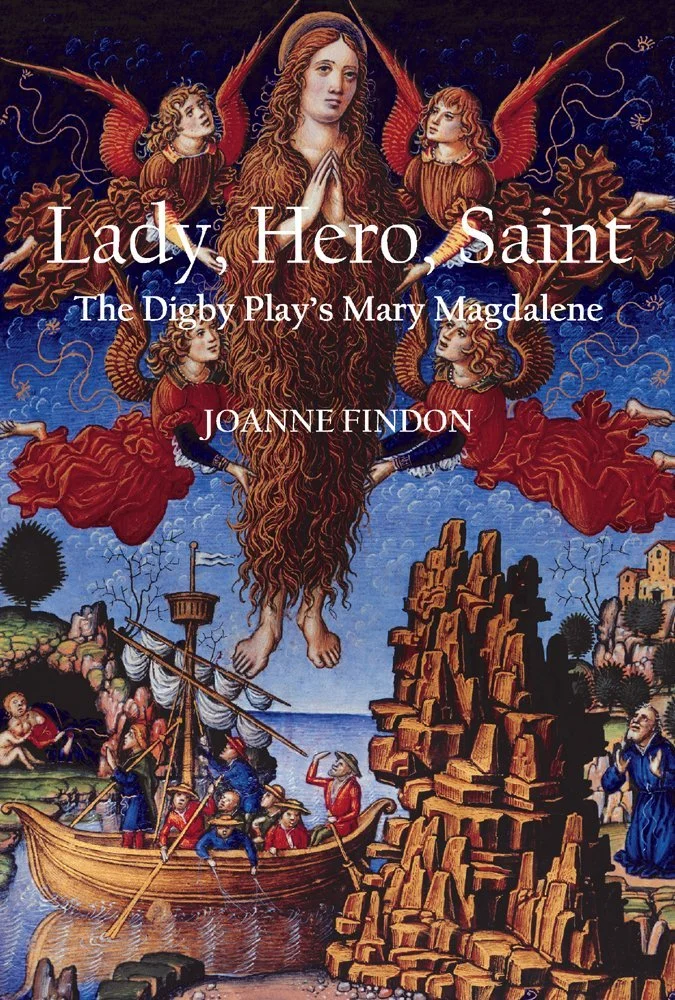
Well, I'm so happy to be talking about this play at this moment, because just a couple weeks ago, I was speaking with Nigel Bryant and Matthew Thompson about romance – specifically musical romances – and those are being directed at a totally different audience. But we have people who might be reading them and sort of reading them onto this one. Okay, so we should probably, at this point, get to the plot – which is going to be difficult for you, but I'm going to need to ask you, because if people look at the front cover of the book that you've written about this play, they will see a very hairy saint, Mary Magdalene, and she is floating over a boat. And this is not in the Bible.
Joanne Findon:
It's not.
Danièle Cybulskie:
Tell us what happens in this play.
Joanne Findon:
Right. And what's happened here is we have the kind of basis. Very few lines about Mary Magdalene in the Gospels. And then this whole body of saints’ lives – hagiography, as we call it – grew up around this figure, and it pulled in elements from other saints. So, for instance, St. Mary of Egypt, who was a prostitute and then underwent conversion and became a hermit in the desert. And, you know, down in Egypt, so it's far from England, right? But also, there was a very famous shrine for Mary Magdalene in Vézelay in the south of France. And, you know, her legend just kept growing and growing. And the most famous version that everybody would have known is in a compilation of saints’ lives called the Legenda Aurea – so, The Golden Legend – which is still in print to this day. So, it just added all these… all these elements. So, we start with Mary Magdalene. Actually, we start with a bunch of tyrants boasting about each other and their own power. The Caesar in Rome, right? And they send messengers to each other. And then we come to Magdalene Castle, where Mary Magdalene and her family live. And her father's kind of boastful, too, but he's not such a bad guy. But then he suddenly dies and he has left his properties to his children, but she inherits Magdalene Castle and she's left there alone. And the playwright is quite acute, psychologically, with his characters because he has her really mourning her father's death. And clearly this makes her very vulnerable to temptation. And The Seven Deadly Sins, and The World, and The Devil have this conversation at a different stage. I mean, listeners have to realize that this play is done probably in the round with probably ten or more fixed stages on the green outside, right? So, you're always… Somebody’s speaking at one stage, and then maybe they send a message to another stage. So, it's very active like that. The World, The Flesh, and The Devil have a meeting and they say, well, you know that Mary Magdalene, if she persists in her virtue, she will be able to destroy hell. We have to do something. So, they send Lady Lechery to go comfort her. So, it's sort of intended that way for Mary Magdalene to understand, but actually it's tempting her. And she goes out to a tavern and there's this fellow named Curiosity who flatters her, seduces her. And then we are to understand she has this whole, basically offstage, sensual life until she's seen on another stage, The Arbour, where she says she's waiting for her valentines to arrive. And she falls asleep. And as she sleeps, an angel comes to her and basically says, what are you thinking? What are you doing with your life?
Danièle Cybulskie:
Yeah, I think you call it an intervention in your book.
Joanne Findon:
An intervention, yes. So, Mary Magdalene wakes up, comes to herself, goes off to meet Jesus, who casts out seven demons from her, and then she's a follower of Jesus. So, that part is from the Gospels. But you might notice that falling asleep in the arbour never occurs in the Gospels. And that is my first romance motif that I talk about in the book. Once he's commissioned her to go not just around in their country, but he says, I want you to go to Marseilles and preach to the king there. And she says, okay. And there she goes up and there's an actual physical ship that is pulled through the playing space with a captain and a sailor. They're very funny characters. And she gets on, she pays for her passage because she's actually quite wealthy. And she goes off to Marseilles and… and she preaches to the king and queen. They initially… The king says, no, no, no, that's nonsense. Come and… come and hear what my priest – my temple priest – has to say. And when she's… She's open to doing that. And then she prays to God and the whole temple catches fire and the priest and his assistant sink into hell, we are to understand. And you can imagine the staging of this, right? It's all pretty spectacular. So, then the king and queen are pretty crushed because the religion that they were relying on is clearly not valid. And the king says, okay, I might listen to you. We've been together for many years, but we've never been able to have a child. If you think your god could give us a child, I'll believe. So, she goes off and prays for them overnight and they miraculously conceive a child. So, they convert. And then... I know this is a long story, right?
Danièle Cybulskie:
It is a long story, but I mean, it's all relevant to the plot.
Joanne Findon:
Yeah, it really is. So, then they go off. She says, I can't baptize you, but I'll send you to Peter in Rome. The king says, fine, we'll do that. And the wife insists on going with him, and so he takes her with him and there's a storm that comes up and she dies in childbirth. And the king is grief stricken, and the sailors are saying, we can't have a dead woman on the ship. So, they allow him to put her on a rock in the middle of the sea. And he leaves, grief stricken, goes to Rome, meets Peter, gets baptized and everything. On his way back, he says to the sailors, could you just pass by that rock? And there the wife is alive, the baby is alive – they're both fine. And the wife says, it's okay. I've been to Jerusalem as well. I've done the Stations of the Cross through the aid of Mary Magdalene. So, somehow she has been able to not only preserve the life of the queen and her child, but invisibly take her on this journey that Peter and the King have no knowledge of. So, of course, she's amazing, right?
Danièle Cybulskie:
Yeah.
Joanne Findon:
They return. Mary Magdalene, who is preaching now the second of two sermons – if you know anything about medieval women and preaching, you know, this is a radical thing. Totally radical. Anyway, there she is preaching on the shore. They return, and the wife is so happy to see her in the flesh. And then Mary Magdalene says, I have to leave. I'll leave you to your kingdom and I'm going to go out to the desert and pray. And that's the last part of the play, where she is a desert hermit and eventually dies and is taken up by the angels when she dies. So, yes, it's very complicated, many stages. But that picture on the – which I was very lucky to get from The British Library, right? All of that is in this. This is why I wanted it. All of those scenes really are on the painting. So, she being lifted up. But also, there's the ship and the sailors, like… and there's the little cave with the queen and the baby, you know, and there's somewhere…. the desert hermit is out there somewhere. So, it's as if it's all encapsulated in that one picture.
Danièle Cybulskie:
Yeah. And it's just I remember coming across this play in your class and being totally stunned because, you know, we didn't learn about this in Sunday School. That Mary Magdalene – she shows up in Marseilles and she, like, converts everybody there. She's in charge of it for a couple of years. This is not in Sunday School. But as you're saying, this would have been expected. Everyone knew this story already, and so they would be expecting all of these bits to show up on the stage.
Joanne Findon:
Not all of them. Not all of them.
Danièle Cybulskie:
Not all of them. You're right.
Joanne Findon:
They knew about the ship and the preaching to the visit to Marseilles, but they did not have, word for word, her actual sermons that she preaches. And if you remember looking at Margery Kempe – we did Margery Kempe in my class, right?
Danièle Cybulskie:
Yep.
Joanne Findon:
She has to be very careful – this real woman, East Anglia – she has to be saying, I do not preach. I just have good conversations with people. Like, she really has to make that… Mary Magdalene, she just gets up and preaches. So, that would have been stunningly radical in the day. And yet the playwright includes not just one, but two sermons. So, he also adds the bit where she's in charge of the kingdom while the king is gone.
Danièle Cybulskie:
Yeah, that's pretty impressive.
Joanne Findon:
Pretty major.
Danièle Cybulskie:
Yeah. Well, I mean, the staging – you started to talk about the staging, but we needed to get back to the plot because there's so much in the plot – but the staging is really critical to this because as I was talking about a second ago, when we're talking about romance, that's really aimed at a noble audience, even if people who are below the nobility are reading these. But this play is aimed at everybody in the town that wants to come out to it. So, tell us a little bit more about the staging. We've talked about how there are different bits, places where scenes might play out, but the staging here is so important to the way that it's addressing the people, right? Can you tell us more about how it's staged?
Joanne Findon:
Yeah, well, unfortunately, we don't have a diagram from this play, but there's another play about the same time period called The Castle of Perseverance. And there is a diagram for that play and what it shows is a sort of central green with stages around. And the idea is that the audience may well have sat in part of that central green and the actors moved through them and to each other on… you know, from one stage to another. So, the technical term for these fixed stages is locus, which is just – I mean, we still have that word, but it's from Latin. It means the place, right? This particular place. And then for the playing space, the term is platea, also meaning place, but, you know, sort of broad. It could be a meadow, it could be a central green. And so, my last chapter in the book talks about the kind of rhetoric of space. One interesting thing is these tyrants who are so boastful at the beginning, they proclaim their power, but they can't actually leave their stage, right, to talk to each other. They have to send messengers. And the messengers are lower class people who can go from place to place. And a couple of other scholars who had talked about staging before I got to the play had noted that all the important spiritual things happen on the platea, which is also the place where the audience would be living, you know, and living, and then sitting there for the performance. And, you know, Jesus is on the platea, the tomb of Lazarus – that he is resurrected from – that is on the platea. So, the tyrants like to think they're all-powerful, but actually they're not, which is a really radical idea in an era where class distinctions are starting to crumble a bit. You know, a lot of people have made a good deal of money from trade. They've been able to buy property, they're gentry now, whereas two generations before they might have been, you know, a cobbler or shoemaker or somebody doing a very menial job. And they're moving up in the world for everyone to see. And of course, that's what the gospel is supposed to be. It's for everybody, not just the rich people. So, this use of the space in the staging kind of drives that home. That's the idea: that this is for everybody. The tyrants are doomed. They're too limited. They. They can't really take their power anywhere. So, that's… that's one important thing, I think.
Danièle Cybulskie:
Yes, well, it is radical, as you're saying, to be speaking to people right there, right in front of them. And these are the people… I mean, it's always about who are you supposed to relate to? And you're supposed to relate to the people that are close to you, not only in space, but also in status. And so having these important saints, a reformed sinner, right there in front of you, it is totally different from how other things may have been performed. And one of the things that really sticks out in this play, as well, is that you have characters who speak – as you're talking about, tyrants, but also there is Curiosity, who I want to get to in a second – but they're speaking in this high language. They're supposed to be noble and they are the villains. And then you have the shipmen who you think could be dangerous, and they're just great guys.
Joanne Findon:
Yeah, exactly.
Danièle Cybulskie:
I mean, this would speak to the audience. Can you tell us more about the shipmen? Because I love these guys.
Joanne Findon:
Oh, I love the shipmen. Yeah. And I talk a lot about them, and I have a chapter on comedy, and how there's comedy woven through this whole thing. And there is, of course, a tradition that, you know, the comic characters tend to be lower class characters, but these shipmen, as you say, you could be… She's a woman alone, she's walking up to a ship by herself with money, right?
Danièle Cybulskie:
Mmmhmm.
Joanne Findon:
What could go wrong? But it doesn't go wrong. You know, she gets on the ship – and what's even funnier is before she gets there, the shipman's assistant – the boy – the shipman says, it's time for dinner, get us some food. And he says, oh, I can't. I'm sick with love, I can't move – so, he's kind of pretending to be lovesick – and only a fair damsel will save me. And then, a minute later, who walks up to the ship but the fair damsel, Mary Magdalene. So, you could imagine she would be in danger of sexual assault. But no, she's not. She bargains reasonably with them, shows the money – in the performance that we did at Toronto, you know, they have a big grin that they share because they can see how much money she's given them – and just, you know, they take her on the ship and they convey her to the place where she's paid to go. So –
Danièle Cybulskie:
Yeah, exactly. No problem.
Joanne Findon:
I think this is really – Yeah, it speaks to a community where... I mean, when I visited Norwich, I was surprised that the part where it would have been a port in the Middle Ages, – when this was written – the rivers all silted up, so, you know, the houses are not close to the water at all. But in those days, it was a very busy port. So, people would have seen this shipman and his boy very often docking, leaving, doing business in the town. So, it would have been very familiar for them.
Danièle Cybulskie:
Yeah, completely. And one of the things I think is really relevant to this story – and what you were saying earlier about a reading audience – an audience that is familiar with romance is going to feel a certain tension that… I mean, it's sort of relatable to us today. A woman going alone onto a ship might be something that we take a deep breath about these days. But in those days, reading romances that have such elements, there is a huge tension there that, you know, might be easy to miss just reading the play.
Joanne Findon:
Yeah. And that's one of the other motifs I discussed, which is so prevalent in medieval romance and saints’ lives both. The motif of the woman cast adrift, right? You've got many versions of that, including Chaucer's Clerk's Tale, where Constance is the one... I mean, a woman who gets on a ship is usually forced onto the ship, sent off into exile. Emaré is another Middle English romance that has that. And so, you have those expectations. When you see Mary Magdalene walk up to this ship, you're thinking, okay, well, it seems to be her choice. She seems to be okay, but what could go wrong? Well, a lot could go wrong, right? But it doesn't. Right? And the motif is repeated with the wife of the king of Marseilles, where she, too, is on a ship alone. She has a baby, she dies. And you think, yeah, okay, I can see how this is going to end. And it doesn't end that way. Right? So, at every turn, this play kind of sets a certain expectation that if you – even if you don't read, you've probably heard stories like this, and so, you know, you think you know what's going to happen. And it's a happier ending than what you expect.
Danièle Cybulskie:
Yes. And as you're saying, there's shipmen in the audience watching this who might be feeling tense, too, and it turns out well, and they turn out to be – I mean, if not heroic, then definitely decent people. And so, I think that, like, this is actually quite a big moment where it could have gone in a totally different direction because so much literature is down on peasants. And this one's like, hey, they're pretty decent, actually. They might be a little bit mercenary, but that's fine.
Joanne Findon:
Yeah. I mean, what do you expect? You’ve got to make a living, right?
Danièle Cybulskie:
That’s right. Which brings me to Curiosity, now. He is such an interesting figure. So, to sort of rewind. In the plot, Mary Magdalene's… she's lost her dad, she's gone to the tavern, she's been pressured a little bit by Lady Lechery, but she shows up and Curiosity speaks to her. And he speaks to her in this real high style, this real high language. And it really, I think, is so interesting that he's called Curiosity, because he could be called something else, like False Seeming, who's another character that comes up elsewhere. But here he is, Curiosity, which I think is kind of telling when it comes to a young lady at the tavern.
Joanne Findon:
Mmhmm. And this sort of speaks to her own possible curiosity. I mean, she's led a very sheltered life. Now, she's in a totally different environment. She's had a couple of drinks. The wine is really good. I mean, this tavern has a very good wine list, as the taverner tells us at the beginning. And so, she's feeling happy and relaxed. And this guy who boasts of his pendant sleeves, trying to be a courtly figure. So, he's putting on – he's performing – what he thinks is courtliness, right? And, you know, it's... it's really funny and interesting at the same time. It tells us that people knew what courtliness was supposed to look like and what kind of language courtly people would be expected to use. So, it was a kind of a persona that you could put on if you had – to use as a strategy, right? In this case, for seduction.
Danièle Cybulskie:
Mmhmm. And you can just picture the audience. Because it's so transparent, what he's doing, because of the language – the way the language is structured. You can just picture the audience saying, like, girl, he.. he's giving you a line. And that's kind of the entire point of it. He is very false in this really noble speech in a way that would be really obvious to people who are sitting there.
Joanne Findon:
And he says, if you don't give me your love, my heart will die, you know. Which is what the shipman's boy also echoes in that later scene, right? You know, love sickness being this really common trope.
Danièle Cybulskie:
Yeah. I mean, it's so interesting because you're supposed to… In so many romances, you're supposed to take this as real expression of a knight's love, or something like this. But here it is clearly a tactic. And so, this is just so interesting to have it show up in a play like this.
Joanne Findon:
I think it really speaks to… I mean, I had to do a lot of research for this, in terms of sketching in the context – the literary context. And it became clearer and clearer that most people in the audience would have at their disposal a number of various different types of literature, and depictions of people in literature. So, they wouldn't be coming at this naïvely, I think. Most of them. Right? So, they'd know what a courtier was supposed to sound like, and then they'd see this guy and think, you know, do we believe him? No. Right? They wouldn't be looking at him naïvely.
Danièle Cybulskie:
Yeah. Yeah, exactly. So, she leaves the tavern with Curiosity, and I guess she finds out, because the next thing we see, she's in the arbour talking about valentines. And this really speaks to me, as well, where it's kind of sweet. Like, valentines... It's about love and not just bodily interactions. And so, it feels as if she still has this sort of sweetness that maybe is not loaned to somebody like Mary of Egypt. It feels like she is still kind of innocent in ways that are unexpected.
Joanne Findon:
I agree. Yeah. Yeah. And, you know, in some versions of Mary Magdalene's story – in certain saints’ lives and sermons – her life of sensuality is much more elaborated, right? This playwright cuts to the chase. She goes off with Curiosity. We can imagine what they do together. And there she is now in the arbour talking about valentines, plural. But yes, still using that term, valentine, which had relatively recently become a big deal through Chaucer and a couple of other French poets who had made... basically made Valentine's Day, and it was now used as a term for a sweetheart. So, one of the Paston daughters… there's a letter in which she refers to her lover as my valentine. So, you know, you're right. It is a sweetness. It's not just about sex. It's about some kind of attachment.
Danièle Cybulskie:
Yeah. Because one thing that was made clear the first time I ever read medieval literature – especially plays – is that they are not shy about language, especially when it comes to bodies. So, this playwright could have picked anything to use as how she was going to describe these people who she's supposed to meet in the arbour, and picks valentines. That really jumped out. So, she falls asleep in the arbour. And for anyone that's read romance, again, this is like a red alert, like, what is going to happen? And this is... This is actually where you sent me when I was researching for you. You sent me in the direction of finding however many people you can find who fall asleep underneath a tree. So, tell us about this in romance.
Joanne Findon:
So, there are a lot of them. It happens also in saints’ lives. But a couple of the more famous ones, in the Middle English romance Sir Orfeo, the wife of Sir Orfeo falls asleep under an ympe-tre – a grafted tree – which is really interesting. It's a hybrid. It's neither natural, nor cultured. It's kind of both. And when she's asleep, she has this terrible dream about the king of the fairies coming to fetch her. And she wakes up and she's like a mad woman screaming. Nobody can… can calm her down. Finally, they calm her down. Her husband comes and she's weeping. She says, I'm sorry I have to leave you. I've had this dream and he's going to come and there's nothing we can do. And he says, oh, no, I'll protect you. So, he has a bunch of his soldiers protect her tomorrow, when she has to go back to that tree. And it's of no use. The king of the fairies plucks her from the tree and takes her to be in his Otherworld realm. Eventually, Sir Orfeo rescues her. But anyway, we all know now that you do not fall asleep under a tree and expect nothing to happen. Another one is Sir Launfal in the Middle English version of Lanval, the French. Well, in both French and English versions, the hero falls asleep under a tree in a forest. And in this case, it's a good outcome because an Otherworld – wonderful, rich, Otherworld – woman sends her maids to him, who lead him back to her pavilion. And she promises him love and riches as long as he doesn't tell anybody about their love affair. Even in some of the saints’ lives, saints fall asleep under trees. There's a very weird – I didn't know about this one – a weird Irish one where an abbot falls asleep under a tree and wakes up as a woman. It's a wonderful, transgender Irish – medieval Irish – tale. And he lives for ten years as a woman, has children, and then next time he falls asleep under the same tree, he changes back.
Danièle Cybulskie:
Oh, wow.
Joanne Findon:
But anyway, we all should know that falling asleep under a tree – or in some cases in a garden, as with St. Anne, the Virgin Mary's mother, all the legends about her – you expect something is going to happen. So, luckily, with Mary Magdalene, she isn't kidnapped by the king of the fairies. She is visited by an angel, and all goes well. But the audience would have – if they knew any of these tales or any other versions of this kind of story – would have been on alert, right? What's going to happen?
Danièle Cybulskie:
You can just see her lying down under the tree and everyone starts whispering like, oh, no, what's going to happen? But it's so, so interesting when you think about this in a romance context – and I mean “romance” as in, type of stories, not “romance”, as in love, in that – I need to be clear about this because, you know, with… with Dan Brown and Mary Magdalene and Jesus I want to be clear I’m talking about literature – but this romance trope here is what leads her to Jesus, leads her to that change in her life, the biblical story. And it's so interesting to see these things come together in the medieval imagination. There's so much I want to talk about regarding this play, so I'm going to try and keep on track. So, she... she meets Jesus, and those stories are very familiar to the audience, and so the playwright doesn't spend a huge amount of time on them. Was that surprising to you when you came across this?
Joanne Findon:
A little bit, but I sort of figured it's because it's so familiar to everybody. Her conversion is very fast, but very powerful moment when it's staged, because when he casts out the demons, all the actors who are playing the Seven Deadly Sins are hidden under the table at Simon's house. And when Jesus cast them out of her, they all burst out from under the table and run away. It's just really vivid, right? So then she is this new person, right? She's been forgiven, she's repented, She's a new person. But then we move very quickly to, you know, the scenes that we... that we all know. One of the things about the gospel story about the resurrection that's always struck me is how it's the women who stick around, right? And the play really does give us that. It shows us how, you know, it's… it's the women who go to the tomb, it's the women who stick around. Peter and the other guys, they run off, but – or they go into town to tell somebody else – but the effect is that Mary is left alone in the garden and she sees this dude who she thinks is the gardener, and… And, you know, the moment where she recognizes Jesus when he says her name, it's just really powerful.
Danièle Cybulskie:
Yeah, absolutely. And this might be a moment where there are people listening to this and who might be asking, was it weird to have Jesus depicted on a stage – or God depicted on a stage? Because I think that there are times – especially later on, as you're saying – people are starting to look at plays sideways, that this might be close, or flirting with, idol worship, to have someone taking on the persona. So, can you tell us for just one second, is it weird to have people playing Jesus on the stage at this moment?
Joanne Findon:
I mean, I think it's weirder for us as modern people, if we have any kind of Protestant background, than it was for people in medieval England, because there are a lot of plays. I mean, many towns had their own cycles, and all of them had pageants with Jesus in them and, you know, people organized in their group, so who would play Jesus and the other characters. So, I don't think it was weird for them. That said, I mean, the advent of Protestant theology… If you go to Norwich now, you will see in the churches where the reformers have taken sledgehammers and bashed off all the little figures of saints that were sculpted into the walls, into the baptismal fonts. And, you know, so after this period, there was a furious crackdown on images of people from the Bible and saints and so on.
Danièle Cybulskie:
Yeah. And so, I wanted to make sure that that came to the forefront, because I think people associate that with the Middle Ages. And for me, the Middle Ages ends at the Reformation. So, this is before that time when people are still doing it.
Joanne Findon:
This is before that.
Daniele Cybulskie:
Yeah. And in fact, for people who are… who are interested, I do remember performing as God in a pink bedsheet for your class on medieval drama. So, that is one thing that I remember doing for your class. Yes, I was… I was playing God in a pink bedsheet. So, it's not weird to have people performing as these figures at the time. Okay. But speaking of… it is kind of a tense time when it comes to preaching, and this is such a big part of this. So, tell us a little bit about Mary Magdalene's preaching – and maybe it's easiest to contrast that with the other preaching that we see within the play, which is quite silly and hilarious.
Joanne Findon:
Yeah. So, she preaches two sermons. The first one, the longest one, is to the king and his wife, and she basically goes through God's creation of the world. So, it's very much drawn from the Bible. The second time, when she's preaching to the people on the shore, when they come back, it's more of a repent-of-your-sins kind of shortened sermon like that. But we also get other sermons where the pagan priest and his assistant, they preach a bunch of dog Latin. So, it's just a bunch of Latin words stuck together with pretty much nonsense as a parody of the sermon. And the parody of the sermon is put in the mouths of these supposed pagans. Now, they are inflected in many ways as Muslims, and of course, Muslims are not pagans – but didn't know that and didn't kind of delineate things like that in this time period. So, you know, they're heretics, therefore they're pagans, therefore, you know…
Danièle Cybulskie
Yeah.
Joanne Findon:
They're preaching nonsense.
Danièle Cybulskie:
Well, this is really interesting because – even though, as you're saying, it's coded as they're speaking to, like, a pseudo-Mohammed, which is really typical in this sort of thing – they are using Latin, which, you know –
Joanne Findon:
Mmhmm. It’s not Arabic.
Danièle Cybulskie
It's not Arabic and it's not even... Well, it's not even pretending to be Arabic. So, it is kind of transgressive in that… it's totally normal to be criticizing the clergy at this time. It is dicey, but it is normal. So, it's really interesting to see the way that they are coding this as being pagan and yet they're borrowing from what they are seeing in church every week. And I think this is supposed to be really hilarious because it goes on for a very long time.
Joanne Findon:
It does, yeah. And you've brought up something that's really important. I think that people who don't know the Middle Ages very well tend to look back on it as, oh, they were so religious then, right? Everybody just did whatever the priest said, blah, blah, blah. But in fact, that was never really the case. There were always reform movements going on, but especially at this time, you can really see the seeds of the Reformation in many, many criticisms of the clergy. And, you know, by this point we had had a couple of translations of the Latin Bible into English – Middle English – including John Wycliffe's translation, and the persecution of people who promoted the Bible in English, you know, so that it could be understood by the masses. So, you do see the beginnings of that. And even though, you know, in slightly later times it was really cracked down on, there was a bit of freedom at this point to do that.
Danièle Cybulskie:
Mmhmm. And so, when – most people haven't read this play, I'm assuming – they're coming up with words that are supposed to be Latin but are ridiculous. And I think the one that jumped out at me most is the boy is just – the assistant – is just speaking this sort of Latin. And one of the words is werewolforum. It is not even close to, well, either what people would be hearing if they were at church or what people would be hearing if they were Muslim at the time. This is just completely ridiculous. And so, this is interesting because even though it is ridiculous, these are people who are supposed to be – again, even though they're pagan, they are high ranking people in this pseudo-church in the play – and they're contrasted against this woman. And one of the points that you make that I think is so significant in the book is saying that it's making a contrast where even a woman is better to listen to than somebody who's going to lead you completely off track. And so, this is one of the things that might be sort of leading towards this being a play that disappears – somebody needs to write this down quickly – because that is kind of still a big statement in the fifteenth century.
Joanne Findon:
Oh, it is, for sure. Yeah. Yeah. We know that there were other plays that were just destroyed. We have references to various plays from other towns and there are no remaining records. So, there was some effort to destroy them. And, you know, I'm glad this one wasn't destroyed. But yes, you're right. You could see why this would trouble many in the kind of the church hierarchy and also in political circles, right? Because this is a very powerful woman.
Danièle Cybulskie:
Yeah. And one of the things that is hard to get across – again, in this audio forum – is that she is dressed in white. And so, she is appearing as somebody who might be a little bit on the edges. Already appearing and preaching on that platea, as we're saying. On the green in front of everyone. So, this is a figure that is difficult to ignore. I mean, she's the star of the play, but here she is. You can't ignore her gendered body here in its costume as somebody who is kind of on the edges.
Joanne Findon:
The mantle of white is interesting. So, after she says, I'll pray for you, king and queen, they actually send her out to spend the night just outside the town. They don't provide any food and drink for her, so she's praying actually that they would give her food and drink. And angels appear to her and they give her a mantle of white. And she says, oh, now I understand this is a mantle of meekness. Okay. Most of us would think, oh, it's probably signifying her virginity – or her born again virginity in this case. But she makes a point of saying this is a token of meekness. And a few people who have talked about this have said this is a deliberate locking down of the meaning by the playwright because he knows that it could very well be construed as signifying virginity. If anybody's read Margery Kempe, you know that she fights for years for the right to wear white because it would signify that she is re-virginized in a way, right? She's not sleeping with her husband anymore. He's taken a vow, and she's now not going to have sex with her husband – or anybody. So, that would be the first thing that people would think when they see Mary Magdalene wearing white. But in fact, it's meekness and it allows her to perhaps approach the king and queen with a certain attitude that gets them where they need to be.
Danièle Cybulskie:
Yeah, well, it is significant because this is the Mary that people associate with her past as a sex worker. Like, this is so significant that to wear white, you kind of need to set… set boundaries as to what this actually means.
Joanne Findon:
Right.
Danièle Cybulskie:
Well, she is a well-beloved saint, and somebody who so many people would be familiar with. And I can't help but wonder who would be performing this role. Because later on – again, people might have questions – because later on in the Elizabethan theatre, you don't have women performing. So, what are we guessing as to who might be performing this role?
Joanne Findon:
Yeah, it probably was a young man or a boy whose voice hadn't changed yet or hadn't changed much. There are a few, very vague, suggestions that once in a while a woman might have played a woman in these things, but there's really not a lot of hard evidence that they did. And we do have lists of, you know – the guilds who put these things on would have lists of costs, right? And they would often pay the players a penny or two, or whatever, and they would list their names, right? And then you get all the masculine names listed. So, probably not a woman. Which means that there would be a young fellow – who knows how old, thirteen maybe? – who would have to play this enormous role, right? I mean, she's on stage for almost the whole thing.
Danièle Cybulskie:
Mmhmm. That is a lot of lines to memorize.
Joanne Findon:
Yeah.
Danièle Cybulskie:
But it's also such an interesting role because, like we're talking about, there's women in the audience who are looking to this person as being so full of agency, and look at all the things that she does. And maybe it's a little bit less transgressive to have her preach if this is the body of a boy who's doing it.
Joanne Findon:
Right.
Danièle Cybulskie:
Yeah. Well, I'm hoping that people will not only read this play – it is Middle English, so there are words and letters that people will have to translate – but also that people will read your book because you have done such incredible work here, bringing in so many different things that people would be familiar with and making that visible, I think, so that we can have a better sense of who might be in the audience watching a play like this. So, I mean, this is not your most recent book, but it is such a great book. I'm hoping more people will read it.
Joanne Findon:
Well, thank-you. It was actually… It was a lot of work to do this, but it was really very interesting. I mean, I learned so much about the real kind of emerging flexibility of fifteenth-century society. I didn't realize that there was as much contention and options that I hadn't thought about the way that people were rising in status and wealth, quite quickly, in some cases. And that brings with it, you know, the idea that, oh, maybe that guy, well, he wasn't born an aristocrat. How do I, how do I think about him now? You know, how do we think about his wife who's also got her own wealth, right?
Danièle Cybulskie:
Yeah.
Joanne Findon:
Yeah. It was a very interesting time.
Danièle Cybulskie:
Very interesting time to be alive. I still don't want to live back then –
Joanne Findon:
No, no. Me, neither.
Danièle Cybulskie:
– unless I'm in a bubble, with all my vaccines. But I think that for people who are interested in saints, in romance, and in drama – these things don't always intersect, I think, in scholarship. And you've really brought this together well. So, it's been such a joy talking about this with you, especially because it was a pivotal moment in my life. So, thanks so much, Joanne, for being here and telling us all about it.
Joanne Findon:
Thank you so much. It's been fun.
Danièle Cybulskie:
To find out more about Joanne’s work, you can visit her faculty page at Trent University. Her book is Lady, Hero, Saint: The Digby Play's Mary Magdalene.
Here we are in a new month, so I thought I’d change it up and bring you some motivational quotes from the Middle Ages.
For pretty much the entire medieval period, when people were feeling down about how things were going in their lives and they needed a boost, they would head straight for the shelf to pull down a copy of Boethius’Consolation of Philosophy. Boethius was a man who really understood the slings and arrows of outrageous fortune. He wrote the Consolation while in prison in the year 524, having gone from one of the most respected figures in Rome, to being slated for execution. As he laments, Lady Philosophy comes to him and explains how everything works according to God’s plan. For medieval Christians, The Consolation of Philosophy was a comforting book for those moments in life that can be hard to reconcile.
I particularly like this quote which comes from a moment when Philosophy has been talking about how Hercules prevailed, but only after going through the hardest possible trials. She says, “Go now, strong men! Follow the high road of great example. Why slack off and turn your backs? When you overcome the earth, the stars will be yours.”
So, if it feels like you’re facing the Labours of Hercules this week, just remember, the stars are waiting for you at the end.
This is from Richard Green’s translation of The Consolation of Philosophy, which, if you’ve never read, you should give a try. Because good wisdom is timeless.
And speaking of timeless, so is my gratitude for each of you. Every week, I take a minute to say thanks to all of you for supporting this podcast, through patronage on Patreon.com, through sharing and posting, and through letting the ads play. And this week, I just want to give you an extra thank-you for all of the extra kindnesses you’ve extended me this past month. I’ve so appreciated your support, and your lovely notes. So, thank-you for being here, and thanks for sharing the love.
For the show notes on this episode, a transcript, and a collection of the books featured on The Medieval Podcast, please visit medievalpodcast.com. You can find me, Danièle Cybulskie, on social media @5MinMedievalist.
Our music is by Christian Overton
Thanks for listening, and have yourself a wonderful day.