



The Medieval Podcast uses affiliate links
Episode 365
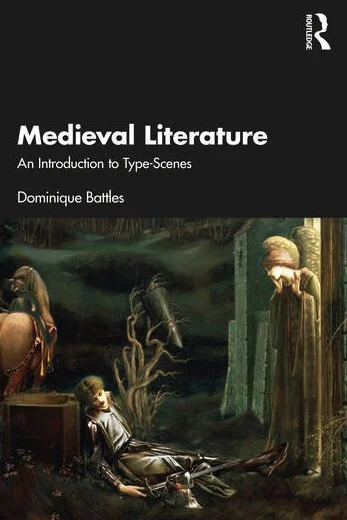
Whether it's an action movie or a romance novel, everyone loves a new story. But we also love having some idea about how it's likely to play out. Medieval authors also played with novelty and predictability, relying – as we do – on a device called type-scenes. This week, Danièle speaks with Dominique Battles about what type-scenes are, how medieval authors used them, and why we still love them.
-
Danièle Cybulskie:
Hi, everyone, and welcome to episode 365 of The Medieval Podcast. I’m your host, Danièle Cybulskie.
It’s a truth universally acknowledged that human beings love storytelling. And while we love a new story, we also love it when we have some idea about how that story is likely to play out. If we pick an action movie, or a romance novel, we know to a certain extent what we’re in for, and it’s that very thing that helps us relax and enjoy the ride. Medieval authors also played with this sort of novelty and predictability, relying – as we do – on a device called type-scenes.
This week, I spoke with Dr. Dominique Battles about medieval type-scenes. Dominique is a professor of English and Medieval Studies at Hanover College, and the author of The Medieval Tradition of Thebes and Cultural Difference and Material Culture in Middle English Romance: Normans and Saxons. Her new book is Medieval Literature: An Introduction to Type-Scenes. Our conversation on what type-scenes are, how medieval authors used them, and why we still love them is coming up right after this.
Well, welcome, Dominique. It is nice to meet you, and it's nice to be talking about literature, which is how I got into medieval studies. So, welcome to the podcast.
Dominique Battles:
Thank-you for having me, Danièle. This is – I've been looking forward to this.
Danièle Cybulskie:
Oh, thank-you. So, we're talking about a book that you've written about literature and how there are pieces of literature that sort of fit in that we see a lot, called type-scenes. So, what are type-scenes?
Dominique Battles:
Well, type-scenes are recurring scenes. You've seen them before. So, they're recurring scenes that convey meaning through a predictable configuration of characters, setting, and action. And these elements of character, setting, and action are, themselves, predictable. And I can assure you, even if your listeners have never heard the phrase type-scene, they know what a type-scene is from the popular movies that we all love and watch. And my students, for example, are really into action and adventure movies. And if you think of a typical action and adventure flick, you always have, for example, a Chase Scene.
Danièle Cybulskie:
Mmhmm.
Dominique Battles:
So, it might be this is a chase where the good guys are chasing the bad guys, or the bad guys might be chasing the good guys. And it could be a car chase, it could be a motorcycle chase, it could be a space cruiser chase, it could be a foot chase. It might happen in a city street, it might be over the rooftops of a city, it could be in a parking garage. But you always get the chase, and the purpose of the Chase Scene is to intensify – to raise the stakes, if you like. To give a sense of whatever the story is about. It's super important and there's a lot at stake. And other type-scenes that you would get in an action movie would be the Arming of the Hero, where the good guy is suiting up and equipping himself to sort of confront the bad guy. You get explosions – they're very common. You get a Showdown between the good guy and the bad guy where they have this big face-off. And so, those are all type-scenes. And our movies are full of it.
Danièle Cybulskie:
Yes.
Dominique Battles:
And medieval literature is full of it. And not just medieval literature, but classical literature is full of it, and Renaissance literature. So, these are the building blocks of all literature, these type-scenes. Now, I would make a simple distinction between contemporary uses of type-scenes in movies and medieval uses. And that is, oftentimes, a director and the screenwriter – they'll use type-scenes. And of course, they always vary them up in some way. And oftentimes, in popular movies, I feel the variations are motivated by simply a desire to be different – to introduce novelty – and there's nothing wrong with that, of course. But in medieval literature, there's much more intentionality behind the variations on the type-scene, and so these type-scenes actually are varied in such a way that encode into the scene whatever the major themes are, or major values are, at play in the work as a whole. Those get encoded and embedded into the scene. So, each of these scenes, in a nutshell, distills the main values and themes of the entire work. And it's not just one of the type-scenes: it's all of the type-scenes in the work will reaffirm, and reaffirm, and reaffirm the same message. So, there's much more deliberate artistry in the medieval use of type-scenes than I would say in popular movies. But – so, both of them are using variation, but for different reasons.
Danièle Cybulskie:
Yes. Well, them's fightin’ words, right?
Dominique Battles:
Yeah.
Danièle Cybulskie:
We're going to have the film students up in arms. But I'm glad that you brought this up because one of the things – and I don't know if you came across this when you were studying literature in university – there's a thing that happens where people are like, medieval stuff is just too formulaic, and it's boring, and nothing good happens. Well, the Greeks are amazing. The Middle Ages is too formulaic. Yeah. And then nothing good happens until the Renaissance – you know, the capital R Renaissance. And I… I don't think that that is true. There's so much to love about medieval literature. But I love that you brought this out because we still love our type-scenes, and we find a lot of comfort and enjoyment in them – like you're saying – in… in movies like this. So, I'm glad that you brought this up because this is something that gets thrown at the Middle Ages whenever you're studying literature, I think.
Dominique Battles:
Absolutely. And I think the formulaic nature of type-scenes – and they are formulaic. They are, by definition, formulaic because they recur over and over in the same way that a wedding – weddings are formulaic, right? There's a familiar choreography, there's a familiar costume, there's a familiar script, exchange of vows, and the whole thing. But every wedding is different because the people are different, right? And their families are different, and their lives are different. And so, it's true that type-scenes are formulaic. But one of the things I'm trying to emphasize in the book is that medieval poets participated in a tradition where these type-scenes became – are the foundational elements of narrative. However, they use these type-scenes as engines of innovation. So, you get creativity and ingenuity by means of the tradition. So, just because they are using the Arming of the Hero, or using the blason of the beautiful heroine, it doesn't mean that it's therefore rote in any way. They're using it in such a way to introduce a new vantage, or a new meaning, or a new perspective. And if we just take the time to dwell with the scene for a little bit, we can see the newness that is coming through the traditional element.
Danièle Cybulskie:
Yeah.
Dominique Battles:
So, tradition and innovation are actually working simultaneously through these types of scenes.
Danièle Cybulskie:
Yes, exactly. I think medieval literature is very sophisticated, and again, we're going to get to these things in a minute. I always like to set things up for our listeners first. And so, one of the things that I want to sort of bring out, because it'll probably come up later, is that when we talk about medieval literature, most of us who study this put saints' lives – put hagiography – often under the same umbrella, and part of that is because of type-scenes, right? So, it's not about the story of the saint. We don't have to, like, get into whether this saint is real or not, but the way that people tell the stories of the saints also have these type-scenes, right?
Dominique Battles:
Mmhmm. Very much so. I include two of those type-scenes in the book, and one of them is the Inventio, which is a standard feature of a certain type of hagiography. And that is – the Inventio is the discovery of the relic remains of a saint. So, the first time a tomb is opened, and the remains of the holy person are seen, either in the form of an incorrupt body, or they're seen sort of glowing with a holy light. And so, the Inventio essentially signals the presence of a saint. And then, that's usually the beginning of the Translatio scene, where the relic remains are then disinterred. And then, this is the start of the cult, where they are reinterred with greater honor. So, that's one of the scenes that we have in there. And the other one is one that I sort of named because it lacked a name, but I felt it was an important scene all of its own that deserves to have a name all its own. And that is the Crowd of Onlookers.
Danièle Cybulskie:
Mm-hmm.
Dominique Battles:
And this is a scene that you get in martyrdom narratives, where usually, toward the end of the saint's life, you see a saint who is being persecuted and effectively killed. And there's a crowd of people who are faceless; anonymous. We don't know anything about them. They're there to be numerous. And they're there to, in unison, using a single voice, to express anguish over the suffering of the holy person. And there, what they're doing is they're modeling for the reader the appropriate response to Christian suffering. So, they're… they're prompting us to have the same emotional reaction to the saint that they do. And so, those are two that I include in the book because I felt like it's… they are forms of narrative and they do use their own formula. And we recognize that when we see a hagiographic element in, say, a romance, we recognize it because of the, the formula, if you like, of the saint's legend.
Danièle Cybulskie:
Yes. And like you're saying – well, we're going to get into fiction in a second – but like you're saying, this is using these type-scenes together and using innovation in them is meant to sort of reiterate themes, or emphasize themes. And that really works well in something like a saint's life because having these really familiar scenes – it's not something that sort of flattens the story of the saint. It's something that reinforces it, right?
Dominique Battles:
Oh, absolutely. And honors it, too. Every time you have an Inventio scene, or a Crowd of Onlookers, you're honoring, again, the holy person. And that's the purpose of the scene: to recognize them as being unusual and worthy of our sympathy and veneration. Yeah.
Danièle Cybulskie:
Yeah. And I wanted to bring this out because I think that hitting those notes again… I think when people are listening to this, they're going to be thinking about their favorite genres, and how hitting those notes can be really, really reassuring, and just feel really good. And when you hit those notes again, you want to see what the author is going to do with that. And so, this is… this is something that is really familiar to us. And it's one of, I think, the ways that we, as humans, enjoy storytelling: that sort of familiarity that builds.
Dominique Battles:
Absolutely. And, you know, in contemporary writing, when writers violate expectation – because all of these type-scenes introduce a series of narrative expectations of what the experience is likely to be like – when writers, or film directors violate those expectations, people actually feel dis-ease.
Danièle Cybulskie:
Mmhmm.
Dominique Battles:
We don't like it. There's something consoling about the rhythm of the formula, but the formula done differently so that it's… it's familiar and it draws us into an experience that we expect, but it's unfamiliar in that it introduces sort of novelty, and newness, and freshness.
Danièle Cybulskie:
Yes. I'm thinking about how romance novels are some of the biggest sellers in the market and have been for such a long time. And that's because people really enjoy that sense of security that you get from, like, we're going to hit the same notes around the same time, and that feels good. But we want it to be different.
Dominique Battles:
Yes. And we're so delighted when there's something new and fresh. We just think, ah. It just reaffirms how wonderful the genre is. Yes.
Danièle Cybulskie:
Let's… let's bring this to medieval literature. And I think – we were talking before we turned the microphones on – we both really love, like, that romance literature, and things like that. So, maybe I'll invite you to pick out some examples that you like, and you can walk us through some of the type-scenes that we find in a work that you particularly like – or that's particularly fresh. Because we were saying, you know, it's a long time from when you write a book to when it comes out.
Dominique Battles:
Yes, that's right. Well, I'm equipped with my notes, here. So, one that readers will have no doubt encountered many times – and it's also a type-scene that carries over well into later literature, into the Renaissance, into the 19th– 18th century, 19th century, and even into our own day – is the blason. And the blason is a formal, head-to-toe description of whichever character is going to be the driver of the plot. So, it can either be – it's most often the beautiful heroine that the hero is going to fall in love with.
Danièle Cybulskie:
Mmhmm.
Dominique Battles:
And in orienting toward her, and falling in love with her, he's going to become a better man. He's going to grow as a result of being in love with her, and proving himself worthy of her love. It can also be, though, a head-to-toe description of the monster that the hero will have to contend with going forward into the narrative. So, the blason really functions as – it triggers the orienting response, and it functions as a big arrow. This is the person that you need to be focused on. The hero is going to be focused on her, or it – whatever it is. And you get blasons all over the place in romance, but again, they're always varied in some way. So, for example, a very… a very famous one, it occurs in Yvain – and we just talked about this in class – where Yvain sees Laudine for the very first time. And we get this description of her beautiful hair, and her eyes, and her cheeks, and her nose, and her lips, and her neck, and her beautiful shoulders, and her arms. And there's this – it's a catalog of the woman's physical beauty. And he sees this beautiful woman. But the thing is, she doesn't – she's not beautiful at the moment. She's a wreck. Her husband has just been killed. She's crying. Her hair is disheveled. She's been scratching her face. She looks terrible. However, Yvain sees beneath the distress, and he sees only her beauty. And this is what these romances are all about: the knight being able to see beneath the surface, and to see the beauty of the woman within, and his being able to sort of discern subtler things than just physical description. And so, this is the beginning of his orienting – reorienting – toward her, and the rest of the story is about him proving himself worthy of her. Well, we get a wonderful variation of a blason in Chaucer's Book of the Duchess, where – this is a poem that commemorates the death of Blanche of Castile, who is the wife of John of Gaunt, and she seems to be the… the Blanche of the poem. And so, the dreamer encounters this Black Knight who is lamenting the loss of his love, and he starts describing this woman. Well, typically, you know, a blason is a still life of the woman's physical features, and it tends to be short. Maybe ten lines, twelve lines, you know, fifteen lines, something like that. But it tends to be a brief description that simply orients the reader. What Chaucer does is he expands the blason so that it lasts for 143 lines – not ten lines, but 143 lines – and he circles back to details of her hair, details of her eyes, or details of her mouth. So, it's the longest blason that I know about. But not only that, Chaucer doesn't just sort of describe her beautiful hair, or beautiful eyes, or a beautiful mouth, but how she uses her eyes to cast very loving and kind glances at people to sort of convey compassion; how she uses her voice to speak eloquently, and truthfully, and kindly, and compassionately toward the people around her. And so, he… he uses the blason to give us a sense of who she was as a person, how she used those physical features. And then he also… He ends the blason there, as well. Oh, and, you know, he also uses the blason – the Black Knight speaks about how she dances, and how she laughs, and how she plays. And, and so what Chaucer is doing is he's infusing movement into what is typically a frozen, still – a still life, essentially, of the woman. He infuses movement into it, and, really, in doing that, what he's doing is raising the dead Blanche. He's using his artistry and the blason device to bring the dead back to life, which is his virtuosity, if you like, as a poet. And then, of course, this is a blason not of the woman who will be the future love interest of the hero, but this is a blason of a dead woman, who represents a past relationship that's now gone. So, those are wonderful variations that you get on a formula, right? Lots of variation within the formula.
Danièle Cybulskie:
Yes. And so, you're expecting to see this showing up in a poem, but the way that it's done is going to be completely different. And as you say, when you settle into sort of – I don't think that this is often very conscious, except for maybe for you who study this all the time – but when you're settling into, okay, this is the moment where we're going to get the description, or, you know, this is that particular montage-type thing, then when you settle into it, then it's almost like that comfort allows you to explore and appreciate these things that are different – like that it's going to be longer, that it has movement in it. And so, yeah, that richness really comes out, and it is why so many medieval scholars are obsessed with Chaucer.
Dominique Battles:
Yes, and Chaucer – that's one of the signature moves of his when it comes to type-scenes. He will take an element, and he will put it on steroids, and he'll expand it out, and it becomes so much more. He makes that one little element do real work, and that's typical of Chaucer.
Danièle Cybulskie:
Yeah. So, one of the things that Chaucer does – one of the type-scenes that he uses – is catalogues. And I want to get at Catalogues of Warriors in a second, but it's occurring to me when you're talking about him working within structures and changing them, that he likes to list things for way too long to give you some comedy. Like, I think he was listing trees once and it went for a really long time. I was talking with Tyson Pugh about this.
Dominique Battles:
Yeah.
Danièle Cybulskie:
But I want to talk about Catalogues of Warriors for a second, because I think this is something that really crosses genres, again. Like, sometimes when we're talking about literature and medieval studies, we're like, do chronicles count? Because there is this sort of literary device where – there's a type-scene where – you're cataloguing the warriors. So, can you tell us about this type-scene?
Dominique Battles:
I can, yeah. So, the Catalog of Warriors is essentially a listing of the warriors who are showing up for both sides of a major conflict. And you get a Catalog of Warriors at Troy, you get a Catalog of Warriors at Thebes, and we get a Catalog of Warriors in The Knight's Tale, for example, with the two sides of Palamon and Arcite. And the purpose of the scene is really – it's like a long drumroll, if you like, of: this is going to be a major event. Everyone who's anyone is going to be there. And we get introduced to all the major players on either side. And typically, it's a showing up of the best and the finest of talent, if you like. What's interesting in The Knight's Tale is the Catalog of Warriors who show up for Palamon and Arcite. All of them – or almost all of them – are showing up from the remnants of the Theban War. So, it's not so much a catalog – it turns into not so much a catalog of who is there, but a catalog of the only people who are left after the war is over. It's almost a catalog of loss and absence, and that's an unusual use of the catalog. And then also the commanders who are there are deeply disturbing characters. They're not men who you would admire, but men who give you the creeps, in a way. And so, he uses what should be a big, impressive scene to give a sense of unease, you could say, and also of absence as opposed to presence.
Danièle Cybulskie:
Well, I like what you're getting at here where you're talking about type-scenes – and they're not just plot points. Often, they are there as something to emphasize. And this is something that you say right at the beginning of your book where it is about thresholds, and it's about emotion. And so, again, thinking about something that people will have seen for themselves if they're not familiar with medieval literature is – I'm thinking about The Avengers, right? Before they have a big old battle – and they keep adding more characters to each of these movies – they have to line them all up, right? And they have to do their, like, signature move.
Dominique Battles:
Right.
Danièle Cybulskie:
You have to see, like, that they are there. And it's not there for plot, but it is kind of essential, because you can't just go straight into a battle. You need to ramp up the tension, as you were talking about: Chase Scenes raising the stakes. And this is definitely something that you see in medieval literature. As you're saying, it's building emotion. It needs to be there.
Dominique Battles:
Right. Exactly. And we see this also in sports matches. For example, you know, if you watch the Olympics, I mean, here comes the, you know, the team – the Olympic team – for track – for women's track – from Canada, and you get to see one at a time they're introduced, and it's a Catalog of Warriors. So, we know what this is.
Danièle Cybulskie:
Yes, thank-you for that.
Dominique Battles:
Yeah.
Danièle Cybulskie:
Yes, go, Canada.
Dominique Battles:
Yeah.
Danièle Cybulskie:
But you do see this in chronicles as well. Like, they're lining up for the Battle of Crécy, or something, and they're like, here's who was there, and it needs to be listed. And I'm thinking about this poem that Michael Livingston's worked on quite a lot that reminds me of what you're saying about Chaucer, where it was sort of a list of the people who were lost at Crécy. And so, like, using this sort of backwards and forwards really builds emotion. That's a dream written by a herald, he thinks. But, like, using this across genres – it's the same type-scene. It's very important to get your point across.
Dominique Battles:
Yeah. And there's – and chronicles are surprisingly literary. And literature draws a lot on chronicles because there is a lot of overlap in things like – not just Catalog of Warriors, but Conciliar Debate. In chronicles, you're going to have, you know, the commander will assemble several advisors to say, well, what should we do? And one side will say, we go, you know, we double down with the war. And somebody else will step over and say, we should use diplomacy. We should sue for peace now. And that's a standard type-scene that you get in chronicles. And there's a lot of borrowing in literature from chronicle accounts. So, one of the – a project that I did some years ago was looking at Floris and Blanchefleur. And where Floris is infiltrating the city of the Emir, where – Babylon – where, you know… where Blanchefleur is being held. And it borrows from – ultimately – from a chronicle account of the First Crusade. Of the Siege of Antioch. And so, there's a lot of borrowing – cross-borrowing – all the time. Yeah.
Danièle Cybulskie:
Yes, which makes medieval studies the least boring, right?
Dominique Battles:
I would agree. I would agree.
Danièle Cybulskie:
Take that, literature scholars.
Dominique Battles:
Yeah, exactly. Yeah.
Danièle Cybulskie:
Alright. One of the ones that – having kids myself – that comes across in youth literature, especially, that's – like, in contemporary literature that I'm thinking about right now – is something that really comes across in a lot of medieval literature, as well, which is the Rash Promise, where, like, someone says something and you're immediately, like, we can't. No, don't do it!
Dominique Battles:
Yes, exactly. Yes, the Rash Promise. The promise is a wonderful one. And it's – again, it's a type-scene. And it tends to be where a more powerful person will try – a magical person, for example – will try to get a mortal to make a promise to them. And of course, they end up breaking the promise.
Danièle Cybulskie:
Mmhmm.
Dominique Battles:
And so, you see that, for example, in Marie de France's Lanval, where the fairy princess gets Lanval to promise her that he will never disclose her identity. And of course, he breaks the promise later on. And what's interesting there is that you have two types of Rash Promises, one between a man and a woman, and those are always broken.
Danièle Cybulskie:
Yes.
Dominique Battles:
But then you also have this style of Rash Promise between two men, and those are always kept. Right. And you see one of those in Sir Orfeo, where Orfeo – who's actually not the more powerful person, but he's trying to get the more powerful fairy king, or the fairy king who's in a more powerful position at the moment – he lures him into saying, well, if I play for you, can you give me whatever I want? Can I? I'll take whatever I want. And the fairy king says, you know, you take whatever you want. He says, I want the woman. I want Eurydice. And so, he's able to – as the weaker man in that moment – he's able to use the Rash Promise to sort of turn the tables; to flip the tables on the fairy king. And that's where his comeback begins.
Danièle Cybulskie:
Yes.
Dominique Battles:
So, yeah, the Rash Promise is a fascinating one. And those scenes often can overlap. So, in Sir Orfeo, for example, the Rash Promise scene actually overlaps with the Disguise and Infiltration scene. So, sometimes they can occur together.
Danièle Cybulskie:
Yes. Well, I'm thinking about the Rash Promise being something that is typical, but something that really stands out in a poem that is my favorite – and we were just talking about before we turned on the microphones – is Sir Gawain and The Green Knight, because he has several Rash Promises, and it's when they collide that is the problem. And so, taking, again, as we're talking about these type-scenes and working them together, really, I think, makes something wonderful in that poem.
Dominique Battles:
Yes, very much so. There are lots of wonderful type-scenes in Sir Gawain and the Green Knight. There's, you know, the blason, but not of the beautiful woman, initially: it's of the monster. That's another one. And then you get a double blason of the Lady Bertilak and Morgan le Fay later in the castle. The Gawain poet uses type-scenes in very unusual ways. And you also see the Rash Promise also overlay with the Loathly Lady encounter.
Danièle Cybulskie:
Yes.
Dominique Battles:
Which is another type-scene, so that the loathly lady says, well, I will give you the answer to the riddle if you promise to give me your love and to marry me. And he thinks, well, to save my life, sure, I'll do, you know, whatever you ask. Or often, it's a blind promise. He doesn't know what she's… she's asking him to agree to. She just says, will you give me what I want if I give you the answer to the riddle? He says, sure. And then it ends up becoming – having a hold on him. Very much so.
Danièle Cybulskie:
Yes, because you are tied to these promises as a knight. And I think that this is… this is one of the reasons why I think these promises go with stories of knighthood, right? So, you don't see Rash Promises – I can't think of one in saints' lives, but you see them when it comes to knightly behavior because this is also, in a way, supposed to be teaching you something. These type-scenes are not just for enjoyment, but also teaching something.
Dominique Battles:
Right. Keeping your word. And you can either – in Sir Orfeo, for example, that's the way he convinces the fairy king that he should honor the promise, because he said, well, a king has to keep his word. And so, here's, you know, a king in disguise telling another king – advising a king – on how to conduct himself as a monarch. And so, he uses it as a reminder. But also, it's a reminder that gets honored because the fairy king agrees to give him Euridice.
Danièle Cybulskie:
Yes. Yeah. And it all works out happily ever after, right?
Dominique Battles:
Right.
Danièle Cybulskie:
Totally.
Dominique Battles:
Yeah.
Danièle Cybulskie:
Well, I want to bring one last type-scene up that I think is really important and is the literature that many people are familiar with when it comes to the Middle Ages – which is earlier than both of our periods – but it's Beowulf. You bring this out as using virtuosity by hitting the same type-scene over and over again, which is something really familiar and satisfying in storytelling, right? Hitting the same note, but doing something different. And for you, this type-scene is Joy in the Hall. So, tell us about how the Beowulf poet uses this.
Dominique Battles:
Ah, I will turn to that. I have my book here.
Danièle Cybulskie:
I may have set you up. I don't know.
Dominique Battles:
I thought you were going to say Sleeping After the Feast.
Danièle Cybulskie:
Yeah, we could say Sleep– we could go in that direction.
Dominique Battles:
Okay. Yeah. Because that's one that your readers will certainly be familiar with. So, I have one of the – in part two of the book, I have three chapters on unusual sequences of type-scenes. And the third of those chapters has to do with the type-scene of Sleeping After the Feast. And it's a type-scene that involves three main elements. One is feasting, followed by sleeping, followed by danger striking. And typically, in a poem, a poet will use a type-scene once. So, for example, once you introduce the beautiful woman with a formal blason, you don't have to introduce her a second time, or a third time, or a fourth time. Once is what you get. Or, you might get a single instance of a Catalog of Warriors , as we talked about. But what's interesting with the Sleeping After the Feast is that the Beowulf poet uses it six times – the same type-scene, six different times within the poem – with a suggestion that there have been countless iterations of the same type-scene for the twelve years where Grendel has been attacking Heorot.
Danièle Cybulskie:
Mmhmm.
Dominique Battles:
So, we see the first major instance sort of in real time with Grendel's attack on Heorot, and we get Beowulf's arrival, of course, with his men. There's feasting the night before, they all go to sleep, and then danger strikes as Grendel attacks the hall. And Grendel is relying on the scene working the way it always does, because he's been doing this for twelve years. He's been attacking at night, after they’d feasted and gone to sleep. But Beowulf, himself, violates the formula of the scene because he stays awake. And that one difference makes all the difference, because it puts an end to Grendel's attacks. And the Beowulf poet uses those – the elements of feasting, and sleeping, and danger numerous times throughout the poem, but in different configurations. So, that each time it occurs, you recognize the formula, but he's doing it in ever more ingenious ways. And I think what he's doing there in repeating it, and repeating it is giving us a sense of infinite possibility using finite means.
Danièle Cybulskie:
Yeah.
Dominique Battles:
And there's this beautiful virtuosity of how many: how many ways can I use this type-scene and take you by surprise? And so, I think that's what's happening there.
Danièle Cybulskie:
It's funny because as you're talking, I'm thinking there's nobody who reads Beowulf – I think the people who love it – no one who reads it that says, oh, my gosh, they're sleeping again. Like –
Dominique Battles:
Yeah.
Danièle Cybulskie:
Because it's – you know, it's going to be different. You know, it's… something is going to happen. And again, it builds that tension that you're expecting in the repetition. As you… as you say, it really shows the virtuosity of the poet, but it also ramps up the tension every single time. Well, I really appreciate your being here and helping me, like, think back to all the literature that I've known, and read, and loved over time. So, maybe as we finish up, you can tell the listeners about how knowing this doesn't detract from the enjoyment of it, right? Because I think sometimes people… people will say to me, like, how can you think about literature while reading it? Doesn't it ruin the enjoyment? Tell us about type-scenes and how it doesn't.
Dominique Battles:
Oh, definitely. One way that I like to think about type-scenes and when I'm working with type-scenes is, you know, if you think of – you borrow a metaphor: craft – you're really working with hand tools when you're working with type-scenes. You're working very close to the materials, you're working slowly, and you're studying the artistry of the poet because these are structural narrative units. You're studying, essentially, the vernacular architecture of the whole poem, the scenes around which the whole story is built. And I would say that, you know, we live in an age – of course, as we know – of tremendous power tools, and literary theory of various kinds being those power tools. And those can… can help us do great and wonderful things, but type-scene analysis is more like working with hand tools. And it's as much an exercise, I think, in appreciation as an exercise in interpretation.
Danièle Cybulskie:
Yes.
Dominique Battles:
And I would like readers to have a sense that, you know, yes, type-scenes are, you know – they're modest, and they're unassuming, and they're not very fashionable. And when you're working with them, you are working slowly with hand tools. But I think there's – I hope the book gives readers a sense that there's so much you can still learn and do, and so many wonderful insights that you can have just working with hand tools, and working slowly and very close to the poem itself.
Danièle Cybulskie:
I love that because it is about appreciation. And I think that there is more of that sort of in film studies now. People will look at a type-scene or an element that repeats itself and appreciate it. But I think that gets lost with medieval literature. So, I'm so glad you were here to tell us all about it. So, thanks, Dominique, for being here.
Dominique Battles:
Oh, you're welcome. It's been a joy, Danièle. Thank-you so much for inviting me.
Danièle Cybulskie:
To find out more about Dominique’s work you can look her up on Google Scholar. Her new book is Medieval Literature: An Introduction to Type-Scenes.
This week, I was rereading one of my favourite sources: The Chivalric Biography of Boucicaut, Jean II Le Meingre, translated by Craig Taylor and Jane H.M. Taylor. Boucicaut was that knight who took on all comers in a month-long jousting event, created an order to protect ladies, and famously could somersault and dance in full mail. But even someone as legendary as Boucicaut had his fair share of haters – a good reminder for us all, and one that his biographer is at pains to stress. He writes, “you who read this book should note that no-one can be so perfect in word and deed as to be universally beloved.” So, if you’re worried about being judged this week, remember that haters are just gonna hate, so get out there, and dance in your armour like nobody’s watching.
You may have heard me talk about Boucicaut on This is History Presents… The Glass King last year, and if you loved that, then good news. Because next week, Dan Jones is coming to Toronto and I’m hosting, which means a Glass King reunion, and an all-round great time. If you’re in or around Toronto on November 10, come see us at the Church of the Holy Trinity downtown, where Dan will be launching his new book Castles: A Fortified History of the World. Check out benmcnallybooks.com or my Patreon page for the details. I’m looking forward to seeing you there!
And speaking of Patreon, this is a good moment to say a special thanks to everybody on Patreon who has been so supportive with your messages and your patronage this past week. I’m not going to rehash the details here – you can read my posts if you choose – but I’m so very grateful for all the love and support you’ve shown me. It is so appreciated. If you’re interested in joining the Patreon community, please visit patreon.com/themedievalpodcast.
For the show notes on this episode, a transcript, a list of the books featured on The Medieval Podcast, and more, please visit medievalpodcast.com. You can find me, Danièle Cybulskie, on social media @5MinMedievalist.
Our music is by Christian Overton.
Thanks for listening, and have yourself an amazing day.