



The Medieval Podcast uses affiliate links
Episode 367
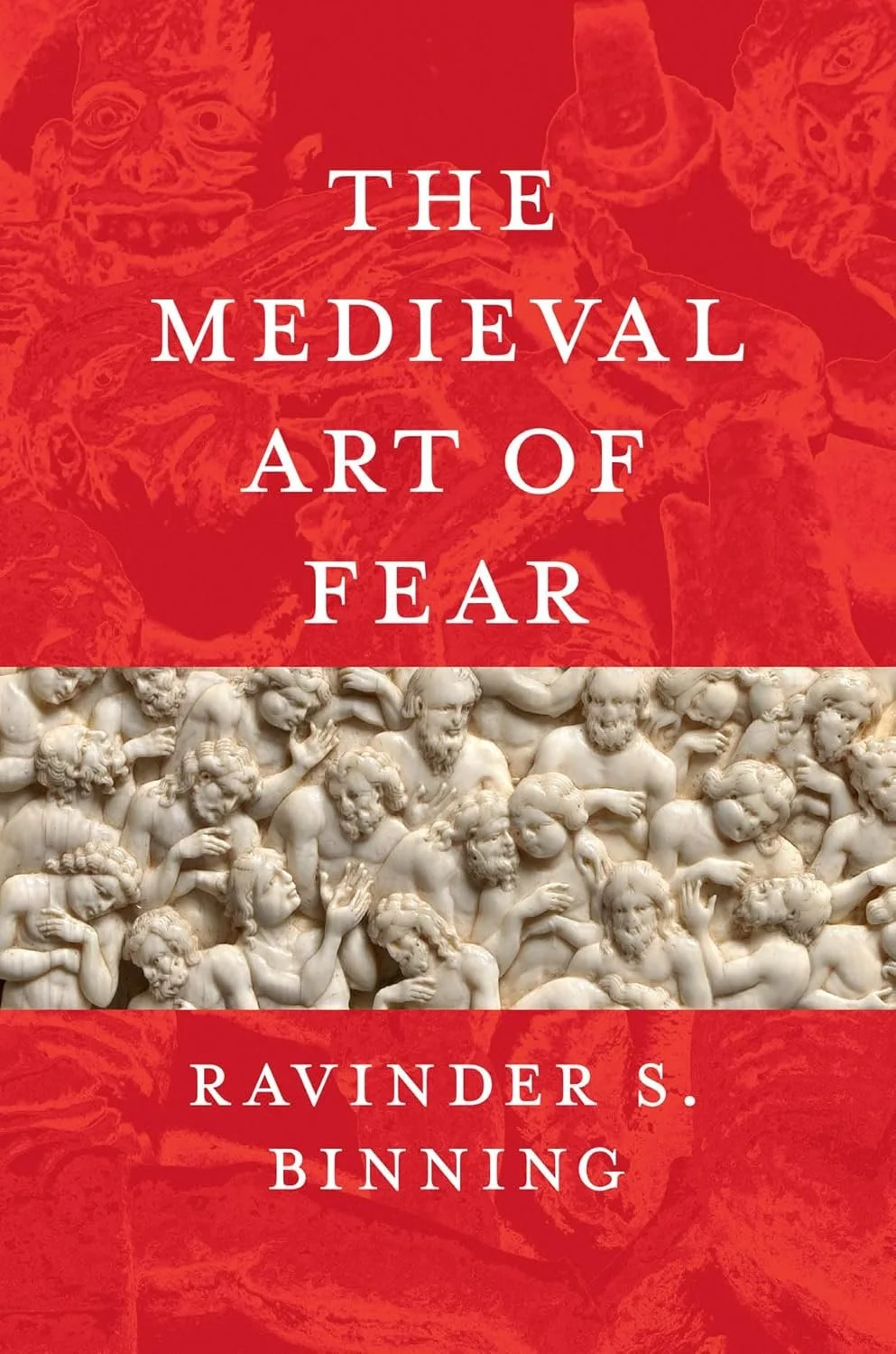
As we've seen this year, medieval artists sought to inspire raw emotion through literature, music, architecture, or telling stories about the terrors of hell. In this episode, we look at the way visual artists worked their magic to inspire fearful contemplation in their viewers. This week, Danièle speaks with Ravinder S. Binning about why medieval artists played with the concept of fear, how they achieved this, and why we should look again at medieval art.
-
Danièle Cybulskie:
Hi, everyone, and welcome to episode 367 of The Medieval Podcast. I’m your host, Danièle Cybulskie.
We’ve spoken on the podcast a few times this year about the way medieval people inspired raw emotion in their fellow humans, whether that was through type-scenes, musical and architectural prowess, or by telling stories about the terrors of hell. This week, we look at the way visual artists worked their magic to inspire fearful contemplation in their viewers.
This week, I spoke with Dr. Ravinder S. Binning about the art of fear. Ravi is Assistant Professor of Medieval Art at SMU, and the author of several works on medieval mysticism, art, and affect. His new book is The Medieval Art of Fear. Our conversation on why medieval artists played with the concept of fear, how they achieved this, and why we should look again at medieval art is coming up right after this.
Well, welcome, Ravi, to The Medieval Podcast. We've already been having a great chat, and it's time to turn on the microphones and let other people into it. Welcome to the podcast.
Ravinder Binning:
Thanks so much. Happy to be here.
Danièle Cybulskie:
So, we are talking about medieval fear today. Maybe we should have done this in October, but we're doing it now. What kind of fear are we talking about? Are we talking about things that go bump in the night?
Ravinder Binning:
Not particularly. Fear, as I explore in the book, is kind of understood as its own condition, as a psychological – or maybe better – psychosomatic condition that was actively pursued by people. So, it's not an everyday fear. It's a kind of mystical fear that people were actively trying to obtain through meditation, through close reading and acts of memorization, but also – and most importantly for me as an art historian – through engagements with works of art and architecture.
Danièle Cybulskie:
Yeah. And what they're looking for is a big experience, right? So, not just I'm watching a horror movie on TV, right? But that sort of mystical experience that you're mentioning, right?
Ravinder Binning:
It's a fear with a kind of capital F. And throughout the book, there's a sort of subtext that it's almost an erotic – or something physical, or maybe you could see it in an economy of eroticism on the other side of what we might think is erotic.
Danièle Cybulskie:
Mmhmm.
Ravinder Binning:
And that's where it gets into sort of asceticism and extreme events of the body. That's from what I could parse in the medieval archive. That was what was being pursued.
Danièle Cybulskie:
Yeah. And I think for people who are new to the medieval world, they might find that a little strange. I mean, if you think about things that we tend to look at as things that inspire fear now, like vampires, there's always a bit of fear and eroticism there, right? But when it comes to the Middle Ages, you see that in the spiritual space, which I think people might not expect so much.
Ravinder Binning:
Totally. And I think we… we might think of, like, the gargoyle in medieval fear. Something like that. Or, the medieval monster in a manuscript. And that's certainly a way to think about things like deformity and terror, as well. But this had something to do more with a kind of mysticism in certain ways coming out of the ancient Greek tradition, as well. What got me into it was I started in art history – before being an art historian, I was into classics. In high school and college. And part of what's compelling about Byzantium is that you have the long march through the medieval period, but also, of these terms from ancient Greece. So, phobos. You read Homer and these terms are already there, and they get kind of transposed onto Christian contexts by artists and poets. So, that really interested me. So, there's this aspiration. It's almost a poetic effect, as well, if that makes sense.
Danièle Cybulskie:
Yeah. So, let's start at the beginning to give people a sense of how this is both embodied, and sort of spiritual and mental at the same time.
Ravinder Binning:
Embodied is the word. Yeah.
Danièle Cybulskie:
Yeah. You start with the Holy Forty. Why start there?
Ravinder Binning:
Right. The book takes as its kind of point of departure this ivory carving that shows these martyrs that are freezing on a lake. And it's a really strange picture. You have forty men shivering on a lake. And we have two ivory carvings that are really extraordinary, and they're from the court in Constantinople – so really, the best of the best. And if you look closely at these ivory carvings – I mean, they're virtuosic in how they treat the body, they treat the form, and they even evoke an atmosphere in ivory, which is not easy to carve. And it gives this tactility to these suffering men on this lake. And I was really struck by this image because why would the Byzantine emperor enshrine, basically, in such an expensive material, this very disturbing scene, and catching a martyrdom? So, it was just strange to me that – because I'm working on Greek material in this book, Byzantine material – that's the only scene where you have a martyrdom. You know, in other words, you got, you got images of saints like Theodore, or saints like Demetrius, but you don't actually see them dying. For some reason, there was something significant about these saints dying, and so much so they had to put it in like the best material. So, I looked closely and then it dawned on me. And you have these eureka moments as a scholar. The bodies are doubling as something else. They're shivering, but they're also kind of, like, actually expressing an embodied state of horror, of panic, of anguish. And I wanted to know why. These gestures were almost presented as divine. It's such a negative idea to the modern mind and how this basically mystified all of these gestures. So, that's where the fear point took off. And it turned out that the more research I did on that, the ivory actually poses the bodies as a kind of ideal – as a spiritual ideal, as a somatic ideal. The emperor himself was trying to emulate – in acts of meditation – these martyrs who received purification, right? So, that, you know, a martyr dies freezing on the lake. The Roman emperor is like, you guys didn't turn back to paganism and, you know, do sacrifice. You wanted to remain Christian, so we're going to execute you in this horrible way. But the whole – without getting too into the details – the whole martyrdom story is they eventually find purification, which is katharsis.
Ravinder Binning:
So, these ivories kind of became paradigmatic of the whole book: that fear leads people to katharsis. So, you get this climactic experience of terror that leads to actually a feeling of spiritual purification. And again, we're still in this economy of Greek thought that cuts before and below Christian thought. So, that's – I was really lucky to get this paradigm out of that ivory object and then be able to surf across other spaces and times, and see that people were cultivating fear as a kind of almost alchemy of the self, if you think about it that way, that, like, the coldness that people get from an experience of terror was almost like this holistic medicine. Does that make sense? Like, it's that – so that's where it was like a medicinal experience. It was just— it became stranger and stranger to our own modern idea, and it went from this kind of medical experience, or the psychological experience, to something that was simulated in aesthetics.
Danièle Cybulskie:
Yeah, absolutely. And it's interesting the way you're connecting this back to Greek tradition – into the classical world – because, I mean, anyone who's heard the word katharsis has heard of Greek theatre, right? And this idea that we go through an emotional experience to reach katharsis. This is part of the point. I think Aristotle was talking about that when he was talking about watching a tragedy: this is medical. It feels good. It helps us get to that… that feeling of purification that you're talking about. So, it's interesting to have this – as you're saying – work into Christian ideas of how to interact with the story of martyrdom.
Ravinder Binning:
Right. And it gave us – so, you know, the Aristotelian idea of tragedy and how we have a katharsis of emotion was absolutely at play when I was sort of refining this idea. But at the same time, I didn't want to make it necessarily, like, take that idea too far because then it'd be like, okay, yes, people watch the play, or saw the image, fear leads to this. I was really trying to make it as… trying to surf the complexity a little bit in this object, because then it becomes this idea, actually, where they're talking about fear in terms of bodily thermodynamics, which was what was so strange the more research I did that… because Aristotle says phobos: fear. But the ivory carving gave me an actual vocabulary where There's built into the Greek language is this kind of idea that in states of fear, your body is actually changing thermodynamics. So, that's where the shivering martyrs came in and became a kind of paradigm for this almost, like, medical – late antique medical – idea of fear.
Danièle Cybulskie:
Well, I like this because there are people doing research into how to release things like trauma these days that still talk about shivering as being a really important part of release. So, it's interesting to see all of these things sort of resonate through the centuries. And one of the things you talked about in terms of ivory, because ivory comes up at different points in your book, is that that tactile sense of ivory – the coldness of it – is part of the experience, as well, is what you were thinking, right?
Ravinder Binning:
Right. So, that's a great point. And if we move out of, let's say, the Renaissance, and this is what's kind of – medieval artists – why it's cool, is that we're in these media that aren't the flat picture that we see in the gallery. This is something I'm always talking about with students, is that let's, like, shift our brains away from art having to be this thing on the wall under static lighting. But part of why medieval is fascinating and strange and profound is that it's… it's constantly challenging the senses in ways that like other periods don't. So, you might never think that touching ivory and feeling a cold, bony substance turn warm be part of the aesthetic experience, but it's so essential. And it's just one of the ways this kind of physical immersion with objects gets put into this economy of fear that I'm tracing. Ivory is obviously prized in the medieval world. Some of the best surviving stuff from Constantinople is ivory. And not every image in ivory is meant to induce fear, but some of these objects totally have this paradox between what we would consider this kind of fine, smooth material, but also this grotesque or strange scene. So, yeah, absolutely, the tactile aspect is something that I'm trying to understand in The Art of Fear.
Danièle Cybulskie:
Yes. Well, you've brought up the fact that it's a sensory experience that's supposed to be strange to us, and that it's built that way – especially in the Middle Ages, as we're talking about. And I was speaking with Jonathan Berger earlier this year about domes – about, like, the dome in Florence and how the sound as it bounces around is… is supposed to be in a way disorienting. It's supposed to be a way that inspires fear. And you explore this, as well, too, when you're looking at domes and architecture. So, how does this work with fear in your exploration of it?
Ravinder Binning:
Great. So, yeah, this is also a fabulous point and question. I should say that the whole project began… you know, I was, like, a fourth-year graduate student. The clock was starting to tick. Like, why don't you have a dissertation project? And, you know, I got one when I was looking through – just randomly – books about medieval Cyprus. And there's a dome, an image of Christ in the dome, and around… around the image has this Greek text that says: tremble in fear. That was it, you know? And what was interesting is, is that I was actually working at Stanford with Professor Bissera Pentcheva, who is a kind of leading scholar in studying art and the senses in the medieval world. She was very interested in acoustics and soundscapes. And this took things in a little bit of a darker direction, right? And it was absolutely about this idea that not just the image in the dome would have evoked fear, but the idea of just kind of general disorientation with this kind of psychoacoustic effect, as well. I don't explore that in the book actually too much – the soundscape angle – largely because, for me, this was a book that was about, you know, close reading objects and writing about them. And with that, it's… it's hard to convey that in text, right, without giving an accompanying CD-ROM, which would be a little bit of a throwback. But I think this is a fascinating direction in the field. The idea of sensory immersion and soundscapes. You know, there's a fascinating study even in archaic Greek ritual caves where they were worshiping the god Pan and how Pan – panic – dark spaces echo as a fear-inducing effect. I mean, I also come from a sound art background, so this was something that connected all the dots in a really interesting way. And hopefully, our research will inspire also working artists and musicians to think about their own practices. But as I said, the issue becomes like, how do you reconstruct those… those experiences if you're just trying to write about it in a book? And this is always the problem with… with any kind of sonic description, right? But yeah, I think it's a fascinating point.
Danièle Cybulskie:
Yeah. So, let's talk about your… your people in the book standing under their domes, looking up at the visual effect – or the visual image – that they see there. Tell us about what you're supposed to feel when you're looking up at a visual image on a dome.
Ravinder Binning:
So, one thing that the book confronts, let's say, on a meta level – and I don't want to be too obnoxious with the jumps from the literal to the meta level, but you'll have to bear with me – is the very problem of, like, how does the art historian even posit a medieval viewership?
Danièle Cybulskie:
Right.
Ravinder Binning:
And so, when you, when you ask the question like, what is a medieval person supposed to feel? This is a great question because it cracks open almost the philosophical anxiety that comes with, hey, we want to study emotion or we want to study something that was clearly important to people – this affect. But we're not medieval, and we're never going to be, and we're never going to even get anywhere close to being able to glimpse, also, the simplicity, or, like, the lack of visual noise in a devotional scenario. So, I mean, think about all the images we encounter on a daily basis. It was not… not like that. That was the image. I mean, you know, it's not saying that they didn't have images, but it's not like every ten seconds that we see visual material. So –
Danièle Cybulskie:
Right.
Ravinder Binning:
The point is… is then how does the scholar today account for this experience? And so, when you ask what was the ideal way, I think standing and looking up into the dome is a great example because you actually enter that same physical encounter that the medieval person would have insofar as you're turning, you're twisting, you're bending your neck. You're actually rehearsing an embodied experience in order to get that thing. So, I kind of go ahead and say, well, actually, we can glimpse how it was, and we do experience the same fear and actually physical disorientation unrelated to even any mental processing that someone would have had in order to get those sightlines.
Danièle Cybulskie:
Yeah. And I think these are some of the – they are definitely some of the highest structures that you have in the medieval world. And I think just that sense of height… I know that being in a cathedral like that, it is dizzying when you look up and you realize just how far that ceiling is. And just, like, the small practicalities. Like, it's made of stone and it's way above your head. But there's also the images that are painted on these domes. So, what kind of images have you come across as being painted in a church, for example, but especially on a dome?
Ravinder Binning:
So, you have stone images, right, in architecture, and they have their own, let's say, phenomenological or sensory conditions. You know, you see images that kind of have sharp contouring and… and have a tactile aspect almost amplified in them. But then you have, indeed, pictures or fresco painting, right? In maybe more humble churches where the patron couldn't afford a mosaic, you know. And then, of course, you have mosaics in the dome, such as this extraordinary one about ten minutes outside of Athens’ city limits in Daphne, Greece, which is, like, the supreme example of Christ staring down in the dome. You see him from bust length and he's basically the surveilling God that almost evokes this Old Testament terrible God in an anthropomorphic form. And then you see that reproduced all around the remains of Byzantium – so, Cyprus, other parts of Greece, and so on. And in a sense that they're – I don't want to say that they're imitating mosaics, but the biggest and baddest ones were mosaic. So… And you can see, like, okay, I'm a patron. I want my own private domical church. I will use – I'll get a fresco and play with the space in the same way, right?
Danièle Cybulskie:
Yeah. Well, one of the things that you talk about in the book is this idea of panoptica, right? Where you have, like… God is there and we see him – there he is painted on the dome, or he's in mosaic – and he's looking at you all the time, and you have this sense that you can't be anywhere within the church where you are unseen. And this idea of being watched all the time is meant to invoke some fear, right?
Ravinder Binning:
So, this is also what – the other part of that first object I found when I was sweating to find a dissertation topic. Not only do they say tremble in fear, they call the image pantepoptes in Greek: all-seeing. So, this was also when I was a graduate student, you know, reading a lot of Foucault, and this was, again, just wires crossing. So, you know, it just seemed so crazy to me that I had not just an image that was evoking an all-seeing, surveilling God, but actually a text in Greek that had the word panoptic in it. And that was also, like, another one of these moments. And as I was researching this, I was like, that's going to be a chapter, that's going to be a driving theme, because we really have the evidence that this term was thought about – panopticism, all-seeing – in the Greek language. And it was even more – not just, like, in a religious text: it was in a poem. So, you could say that panopticism is almost like a poetic fantasy. So, this is another aspect of the book. Is it just about religion, or does it start to move into the kind of fantasies and imaginary worlds of… of people and artists where it becomes like kind of an artistic idea rather than like, okay, this is religion and they're inflicting panopticism on you? Or, does it actually become kind of the fantasy of how they thought their way of interacting with the sacred was? It almost became a positive idea. So, that's where… that's where I go with the panoptic chapter. That this became something that the patrons actually wanted to experience repeatedly. I initially started out in a very Foucauldian, like, oh yeah, it's all-seeing God. This is the inflicting of terror on a population. But then the more I looked at it, I was like, wait a second, they're – this is how they understood, also, divine intimacy. Which, again, is like a paradox and a surprise that comes with… with getting close to a culture that is far different from ours.
Danièle Cybulskie:
Yeah, let's go there because there have been other points in this podcast where I've discussed things like pilgrimage, where there is very much a sense of – you have this in the book, as well – the vision being touching, right? So, when you see something – when you see a relic, then it has given you its powers, or you hold up a mirror and you collect its powers in it. That visual sense is a touching that we don't really think of, I think, usually in the modern world.
Ravinder Binning:
In the sense, like, just how strange conceptions of sight were.
Danièle Cybulskie:
There's that. But I was also thinking about… you were talking – we're talking – about images of Jesus, which are terrifying at some… on some level. You have him always watching you. There's an idea of judgement, which we'll get into in a second, but also that idea of intimacy where Jesus… his gaze seeing you is like a touch, is like a caress in a way that it's not for us usually today. I think when we're looking at the Mona Lisa, we don't imagine the Mona Lisa is touching us, right?
Ravinder Binning:
No, I see your point. And absolutely, I wish I'd actually drawn that out more in the book. There's this idea that the gaze is actually like looking inside the person's heart. And this gets dramatized to the point where people start wearing small pendants with the all-seeing Christ on them, and that's going to rest on their chest, or, like, where they thought the site of their pneuma was, right? The heart. And there's, like, a physical penetration into the body with the… with the image. And this, you know, exists in the space of medieval fantasy, but it probably trickled down to the point where it was orienting how artists were conceiving of their mode of execution, so adjusting it into certain scales and certain sacred positions to enact that effect of penetrative surveillance. Yeah.
Danièle Cybulskie:
Yeah, so let's talk about that for a second because some of the most beautiful images in the book are of these small, carved… icons, really, of Jesus, done in precious stone. So, tell us about these – why you might be using these materials, or why you might be carving the face of Jesus in these materials.
Ravinder Binning:
Yeah. I mean, I'm so glad that we got great color photos of those because to my mind, they're so cool, and dreamlike, and strange. And we actually haven't had a lot of writing about them. Why? Because they're tiny, handheld objects, and that doesn't usually count as art with a capital A. But to my mind – I mean, they're sculpture, and they're sculpture against really rare, beautiful materials. And, you know, the more you move them around… You know, so there's a sapphire in the book. I mean, sapphire is an extraordinary material. And I was at Dumbarton Oaks in Washington. They let me into their vault, and I was able to pick that thing up and move it, and see how… how much relief – how high the relief was. So, Christ is literally coming out of this sapphire orb, and it's very psychedelic to look at, and you move it around. And then, I was like, what is this thing going to look like behind certain light? I mean, it's… it's the instability of the image of Christ, too. So, it, like, sort of looks like water, it looks like heavenly air. Anyway, I can go on about this. The point being is that why did they do it? I still have a lot to say about the carved gems, but it seems to my mind that these little objects… when you carved Christ's face against materials that were unstable, right? So, the ground – you know, if we're talking about figure and ground, the figure of the face and then the ground being the background – is unstable, unlike, let's say, a white canvas or a, you know, a gold mosaic even. It's creating this, like, never-ending kind of challenge for the beholder to catch Christ's gaze in a stable way. But it's like a game. And that game, itself, starts to create a kind of tension in the beholder that in itself is an exercise with climaxes and releases, in a sense. A katharsis and a fear. If we think that a wealthy patron could afford a rock crystal image – you're in this constant loop of interacting with Christ that's kind of half there and also distant. So, that's… that's what I think about those… those objects. But yeah, you have to see them in the book – and see them in person if they're on display – because to my mind, they're very extraordinary and under-researched.
Danièle Cybulskie:
Yeah, they are gorgeous. They are absolutely gorgeous. I kept coming back to them when I was reading your book because I want to see this again. And you do have a really good example – we were actually talking about Empress Zoe not too long ago on an episode about Harald Hardrada – and there is a story in your book about Empress Zoe having one of these small, little icons – these little carvings – and sort of using it like a Magic 8 Ball. It's supposed to divine what she's supposed to do next. And that's a really interesting way of interacting with it, because, as you say, if her little image of Jesus indicates one direction, it is a fearful thing because this is an image of Jesus. But if it's looking on her in a way that's compassionate or positive, then that's a different sort of embodied feeling that she's getting from it. It's such an interesting story to have in there, especially when you have these beautiful pictures.
Ravinder Binning:
Right. So, the… the Empress Zoe quote is pretty well known to art historians. And, you know, people have looked at that quote as evidence of how, you know, people had these kind of relief icons, you know. So… so, what's strange about these is that they kind of skirt the boundary of idolatry, right? You've got Christ's face in stone. I mean, you know, it's a… it's an overtly handmade thing, right? So, in the Middle Ages, we've got legends about images that come from – you know, Veronica's Veil, or a miracle image, and no one has a problem with that, right? Because, you know, God made them or an apostle made them. But this is some… something clearly made in a workshop.
Danièle Cybulskie:
Yeah.
Ravinder Binning:
So, how do you justify the right way to engage with something that's so clearly handmade, especially after, you know, a hundred years earlier there was this great crisis over what an image was in the city of Constantinople? So, you know, the empress goes to this and she's trying to kind of divine from the light quotients of the icon. Sometimes, it's turning a bright color, other times the face goes pale and she's crestfallen. And she feels sinful, and so on. But what I was really struck by in this text is also something that – and I'm glad you bring this up – is paradigmatic of the whole book, which is fear is an end, in a sense, of the aesthetic experience. But it's… it's a way for me to understand how, actually, the act of interpretation – and sorry if this is, again, becoming obnoxiously meta – the act of interpretation ought to never end when we engage with a work of art or a poem. And one of the things that I was… I get frustrated or a little sad about when people – okay, yeah, the image-induced fear. Next. Turn the page. Actually – and, you know, someone asked me recently, okay, so your book is about like religious art and, like, people should have fear. It's a little more complicated than that. That fear is actually this, like, very circular process that doesn't end. That the beholder is bringing things to the picture and the formalism, right – the kind of labyrinth that the picture puts you in – never concludes. And that's their experience. But that's also how… how our experience should be, and how I think we should be teaching students to engage works of art. There is no AI answer to, okay, this is how we're supposed to look at this thing. That forecloses interpretation. It forecloses – the joy of engaging with works of art across a lifetime is that actually, yeah, Jesus's face is changing constantly in the work of art, and that's the point, right? So, yeah, now back out of the meta level.
Danièle Cybulskie:
Well, I was thinking about, as you're talking about this, this constant engagement with fear, this intentional engagement with it, and a way of just sort of moving through the emotional experiences in a way that is circular or that never ends. And I was really thinking about how you talked about this monastic practice of making yourself feel this divine fear, especially when we're talking about panopticism, where Jesus is looking at you all the time. It's like the Santa Claus thing, right? Like, he knows everything that you've ever done. And so, monks are really trying to bring this fear out in themselves, but you also talk about them really wanting to find a way to conquer this fear. So, it's very circular. So, can you tell us a little bit about how that works?
Ravinder Binning:
So, I'm reliving the joy of discovering all these things and encountering people that put it probably a lot better. So, one of the great books on the philosophy of monasticism comes from this author, Pierre Hadot, and it's called Philosophy as a Way of Life. And he has a chapter on the Stoic grounds of monasticism – especially early monasticism. I mean, Egyptian – you know, monasticism coming out of the tradition of Pachomius. And the monks were pursuing things like fear and a kind of therapy of the passions as a philosophical thing. And again, this was another one of those twists in… in the research process. So, I start out being interested in fear. I didn't think I would come to the point where I was like, wow, fear was essential to… to this pursuit of psychosomatic control that was understood first by monks and then later, as I try to prove, by emperors in Constantinople as actually a philosophical problem. A philosophical exercise. And this is where the images kind of gain a higher power and a dignity in the story: that they're facilitating modes of contemplation and embodied experience that was all under this economy that was understood as philosophy – as a philosophical way of being. Because the monks are actually seen as sort of, like, living a philosophy rather than, okay, we're just sitting here copying manuscripts and memorizing the Psalms and walking around in a cloister. That's what the earliest – and this is where I get so into John Climacus in the book, because he's constantly referring to the monk as a philosopher who's, like, living this active pursuit of also certain emotions. Yeah. Did that answer the question? I mean, that's what…
Danièle Cybulskie:
Yes. Well, I was thinking about – because I've written about monks, so I think about them quite a lot now – but thinking about how they're invoking this fear in themselves so that they can conquer it. And it makes me think about how immediately, if you feel like you've conquered this fear, then you fear again because maybe you're being too prideful or something. And so, you fall back into it. And so, as you're saying, like, it is this practice that is never-ending. And I wasn't expecting to encounter that in your book when we're talking about, like, art and things like that, but it is such an important part of monasticism. And as you say in the book, it sort of starts there. And because monks are eager to tell people how to practice their Christianity, it really comes out of that, as well.
Ravinder Binning:
Right. And, you know, I think we understand this point about using images. I mean, think about Albrecht Dürer's Melancholia II. How, like, you're mind mapping, and you're getting into this kind of psychological game with a print. Like, later medieval and Renaissance art has this that becomes – you can see the connection between, like, deep immersion in an image, and a kind of philosophical act. And I was trying to read that, actually, in also, and I was seeing that in even the ivory carvings from Byzantium – that they're opening up this viewing process that was probably first developed by monks – and then the emperors wanted to get in on, as well – where the kind of pursuit of these emotions, yeah, was understood as this kind of meditative process. A contemplative process. So, that was another direction I think the book goes in. Yeah, no. I mean, the monks are… are fascinating, and you can totally go down a long rabbit hole of studying just the first two centuries of monasticism and the texts. And…
Danièle Cybulskie:
Yeah. Well… and another place that people don't tend to find – or think that they're going to find – eroticism is in the monastery, but you're talking bit about how fear in the book can create this sense of wonder that feels really good in a way that's sort of, like, pleasurable. Like, you are seeing that God is in charge of everything. He sees all your problems, and that invokes sort of this sense of wonder that is a good feeling in the middle of the bad feeling, right? And I think this is called thauma. How do you say it?
Ravinder Binning:
Yeah.
Danièle Cybulskie:
I'm not Greek.
Ravinder Binning:
So, thauma is – this is a fascinating term. Again, we have it in Homer, and thauma has been important to scholars of Ancient Greek art because it cuts to this extraordinary aesthetic experience that we find, yes, already in Homer through to the Hellenistic period, but in Byzantium, as well. But thauma almost describes how we would look at, like, an obelisk, or a giant building, and feeling actually, like, knocked off center. So, thauma comes from the great ekphrasis of the shield in Homer, where the light rays are hitting you. Or, you know, you're looking at something where you become the object, right? Instead of I'm the… I'm the subject and that's my object of consciousness, I'm suddenly the object of another object. And that's basically what thauma is. And it's almost a – it is indeed a pleasurable – or, it relates to our word wonder, but it's not the same thing. It’s like wunderkammer, right? It's wonder that's almost beguiling, perplexing, because you can't – the subject can't take a full grasp over the totality of the spectacle, or the sightlines. So, there's something, like, quite material about thauma, and I hope I tease that out in the book – that it's, like, really a way to talk about objects. And some of the really exciting material in Ancient Greek art history is doing that.
Danièle Cybulskie:
Yeah, I think that you did in a way that… Sometimes, you come across that in literature – you'll read something, and it just hits you, and it's amazing. But I think usually, we feel that sense in a physical presence: the presence of art, the presence of nature. Things like that. I think that people usually feel that in a physical presence, which is what you're talking about in the book. Often, it's a physical presence. You're in a place that just knocks you off your feet. And so, I do think that you got at that in the way that you wanted to, anyway. I understood what you meant, which is important, right, when you're reading a book?
Ravinder Binning:
Well, I mean, also in this thauma is that things can be extremely small, which brings us back to the carvings. You know, something could be, like, three centimeters, but that's also thauma because all of a sudden, you're dealing with the paradox of a tiny image of God, right? Something like the ruler of the universe is now the size of… of the palm of your hand, which is also a disorientation effect. So, this inverted magnitude, to use a term that Peter Brown has for reliquaries.
Danièle Cybulskie:
Yeah, well, I have to applaud you because you're coming up against some terms – you keep getting meta because you come up against these terms that are so hard to describe. It's like when somebody has an amazing experience and they try to explain it and it just never comes across the same way. You don't feel that awe that they did in that moment. So, kudos to you for trying to even engage with it.
Ravinder Binning:
Yeah.
Danièle Cybulskie:
Well, there is one more place I want to head in terms of looking at art objects and feeling this idea of fear. We were talking about hell on the podcast with Stephen Hopkins a couple months ago, and this idea of people engaging with hell, I think, is a common idea when we think about medieval fear, right? And I love that most of your book is about encountering God – like, this beautiful creator – that also makes you feel some fear. But I think hell is more familiar. And one of the things that came out in the book that I thought was kind of a relief to come across was that when you look at images of the Last Judgement, one of the things you say in the book is that they are often so chaotic that it's difficult to follow them. There isn't a clear narrative, is one of the things that you say. And so, that's kind of reassuring for me because I always look at these images of the Last Judgement and I don't know where to look or who I'm supposed to be engaging with. And one of the things you mentioned is that this might be the point of it.
Ravinder Binning:
Right. I'm only laughing because sometimes, like, the problem becomes the argument. So, the Last Judgement is the kind of crowning chapter of the book. And again, it becomes paradigmatic of the idea of that – what I'm arguing is the formalism, the disorder of the scenes… the chaos is the point, yes, because it's putting us in a constant loop of not knowing where we're going to go on the map. And that's actually, again, supposed to be generative of this kind of terrified energy that the work of art was trying to induce. That it's… it's something that gets reflected upon it across the lifetime. Every time you leave the Cathedral of Torcello, let's say, if you lived there. Not a bad place to live. So, the thing is… is also, what was interesting about that chapter is… is that, you know, we think of the Last Judgement, okay, you know, it's a big, you know – in a French Gothic or Romanesque façade. But actually, it begins in Byzantium. Our earliest images come, you know, from the ninth century in Kastoria in Greece, and those were difficult pictures to get because that church is very ruined. I mean, the paintings are not well preserved, unfortunately. But from the… from the get-go, you have this desire to make a kinesthetic experience that's confusing, that's a labyrinth, but almost makes – and here's another one of these weird paradoxes – that makes the Last Judgement feel like a landscape.
Danièle Cybulskie:
Yeah.
Ravinder Binning:
I mean, even look at Bosch's Last Judgement. It's like almost like this very perverse landscape. So, I started to think about the Last Judgement as a landscape painting, and then a topography, and then a topography that you would imaginatively traverse but never get out of. And I think there's more work to be done on this topic because the people who could claim an imaginative ability to traverse the Last Judgement and predict it, kind of, again, were master monks that were like, we're almost prophetic in our meditation. So, it again became this competition – like, who could fathom the Last Judgement? Who could, again, have a power over fear that was almost akin to projecting yourself into an impossible geography? So, again, it was a way to really read the Last Judgement in a weird way as a geographic problem. But I think that was totally at the point of it, where, like, space and time collapses. So, again, it's trying to bring it back to a rather material – or put it in a material dialogue with our own understanding of space and time.
Danièle Cybulskie:
Yeah, well, it's such a contrast to thinking about the way that Dante talks about it, right? There's such a linear way that you go through it – we're going to go look at this, and then we're going to look at this, we're going to look at this – and it's so different from the way that people paint or create visual images of hell. And I think that one of the things that is coming up as you're talking about is – picturing these images, there's always so many things in it, so many people in it, that you actually have to stand there for a while and contemplate it in order to take it in at all. And I think that it becomes sort of like that trippy, immersive experience. The longer you look at something, the more I think it resonates within you. And that could also be the point.
Ravinder Binning:
Absolutely. And I use, again, a Greek word called ekplêxis, which is not quite shock, but a sort of disorientation. I was… I was very committed to building a vocabulary immanent to the Greek language for understanding fear. So, one of the important words that we find in rhetoric – in Homer, also in poetry, and also in Byzantine sources – is ekplêxis: like, chaos, and how that's a positive aesthetic value. So, again, another sort of campaign of the book is that the things that maybe your good art historical narratives have said are bad, like chaos in a picture, is actually, like, what was the demonstration of, like, the virtuosic art in the period. That would sustain an engaged beholder, as you put it nicely.
Danièle Cybulskie:
Well, I think that this is such a great point that you're making because so often medieval art – and I think, especially, Byzantine art – gets dismissed as being not very sophisticated, right? Why are these not more photorealistic paintings, for example? But I think that what you're getting at throughout this whole conversation, and especially now, is that the driving force behind these things is different. Like, they're not looking for photorealism for these particular images. They have a completely different goal. And you have to engage with art, especially medieval art, as best we can from the perspective – as we started with in this conversation – as close as we can get to what they may have been thinking, which is definitely not… well, not necessarily what we are thinking today, if that makes any sense at all.
Ravinder Binning:
Totally. This becomes, again, a meta question, but an important, really fundamental one is that, beginning with Giorgio Vasari, the great first art historian who's writing about the lives of the artists, it's a long march beginning with Giotto that saves culture from the maniera greca – the Greek manner. The hieratic, stiff poses; the endlessly repetitive forms of image-making where every icon – okay, another Saint Nicholas looking gaunt against gold ground. But it's amazing that that's also kind of still how we teach art history. I mean, we're making strides, and of course, I'm a product of that generation. I had wonderful teachers that taught me how to look at this stuff differently, but it's still an ongoing project. And, you know, built into our survey courses, we still do make that long, long march from the Arena Chapel to the present. And I love that stuff, too, I really do. But the joy of medieval art is – and why it's almost an avant-garde thing to study, if I may say something a little bold, there. I would say actually pre-modern art in general from all around the world – like, I oftentimes will, you know, read a book on non-Western pre-modern art as a way to keep my… my looking and my thinking fresh, is that we're looking and seeing materials and conceptions of space and different ways of kind of capturing the beholder. It's just a different language, a different kind of mode of viewing, as you say really nicely. And I think photorealism is the word, is from the tradition of mimesis or mimesis.
Danièle Cybulskie:
Yeah.
Ravinder Binning:
That sometimes these pictures were meant to enter our world. Maybe the light was actually supposed to become real. And in many ways, it's cooler and weirder than seeing these perfectly done, you know, or aspiring to that kind of enlightenment control over space and the image, right?
Danièle Cybulskie:
Mmhmm. Yeah. And maybe people are going to head back in the pre-modern direction now that AI can create things that look photorealistic.
Ravinder Binning:
Well, I don't want to – I'm not proposing, like, a… you know, a move backward that we, you know, or –
Danièle Cybulskie:
Sure.
Ravinder Binning:
– and certainly not a kind of romanticism about a primitive age, which is not what I'm saying. But we have a responsibility to the objects that inhabit our museums. We have a responsibility to be able to speak about them when we encounter things from antiquity, from the Middle Ages, in a way that's not dismissive. And I was just hoping that the book would contribute to that discourse.
Danièle Cybulskie:
Yeah, I think so. And so, as we come to the end of our time, you have said that you are teaching students. So, when you are teaching students – someone, a complete beginner to this Byzantine art, but pre-modern art in general – what do you want to say to them when you are encountering a piece of art for the first time, not from your culture, not from your era? What do you say to students when they're about to encounter it? What should they be thinking about?
Ravinder Binning:
This is a tough question, and –
Danièle Cybulskie:
I know.
Ravinder Binning:
I usually defer – I've got pictures in front of me. So, okay, we're talking about, let's say, a pharaoh's portrait in pink sandstone – or, I'm sorry, or a type of granite, let's say. And I tried to get them to think about it in a way more abstract way, probably against the problem of photorealism that you're… you're saying. I really want students to think about how unique the material choices were; how ivory, or rock crystal, or amethyst becomes part of the aesthetic scenario. I want them to see, also, the kind of labor that was on display, too, how carving, and how scale, and all these things really required a dizzying amount of concerted effort. I want them to also think about how, in many ways, the images, and the objects, and even the extensions of the architecture are implicating the body – if we can imagine it from our seat in the lecture hall – implicating our body in a unique way that's fundamentally different from the flat picture inside the Uffizi Gallery, let's say. We are fundamentally stepping into a different kind of viewing experience. It's exciting to open up all of those phenomenal conditions.
Danièle Cybulskie:
I love that. I love that. I think that is a great way to approach history in general, and especially the history of art. So, thank-you so much for introducing us to The Medieval Art of Fear. It has been a great conversation. Thanks for being here.
Ravinder Binning:
Thank-you.
Danièle Cybulskie:
To find out more about Ravi’s work, you can visit his faculty page at SMU’s Meadows School of the Arts. His new book is The Medieval Art of Fear.
In this episode, Ravi and I talked about the katharsis that people seek from art of all kinds, helping us to work through big feelings, either directly, or indirectly. A quote Ravi has pulled out from John Climacus in his book puts this simply, “Like the fire that consumes the straw, so do real tears consume impurity of body and soul.” So, if you ever find yourself overwhelmed by tears in front of a piece of art – whether that’s a painting, or your favourite tearjerker movie – just know that you’re part of a long tradition of working things out with a little help from artists.
And speaking of expressing your feelings, allow me to say thank-you for being here, for listening, for sharing, for letting the ads play, and for becoming patrons on Patreon. Patrons get their episodes ad-free and just in time for the Monday morning commute, as well as getting new articles each week, and livestreams every month. They also get my tearful, eternal gratitude because without patrons, this podcast would be history. To find out more or to join the community, please visit patreon.com/themedievalpodcast.
For the show notes on this episode, a transcript, a list of the books featured on The Medieval Podcast, and more, please visit medievalpodcast.com. You can find me, Danièle Cybulskie, on social media @5MinMedievalist.
Our music is by Christian Overton.
Thanks for listening, and have yourself a wonderful day.