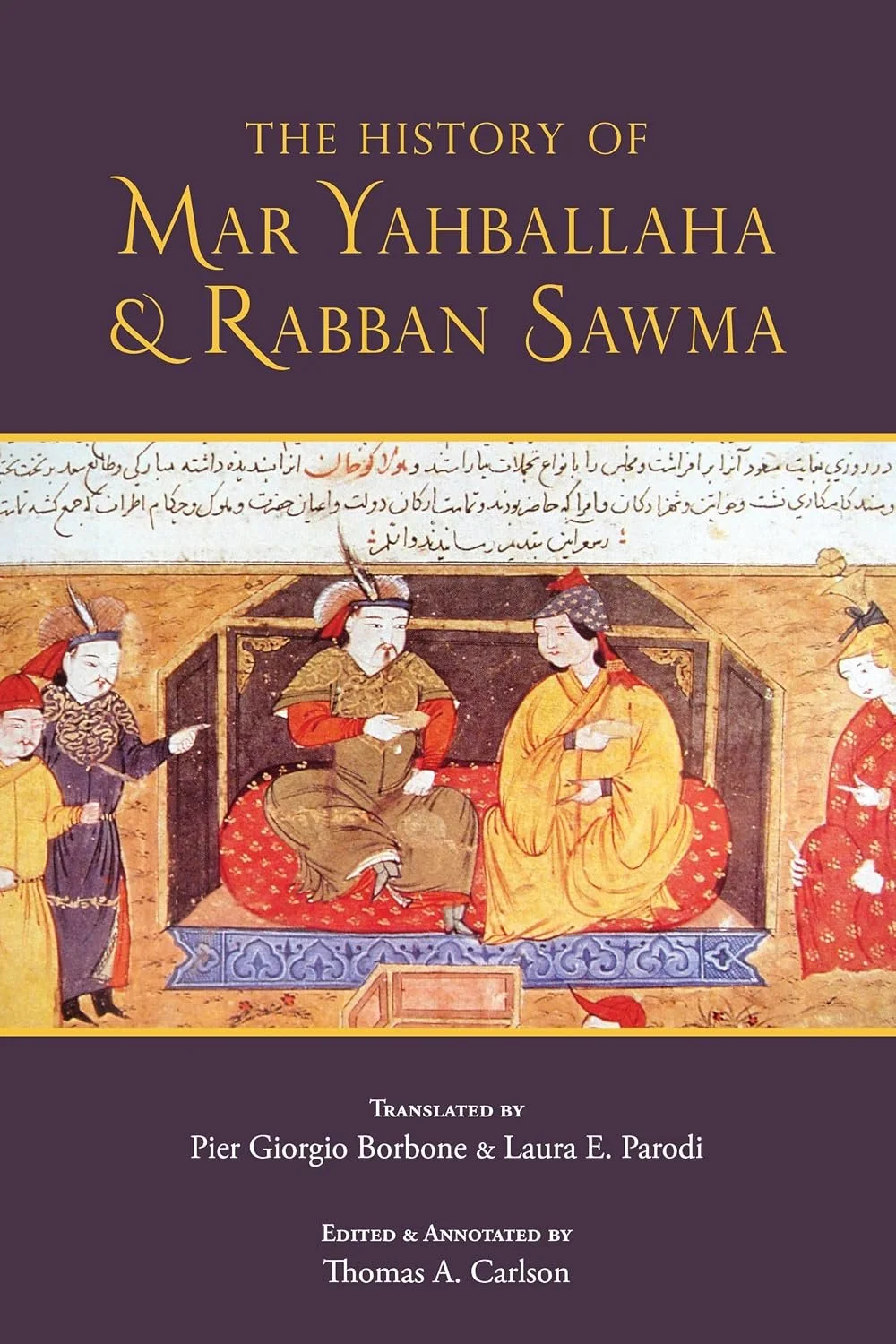
The Travels of Mar Yahballaha and Rabban Sawma with Thomas A. Carlson



The Medieval Podcast uses affiliate links
Episode 351
Pretty much everyone has heard about Marco Polo and his thirteenth-century journey from Italy to China. But just as the Polos were making their way east, two other intrepid travellers were making the journey in reverse. This week, Danièle speaks with Thomas A. Carlson about two Eastern Christian monks who made their way from China all the way to Western Europe, and this unique account of what medieval Europe and its kings looked like from the outside.
-
Danièle Cybulskie:
Hi, everyone, and welcome to episode 351 of The Medieval Podcast. I’m your host, Danièle Cybulskie.
Pretty much everyone has heard about Marco Polo and his thirteenth-century journey from Italy to China. Sharon Kinoshita was on the podcast not long ago to tell us all about it, and her episode is definitely worth revisiting – especially after you hear this one. Because just as the Polos were making their way East, two other intrepid travellers were making the same journey in reverse.
This week, I spoke with Dr. Thomas A. Carlson about two Turkic monks who made their way from China all the way to Western Europe. Thomas is professor of history at Oklahoma State University and the author of Christianity in Fifteenth-Century Iraq, as well as many articles on Christianity, the Mongols, and Syriac. His new book is The History of Mar Yahballaha and Rabban Sawma. Our conversation on the Church of the East, the story of these two incredible travellers, and this unique account of what medieval Europe and its kings looked like from the outside is coming up right after this.
Well, thank-you, Thomas, for being here to talk about a primary source that I have never been familiar with. So, this is awesome. Welcome to The Medieval Podcast.
Thomas Carlson:
Thank-you so much for having me. It's an honour to be here.
Danièle Cybulskie:
So, this is the story of two guys who are traveling sort of – as you say in the book – in reverse of Marco Polo. So, let's start with the when and the where we're talking about. Where do we begin our journey and when do we begin it?
Thomas Carlson:
The story takes place over about a hundred years. It starts probably in about the 1220s in the Far East, in what became Beijing, but this is before the Mongols even founded Beijing. But these guys then traveled from northern China across the middle of Central Asia on a pilgrimage to Jerusalem that they never completed. But before they got to Jerusalem – they couldn't go because there's a war in the way. We'll probably talk more about that. But then they're in Iraq. One of them then gets sent as an ambassador all the way to Western Europe. He meets the pope, he meets the king of France, he meets the king of England, who's in southern France – which is where the king of England usually was at that time. And that's in 1287 by that point. He comes back and then the story wraps up then in Iraq and northwestern Iran in – the death of the younger of the two guys is 1317.
Danièle Cybulskie:
Well, this is really interesting in itself, and that is a biography – or the travel story – of two people at the same time. Is this something that you see a lot in this kind of source?
Thomas Carlson:
Well, it's hard to find – you say this kind of source – it's hard to find a kind of source like this. And so, I was thinking when I wrote the introduction to this book… I was trying to think, what kind of a source is this? Just the “what is this?” which I try to train all of my students to ask about every primary source. So, on the one hand, it's kind of like a travel account. And having a travel account with multiple people traveling isn't the most obscure. But this is literally the only travel account from outside of Latin Europe, into Latin Europe and back. So, that makes it unique right there. And it's kind of like a saint's life. And you sometimes have saints' lives of two people if they're closely affiliated saints, like Sergius and Bacchus, for example, or Felicity and Perpetua from an earlier period. But that's not the most common either. And then the saint's life kind of falls into political history and the main protagonist gets criticized by the author for being too naïve. And so, it It's a very strange text which pulls together these different elements of different genres, and that just makes it all the more valuable for historians trying to figure out: what do we learn from this?
Danièle Cybulskie:
Yes, and you brought up a whole bunch of points I'm going to try and get to sort of one at a time. So, where did you come across this source? Because you're working with a translation – where did you come across this source?
Thomas Carlson:
Well, so this is within the very small field of Syriac Studies. The people who study the Syriac language. This is a very well-known source. It was translated by Ernest Wallace Budge in the 1930s. Curious thing about Budge is that he was not an expert in Syriac, which is what this text was written in. He was primarily famous for doing the first English translation of the Egyptian Book of the Dead, and he published lots of ancient Egyptian translations, lots of ancient Assyrian – Akkadian – translations, and he was such a fixture at the British Museum in the early twentieth century that he appears in children's books by E. Nesbit as a character because he was there. But because his expertise wasn't Syriac, his translation was not a good translation. And so, scholars have been saying – for as long as I've been in Syriac Studies they've been saying this translation needs to be redone, this translation needs to be redone. But until 2021, it was the only complete translation in English that had been published. And so, after I finished my.. my first book, which came out in 2018 with Cambridge – that's Christianity in Fifteenth-Century Iraq – I started thinking, well, maybe, maybe this is the time. Now is the time I could work on this. And I started asking questions. And I know Pier Giorgio Borbone, this very eminent Italian scholar in Syriac Studies. And I emailed him and he said, well, he's, he's just finishing up his English translation and this is the good push to get it over the finish line. So, I said, alright, it's yours. It's not mine. That's fine. And hooray, it's being retranslated by people who actually know Syriac. Wonderful. And I thought that was the end of it until Pier Giorgio Borbone and Laura Parodi published the English translation with Tradition – a German publisher – in 2021. Then, I was contacted by Rick Todhunter from Hackett saying we should do a new translation. I said, but do you know that a new one has just come out? You need to talk to Pier Giorgio Borbone. And so, he contacted Pier Giorgio, who was very gracious and said, you could just publish mine again. That would be fine. And Rick said, well, maybe we could have Thomas Carlson edit it. And Pier Giorgio said that would be great. And so, that's how I got, then, an editorial role working on really just polishing this translation primarily towards an undergraduate audience – or a general public – and omitting most of the very learned, erudite notes that Pier Giorgio put in his translation. I omitted all of those and replaced them with just some notes that I would think someone outside the field entirely would benefit from, just to help them through the text.
Danièle Cybulskie:
I love this because it really demonstrates something I'm saying all the time, which is that our field is actually very congenial when it comes to sharing stuff and working together, because everyone really wants this information out. There's a lot of sharing that happens. It's such a nice story that you've brought forward here. So, this is a translation, as you mentioned, that you have edited for other people to read. So, it is actually a very friendly translation because there's a lot in here that I think that most people listening to this podcast are not familiar with. And so, let's start there, which is you've just said there's a couple of Christian dudes who are around Beijing traveling to Jerusalem. I think most people don't imagine there are Christians near Beijing. So, tell us about the Eastern Church.
Thomas Carlson:
Yeah, so there's this wonderful bit – I actually want to start first with when Rabban Sawma, the older of the two, is sent as an ambassador to the pope. Now, unfortunately, the pope has just died, so he can't complete the embassy, but the cardinals are just astonished. They hadn't heard that there were Christians so far to the east, among the Chinese. Now, they knew about the Chinese from Greek classical learning, but they hadn't heard that there were Christians there.
Danièle Cybulskie:
Right.
Thomas Carlson:
And Rabban Sawma’s answer is just delightful. He says, there's lots. Where have you been?
Danièle Cybulskie:
Yeah.
Thomas Carlson:
And so, the story, you know… As people who live in a society which is sort of downstream from Western Christendom – you know, Latin Christendom – we tend to think of Christianity as the Western religion, or at least a Western religion. But in fact, it started in Jerusalem. It moved east as fast as it moved west. So, some of the early history is very difficult to reconstruct eastward across Asia, as it is also difficult to reconstruct westward across the Mediterranean in the first few centuries. But already by 275, we have Persian royal – well, not royal inscriptions, but inscription of a Zoroastrian high priest – that lists Christians in the Sasanian Empire. By 410, there's an important metropolitan – that's kind of like an archbishop – there's a metropolitan in the trading center of wonderful name, Merv – or… or Mari, in what is today Turkmenistan. So, you're really getting into Central Asia there. There were missionaries from the Sasanian Persian Empire who brought Christianity into China in the early 600s, where they got permission from the emperor to preach. And so, there's a history of Christianity in China in the 600s and early 700s. There's a famous stone called the Nestorian Stele that Jesuit missionaries in China discovered in the 1600s. And made a copy of it. And because the 1600s was also the heyday of Protestant-Catholic arguments in Europe, the Protestants said, oh, that's entirely a forgery. But actually, it's legit. Astonishingly, sometimes reality doesn't work with our polemics. So, there was this history. And even among the nomadic tribes north of China, in what became the Mongols, there was a deep history of Christianity. Now, of course, nomads don't leave as much written records, so we have just bits and pieces – little hints – but certainly then as Chinggis Khan rises to power, we see evidence that his first protector, his father's blood brother, is a Christian. One of his main daughters-in-law, the most important of his daughters-in-law really – Sorghaghtani Beki – she's a Christian. And so, you have Christians just within the Mongol imperial family. It wasn't weird for them. What's weird is the people from the far western edge – which I like to riff off of Douglas Adams: the unfashionable end of the galaxy – that they hadn't heard of this. And, you know, this entire history eastward. And even now, scholars like medievalists, even within the field – we know so much better what's going on in Western Europe. And it's much harder to get the languages to put together – reconstruct what happened, basically, and then also why it happened – across Asia, but there's a whole… a whole history there, which is known only to very obscure specialists.
Danièle Cybulskie:
Well, very obscure specialists are what we specialize in here. Yeah, we're starting to really understand more, I think – I'm thinking especially of the work of Verena Krebs, who's really been pushing to let people –
Thomas Carlson:
Ah. Wonderful.
Danièle Cybulskie
– yeah, to let people know more about what's going on in Africa in terms of Christianity. And so, now we see there's Christianity as far as the Far East – so, near Beijing. So, we have this first person – this is where we start the story: with Rabban Sawma, who is basically a monk, right? Tell us his story.
Thomas Carlson:
Yeah, I mean, it's hard to know how much of this story is really his story and how much of it is the author writing after his death, casting him as the perfect monk. And so, Rabban Sawma's childhood sounds like the normal backstory for a great saint. He's the only child of a barren couple who pray, and their prayers are answered. They have a child. Wonderful. They're so happy. They have an heir. But then he endangers the entire family line by deciding actually he's called by God to be a monk, and they're kind of pissed at this. But he submits in great obedience to his parents and postpones becoming a monk for three years until finally they say, okay, you can do what you want, I suppose. And then he goes and withdraws to the countryside. We have no idea where. We're just told that he grew up – well, the text says he grew up near Khanbaliq, which is the Mongol name for Beijing. But this is forty years before Khanbaliq was founded. So, somewhere in that area – somewhere in what is today northern China. Well, the first thing he does, of course, as soon as the parents say okay, is he gives away everything. This is what you have to do to become a monk, obviously. And he wanders into the wilderness and finds the most beautiful spot with a cave opening onto a spring, you know, flowing water right nearby. Best place to live ever. And even better, he doesn't need to deal with any neighbours. So, this is the virtue of being a hermit type of monastic, as he was. But of course, in the culture at the time, if someone is doing this and giving up the comforts of the world – as if the medieval world were all that comfortable, but anyway – if someone is giving up the comforts of the world, then they must be a holy man. And therefore, his fame spread far and wide, and he attracted people. So, you know, you can go where you don't have neighbours, but you can't prevent neighbours from finding you.
Danièle Cybulskie:
It's true. It's true. So, one of these neighbours – one of these people who has heard about his holiness and shows up – is the second character in our story. Tell us about him.
Thomas Carlson:
Yeah. So, he's first introduced by the name Mark, or in Syriac, Markos, just like in Greek or Latin, Marcus. And we don't know much about him because unfortunately there's some damage of the text right there. He seems to come from a little bit further west within northern China. The Ongud people – he seems to be from the Ongud people, which lived at the bend of the Yellow River. Northern China. Now, at this point, I should maybe interject. All of my students ask me, does that mean he was inside or outside the Great Wall? I say, well, there was no Great Wall at that time. So, this is one of the fascinating things. There was an earlier Great Wall of China built in the ancient period by the Qin Dynasty, which was rammed earth, apparently, and had long since rained away. Nothing of it survives particularly. We can sort of trace where it was by archaeology. And the Great Wall that you could go visit today and that you can see pictures of online, that was built by the Ming Dynasty two hundred years later, so in a failed attempt to keep the Mongols out, but to keep out much later Mongols. So, there was no Great Wall, but the Ongud were sort of within the general orbit of Chinese politics. China at this time was divided into three dynasties: the southern Song Dynasty, the northern Jin Dynasty, and the Xi Xia – or Tangut – Dynasty. And I don't know Chinese, so I have no idea if I'm pronouncing that correctly. But so, this Mark from the Ongud apparently hears about Rabban Sawma and so comes to be his disciple – comes to learn from him how to be a pious, holy monk. And they do all their prayers together. They eat together. The only people they prefer to talk to is each other. And then Rabban Mark – rabban, here, I should say, is an honorific title. It literally means, like, our master, or our leader, but it's what you call a monk. So, it's just the honourary way of saying monk. So, Mark becomes a monk, as well. So, we have the Rabban Sawma and Rabban Mark, and Rabban Mark is the younger of the two, and he gets bored, and he decides it would be really great if we go to Jerusalem. Wouldn't that be wonderful? And Rabban Sawma says, kid, you've got no idea what you're talking about, here. Do you have any idea how hard that would be? And Rabban Mark's like, but we could do it.
Danièle Cybulskie:
Yeah.
Thomas Carlson:
And so, after badgering his senior, then they… they agree. Next stage is: go to Jerusalem. Now, again, how much of this actually happened? The author knew these guys later in their lives. If any of this is real, it came from them. But how much of it the author is saying, well, this is probably what happened.
Danièle Cybulskie:
Yeah. Well, I love this where it's like, hard stuff is what we do. We need to go and do this. I mean, but it makes sense when we think about people who are practicing Christians as far away as what is now Beijing, they're thinking that this is the place to go. It's the place to visit. It is where Christians go when they want to sort of have that ultimate holy moment. So, it's interesting to think about these guys wanting to go there.
Thomas Carlson:
Yeah, they want to go, but on the other hand, there's a long debate within Asian Christianity about whether you should or not. And so, once they decide they're going to – and in terms of hard stuff is what we do, I mean, walking by foot five thousand miles – that's hard.
Danièle Cybulskie:
Yep.
Thomas Carlson:
But also, then when they start telling people, you know, you can't just start walking, you need to prepare for a journey like that through uninhabited areas. And so, they sell what few belongings they have amassed as hermits in northern China, and they start trying to get provisions. And they come to the attention of the Ongud princes who say, no, no, no, you don't know. We've been across Central Asia. You haven't. You will never get there. But then they also make the argument, we require holy men to come to us from the West. You want to deprive us of the few holy men we have by going to the West where they have a surfeit. Like, they have too many already. Stay here where we need you. So, there's this really internal Christian argument that says, you know, wanting to go to Jerusalem is probably just as good as going. And you see this in many different contexts, but it's reflected very explicitly in this particular text, in a couple of different points – the Christian argument against pilgrimage to Jerusalem.
Danièle Cybulskie:
Yes, I loved that moment because that one – as you're saying, some of this really sounds like the regular hagiography – saint's life – right? This is just the type of thing that you say about holy people. But this jumped out at me as being something that is from life, right? Where you shouldn't go there because we need you here. It sounds like something that you would hear if you were a monk that decided you're going to go to Jerusalem.
Thomas Carlson:
Absolutely.
Danièle Cybulskie:
It sounds very real to me.
Thomas Carlson:
Mm-hmm.
Danièle Cybulskie:
Maybe I just imagine it being real. This is also a really good moment because they're like, okay, you've decided to go. We're not going to stop you, but you need to take all of this wealth with you. Just trust us. You need this. And they're like, oh no, no, we shouldn't. And they're like, well then just give it away, but you probably need this. And that really sort of speaks to those practicalities that I think illustrate people are making these journeys. They're tough journeys, but Marco Polo is not the only person who's making this journey.
Thomas Carlson:
Certainly not. And yeah, that is a wonderful moment where the Turkic princes finally say, okay, you can go, but take all this money with you. And these are monks. These are monks who've renounced the world. The last thing they want to be doing is carrying around bags of gold. And the princes simply say, well, do you want to go or not?
Danièle Cybulskie:
Yeah, basically.
Thomas Carlson:
The only way to go is to pay. You need to pay for food, you need to pay – even if you sleep outdoors, you need to pay for guards. There are robbers along the way. You need to go with a group. And it's months. This isn't a walk in the park. This is many months. And the only way the princes persuade the monks to take the gold is to say, well, anything that's left over, you can donate in our name to the holy places in Jerusalem. So, the monks say, okay, we could do that. We could donate in your name. We could be couriers of gold. And it turns out they have nothing left by the time they get to Iran. Like, they, they were not overpaid.
Danièle Cybulskie:
Yeah, they were bled dry. It does say something to that effect. Like, they ran out of money because it is such a difficult journey, and you do meet all of these people, whether they are robbers or not. Everything is expensive. Anyone who's traveled knows that it's expensive to do. So, they do make it to the Middle East. But they don't make it to Jerusalem. Why not?
Thomas Carlson:
Yeah, so geopolitics has a bad tendency to get in the way sometimes, right? It all looked clear sailing from the perspective of China, five thousand miles away. But when they get to the Middle East, we're probably at this point in the mid- to late 1270s, and there's a war going on. The Mongols rule Iran in the state that gets called the Ilkhanate, from the Mongol title. Ilkhan means subordinate Khan or something like that.
Danièle Cybulskie:
Yeah.
Thomas Carlson:
And they're fighting primarily with the Muslim rulers of Egypt – the Mamluk Dynasty at this point in Egypt. And it's an on-again, off-again war from 1260 to 1322. It's not always very intense. Merchants could often find ways and means of getting around, but not always. And so, there's a more active phase of the war. They get to Iraq and they're told the roads are all cut off. You're not allowed to go. No one's going, because at this point Jerusalem is ruled from Egypt, even though it's not within Egypt, but the Mamluks consistently governed Syria, and most of the battles between the Mongols and the Mamluks took place in northern Syria. So, that was the frontier between the two empires. Traveling by foot is bad enough. You don't want to travel by foot through a war zone.
Danièle Cybulskie:
Yeah.
Thomas Carlson:
This is just not a good choice. Medieval people knew that. They were very practical people. And so, that's not a winning move. So, as much as these two were longing to go to Jerusalem, they were told, chill. And so, they took up residence in any of the, you know, number of the monasteries in Iraq, where, you know – just as with the history of Christianity in China is not much known, but Iraq was actually the center of Asian Christianity. There were many monasteries in Iraq to choose from. But the text very explicitly says they paid some money to join a particular monastery and set up their patriarchal cell so that they could be full-fledged members of this monastery. And, oh, after – but that was after they visited all the relics. You have to see the relics of Ezekiel and the relics of Jonah and all of these different relics. Even if Iraqi Christianity maybe didn't proliferate the relics to the same degree that Latin Christianity did, they still loved their relics. And so, they did the ecclesiastical tourism thing, visit all the churches, see all the shrines, kiss all the relics, and then they settled down to normal monastic life in a monastery in Iraq.
Danièle Cybulskie:
Well, it's what you do. You visit the relics. You're a pilgrim. This is what you're there for. So, you visit the relics. And people take note of them right away. So, there are these two monks. They've been trying to renounce the world. They keep being given, like, gold and stuff. Then they arrive and they make a cell for themselves – or they buy a cell for themselves – and still the world does not leave them alone because all of a sudden they are involved in these geopolitics. So, how does this happen?
Thomas Carlson:
Well, so it turns out if you are the catholicos – now catholicos is the… the title of the Iraqi equivalent of the pope, the highest-ranking church official in Iraq – and you're the catholicos in the 1260s, 1270s, you've got these new Mongol rulers. Now, you and your predecessors have learned for centuries how to interact with the caliphs in Baghdad. These Mongols are very familiar to China, very unfamiliar in Iraq. Who in the world are these people? What do they value? What's a good gift? It turns out fabric. If you want to give a gift to a Mongol, pretty fabric is the way to go.
Danièle Cybulskie:
Hmm.
Thomas Carlson:
But there's a great book about that that talks about the “stuff of politics” using the fabric term for stuff. So, there's the great book – “the stuff of politics”, that's the phrase of Thomas Allsen's book, Commodity and Exchange. Great book. But the… the catholicos finds himself in this odd position of how do you interact with these new political leaders? And then you get a couple monks who know their language, who know their customs, who understand them at a much deeper level than just, oh my God, who are you?
Danièle Cybulskie:
Mm-hmm.
Thomas Carlson:
And so, that is explicitly the reason given for Catholicos Denha – this is Denha I at this point – deciding, you two monks are useful for me. You're too useful for me to leave you as just monks. And he starts using them as messengers to go to the court of the Ilkhan because they know the ceremonial, they know how to be polite, they know that you don't dare step on the threshold of the tent, otherwise you might be executed. This is a very important rule in Mongol culture, completely foreign to anyone in the Middle East or anyone in Western Europe. A Latin monk almost got executed because he stepped on the threshold, and he was closely questioned by the Mongols. Did anyone tell you not to? Because if they did, that's the end of you. So, it's just so useful having people who know the culture and know the language. So, they get involved by the church hierarchy. The church hierarchy makes these the liaisons. They're helpful. And then the catholicos has the idea, well, you're so useful, actually, it would be great to make you bishop, especially the younger one who will live longer. Rabban Mark gets ordained as the Mar Yahballaha. Now, mar, in this case, is the honorific. It means my lord, but it's what they put before every bishop's name. And Yahballaha is God gave – the gift of God. They actually have a debate recorded in the text. We can't call you Rabban Markos because that just sounds weird. We have to give you a new name. So, Rabban Yahballaha it is, and that's how he becomes Mar Yahballaha. He's ordained, and then the older – his mentor, Rabban Sawma – is then appointed sort of his right-hand man. His – Visitor General is the formal title translation, who can do things for him. And they're supposed to go back to where they came from, but they can't because geopolitics. Because there's this war going on. After 1260, we always think of, oh, the Mongol Empire was the largest land empire in history. Well, it was – sort of. After 1260, it was divided into four rival khanates. And so, there was a war going on between the Ilkhans, the Mongols ruling Persia, and their cousins, the Mongols ruling Central Asia. The two had made their way through this conflict, which was at a lower simmer on the way there, but when they tried to go back, they said, nope, now's not the season. So, they're stuck. They're just stuck in Iran and Iraq, and then the catholicos dies.
Thomas Carlson:
And then it's time to pick a new catholicos, which – popes would be picked by a college of cardinals. The Church of the East does it a little bit differently. It gathers these metropolitans – they're like archbishops – but only the nearby metropolitans get sort of brought into Baghdad. And this text actually gives us more information about this debate. It clearly is not a conclave or anything like what goes on in Latin Europe. It's a lively debate in which the laypeople, especially the physicians of Baghdad, play a prominent role in picking the new catholicos. They see the same logic that Denha does. This Yahballaha guy, he knows the Mongols. He protests, but I don't know Syriac very well, the church language. This would be like a pope who says, my Latin is rusty.
Danièle Cybulskie:
Yeah.
Thomas Carlson:
And they say, we don't care: you speak Mongol. And so, he gets ordained, he gets selected as the next catholicos. Now, of course, the text in its hagiographical mode also reports all of these dreams that he has, which foreshadow his selection to lead the church. And we don't know how many other people were having such dreams at this time. But these are the ones that got recorded because he's the one who actually got selected. And so, that's how we get Mar Yaballaha III of that name in the office of Catholicos of Baghdad, Catholicos of the East, and his – Visitor General Rabban Sawma, his right-hand man.
Danièle Cybulskie:
Well, it's crazy when you think about this. It's… Any obscure monk just rising to what in Western Christendom is called the papacy. Like, the odds – the odds are very remote. And so… But you can see the logic – the internal logic, as you're saying – where we really need somebody who can bridge these divides because that is a huge part of the job, as we see with the pope. His job is to bring people together, you know?
Thomas Carlson:
Yeah. And particularly challenging when you have these… these new rulers who are still figuring out the Middle East for themselves and trying to figure out the religious dynamics of the Middle East. And here, it might be worth mentioning, a lot of people tend to think, oh, by 1200, the Middle East is very clearly the Islamic world. We actually do not know whether Muslims or Christians were more numerous in Iraq in 1200. This is some research I did that I published in article form in a journal that's already gone defunct, Mizan. But it's an important point: that our notion that this is the Islamic world is actually dependent on assumptions about how mass conversion to a religion happens. And these assumptions have all been debunked. And also, they were made because they really supported Western notions of the legitimacy of Western Christianity and the delegitimacy of Eastern Christianity that Westerners have been calling heretics for 1,500 years now. And so, the actual demographic strength of Christianity or Islam in northern Iraq in the 1200s – we have no idea. We know there were a bunch of Christians. We know there were Christians in the Mongol army – both Mongol Christians, but then also the Mongols recruited mountaineer Christians, presumably Georgians, and Armenians, and Syriac Christians from the Hakkari Mountains. So, there's a large demographic strength of Christians. We don't have any census records, so that's as far as we can get with that. But it's worth remembering that the Middle East was very much a religiously mixed world.
Danièle Cybulskie:
Yes, and it definitely is not settled. And in fact, this is a big part of the second part of the book. I hate to rush, but we do… we do need to get going on this, in that this is where you have a moment where Rabban Sawma is going to the West and he's describing it. And as you say, this is, like, the only time we have someone describing the Latin West who has come from so far. So, why does he end up going to the West?
Thomas Carlson:
Well, so this is where the geopolitics have more of a driving than a restraining force on him. The Mongols are trying to conquer Egypt. And the Mongols have a very fixed policy, a foreign policy that is: the enemy of my enemy is therefore my potential friend – at least until we succeed, and then they're my enemy.
Danièle Cybulskie:
Yeah.
Thomas Carlson:
There’s some good scholarship that says the Mongol world is divided between people who are subject to us, and our enemies. So, the Mongols were not in the process of conquering the Latin West. They had – so, the Mongols of the north in what is now Russia – the Golden Horde area – they had attacked Hungary, they had attacked Poland. They saw the Latin West as enemies, and Latin West saw them as enemies. But the Mongols of the Middle East had no interest in sailing across the Mediterranean. They had a lot of interest in Egypt, and conquering Syria and Egypt. And they heard that there are these crusades.
Danièle Cybulskie:
Mm-hmm.
Thomas Carlson:
What a fascinating idea. And so, if the Franks – and every Latin Christian, every Western European Christian is called Frank in a Middle Eastern text of any language – so, if these Franks want to attack Egypt, the more the merrier. And so, they… they started this – and it already starts with the founder of the Ilkhanate, Hülegü – who ended the Abbasid Caliphate in Baghdad – he starts this diplomatic exchange with Western Europe to try and persuade them to do another crusade. Now, the timing was just off.
Danièle Cybulskie:
Yeah.
Thomas Carlson:
Because by 1260, when Hülegü starts these embassies to the West, the Europeans love the idea of a crusade. They love the idea of recapturing Jerusalem. They can't be bothered to send an army. It's literally more than five hundred years before they send an army to the Eastern Mediterranean again, and then it's Napoleon, who takes great pains to say it's not a crusade in 1797. So, the crusaders, they're more interested in fighting each other. The papacy is like, a crusade would be wonderful – once you convert to Roman Catholicism.
Danièle Cybulskie:
Mm-hmm.
Thomas Carlson:
And so, no army actually ever gets sent. Well, there is – no, there is the one exception: Edward of England. The future King Edward I goes on a crusade, rah, rah, rah, proves his crusader credentials, accomplishes absolutely nothing other than breaking a few treaties, and sails home, having gotten that line on his resume. Hurrah. But he's then the king of England that Rabban Sawma meets as one of these ambassadors in 1287, when the Mongol ruler sends this embassy to try and drum up interest in a crusade yet again. And the king of England says, that would be wonderful. We should totally do that. He doesn't send anyone, but he's presented in the text as maybe a little more eager than the king of France, who of course is also saying, that would be great. We should definitely do that. We need to get our affairs in order.
Danièle Cybulskie:
Well, I love this contrast because I've spent a lot of time looking at Philip the Fair, especially, but also Edward I. And so, people who are familiar with other stuff that I've done will see why I'm excited about this, but the contrast is so visible where you have Rabban Sawma who visits Edward I, as you were saying, in Gascony, and Edward takes the Eucharist from him, which is so interesting because if – again, if it happened – it is something that I think speaks to a certain amount of piety, a certain amount of flexibility. And when Rabban Sawma is seeing Philip the Fair, Philip is more interested in saying, and we have this relic, and we have this relic. Check out this relic that my ancestors –
Thomas Carlson:
He’s totally bragging.
Danièle Cybulskie:
Yeah, my ancestors brought back. And so, the contrast is hilarious. But having Edward take the Eucharist from this person who has a completely different practice of Christianity, down to the language – and this is important, something that you mentioned elsewhere in the book – where they think it looks the same, but they don't understand what the language is, so they're just assuming.
Thomas Carlson:
Yeah.
Danièle Cybulskie:
To do that in a Christian context is something I think that we rarely would ever see in the Middle Ages in the wider discussion of Christianity, where when people talk about it, it must be a certain way or you're a heretic and you're in trouble. For Edward to take the Eucharist from somebody who has a different practice of it is really monumental. I think it's noteworthy for anybody who's coming across this.
Thomas Carlson:
Well, absolutely. But if I could push back just a little, I think part of that is the monopoly, basically, that the Latin Church hierarchy has through much of this period – not through all of it – within Western Europe. Within the Middle East, it would be far more common.
Danièle Cybulskie:
Yes.
Thomas Carlson:
And so, here, the work of like Jack Tannous about Late Antiquity and the early Islamic period has really shown that these refinements of theology – or as I like to call the deep weeds of Aristotelian philosophical theology – these matter to the eggheads. These matter to the college professors. And your average Christian is just – they want the Eucharist, they want the body and blood of Jesus Christ, they don't care who serves it.
Danièle Cybulskie:
Yes.
Thomas Carlson:
And I wonder if we had more travelers like Rabban Sawma who could bring the Eucharist, how many other kings might be like Edward? Now, you mentioned Philip the Fair. It's not recorded that he does so, but we do have the pope himself. When there's a new pope selected, he gives Rabban Sawma permission to celebrate the Eucharist in the middle of Lent. And so, he wants to see. And so, that's when the Romans say, oh, the language is different, but the ritual is the same.
Danièle Cybulskie:
Yeah.
Thomas Carlson:
And so, there's this notion, even at this time that we tend to think of, oh, they're heretic hunting, they completely missed this guy whose theology they would call heretical, but they're much more interested in the diplomacy. He's very diplomatic. He's very good at what to say and what not to say when. This is why I would be a terrible diplomat. But it is interesting. There's a certain piety… a certain piety that disregards these, one might almost say, denominational boundaries.
Danièle Cybulskie:
Yes, and that's exactly what I mean, is that whenever we look at sort of these broad sweeping things, as you're saying, like the Middle East, it's all Muslim at this moment, or like there is only one way of being Christian, when there's a lot of nuance. I think that we… we have these impressions of the Middle Ages, when you can find stuff that pushes back against it, as you're saying. And I think that this text is really a good example of the way that we can dig into that and see, like, what are the nuances that are happening right at this moment. Also, I think that the thirteenth century is a little bit more flexible than you see, like, a fifteenth century, too.
Thomas Carlson:
Yeah, alright. That's fair, too.
Danièle Cybulskie:
There's that. But this is also probably one of my favorite parts of the whole text, is these journeys by Rabban Sawma into Europe where he's observing things and then recording things to send back, right? So, they're like, here's how they practice Lent at the pope's place. And so, like, this is… this is just so interesting because you find out what people value, what's worth writing down, what's worth sending back to tell people about at home.
Thomas Carlson:
And that's the wonderful thing about a travelogue at any time, that – the way that the liturgy was actually celebrated in Rome for Easter in 1288, no Roman person cared to write that down.
Danièle Cybulskie:
Yeah.
Thomas Carlson:
They cared to write down how it ought to be celebrated. They were much more interested in the prescriptive thing. And other travelers would only write it down if it were different from their own practice. A lot of it just went without saying. The fact that you fast before the Eucharist, that goes without saying. Everyone does that. And then Rabban Sawma comes in from outside, a very different experience, very different ritual, and says, they're weird. And he has this wonderful line about – he asks why the Genoese celebrate Lent differently. And now, this has to be fictional, where the travelogue reports that Genoese say, well, the apostles saw that our ancestors were weak and couldn't fast as long as you do. So, they had mercy on us and gave us a break. When the actual reason I'll leave to the liturgy experts of medieval Latin history. But this is – there are these liturgical differences which Rabban Sawma records because they're different. And so, this is just the value of a diversity of experiences of people. Not – have to be careful when you talk about viewpoint diversity these days, and people mean a variety of things. I don't mean just being contrarian based on bad evidence. I mean actually people with different lived experiences, bringing multiple lived experiences to bear on what's going on is so informative. And that's where we really learn a lot about the practical experiences. What does this work like in real life?
Danièle Cybulskie:
Yes. And it's so great to see somebody from outside who is speaking with the people. They do – the cardinals do question him and say, well, what do you believe over there? And as you were saying earlier, he's like, you guys are crazy and also kind of ignorant. He says it very politely, but they do have this discussion. And it's really interesting to see, again, like, what questions did they ask him? What did he think was valuable about this discussion? And what did he think was kind of ridiculous. And so, having this outsider's view is just – again, is so valuable, and… and I'm so glad that it exists. Alright, so I guess we have to send Rabban Sawma back to the Middle East, which is where he goes, because the second part of this involves quite a lot of conflict. And I think this is really interesting in that when people think about – putting the Crusades aside for a minute, where there's, like, the “clash of civilizations” – a moment like the Protestant Reformation, I think, has some parallels here, where there's a way in which religion goes back, and it goes forth, and there are new rules that are set onto the places where people are living, where they have to live by this way, and then this way, and then this way. And we see this happening in this story. People are going from Muslim to Christian, to Muslim to Christian, and seeing this sort of in real time – seeing it happening for the people who are living there – is really interesting. So, tell us what's happening here.
Thomas Carlson:
So, the difficulty here is that it's difficult for us today to talk about this without falling into one of two pitfalls. So, there's the pitfall you already said, clash of civilizations, the idea that Muslims and Christians cannot get along; they will always be at each other's throats. The other pitfall – equal and opposite reaction, or if you prefer a classical reference, Scylla and Charybdis – the other side of it is the Convivencia: the idea that under Islam, which was famously tolerant, Christians and Jews flourished, and it was only the Latin West that had its problems with intolerance, and everyone got along just peachy. The reality, of course, is what reality is: it's messy. And so, we need to keep that in mind in discussing this. We also need to keep in mind this is one primary source written by one author who's got an axe to grind.
Danièle Cybulskie:
Mm-hmm.
Thomas Carlson:
And this was an important part of my own thinking as I was preparing the introduction for this book, and trying to contextualize it for a broader audience, and help people see what's going on, because there is a lot of conflict reported. Starting right away, Rabban Sawma – or even before Rabban Sawma goes to Europe – there's this moment where there's an earlier Ilkhan who the text always names Ahmad because he converted to Islam. Ahmad is an Arabic name. Alright. His Mongol name was Tegüder. The Mongol – the sources that are more pro-Mongol – are always calling him Tegüder. But he converted to Islam, and there's… there's been a huge argument among scholars: did that matter for his policy? But according to this text, he persecuted Christians. But he was also an idiot who was being manipulated by other Christians. So, a lot of the suffering that the Christian leaders are experiencing from Ahmad the Muslim is actually rival Christian leaders who want to bring down this catholicos and replace him. So, it's actually politicking and maneuvering within Christianity, using the ruler who happens to be Mongol, who happens to be Muslim. It wouldn't matter either way. And so, when we get to the more extreme conflicts, then – well, you don't… you don't get a huge amount of conflict right when Rabban Sawma gets back. Arghun lives a bit longer, and then you get Geikhatu, who is famously generous. He ruins the economy of all Iran because he's just too generous. He tries to introduce paper money based on the Chinese model, because he thought that would make it easier to be generous. And the Middle Easterners say, no, that's not valuable, and they just stopped doing commerce. But then when Geikhatu dies, then you get a conflict between one claimant for the throne, Baidu, who openly supports Christianity, and Ghazan, his cousin, who is supported by a Muslim Mongol, and who converts to Islam in order to get that support. Every time a Mongol dies, you get conflict between claimants for the throne. There's no precise rule for who gets to inherit, so you get conflict. And here we start to see this conflict in a religious register, and you get a lot of suffering, which is really, I think, largely because Ghazan wins, and Ghazan is – he's going to put down anyone he perceives as a threat. And so, he suspects that the Christians preferred Baidu, who was openly pro-Christian. So, he causes problems. That lasts eighteen months. And as soon as Nawruz – the Mongol Muslim emir who supported Ghazan – as soon as Nawruz dies – well, is executed, is hunted down by Ghazan. As soon as Ghazan kills Nawruz, then Ghazan is generosity itself to Mar Yahballaha. And he gives so much patronage. So, we get this – it switches very rapidly between government repression of Christianity – and Buddhists, by the way – to government patronage for Christianity. And so, it has a lot more to do with just the personal politics of this particular ruler. And it's in that context that we see then the conflict in Arbil, the initial conflict in 1297. And I did – I tried really hard to move beyond the stereotypes that I see in the text, to explain what's going on from different perspectives. And from the Mongol perspective, it really looks like the Christian soldiers in the citadel of Arbil are probably rebelling against the Mongol Empire. And from the Mongol perspective, that just means they get crushed.
Danièle Cybulskie:
Mm-hmm.
Thomas Carlson:
Like, A therefore B.
Danièle Cybulskie:
Yeah.
Thomas Carlson:
But the text presents this as Muslims attacking Christians. Well, a lot of those Mongols – some of those Mongols at that point were Muslim. There were also Muslims in town who maybe had their own grievances, or opportunistic, but the crisis was averted in 1297. But then in 1310, thirteen years later, it isn't averted. And again, the text – the author really wants to present this as Muslims versus Christians. I don't think that's what the Mongols saw it as, anyway. And also, the text itself gives evidence that this isn't exactly what's going on when it presents Muslims helping Christians.
Danièle Cybulskie:
Mm-hmm.
Thomas Carlson:
You get Mongol Muslims like the emir of emirs, Chupan, who tries to broker a solution. You get the famous vizier Rashid al-Din, who's Muslim, and he praises Ghazan in his history as the greatest Muslim ruler in all history. And yet he's also trying to broker a solution. We have reports of just everyday kindness in Arbil, Muslims in Arbil who shelter Christians who are being hunted down by others in Arbil. So… so it's clearly a much messier picture than just Islam versus Christianity. And when we think of that – think that this author himself gives the evidence – that it's clear that his axe to grind is he wants there to be a culture war between Islam and Christianity because he doesn't want Christians converting to Islam.
Danièle Cybulskie:
Mm-hmm.
Thomas Carlson:
At an earlier period, you get some conversion both directions: Muslims to Christians, Christians to Muslims. At this period, most of the conversions are moving in the direction of Islam. So, this is almost certainly a church leader. I think we have a good guess as to who he was now, though he's not named in the text. He doesn't want to lose his flock to conversion is what's going on. And so, he's presenting it as all Muslims are always hating Christians, but this is obviously culture war stereotyping is what's going on here. On the other hand, the Mongols saw it as rebellion, which must be dealt with, and they dealt with it in a very Mongol fashion, and a whole lot of people died. So, that's really real. You know, the violence is real. Understanding the violence is the trick.
Danièle Cybulskie:
Yes. And what I think really comes through, as well, is that the people who are on the ground here are seeing misinformation, or the wrong information, or the information's changing. And so, there's ways in which you're acting on some information, but then you find out that that's wrong and then you have to adjust your behavior on that. And I do think that that is probably true, as well, where if you have the ruler who's very far away, you know, you might be acting on stuff that you think is true but may not be true. And maybe that's something that we should take as a lesson for ourselves, as well.
Thomas Carlson:
It's also astonishing. Now, we – I think our notions of medieval rulers are maybe a little exalted. That is, they claimed to be God's choice for this. But this is the period where the ruler has power where the ruler is, and you get beyond the ruler's reach and how much power does that ruler have? Well, it depends on the local conditions.
Danièle Cybulskie:
Mm-hmm.
Thomas Carlson:
And so… so, the rulers – the Mongol Ilkhan at this point, Öljeitü, had given an order that the Christians who came down should be allowed safe passage. But that order wasn't followed. And we see a really nitty-gritty picture of the behind-the-scenes politicking that's going on in the subordinates, some of whom want to follow the order, some of whom don't want to follow the order, but order – follow it enough to not lose their heads. And so, the practice of power in the medieval world is very granular and very local. And so… so, related to your point about misinformation, you know, what are the conditions? Well, this person is saying you need to come down, and you'll be safe if you do, but if you try it, then… good luck. So, there are all of these challenges that go into understanding this and show that it's a horrible situation. The author breaks out in lament, very much quoting the biblical Book of Lamentations, but the actual reality of this horrible situation is much more complex than simply, oh, clash of civilizations. Most Muslims, most Christians got along fine. This was the exception, not the rule.
Danièle Cybulskie:
Yes. Okay. So, we have our favorite monks there. They're getting involved in this. Rabban Sawma has passed by this point. [Mar] Yahballaha, the catholicos, he's still in existence at this moment. He's enmeshed in the politics. Eventually things settle down. How do things end for our hero?
Thomas Carlson:
Well, so that's the interesting thing. He actually – he's getting older and he stops going with the royal court everywhere. He sort of settles down. And that actually is one of the issues that precipitates the crisis of 1310, because the Christians in the Arbil citadel don't have anyone at the royal court to present their viewpoint on what's going on. So, the view – only viewpoint presented is this is rebellion against the empire. Oops.
Danièle Cybulskie:
Yeah.
Thomas Carlson:
And that's where the author actually critiques Mar Yahballaha, the catholicos, for not doing his job and for being too naïve; for assuming it would all work out. So, we get this criticism, which you would never find in a real saint's life. The saints are supposed to be guided by God, but this Yahballaha – Mar Yahballaha – he's a saint, but he's insufficiently political at this stage of his life. But after the crisis of 1310 – he survives it. He lives for seven more years. Those years are presented just very briefly, very tersely in the end of the text. It's probably added as an afterthought, other than this punchline that says, “I am tired of serving the Mongols.”
Danièle Cybulskie:
Yes!
Thomas Carlson:
It's an amazing line!
Danièle Cybulskie:
Yes. Wow.
Thomas Carlson:
Like, where else in a medieval text written under a current dynasty do you have someone saying, you know, this dynasty kind of sucks? It's not fun. And so, this amazing punchline, which I think is also probably part of the punchline of the author, who I think is finishing up this text as either newly elected catholicos – Mar Yahballaha’s successor – or between the death of Mar Yahballaha and the succession. I think he's presenting this as, folks, we need to be a little less involved with politics as a church. That political involvements are maybe causing us some troubles. And so, I think that's a punchline. I think that's probably – if there's a moral to this story, “I am tired of serving the Mongols” is probably the closest it gets, but we've gone a long way before we get there.
Danièle Cybulskie:
Well, I mean, it jumps right out of the text because this guy is the equivalent of the pope, and I can imagine the pope having that sort of thought very often in his work, as well, but you never see it written down. Like, here it is. And I do think that that probably has, as you were saying, a lot to do with the agenda of the person who's writing this, right? Did he think it? Did he say it out loud? Who knows? But it is there in the text, in the biography, and that is fascinating.
Thomas Carlson:
Well, it's interesting that he can also get away with it in part because he's writing in this very dead language, Syriac, which is only known by other priests.
Danièle Cybulskie:
Yeah.
Thomas Carlson:
And so, if he'd written this in Arabic, it would have been a very dangerous thing to write. But he's writing it in a language that only his in-club can actually decipher at this point. So, he can get away with it. But It's just an amazing punchline at the end of this story. Where in the world?
Danièle Cybulskie:
Yes. Well, I mean, that line definitely will make people want to read this. So, as we come to the end of our time, what do you want people to take away from the fact that this exists? What do you want people to think about, having heard this story, having heard about this story?
Thomas Carlson:
I mean, I think the biggest thing is that we humans are fundamentally lazy about understanding things.
Danièle Cybulskie:
Yes.
Thomas Carlson:
We like binaries. We like Christendom versus Dar al-Islam: the Land of Islam. And the Land of Islam was not the Land of Islam, and Christendom was never fully Christian, as we now know, as the specialists know. But we like this binary. And then within Christendom, we like to distinguish between the state church – the official doctrine of Rome – versus all the heretics. And within Islam, we like the binary of Sunni and Shia, to say nothing of the Kharijites, the Ubaidis, whatever. We like these binaries. And I get it. Thinking is hard. The world is far more complex than we can ever fully understand. Absolutely. But I've been thinking – with this text and in some of my other research – there's a danger of essentialism. And I'm not the only scholar to call out the danger of essentialism. To say, okay, but what is Islam really like? Which Muslim? What is Christianity really like? Which Christian do you have in mind? But – the antidote to essentialism is clear, but we too often leave it by the wayside. We just fail to pick it up. The antidote is we need to assume diversity. We just always – the medieval world was an incredibly diverse world, in part because it was an incredibly local world. Most people didn't travel across Asia like these guys did. Most people would never compare what had happened in China with what was going on in Paris. They had no opportunity to do so. But because of that, all politics were local. All culture was local. All society was local. It was all about the relationships. Institutions are great. I love institutions. But institutions were being forged slowly through the experiences, the lived experiences of local relationships. One of the things that I have been struck with working on this text and in my other research… we need to assume – especially the medieval Middle East at the crossroads of Africa and Eurasia – there's all kinds of diversity. You can find everyone. You can always find a community of Ethiopians living in Jerusalem, as the wonderful work of Verena Krebs, that you mentioned earlier, has reminded us. But also, when we have this diversity, we need to try and perceive it through multiple perspectives, not only from one. So, I think too many scholars have taken the most accessible sources and privileged those as the explanation. And they've ignored this amazing source because they don't happen to read Syriac. I get it. Most people don't read Syriac. It's an obscure language. It's actually not a difficult language – far easier than Latin, by the way – but it's not a widely known language. And so, if we can see the diversity from multiple perspectives, it will really enrich our understanding of the past.
Danièle Cybulskie:
Yes, absolutely. Which is why, as soon as I saw this coming out, I figured I needed to speak to you about it to make sure that other people are getting in touch with this amazing source, and reminding ourselves that this is a lot more complicated than we tend to give this world credit for. So, thank-you so much, Thomas, for being here and telling us all about it.
Thomas Carlson:
Thank-you so much for having me. It's been a real honour and… and pleasure to talk with you about this book.
Danièle Cybulskie:
To find out more about Thomas’ work, you can visit his page at thomasacarlson.com. His new book is The History of Mar Yahballaha and Rabban Sawma.
In this translation of the travels of Mar Yahballaha and Rabban Sawma, the writer drops a bit of timeless wisdom that I thought was worth sharing. He says, “A noble family is worth nothing when thoughts and conduct do not conform to what is good; nor is the gift withheld when an ignoble family is coupled with good conduct and right thoughts.” In other words, it doesn’t matter what your name is or what you’ve got: it’s who you are as a person that matters.
This is from Thomas’ edition of The History of Mar Yahballaha and Rabban Sawma, translated by Pier Georgio Borbone and Laura E. Parodi.
Thank-you, as always, for supporting the podcast as you do each week by sharing, letting the ads play, buying yourself some sweet merch, and especially by becoming patrons on Patreon.com. If you’d like to be one of these cool kids listening early and ad-free, and reading exclusive articles each week, please check out patreon.com/themedievalpodcast.
For the show notes on this episode, a transcript, a collection of the books featured on The Medieval Podcast, and more, please visit medievalpodcast.com. You can find me, Danièle Cybulskie, on social media @5MinMedievalist.
Our music is by Christian Overton.
Thanks for listening, and have yourself an awesome day.