Scotland and the War of Roses with Michael Brown




The Medieval Podcast uses affiliate links
Episode 352
There’s a beautiful country that every once in a while comes to the forefront of our collective consciousness to steal our hearts. But Scotland isn’t a country that just appears out of the mist from time to time. It’s always been an integral part of European politics, especially during the late Middle Ages. This week, Danièle speaks with Michael Brown about Scotland’s involvement in European politics, its long alliance with France, and its tumultuous relationship with England during the Wars of the Roses.
-
Danièle Cybulskie:
Hi, everyone, and welcome to episode 352 of The Medieval Podcast. I’m your host, Danièle Cybulskie.
There’s a beautiful country that every once in a while comes to the forefront of our collective consciousness to steal our hearts. This year, it was the enthusiastic Tartan Army which took the World Cup by storm. But Scotland isn’t a country that just appears out of the mist from time to time. It’s always been an integral part of European politics, especially during the late Middle Ages.
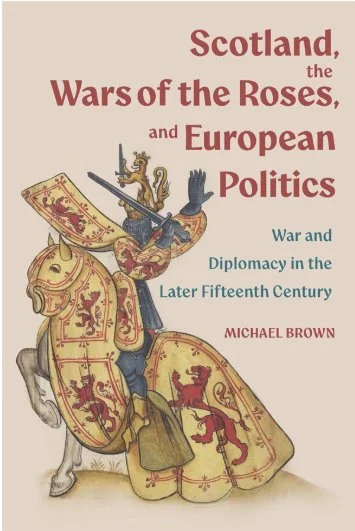
This week, I spoke with Dr. Michael Brown about Scotland’s place on the European stage during the fifteenth century. Michael is professor of Scottish History at the University of St. Andrews, and the author of several books, including Disunited Kingdoms: Peoples and Politics in the British Isles 1280-1460, Bannockburn: The Scottish War and the British Isles, 1307-1323, The Wars of Scotland, 1214-1371, and The Black Douglases: War and Lordship in Late Mediaeval Scotland (1300-1455). His new book is Scotland, The Wars of the Roses, and European Politics: War and Diplomacy in the Later Fifteenth Century. Our conversation on Scotland’s involvement in European politics, its long alliance with France, and its tumultuous relationship with England is coming up in just a moment, and be sure to stay until the end for a nice little surprise.
Well, welcome, Michael, to talk about Scottish history. It is so nice to have you here and to talk about this because it doesn't get talked about enough. So, welcome to the podcast.
Dr. Michael Brown:
Thank-you very much for having me.
Danièle Cybulskie:
So, we need to ask this question: why doesn't Scottish history get talked about enough? We’ve got the Wars of Independence – as we were saying before we turned on the microphones – we’ve got Mary Queen of Scots, we’ve got the Jacobites, and other than that, you know, people are not digging in. Why do you think that is?
Dr. Michael Brown:
I think on one level, it's because of those kind of bright spots that people are fascinated with. So, you know, they do a great job for Scottish history – don't get me wrong. I think it… it's brilliant that people are interested in the Wars of Independence. Mary opens up a whole range of avenues for people to talk about. And similarly, with the Jacobites, you know, you're into avenues that you can explore. So, they're great topics, but I think there are periods that, as a result, I guess, don't get the same kind of attention from outside Scotland. I mean, I talk about them all the time, but, say, something like the fifteenth century – which I think we're going to talk about today – it tends to be overlooked. It may not be helped by the point you were making before we came on air, that they're all called James.
Danièle Cybulskie:
Yes.
Dr. Michael Brown:
Which, in a sense… once you get to know them and see that they are, you know, really quite different people, there is a certain kind of samey-ness about the kings. And they all succeed father to son, which obviously is very different to what happens in contemporary England.
Danièle Cybulskie:
That's right. And in your title, you're making that direct connection between Scotland and Wars of the Roses, here. So, why did you pick this period as the time to talk about?
Dr. Michael Brown:
I mean, it's a period I've always been interested in. My first book was on James I, who was King of Scots from 1406 to 1437, though the first eighteen years of that he spends in England as a captive. So, it's really just 1424 to '37. And my second book was on the family the Black Douglases, one of the great infamous noble families of fourteenth- and fifteenth- century Scotland. So, I've just been fascinated with this period for what is now decades. And in a way, that wasn't the question. It was a question where, having written these things, I felt I'd missed a point. And one of the great things as you get older is you can kind of go back and clear up your own omissions. And I thought, well, there's a whole series of well-known interactions between Scotland, obviously, and England, but also with continental states. I haven't really dug into those and seen how they affect things within Scotland. You know, how much Scottish politics is, if you like, related to the bigger picture. Similarly, how a small country, and quite a geographically peripheral country, like Scotland can participate in the really quite hyperactive events of fifteenth-century Europe. And again, one of the things I think that Scottish historians have been conscious of in this period, but at other periods too, is the desire of Scots to leave home and go somewhere better. I mean, that sounds terrible, but to make their way in the world. I mean, you know, we've just had the Tartan Army in North America. That's a small-scale example of the same thing. Scots go abroad and want to be recognized and participate, but retain their Scottishness. And you can see that in the fifteenth century too. So, there's a lot of big stories there. And I also felt, something I knew about, that Scotland was a good example of something else, which is we tend to talk about European politics from the perspective of the big players of the time. So, in the fifteenth century, in Western Europe, you're talking about the French kingdom, you're talking about the Dukes of Burgundy, you're talking about the Empire, and you're talking about England, and the Spanish monarchy. You're not really talking about Scotland, or Savoy, or Naples, or Brittany, which are active and conscious polities with their own diplomatic and foreign policy objectives, too. So, looking at it from the perspectives of people who've got to jump up and down and say, I'm here, why don't you talk to me? Or: I need help, someone's coming to attack me, who's going to deal with me? I thought was a kind of interesting way of altering the focus.
Danièle Cybulskie:
Yes. Yes, absolutely. And as someone who is a direct result of the Scots wanting to go across the sea and… and make their way in the world, I'm always happy to talk about Scottish history. So, as you're saying, some of the biggest moments in the fifteenth century are happening on the continent, and they are really connected to Scotland in ways that go back a really long time. So, in order to understand this real tightness between Scotland and France, we have to talk about the Auld Alliance. So, tell us how this came about.
Dr. Michael Brown:
I think, I mean, the starting point is a debate in itself. And interestingly, in the late Middle Ages, the Scots are inventing origins for it going back to Charlemagne. So, going back hundreds of years already. And the Auldness of the Auld Alliance is something that's kind of wired into it. This is a natural, ancient connection. So, the Scots, and to a lesser extent the French, have this kind of default setting that these two kingdoms should be on good terms. I mean, the obvious starting point is the starting point of both the Anglo-French conflicts – the recurring Anglo-French conflicts that I think we certainly start to roll into the term Hundred Years' War – and the parallel long war, which is the war between England and Scotland. And those wars essentially both start in the 1290s, and then, with some short interruptions, continue into the late fifteenth century. And it's only in 1503 that you get – or 1502 – that you get an Anglo-Scottish treaty that essentially ends that war. So, a war that starts in the 1290s runs with only a very short break until the early sixteenth century. And similarly, you know, the Anglo-French War – the English claim on the French throne – runs parallel to it. So, these two kingdoms have a common enemy, and what better way to define a friendship than saying, you know, it's the English. The English are the problem. They're the common disturbers of Christendom, is what James II calls them.
Danièle Cybulskie:
Yeah.
Dr. Michael Brown:
So, that… that's the basis of it. And so, on one… on one level – certainly, I think, in the fourteenth century – it's a pragmatic alliance. It serves both kingdoms. It serves the Scots because they know they're not isolated. They're in a war in which English resources and English attention tends to be now directed to the continent rather than focused solely on them. And for the French, you know, it is another ally, I think. It is a source of friendship. And the Scots, of course, militarily – the idea is that they will distract and draw away English resources from the continent. And Scottish leaders try and perform that role. And very occasionally, French troops come to Scotland to support them, though that usually goes disastrously wrong for everyone. They work better at a distance in the fourteenth century. So, by the fifteenth century, I think you have this longstanding connection. And for the Scots, I think – culturally, as well as, if you like, politically, militarily – it's their route to the European core. You know, they know, and they know everybody else knows, that they're at the northern edge of Europe. You know, in finibus orbis: at the end of the world. And so, the route they used to go to access education, to access trade, to access cultural norms tended to be filtered through the southern parts of Britain. But obviously that's much more difficult in the fourteenth and fifteenth centuries. So, their route to the Low Countries – very important, their principal economic route – but also to the French court, and to the French kingdom, and through the French kingdom to Avignon and the papal curia, once it's directed there. So, for the Scots, I think it's a really important – I suppose, almost psychological – connection to the European core. And I think they value it. I mean, obviously, they value it more than the French do. And the French, I think, certainly up until the early fifteenth century, recognize its value, recognize its consistency. But it's one of a range of alliances that in a way they have a similar view of. The link with Castile, for example, in the fourteenth century, is much more important for the French crown.
Danièle Cybulskie:
Yes, well, we're talking about practicalities. There is a certain amount of sentiment here, and that really comes through when we're talking about Charles VII. So, let's set this up for… for people who listened to a miniseries I did last year on Charles VI, this is the king who thinks he's made of glass. He's not available to be king most of the time. His son is challenging his power. His son is called the Dauphin Charles at that time, and the Scots support the Dauphin against his father. And this is kind of a strange thing to be doing, especially when you're a kingdom that is, like, always having to defend its own sovereignty. So, before we get into the moment when James has actually ascended to the throne – he's in captivity right now – I need to know for my own sake, why do they back the Dauphin, here?
Dr. Michael Brown:
It's an interesting question because they… I mean, Charles VI himself, as you've said, he… he's… I mean, I think by this stage he's not capable of playing any political role. He's a… he's a puppet in the hands of whoever has him. And at this point, the Burgundian faction – John the Fearless, the Duke of Burgundy; Queen Isabella; and Henry V – have essentially control of Charles VI. And the Scots have, as I was saying, have strong connections with the Burgundian Netherlands. They have strong connections with Duke John, and a number of Scottish nobles have served Duke John, have been at his court. So, there are those connections, and John is sending people to Scotland looking to recruit soldiers. I think, in a way, what changes is the Dauphin murders the Duke of Burgundy. And some Scottish nobles clearly never participate in supporting the Dauphin. And I wonder if some of those are – well, certainly some of those are people who have connections with John. So, it has an effect. But the others think, I think, you know, the money's on the table, the link with France is there, and they go to back the Dauphin. But it's a close decision. And it's all about timing of events on the continent. I think they could easily – I mean, what they see their role is, is fighting Henry V. So, if there's a French party that's identified as being at war with the English, they will support them. What they don't necessarily want to be is on the side of the English fighting against the French faction. So, the Scots, I think, have to navigate that chaotic environment. But once they line up with the Dauphin, I think that relationship becomes fairly settled. And it's through the family that's governing Scotland – the uncle and then the cousin of James I, who are the Dukes of Albany – the Stuarts; and then the Douglases – that family that we were talking about before. Those two families lead the way and recruit a lot of the army from their connections within Scotland.
Danièle Cybulskie:
Well, it seems that they backed the right horse because when Charles VI dies, Charles VII – who we've just called the Dauphin – he becomes Charles VII. And then Henry V dies, as well. So, the English king that's supposed to be in charge of France is just a baby. So, they've backed the right horse, they backed an adult, and they support him throughout. This relationship between the Scots and Charles VII is super tight, right?
Dr. Michael Brown:
Yeah. I think it's because, whilst by, I guess, probably the 1430s and 1440s, you can start to be more confident, there's a decade in which the Scots are one of the mainstays of Charles's armies. Interestingly, he very quickly chooses a group of Scots as his personal bodyguard: 100-150 Scottish archers become the bodyguard of the French king. And that continues up to the Revolution. And I think partly that's because these guys are – their only connection in France is with him. They don't play the politics that the rest of the French nobility are playing around him. The factionalism at Charles's court in the 1420s is chaotic itself. So, he's got this body of people who he can rely on. And he is a king – his personality, I think, is quite nervous, quite cautious. He doesn't tend to go into battle himself. And I think that personal security… there is something going on there. Because the way, as you say, the way he regards the Scots for the rest of his life is as this source of security, this source of support when he couldn't really count on anybody else. And I think, you know – what I felt in the book, and what I try and argue in the book, is it does go beyond the diplomatic norms. Both in terms of the relationship between him and the Scottish kings, but I think his attitude to Scots in general, Scots in his kingdom. He likes having them at his court. He likes having Scottish servants. And obviously, this is a king of a much richer, more populous kingdom. Scots like being there, you know – climate's better, good wine, good cheese. French peasantry? Not so keen on the Scots. But the French king loves them.
Danièle Cybulskie:
Yes, well, I mean, he's managed to make enemies with everybody in his own kingdom from time to time, so he might as well lean on strangers, which is something that you say in the book. So, as we've started this discussion, the Scottish king, James I, is in captivity in England. He gets released. Tell us what happens here.
Dr. Michael Brown:
Yeah, so in a way, when I was writing the book – like, just aside to my process – it was almost like following the trail backwards. So, I really started in the late 1440s when the Scottish king then gets a prestigious marriage, and I kind of thought, well, where does that come from? And I followed it back. And you follow it back to Scots coming to France in 1419 to 1424 in these big armies. And I think that puts Scotland on the diplomatic, political, military map in a way that it hasn't really been before. Suddenly people are thinking, whoa, you can actually get full-scale armies sailing across, you know, the Irish Sea, Bay of Biscay, landing in western France, and going off to fight for you – not always successfully. And I think that concentrates the minds of the English government first and foremost. They have this asset that they've had for a while, James I. Interestingly, Henry V uses him as a kind of… sort of ideological weapon against the Scots in France. So, he takes James to France – James seems to be actively participating in this – and he's presented at various sieges where there are Scots in the garrison. And the Scots who are in there are told they're fighting against their own king, therefore they're traitors. And after they surrender, a number of them are executed at a couple of sieges. And James does seem complicit in that. So, Henry's using him in that way. But once Henry dies, as you say, you've got this regency, this minority council. And I think they lack the confidence, the direction, of Henry V, particularly in England, where factions are starting to open up. And they decide to kind of cash in their asset to send James back in return for the payment of a large ransom, and also with an English queen. And his marriage to Joan Beaufort, which kind of clears part of the ransom, – that's part of the arrangement – supplies him with an English wife. She's the niece of Cardinal Beaufort, who's in a way the chief minister in this regime. Certainly, you know, he's a senior member of the kind of royal family – the head of the Beaufort family. And I think he's pushing for it. He's getting his niece married to a king. So, there's a certain amount of family politics there. But I also think he and his family think they can use that connection then to make James a much more malleable, much more favorably disposed Scottish king who will cease the flow of soldiers to France. So, there's that aspect to it, as well.
Danièle Cybulskie:
That doesn't work out.
Dr. Michael Brown:
No. Well, there you go. Yeah. And their enemies in England turn around a decade later and say, look what you did. Henry V would never have done that, and you gave away this asset, and now it's worse than it was before. Yeah.
Danièle Cybulskie:
Yeah. Although you give them some grace in the book because it seemed like a decent idea at the time. As you say, James had spent his whole life in England to that point. They figured he is anglicized, he's got an English bride… But that connection with France is so strong. It's really difficult to work against, especially when the rest of your country is against the English, you know?
Dr. Michael Brown:
Yeah. And I mean, that'd be, you know, those things you'd like to know, but don't, would be what is the relationship on that level – like, between James and people in Scotland who have fought against him on the continent. So, some of his leading subjects – his own nephew, the Earl of Douglas, has been one of the commanders on the continent. And when, for example, the Scottish Parliament is debating a peace offer from England – that you will have a peace treaty, the English will essentially withdraw from the war with Scotland, they'll hand over the last remaining bits of Scottish territory, particularly Berwick, right on the border. And in return, the Scots will essentially practically break the Auld Alliance. And the Parliament says, no, we can't do that. You can't break the Auld Alliance. And whether… James is clearly exploring this with the Parliament, and they just say no, and he backs down. I think that's a revealing moment. Because James isn't, in Scotland, particularly well known for backing down. So, it must suggest, as you say, that he recognizes you just can't push that too far.
Danièle Cybulskie:
Yes. And instead, he really uses this to his advantage. So, when we talk about Scotland getting sidelined, this is a moment where they are in the spotlight. They have this really great relationship with France, and they use this to their advantage on the marriage market, which is so, so interesting. So, tell us about the marriages that happen because of James's strength and his relationship with Charles VII.
Dr. Michael Brown:
Yeah. So, I think… What's interesting about James's release, of course, is that once you have a king in person in Scotland, he has a much freer hand. He speaks for his kingdom, he embodies his kingdom, in a way that no sort of regency or minority government can do. So, Charles can go to him directly. And he makes him an offer. He offers to renew the Auld Alliance. Sure, that's fine. But above that, he's offering a marriage between James's infant daughter and his own infant son and heir, the Dauphin Louis. So, Margaret of Scotland, who's born – I think, you know, she's like three, I think, when this marriage is being negotiated, and the Dauphin, I think, is a year older. So, it's one of those medieval, in-the-future marriages, kind of. So, in return, the Scots will send an army of 6,000 men. And there's even a discussion that James will lead that army. And people, you know – you might think that's ridiculous, but James has fought on the continent. His leading subjects have fought on the continent. The idea of a Scottish king going there in the 1420s? Probably not so wild. So, no French king has offered that kind of marriage to a Scottish king. No French king will, until the sixteenth century, make a similar proposal. So, as you say, the fact that Scotland has this recruiting ground sort of reputation, I think that pushes Charles into making that offer. And it's interesting – one of the things that Joan of Arc, the Maid of Orléans, who's emerging as this iconic figure at the French court at this point – 1428, 1429 – says, you must put all your faith in me. Do not trust in your nobles, do not put your faith in the daughter of the King of Scotland. So, clearly that's what Charles is looking for. He thinks we need this marriage or it's over, you know, once again. So, yes, and it puts Scotland – the marriage takes place eight years later, in 1436. Margaret goes to France with a thousand-strong escort, which Charles then disperses and sends back. He doesn't need the troops by that point, but he goes ahead with the marriage. And so, you have the daughter of the King of Scots married to the heir to the French throne, and the potential for a Franco-Scottish royal dynasty. It doesn't happen because, sadly, a) the marriage doesn't seem to be very successful. The couple do not get on. And b) Margaret dies in… in 1445, so nine years later. But I think it signifies Charles's personal connection to not just Scotland but to the Stuart dynasty. And during the 1440s, so around the time of Margaret's death, once again Scotland has no adult king. It has James II, who's a child growing up as king during quite a confused, conflict-ridden period in the 1440s. And Charles, in a way, steps in as a sort of surrogate protector of the king and his sisters, and brokers marriages between four of James's sisters and continental dynasties, which is quite remarkable. And again, I think, you know, going back to what you were saying, it's showing Charles, I think – I mean, he's… he's making alliances which are useful to him, but he has this kind of almost paternal attitude to the family. To James. And as James grows up, the language in which they talk to each other is very much father and son, as well as brother monarchs, which is quite conventional. Both of them are using that sort of paternal language to suggest that that works for them. It's something which is useful. It's probably something that they quite like as a mode of communication. And Charles is… is involved in James's own very prestigious marriage with his own vassal – and to some extent rival – Philip, Duke of Burgundy. Philip the Good, Duke of Burgundy. Probably, you know, the richest, most influential prince in Western Europe at that time. James marries Mary of Guelders, who is the great-niece of Philip. But Philip essentially negotiates the marriage and pays for it. He puts up the money. And it's part of the ongoing Franco-Burgundian negotiations. You know, I think if – you were talking about Charles VI – you have this split between, if you like, the royal line and their junior branch, the Burgundians, which is involved in civil war, and the Burgundians backing the English, and then slowly being reincorporated into the kind of structures of the kingdom. But it's never comfortable. And that Franco-Burgundian tension just runs on and on through the fifteenth century. And Charles and Philip are using the Scots as a kind of means of talking to each other. It's a marriage they can both support and both are prepared to kind of invest in, in terms of time, and in terms of money. So, it's that example, again, in a slightly different way, of showing how Scotland fits into these patterns – almost because it's distant, I think, to a certain extent. It's not something which territorially is going to directly impinge on either. But the marriage, I think, signifies a kind of common friendship, the links that Scotland has with Charles, but also those very strong links that come through Scottish merchant communities and the crucial trading links that Scotland has with Bruges in particular, but also Middelburg, and Zeeland, as well. Scottish wool goes to the continent, as it has done for centuries, to supply that great cloth-making industry. And it's one of the principal sources of revenue for the Scottish kings and the Scottish economy more generally.
Danièle Cybulskie:
Yes, well, it's just so extraordinary to have these marriages being brokered by Charles because it's not – as you say, it's not completely selfless. He's making these that are going to strengthen his position. And of course, you want to be friends with the Scots when they're bordering the English. It just makes sense. But at the same time, as you say, it seems a little bit more than that. It seems a bit warmer. And he's also willing to foot the bill. I mean, he's… he's constantly at war – I'm thinking of Charles here – he's constantly at war with the English. He doesn't have a lot of cash to spare when you think about it. And he's spending it making sure that these Scottish princesses get married off. And yeah, it is very extraordinary. So, this is sort of the setup that's happening around England as England is starting to descend into the Wars of the Roses. And then, Scotland gets to be quite involved, in that they are the safe place for people who are antagonizing all of the English nobility, right? So, bring us into the Wars of the Roses, here.
Dr. Michael Brown:
And again, this was one of the things I wanted to kind of bring out in the book: the sense, I think, more broadly… I suppose there's a tendency with civil wars in England to think that they're kind of contained. And whilst there has been exploration of aspects of the wider conflict, I still felt that the tendency was for things to kind of get sucked into a kind of discussion of English disputes. Whereas the Wars of the Roses throughout depend on, as you say, safe spaces outside England which serve as refuges, which serve as recruiting grounds, which serve as kind of diplomatic bases where you can gather your support for another… another go or whatever. So, seeing Scotland in that way. And of course Scotland is unique in that sense it's territorially attached to England – they're part of the same island, you don't have to cross the seas to get to it – and yet politically it's entirely separate from it. Unlike Wales, for example. So, it's… it's a place from which you can access England, albeit one of the further edges of England. And it's used in that way several times during this period. And just, again, that idea to continental princes that Scotland has a greater latent threat to regime change in England during this period of recurring instability in England. Again, it kind of raises the kind of profile of Scotland. Why will we talk to the Scots? Ah, well, okay, so in this scenario, there's a value to it. So, I think it, in sort of cycles, serves that role for Scotland.
Danièle Cybulskie:
Yes. Well, maybe in the interest of time and confusion, we should skip over Richard, Duke of York. So, we'll, we'll get to the point where – the first point where – Henry VI is actually deposed. And it makes sense to go to Scotland, not only because it's close, but because there is this relationship. Henry's wife, Margaret of Anjou, is related to the French. So, tell us about Henry VI's time in Scotland.
Dr. Michael Brown:
Yes, I mean, in one sense, it's natural. They're defeated in Yorkshire, in the north of England, and they retain a lot of sympathies from northern English families like the Percys, in particular. So, it's the part of England, I think, which, if you like, politically, they're most likely to gain support from. So, Scotland being adjacent to that is of value. They, I think, you know, they've had this catastrophic defeat at Towton, and they flee into Scotland. And the Scots see this as an opportunity. You've actually, again, this is, I suppose, one of the things that people maybe know about fifteenth century Scotland, their kings tend to have a kind of rapid turnover due to a series of unfortunate events. Murdered in a sewer, killed on the battlefield by your own son, killed in battle with the English, and of course James II blown up by his own cannon whilst besieging an English castle on the Borders. Successfully, I suppose. Well, on one level successfully. So, Scotland again is a minority government. You have a queen, Mary of Guelders, who's at the head of a council. That's the first time that's happened in Scotland. One of the fascinating things, I think, in 1460 and then 1461, is you have these two queens. You have Margaret of Anjou, you know, Queen Consort, and then you have Mary of Guelders as Queen Regent, clearly negotiating directly with each other, with their sons, Prince Edward and James III, alongside them. So, you know, adult kings are kind of airbrushed out of the picture. And that's an interesting – it's a rarity. And the Scots are being lobbied by both sides. So, you've got Margaret and Henry there in 1461. You've also got a Burgundian embassy there supporting the Yorkists, supporting Edward IV. And Mary, of course, has a Burgundian background, and the Burgundians are using that to try and persuade her. The Lancastrians therefore have to turn around and say, well, okay, what do you want? And what the Scots want is the last remaining English-held part of the pre-Wars of Independence kingdom, which is the town of Berwick. And Henry and Margaret hand that over to the Scots in 1461, in return for a Scottish invasion of northern England, which doesn't really succeed. And the war is a kind of border war with an additional dimension. You have these great Northumbrian castles which are… which are still there: Bamburgh, Alnwick, Warkworth, Dunstanburgh, all being held by Lancastrian garrisons. Edward IV, and more likely his, you know, second king, the Earl of Warwick – Warwick the Kingmaker – going up to Northumberland, taking these castles. The Scots trying to wage a war which is kind of supporting the Lancastrians, without committing themselves to a full-scale battle, you know, and then you get the North rebelling again. So, it's a kind of on-and-off conflict where the Lancastrians are sitting safely in Scotland, Margaret of Anjou is going backwards and forwards to the continent, recruiting troops there – French troops in particular – and bringing them back to the North. I think what dawns on the Scots is that however much they support them, nobody's rebelling. Nobody's rising in England to support Henry VI. You can go in there and you can, you know – a few families are sort of holding out in castles. But there's not enough support to generate any kind of change of regime. So, what exactly is the endgame? What exactly is your endpoint? I think both the Yorkists – Edward IV – and the Scots realize that actually, there's a need for a settlement, there's a need for resolution. What Edward wants is for the Scots to stop giving refuge to Henry. And what the Scots want, essentially, is to bank their gains: to bank Berwick as a holding, and to end the possibility of Edward launching a full-scale invasion of Scotland. So, the two sides agree a very long truce, you know, an exceptionally long truce – sixty-year truce – that is unheard of. And essentially, both sides are saying there's not really very much to fight over at this point. So, yeah, they fought themselves out, I think.
Danièle Cybulskie:
Yes. Well, that's what I was thinking. They backed the right horse on the continent, you know, a couple decades before, but they've backed the wrong horse this time, and they managed to get out of it.
Dr. Michael Brown:
Well, you've always got to back a loser in a civil war, you know? The gains are big. And if you just make terms with the Yorkists, what are you going to get out of that? They don't need you. So, you've got the Lancastrians, and you get Berwick. So, you've always got to back the outsider as a kind of continental player or a neighboring player to England.
Danièle Cybulskie:
Or maybe an underdog just recognizes an underdog, right?
Dr. Michael Brown:
Yeah.
Danièle Cybulskie:
They recognize something in each other. So, they do make this peace with Edward IV, but as James III comes up, he starts to be a bit more antagonistic. And in part, this is because he's having trouble with his brother, right?
Dr. Michael Brown:
Yeah. So, James III is, I think, is a fascinating king and particularly, he's very interested in external relations. And I think that's the thing about all these kings. They have this problematic kingdom. It's not particularly wealthy. It's full of quite difficult, stubborn people who speak their minds, you know, the way the Scots do. And yet, at the same time, what they're interested in is being recognized as kings, brother kings, on a European stage. And James spends a long period of time – well, the first three or four years after he's reached adulthood – looking to make friends, looking to play roles on a wider European stage, and really getting nowhere. It's not a period when the Scots – they have their friendships, they have their connections, but in particular Louis XI, you know, had a Scottish wife who he didn't get on with. He has still his Scottish bodyguard and Scottish soldiers around him, but he's not like his father in terms of giving Scotland any kind of special credit. He's very pragmatic, he's very slippery in some ways, and the Scots will be dealt with in terms of what they can deliver for him. And I think partly James reacts to that, and the Scots in a sense generally are reacting to what they consider this change of attitude. And James enters a much more, I suppose, amicable arrangement with Edward IV where it's still just a truce, but it's being backed by a planned marriage between Edward's second daughter, Cecily, and James's heir, the future James IV. Again, they're just infants when this is being negotiated. But I think that's signifying, I think particularly James is seeing a smoother relationship with England as being more beneficial in terms of his security. It's removing the king who can make war on him directly. And I think gradually, he comes to put more and more emphasis on that relationship in a way that previous Scottish kings, I think, either haven't wanted to or haven't felt they could do safely. Something clearly changes in James's mentality.
Danièle Cybulskie:
So, where does Albany come into this?
Dr. Michael Brown:
Well, that's the other thing, isn't it? You can do these things, you can think that this is a rational move, and on one level, it is a rational move to have a smooth, close relationship with England. But you're dealing with centuries, by this stage, of conflict. You're dealing with ingrained attitudes to the English. You've got Scottish chronicles being written twenty, thirty years before saying, never trust the English, trust them less when they're making peace than when they're making war. You know, you know where they are when you're making… making war against them. When they start talking about peace, they're just trying to trap you and trick you. So, there's that whole narrative. There's also the narrative of younger brothers in fifteenth century royal families. Well, fourteenth and fifteenth century royal families, I think you can… you can probably say, too. So, people like George, Duke of Clarence in England, and of course Richard III – Richard, Duke of Gloucester – in England. Louis XI with his own younger brother Charles of France. You can go back and talk about Richard II and his close relations at the end of the fourteenth century, as well. So, Albany is a – is the next in line. He's… well, he's the next oldest brother. His lands are in the Borders. He's in charge of maintaining the truce with England. And yet personally, he's a man who believes in the French alliance. Who believes, as a lot of his vassals and tenants do, believe in war with England as a natural activity, both economic as well as military – raiding across the border. So, he's not the man to put in charge of managing a difficult frontier truce arrangement. And on the other side, you've got Richard, Duke of Gloucester, who in many ways is his counterpart. He's warlike, he's aggressive. And as a result, you're getting a series of clashes. And I think… What's interesting is James III's response is to target Albany. He may have suspicions about Albany's other ambitions. But the move against Albany that James makes in 1479 is because he's said to be damaging the truce, to be killing Englishmen in times of truce. And interestingly, the Scottish Parliament refuses to convict him on that basis. Killing Englishmen is not treason. Killing Englishmen is what Scottish border magnates are supposed to do. So, James, in a sense, is this kind of disconnect between what James is trying to do and what a lot of his subjects do. And Edward IV, by this stage, is exasperated. He's paying installments for his daughter's marriage to the Scots. So, he's shuffling up boxes of gold to Edinburgh. And yet the truce is breaking down. James is saying, oh, you know, leave it to me, I can sort it out. But Edward… his patience runs out, and he issues an ultimatum. I think also, at the same time, in a way, Edward wants a war. There's a continental war going on, again, French against the Burgundians, in which it's kind of lose-lose if he intervenes, from his perspective. So, a war with Scotland is a way, in a sense, of directing military ambitions to a target which is probably more vulnerable, and yet still provides a degree of military glory. So, Edward wants a war, James almost certainly doesn't want a war, but the two kingdoms go to war in 1480, and it's a disaster for James because he's put so much credit into the peace policy.
Danièle Cybulskie:
Yes. Yeah, so much for that. So, much for the sixty-year peace.
Dr. Michael Brown:
I know. Things called perpetual peace or whatever, they usually have a sort of five- to ten-year duration, don't they?
Danièle Cybulskie:
Yeah, usually not more than, yeah, five-to-ten years. So, eventually, this James, he's alienated enough people that he dies on the battlefield against his own son, James IV. That was too bad.
Dr. Michael Brown:
Yeah. So, I mean, James III is… you know, he gets a second chance in a way, mostly because nobody wants to be held responsible for actually killing him. He's held in captivity in Edinburgh Castle for a couple of months in 1482. The Scots actually seize him, and hang members of his household, partly because he's… he's confronting an English invading army and obviously they just don't believe he is going to lead them to any kind of victory. So, they arrest him and imprison him in Edinburgh Castle, and he writes later he's daily in fear of death. So, clearly, this is serious. And yet they don't want Albany, either. So, the response is to release James and give him a second chance. Albany goes into exile and is killed in a tournament in Paris. But James, again, goes back to the English alliance, and this now is the… the period after Bosworth in England. So, he's negotiating with the new English king, Henry VII, Henry Tudor, and he's, you know, he's again looking for marriage arrangements. He's even suggesting – he's now a widower – a marriage between him and Elizabeth Woodville, the widow of Edward IV, which would have been interesting. And marriages between his sons and Henry's relations, either through his wife or through the kind of Tudor connection. So, yeah, he hasn't learned. This is not a popular policy. He's a disastrous king in terms of managing the nobility, as well, in a whole range of ways which are too lengthy to go into. But he has no credit, really, and therefore things move away from him very quickly. He's fighting a civil war, but interestingly, he's always on the defensive. He enters negotiations, then he gets word from one of his confidants that the English will intervene to support him. So, immediately he breaks off negotiations and heads south. He's met in battle by what is clearly a larger force led by his teenage son, and his force is defeated. Afterwards, the Scottish records say, oh, the king happened to be slain. You know, oh, we don't really want to dig into the kind of nitty-gritty of who actually did it, but the king was found dead, that's all right, we've got a king here, he's much more useful, you know, a nice fourteen-year-old boy, we can deal with him. So, yeah, James is quietly got rid of. People later are saying, shouldn't we find out who actually killed the king? And nobody's really interested. So, it's a way of dealing with a king who's, I suppose, antagonized too many people over the course of his reign. But it is reminiscent of Bosworth in some ways, I think, except what you're getting as a successor is the heir to the throne. So, you can move quietly on and pretend none of the unpleasantness really… really happened. The next few years are pretty chaotic in Scotland, to be honest. But James IV, I think, really learns from that, both in terms of his own personal inclination and also in terms of seeing where certain types of external policy leads you. As he sort of grows up, as the sort of – through his teenage years and into his early twenties, he's still being maneuvered around by his counselors. But what pushes him into taking direct control of government is the opportunity of war with England. And he seizes that. He's a warlike king, he's interested in military things. But I think he also realizes this is the way you signify that you're a proper King of Scots doing what Kings of Scots do, is you show you're not going to take any nonsense from the English, you're going to do everything you can to weaken and damage them. And this is the Perkin Warbeck episode.
Danièle Cybulskie:
Yeah. So, for people who are keeping score at home, in Scotland we have a king: James IV.
Dr. Michael Brown:
Yep.
Danièle Cybulskie:
In England, we have Henry Tudor, who we know – he had to defeat Richard III in battle. Richard III – you know, I don't even want to step on that landmine – but the Princes in the Tower have disappeared. Richard III is being blamed for their murder, but somebody comes and says he is Richard – Richard, the younger of the two Princes in the Tower. And the Scots are like, great. And it's not just them, it's the people on the continent as well, 'cause they're like, well, we could really use somebody who is young, who is unstable. Whether he's Richard – the real Richard – or not. We can really use him. And the Scots are like, let's take this guy on. And they, they go all in on Perkin Warbeck, the pretender, who's supposed to be Richard of York, right?
Dr. Michael Brown:
Yeah, I mean, I think you're absolutely right. So, in a way, the Scots are following up on what a whole range of continental princes and kings have been doing, from – Charles VIII of France, when he's at war with Henry, discovers this guy in Ireland, brings him back to the French court and proclaims him as the rightful king of England. And then when he's making peace with Henry, Perkin goes on to Maximilian von Habsburg, the Emperor, or the King of the Romans, the ruler of the Netherlands. Similarly, he uses Perkin. And of course, his – what is she – his stepmother-in-law, Margaret of York, is the backer of all these pretenders. She's the sister of Richard III, and she is supporting anybody who can damage Henry Tudor. And so, there's a kind of a court there which is always looking to win support for Yorkist pretenders. Perkin is sent to Ireland with a small fleet, tries to link up with rebel English magnates in southwestern Ireland, and then makes this really interesting journey. So, he's starting from the coast of Flanders, sailing from Kent down the English Channel, then to Ireland. Then he makes this journey up the west of Ireland, through Ulster, to the west of Scotland, and is brought before James IV in this sort of set piece at Stirling Castle, in late 1495. And as you say, James receives him as Richard of York, as the Prince of England, and he's referred to in those terms in all the Scottish records dealing with him. He's the Duke of York, or he's the Prince of England – he's presented in that way. And whether that's because they actually believe that – and I think that's entirely a possibility – or whether it's because you're playing that game, you know, you've invested in this guy, you've got to treat him as he is. That he is what you say he is. That he is the rightful claimant. You're projecting an image of his legitimacy and status to people in England and the English king's dominions. So, it's all part of a diplomatic game. And Perkin's – I mean, Perkin never brings about a large-scale rebellion in England, but he's always this thing that just pops up and Henry Tudor kind of gets the cold sweats, and then he pops up somewhere else. And it's like he can never – it's like whack-a-mole, in a sense. You can never kind of shut this down. It must be hugely frustrating for Henry, who's trying to, you know – I'm… I'm the proper King of England. This guy is nobody. And he's writing that to people. And yet these people are saying, yeah, of course you're saying that, but do you really know? Yeah, it's a game. It's a diplomatic game. But again, going back to the point we're making earlier with the Lancastrians, the Scots are the people who don't need ships to cause this trouble. They don't need to launch an expedition, they can just call out their army trundle it across the border, and then you've got Perkin on English soil with an army. And again, for Henry, that's the potential nightmare. You don't know, necessarily, who's going to stand up and suddenly declare for this guy. That's the danger. What you did to Richard III could be done to you.
Danièle Cybulskie:
Yes. Well, when you think about how many people are sort of ranging around Perkin Warbeck and saying, you know, this is the rightful king – none of them really care whether that's royal blood or not. It doesn't matter to them. It only matters to the English. So, when you have this many people, yeah, I think Henry Tudor has got a cold sweat on a lot of the time. So, maybe we should say what happens to poor Perkin in the end.
Dr. Michael Brown:
Well, I mean, I think there's a recurring thing in terms of warfare generally, but in terms of Scottish interventions in the Wars of the Roses, they look much better on paper than they do in practice. So, the Scottish incursions into northern England, they don't get outside the border counties at any point in the fifteenth century. So, outside Northumberland and Cumbria, you know, they don't penetrate the areas. If you look at the successful usurpations of the throne from England, they don't come from the north. They are people landing like the Yorkists in 1460 in Kent, or like Henry Tudor in Pembrokeshire, in Wales, in 1485, or Edward IV in Yorkshire. You know, they're coming from much closer at hand. Scottish invasion forces, also – you wonder if that's a really good recruiting tool. These are the hereditary enemies of everybody in northern England by this stage. So, to see your potential king coming over the border, you know, with an army of 20,000 Scots is maybe not the best way of thinking, you know, oh, this is the kind of guy I can get on board with. The Scots, you know, James – and on one level, James is using Perkin as a way of saying, this is a legitimate invasion. And what he's actually doing is trying to take English border castles. So, take Castle Norham, in particular. Bishop of Durham's huge – it's a really great place to visit – huge border keep, right on the Tweed, right on the Anglo-Scottish border. And his campaigns are very much focused on first isolating that, and then unsuccessfully besieging it. So, the Scots are really playing a different kind of war whilst, you know, Perkin is issuing proclamations as King Richard IV. But the Scots, you know, they're not marching confidently southwards with this guy at his head. It's not like, you know, Bonnie Prince Charlie getting to Derby or anything like that in 1745. They're staying comfortably within about a dozen miles of the Anglo-Scottish border, so if anything goes wrong, they can scuttle back into Scotland, which tends to be, quite sensibly, their approach. If a large English army is coming, they tend to decamp and look for safe refuge. And James launches an invasion in 1496, and then again in 1497. But by that time, Perkin has actually already been sent on his way. And the Scots have had a nasty fright because Henry gathers an enormous amount of tax money, pays for a fleet, hires continental mercenaries, builds a big army, which he's sending north to invade Scotland to teach the Scots what will happen. The irony, of course, is that that produces a rebellion against the tax. The men of Cornwall rebel and get as far as the outskirts of London before they're defeated by troops coming back from that army that's supposed to be going to Scotland. So, again, I suppose – and this is, I suppose, is the late fifteenth century – the vulnerability of the English state at that point. That there are all kinds of ways that things can start to unravel if you're the king. That Henry tried to deal with one problem creates another one. But the Scots get away with that one. And even later in the summer in 1497, there's an English invasion of southeastern Scotland, and James has dispersed his army. The Scottish army's unpaid and they've sent off to their home, and he's sending out letters saying, everybody come back, you know, the English have invaded. And there's a letter from a Spanish diplomat at the end of the year which says the King of Scots is now looking to build a bed of roses with the King of England because he's seen the ears of the wolf. So, he's seen the wolf just kind of coming over the bushes. Whoa, okay. Getting too close for comfort. So, I think James has a scare and possibly, you know, is backing off from that. But in a way, diplomatically, again, going back to that point we were making earlier, what are the Scots trying to achieve? They're trying to say, hey, we're here, we're important, talk to us, make us offers. What the Scots want is a queen. In the 1490s, they have this young king, and they want a queen who they believe will reflect the status of their monarchy and provide them with interesting and useful connections they can build on, like those marriages we were talking about from Charles VII. And nobody's offering them anything that they want. So, supporting Perkin is a way of saying, we're an ally worth having. And the person they actually convince, of course, is Henry Tudor. He goes from offering one of his cousins, Katherine Spencer, daughter of a Devon gentleman, to James – he's offering her in the early 1490s – to offering his daughter, his oldest daughter, Margaret Tudor, who marries James IV in 1503. So, I suppose that's the benefit the Scots get out of supporting Perkin Warbeck. They get a dynastic marriage to the daughter of a more powerful king as a means through which they can talk with the English, in this case. What James really wants is a Spanish marriage. He wants a marriage to a child of Ferdinand and Isabella. And the Spanish are just stringing him along because the Spanish want the English to be free to participate in the war against France on the continent. So, they say, don't tell the King of Scots there is no daughter. Just say, oh well, you know, one's betrothed to the king of Portugal, one is betrothed to the heir to the English throne, and one wants to go into a nunnery, but just keep them talking. And of course, the letters get there early, and the Scots open them and read them. And then there's a scene at Stirling Castle which is unspecified, but one of the ambassadors writes to the king and says, you know, we're very sorry about what the King of Scotland said to us outside Stirling Castle. So, obviously, James has kind of gone into a rage in the garden in Stirling Castle at the Spanish ambassadors, which is a nice little vignette of seeing this kind of guy in his early twenties – who doesn't shave. He has a long beard at that point. A hairy wild man shouting at the Spanish ambassadors. So, the marriage is what the Scots are looking for. I mean, it's a consistent thread as we've been tracing, that the Scots are looking for a sort of level of prestige and engagement with other European royal dynasties. They want to be recognized. They know, like a lot of other European monarchies, that they can't just count on that happening. They need to demonstrate their value as a partner, as an alliance.
Danièle Cybulskie:
Yes. And I think that throughout our conversation here, you've shown that this has actually happened – that they've manifested it, right? They've made sure that these marriages happen. They have these continental connections. And so, for people who are interested in the Tudors, I know that we don't usually go too far past 1500, here, but for people who are interested in the Tudors, all of this has been a really important background backstory. This history is very rich and complex. I think it's coming through here, as well. Yeah.
Dr. Michael Brown:
Yeah. And, you know, not wishing to go into the sixteenth century – I start to get dizzy if I go past 1500, so – but that marriage: that's Britain. That's the British state, that's the United Kingdom. The marriage of Margaret Tudor and James IV produces the line that goes to James VI and his inheritance of the English throne. So, unintended consequence in 1503, but Perkin Warbeck unwittingly has a role in the creation of the British state.
Danièle Cybulskie:
Yes. Yes, for better or for worse.
Dr. Michael Brown:
I’m sure he’d be pleased.
Danièle Cybulskie.
Yes. Yes, this nobody has really changed history, which I think happens more often than we'd like to say.
Dr. Michael Brown:
Yeah.
Danièle Cybulskie:
So, as we come to the end of our time, you've laid out for us Scotland's participation in all of these really important events in the fifteenth century. As we leave our audience here, what do you want them to think about when they start to think about Scotland as a kingdom in the Middle Ages?
Dr. Michael Brown:
I think I want them to think about it not simply as an appendage of English history. There's a tendency, for obvious reasons – I mean, there is a big focus on English history. But there's a tendency, I think, to think of Scotland, and to a degree of Ireland and Wales in the medieval period in particular, as being shaped by their relationship with England. But the Scots throughout their history are keen travellers, keen participants in a much wider world. As early as the thirteenth century, there are Scottish traders from the Bay of Biscay, from Bordeaux, to the Baltic. And that network just grows, and in a sense the growth of the Atlantic world in the sixteenth century expands that, too. And in the fifteenth century Scotland is a growing economy, a growing population, and its participation in European politics and European society is hardwired into that period of growth and hardwired into its identity. It's not an appendage of England. It's something which is shouting consistently, we're here, and we're different, we're distinctive. And every time somebody acknowledges that, the Scots are absolutely delighted. They are invested in that idea. And their relationship with all rulers across Europe and all societies across Europe is about demonstrating their value, demonstrating their worth, and demonstrating what can be gained from dealing with them. I think that would be what I'd like people to take away from it.
Danièle Cybulskie:
Good. Well, there is so much that we didn't talk about that is in your book – relationships to Scandinavia and elsewhere. And so, for people who are interested in Scotland's place in the world and in medieval politics, this is the book for you. So, thank-you so much, Michael, for being here and telling us all about it.
Dr. Michael Brown:
Thanks, Danièle. It's been really good. Thank-you.
Danièle Cybulskie:
To find out more about Michael’s work, you can visit his faculty page at the University of St. Andrew’s. If you enjoyed this conversation and are interested in his new book Scotland, The Wars of the Roses, and European Politics: War and Diplomacy in the Later Fifteenth Century: good news because Michael wanted to share a special discount code, just for you. If you buy the book on the Boydell and Brewer website, you can get 35% off the cover price by using this code. Are you ready? It’s BB135. So, go ahead and treat yourself to some great Scottish history at Boydell and Brewer with the code BB135. Thanks, Michael!
I was thinking of what would be an inspiring quote to share in an episode about Scotland, and it just feels right to use one from the Declaration of Arbroath, which was written in 1320 by the Scottish nobility on behalf of the kingdom, asking the pope to acknowledge Scotland as an independent kingdom. This most famous passage reads, "As long as a hundred of us remain alive, never will we on any conditions be subjected to the lordship of the English. It is in truth not for glory, nor riches, nor honours that we are fighting, but for freedom alone, which no honest man gives up but with life itself".
And if that last line isn’t the most inspiring thing you’ll hear all day, I don’t know what is. You can find the Declaration of Arbroath on the National Records of Scotland website. And if you’d like more background on why an already independent kingdom needed this acknowledgement, check out my episode on the Scottish Wars of Independence with Iain MacInnes from a few years back.
Thank-you, as always, for supporting the podcast as you do each week by sharing your favorite episodes, letting the ads play through, showing off your sweet Medieval Podcast merch, and especially by becoming patrons on Patreon.com. This work would just not be possible without the support of patrons like you, so you have my undying gratitude. If you’d like to become a patron and help keep this podcast on the air, please check out patreon.com/themedievalpodcast.
For the show notes on this episode, a transcript, a collection of the books featured on The Medieval Podcast, and more, please visit medievalpodcast.com. You can find me, Danièle Cybulskie, on social media @5MinMedievalist.
Our music is by Christian Overton.
Thanks for listening, and have yourself an amazing day.