Magic Books with Anne Lawrence-Mathers
Episode 325
One of the fun things about humans is our constant desire to engage with the supernatural, especially when it comes to getting a peek at the future. From reading bones, to tea leaves, flower petals, or online horoscopes, we can't help but look for a little bit of certainty in an uncertain world - and a little bit of magic. This week, Danièle speaks with Anne Lawrence-Mathers about medieval astrology, palm reading and the magic way to get a university education in just a fraction of the time.



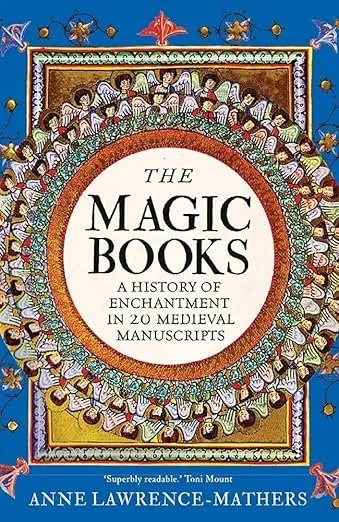
Buy the Book




The Medieval Podcast uses affiliate links.
Transcript
One of the things I love most about humans is our constant desire to engage with the supernatural, especially when it comes to getting a peek at the future. From reading bones, tea leaves, flower petals, or online horoscopes, we can't help but look for a little bit of certainty in an uncertain world and a little bit of magic.
This week I spoke with Dr. Anne Lawrence-Mathers about magic books. Anne is professor of history at the University of Reading and the author of several books including Medieval Meteorology and The True History of Merlin the Magician. Her new book is The Magic Books: A History of Enchantment in 20 Medieval Manuscripts. Our conversation on medieval astrology, palm reading and the magic way to get a university education in just a fraction of the time is coming up right after this.
Well, welcome, Anne, to talk about magic books. It's so nice to meet you. You have such good energy and I can't wait to have other people experience your energy talking about magic books. Welcome to the podcast.
Anne Lawrence-Mathers: Thank-you very much and thank-you for the invitation and, you know, being interested in this subject, which, as you say, I love.
Danièle Cybulskie: Well, who is not interested in magic? There's always some… there's always some aspect of magic that is fascinating and I think that's what comes out in your book: that everyone has been fascinated with magic since the beginning of time. So, I want to start with the fact that there's an intersection throughout the book between church and magic. And I think a lot of people in the public think that the church is totally against magic. If it's not about Jesus, you should just burn the people who are experimenting – with rituals, for example. Is that really what it was like back in the day?
Anne Lawrence-Mathers: No. As you say, I mean, for a start, there was always a difference between the, the sort of high-level theologians and lawyers in the church who were the ones who went in and out of being worried about magic and how do you define it and what are its problems? And people, as it were, on the ground in lower levels of the church and in maybe more distant parts of Western Europe and so on, who were looking for ways to find out things they didn't know, check what the weather forecast was going to be, find out whether a particular battle or war was going to go well or whatever it might be. You know, even if they kind of had a sneaking suspicion that this might be magic, they managed to find ways around that or to justify it to themselves.
Danièle Cybulskie: Yes, this is what I love about humanity as well. There's always a way to justify something to yourself, especially when it's something like magic. So, you start with the early Middle Ages, and you start at a place that is a fairly easy entry point to understanding how these things work together, which is astrology. So, tell us a little bit about astrology and how that worked in the early Middle Ages, where you start the book.
Anne Lawrence-Mathers: Well, in the very early Middle Ages, in most of Western Europe, technical knowledge of astrology had gone, because to do it, you need to know whereabouts in the heavens all the planets – the seven planets that were recognized as planets throughout this period and in the ancient world – were. And to do that in a technical way, you needed planetary tables, which had first been drawn up in the ancient world and then made much more accurate and fuller by someone called Ptolemy of Alexandria in the early centuries of Christianity. But… But although those were known to the Greeks and the Romans, they hadn't really been translated and they weren't needed for early Christianity. So technically, being able to do astrology was almost kind of impossible. And there were sort of shortcuts and simplified ways of trying to do it, which were passed down. But the key things were knowing where the sun was and where the moon was. And that was fine with the church because you needed to know that in order to get the correct Sunday for Easter, because that was tied – well, it still is tied to the Moon's calendar as well as to the spring equinox and therefore to the sun's calendar. And a lunar year and a solar year are not the same length. And a lunar month is kind of complicated because it's not an exact number of solar days. So, you're instantly into all these nice, complicated calculations. But the book starts with the ninth century, when the emperor Charlemagne, who's claiming to be a new Roman emperor, is kind of reviving ancient astronomy and knowledge of the planets and the constellations and the movements of the planets and so on. As part of his concept – or his advisor's concept – of what a true emperor needs to know. I am so tempted to make comparisons with what's going on in the Western Hemisphere at the moment.
Danièle Cybulskie: That's just as well. Well, one of the things that you get at when we're talking about early astrology and starting to sort of re-collect ideas about constellations and things like that – it's one of these things that I thought was so important that you pulled out – where, for example, today we've all established that maps, for example, have north at the top and that is just how maps are. But we had to figure that out and decide and all agree on that. And one of the things that you mentioned in your book is how to look at the constellations. Do we look at them with our view, with our eyes from Earth looking up, or do we… do we look at the constellations as if we are God and looking down? And this is something that I didn't even think about having to figure out or establish or decide on. But this is something people had to decide on.
Anne Lawrence-Mathers: Yes. And it was just as bad in the ancient world because some astronomers said, well, you know, if you're going to make a globe of the heavens, then you're looking at it from outside, so you should do a kind of God's-eye view. Other people said, no, that's not, you know – that's so confusing. It's much more practical if you do it in a fictional sort of way, in a way as if you're looking up from inside, from the surface of the Earth. Because just to get one thing clear, not only in the ancient world, but right through the medieval period, anyone who's doing this kind of stuff knows perfectly well that the Earth is a sphere. Nobody thought it was flat, or at least nobody whose views are actually recorded. That's an insult made up later. And, of course, versions of these globes and what they look like and how the constellations are depicted on them have to be drawn flat if they're going to be in a manuscript, so they get passed on in two different versions. And the result, as I try to say in the book, is wonderful confusion, because in one and the same book, you'll get some things drawn from one angle and other things drawn from another angle. And what becomes very clear is that people who were copying these images had no clearer idea of what a constellation looks like than I do. I don't know how the night skies are where you are, but where I am, they are often pretty cloudy. And, I mean, at the moment, we've been having a run of cold nights here in the UK, so there have been clear skies and you can look up and see the stars. But for me, being able to pick out a particular constellation or even a particular planet can be quite complicated, unless I know that on a given night it's going to be close to the moon or close to some other landmark.
And of course, we think it's obvious that all these constellations and stars just sailed on in the format and with the names that the Greek astronomers had given them. But we have tiny, frustrating little bits of evidence that show that pagan peoples outside of what had been the Roman Empire and outside of Charlemagne's empire looked up in the sky and they saw different star groupings and gave them different names. And it could be really local. We've got one little monk writing in one monastery who decides to pick out Christian constellations and, you know, picks out a cross and calls it The Cross and says, “you'll see this on a particular night when it's hovering over the trees on the far horizon” or whatever, you know. So, part of what Charlemagne does and the people who follow on from him is create this illusion that these basically Greek constellations and Greek names for the planets are somehow just naturally the right ones.
Danièle Cybulskie: I love that. Yes. “It's only this way. This is the only way for it to be.” And to answer your question, here in Canada, we can have clear skies for quite a long time, quite a few days in a row. But there's one sort-of advantage to light pollution, which they would not have had back in the day, where you can see only the bright stars sometimes when you're in the city, and that sort of makes it a little easier. But back in the day, when Charlemagne's astrologers are writing things down, it's even more confusing because there are so many stars in that bright sky.
Anne Lawrence-Mathers: Yes.
Danièle Cybulskie: Yeah.
Anne Lawrence-Mathers: And, I mean, you know, I know a couple of modern astronomers, and I was talking to one and, you know, talking about how people in the Middle Ages could find it difficult to know whether a particular bright star was Jupiter or not, and confess that I have the same problem. And he couldn't believe it. He said, “but everybody knows what Jupiter looks like.”
Danièle Cybulskie: No, no, I'm afraid they don't. I find them all to look very similar, but I know that my perspective is not the only perspective. So, we have astrology as way to predict things, and this is established and it's considered to be okay, even though it's pre-Christian. One of the other ways that I thought was just amazing and early on in your book is the Alphabet of Prognostication. This is really fun. Okay, so moving along, we have different things that people are writing in their manuscripts as ways to decide or figure out the future. This one is one of my favorites from the book. Tell us about the Alphabet of Prognostication.
Anne Lawrence-Mathers: Well, this comes up in a manuscript which raises the same problems that you asked about right at the start, which is, is this stuff okay with the church? Because this Alphabet of Prognostication is there in English, so it could be directly used with people who didn't know Latin – which was officially the Church's language – in a collection of religious texts and prayers and sermons put together for a very powerful monk in a royal monastery next door to the royal palace in Winchester. And it's based on the Latin alphabet, not the Old English alphabet, so it must be a translation of something older. And almost all this stuff at least claimed to come from the ancient world and sort of derived antiquity and status, and it “must be true”, because, you know, the Greeks and the Romans did it, or even more convincing, King Solomon did it, and then the Greeks and the Romans got it from him. So, it's the Latin alphabet, but translated into English. And somehow it doesn't explain how you do it, but you choose a particular letter and then you look up the letter in the list, or the monk owning the manuscript who can read his book, finds your letter for you. And I guess it could be something as simple as the first letter of your name, or maybe you did what they did in church. Sometimes bishops did this. If you needed a sort of guidance for something, you could open a Bible and put your finger on the open page and find a particular word or a particular letter. So, how you do it is left up to you. But then, you know, the reading comes from the letter that you choose. And some of them are very positive, like, “yes,” you know, “this is a good thing to do”, or, “yes, God will smile upon you” or something. But some of them are pretty straightforward: don't do it.
Danièle Cybulskie: Yes. It reminds me so much of a Magic 8 Ball. You know, you're trying to find some certainty, so you just shake this ball, and it will tell you yes or no. But the ones that always were frustrating was maybe they would say “maybe” to you. And this one, it is very focused on God, so that it's not just plain language – as you're saying – yes, no, maybe, or anything like that. Many of them are saying “God's going to help you.” Or there was one, I think it's zed, that just says, “God is amazing,” or something like that, which doesn't answer your question. And so, this is an interesting intersection between, as you're saying, faith and a sort of – I don't know how to say it – sort of like a test of the Universe or something, to try and... to reach out for answers that you can't get any other way.
Anne Lawrence-Mathers: Yes. And I mean, I think in a way it's important that the book is kind of a holy book and the person owning it and opening the book for you and giving you the guidance is a religious person because it becomes almost like a kind of oracle giving you answers from, I don't know, not directly from God, I think that would be too presumptuous, but kind of maybe from the spiritual realm. I don't know. It's not explained. And almost every chapter in the book grapples with this issue of, well, where did they think this stuff was coming from? And angels on one side and demons on the other are fairly straightforward concepts. But a lot of them use the dodge of talking about spirits or spiritual beings or intelligences, leaving it open, well, okay, but what are we dealing with here?
Danièle Cybulskie: Yes, who are we asking? And it's worth talking about this because when we're thinking about things like ordeals, they went by the wayside because you are not supposed to bother God with your trivial questions. And so, who are you asking these trivial questions of? And do they have the authority to actually answer them? Is it random? Is it luck? These are questions everyone's grappling with throughout.
Anne Lawrence-Mathers: Yes. And for theologians, increasingly – particularly from the thirteenth century and good old Thomas Aquinas, who writes, you know, encyclopedias on theology which get picked up by writers of church law – really all these dodges about ethereal intelligences or disembodied intelligences are just kind of guff. There's angels and there's demons, and that's your lot. But a lot of the magic draws on – including astrological magic – draws on the idea of planetary spirits. Because there was lots of debate from the twelfth century onwards when Arabic works of astrology and philosophy and mathematics and so on were being translated into Latin about, well, okay, the planets can cause stuff down here on Earth because they're higher, they're more powerful, they move. And that generates heat and energy in the system. And nobody doubted that the moon causes the tides and the sun causes changes in temperature as well as bringing daylight. And it followed that the interactions of planets had effects on one another, and that the other five planets, not only the sun and the moon, but the other five planets in the system, also had their own particular qualities and powers related to the classical deities that they're named after, but kind of broader than that as well.
So, going back to what you asked about the importance of technical astrology, why you need to know exactly where all the planets are is so that you can understand how they're going to impact on one another. Because Mars can cause heat and bad temper and violence, but Saturn can cause coldness and dryness and caution. So, if they're kind of facing one another across the zodiac, maybe they might cancel one another out. So, what might be a good day for the battle turns into a dodgy day for a battle and that kind of thing. So, you need someone who can do the calculations for you and not only find out where they are, but figure out, well, what is the strongest planet? And anyway, how does all of this relate to you? Because it's all very well to say, well, in a general way, you know, these things are happening. But yeah, okay, fine. But I'm down here, and on this particular day I want to do this particular thing, you know, so that's when you need – or they invoke the idea of – a planetary spirit that you can kind of get to pay attention to you by performing certain rituals, dressing up in certain ways, making certain offerings, burning certain incenses, which is precisely when a theologian says, “look, you are worshipping whatever it is that you think you are worshipping, and whatever it might be, it ain't God.”
Danièle Cybulskie: Well, this is the thing. You have to figure out where the line is. And one of the things that you're talking about that I think is an important distinction as well is if there's something natural happening, do we read this or do we not read this? And is that different from putting a sort of Magic 8 Ball in a manuscript? So, what is the difference between a portent and a prognostication? What happening here? Because they have to figure out what a portent is and whether it's okay to read that and whether it's okay to write down what it might mean. So, tell us about portents.
Anne Lawrence-Mathers: Well, everybody from Augustine onwards accepted that portents happen. And they're not human products. They are, in a way, warnings sent by God, but they're not necessarily transparent to understand. So, often you need a prophet or a saint or the closest you can get to a prophet or a saint to interpret them for you, because otherwise you might get it seriously wrong. And some of it can make pretty uneasy reading for a modern person because they happily say, well, things like monstrous births or particular forms of bodily deformity are portents. And because these things are seen in a negative way, they are negative portents. And more neutrally, you can have portents in the sky of coming weather. And Christ actually refers to the red sky at night thing in one of the sermons as quoted in one of the Gospels. And that is also sort of acceptable. So those are – portents are natural. But you need to know what you're doing if you're going to make accurate sense of them.
Prognostications are things like your Alphabet, where it's a matter of drawing upon supposedly ancient, revealed knowledge. Often and increasingly, it's claimed to be Solomon because of the biblical texts that say that God gave wisdom and understanding of the natural world to Solomon. So, often these things are attributed to Solomon, and they give you tables or alphabets or a geometrical diagram and a set of instructions on how to use them in order to get answers to particular questions. So, that's… A prognostication is kind of a human technology, if that makes sense.
Danièle Cybulskie: Yes, that is what I was hoping you would come up with, because that does seem to be the difference between the two of them. So, it might be worth asking at this point – because your book is based on manuscripts – who is looking at these manuscripts? Who has these manuscripts and who is trained to read them?
Anne Lawrence-Mathers: Well, a lot of them – which is partly why they've survived and why I chose them – are very high-status art objects made for emperors, kings, rulers, but also for abbots, abbesses, princesses sometimes, and monks who could afford to commission them. So, they are high-status objects and they've survived often because they are just beautiful to look at, I think, as well as curious things. Or they've survived because they're in royal libraries or church libraries, which haven't been bombed or set on fire or robbed or something like that. And one of the points I'm trying to make with the book is this kind of magic was not little old ladies going into the garden and picking a few herbs and muttering a few dodgy words and having a pet cat. It's a whole different world from that stuff.
Danièle Cybulskie: Yeah, I think that's important to point out, especially because I think in this day and age, sometimes we can look at things like astrology and assume that it's for people who are “uneducated” – like, “not educated enough to understand the workings of the universe”. Whereas back in the day something like astrology was the height of knowledge. So, it's important to see how society is looking at these things. So, I want to come back around to – we were talking about portents, we were talking about bodies, and in your book, you have something that I had never come across before, which is the earliest Latin guide to palmistry. So, tell us about palm reading back in the Middle Ages.
Anne Lawrence-Mathers: Okay, well, yeah, I mean, of all the extraordinary things – I mean, again, it's a translation into Latin, almost certainly from Arabic. How they got it, we don't know. Where it shows up is in a copy of the Book of Psalms made for Canterbury Cathedral and most likely for the monks of Canterbury Cathedral. And this has led to much speculation about, you know, why were monks interested in palm reading?
I don't think, for a start, that the manuscript is a simple psalter. That's the technical term for a manuscript Book of Psalms, because it's got all three Latin versions of the psalms with little translations and comments not only in Latin, but also in Anglo-Norman French, and some in Old English, and some comments suggesting knowledge of Hebrew, and the Hebrew text as well. And it must have been incredibly expensive to make because every psalm has got these really complicated illustrations at the start of it, and each translation has got a beautifully done initial and so on. So, it's a book for scholars, not to sit and use in church, I think. So, the idea that a bored monk might have practiced reading his own palm, I think no.
Danièle Cybulskie: Well, that's the thing, you know, you imagine these monks, that they've been in the monastery a long time, they're going to start reading each other's palms and figuring out what's going to happen… Sorry, continue.
Anne Lawrence-Mathers: I mean, every monk, for a start, every trained monk was expected to know all hundred-and-fifty psalms of by heart. That's kind of basic. So, no monk should have needed to be reading out of a psalter in church anyway, because by this time the chanting is quite complicated and a lot of monastic chanting is the psalms. So, when the choirmaster says, “right, Psalm 50, off you go,” you do. You don't thumb carefully through your psalter and find Psalm 50. Everybody else is way ahead of you.
And I don't think – this is me, but – I don't think it's any coincidence that they were doing rebuilding in Canterbury Cathedral at the time, including complicated water engineering works and things like that, and that they were in contact with experts in Iberia and in the Mediterranean. And that's where this knowledge of palmistry also comes from.
And it was very rare because John of Salisbury, Thomas Becket's friend and supporter, actually branches off in one of his books to attack somebody – he doesn't give a name, but it seems almost certain to be Beckett – attacked somebody who consulted a diviner or soothsayer and a palmist in Canterbury. And the fact that we have Thomas Becket as John's friend, Thomas Becket in the cathedral at Canterbury at the time, also Chancellor of England, and engaging in decisions – strategic decisions – about when to go in to war in Wales and stuff like that. And this first written version of a text on palmistry – you know, it all kind of fits together.
And you can imagine somebody, if it's not Becket himself, having found out that there is someone who can read palms there, wanting to see what is involved. You know, you don't just naively shove your hand in front of this person and say, okay, tell me my future. So, this is treated as important new knowledge, and it gets written down in Latin. And reading it, you would have to know what you were doing in order to make sense of it. Because the way it describes the lines on the palm is not intuitive and it's not entirely clear when it talks about the higher line and the lower line. I mean, this sounds really basic, but I find it difficult to know, well, which way up is your hand meant to be? Because by the thirteenth century, the palms are depicted in diagrams in this kind of manuscript, and they're exactly as you would expect: wrist down, fingers up. But the way the hand and the lines are described in this text, to me, makes more sense if it's describing what the palmist would see, which is fingers down, wrist up.
Danièle Cybulskie: Which brings us back around to the constellations, right?
Anne Lawrence-Mathers: Yeah, yeah. And as I say, you can see that as time went on, people were finding this text a bit tricky, too. So, you start to get much more modern-looking diagrams and fuller versions. But this early text is not so much interested in the lines. It does talk about the lines, but what it's really interested in is the extra stuff, signs that might get added to the lines or close to the lines on your palm. And particularly these are important because they're going to tell you how you will die.
Danièle Cybulskie: Mmmhmm. It's something that I think a lot of people would like to find out – or maybe would never like to find out – and something you're really not supposed to do when you're talking about other people, like kings. You're not supposed to figure out when the king is going to die. But I could see people wanting to have a peek as to when they are going to die. It seems like something that many people might want to plan for. So, we are talking about monks, and these are the people who are trained and educated. And one of the interesting books that you have pulled out is one that's supposed to give you a shortcut to learning. So, what is this book that's supposed to give you a shortcut to knowing everything for the discount price instead of buying all the university textbooks?
Anne Lawrence-Mathers: Well, it's called the Ars Notaria. So, it's not about being a notary, though those did exist in the Middle Ages as well. Why “notaria” is not at all clear. But anyway, that's how it comes into Latin Europe. And as ever, it claims ancient origins, and this time claims to be a divine revelation from God via a particular angel to Solomon, which then solemnly gets written down and transmitted to the ancient world and then to the medieval world. And as you say, it promises that if you carry out accurately some really quite complicated and demanding rituals, you can put yourself through the equivalent of maybe a ten-year set of university degree courses and come out knowing not only all of your selected higher education subjects, but also, at least in some versions of the book, the art of magic as well.
Yet again, it comes back to observation of the planets, and particularly the sun and the moon, because you've got to time your rituals so that the preliminary buildup will last up to something like eight days. And they've got to be eight days terminating on a Sunday, which must be the last day of a lunar month. So, you need to know whether this is a lunar month of twenty-nine days or thirty days, and is it, crucially, going to finish on a Sunday, and if not, what do you do about that? Because a thirty-day lunar month ending on a Sunday might not come around for months.
So, it looks all very simple, but in fact it isn't. And it makes sense that if you're going to get this great divine gift of wisdom and knowledge, you've got to be in the right state. So, you've got to sort of shut yourself away, go to church and hear masses, or maybe even have a sort of priest in your household who can say services and masses for you. You've got to be able to pick laurel leaves, or basil leaves, or bay leaves or something, soak them in a special liquid in which you've already soaked saffron. Then you write words on your soaked leaves, and you soak those off, and you sip your solution through your eight days of preparation. You ain't even started on the ritual for learning your subject yet. Because then, you might want to work through the university syllabus as it developed from the twelfth century, and start with the basis, which is Latin grammar, and say you're going to do that, having got yourself into the right state of mind,and the right day of the lunar month, and the right day of the week. Then you open your book to the prayers for grammar, and in effect you have to memorize these again, because you've got to recite them, including great long names with unpronounceable strings of sort of Latin and Greek Letters. I mean, good luck to anyone trying to pronounce them. And you've got to have books with instructions for grammar open around you so that, in between reciting these prayers on these strings of names, you can refresh your memory on what is involved in the art of grammar. And then, having carefully prepared, you have to do all this while gazing deep into these strange diagrams with yet more strings of peculiar words inscribed inside very weird geometrical patterns, and symbolic figures, and things.
And you can see why people found it really dodgy. You know, “what are these strings of names? What are you summoning?” It's all very well for the book to claim that it's holy and it's a divine revelation, but, you know, just because the book says it doesn't necessarily mean it's true. And in fact, Thomas Aquinas – it's clear that by the thirteenth century, this thing was understandably popular in universities – and Thomas Aquinas, in his encyclopedia on theology, goes out of his way to devote a few paragraphs to condemning this book.
Danièle Cybulskie: Yes, it almost feels like it could have been written by a professor who was like, “you know what, it's going to be easier to do – just do your lessons,” because it's so complicated. But one of the things I think that is so important that you brought out is that it's popular because university is expensive and people want to learn things, and so they're going to try their best. And so, I think that the compassion you put in there for these poor people who are trying to just learn and can't afford a university education, I think that's something that I felt was really worthwhile that you pulled out.
Anne Lawrence-Mathers: Yes. And if you've got access to a library, you don't have to own these books yourself, necessarily – the books on grammar, for instance – because you could go and copy them for yourself. And in fact, students in the Middle Ages, if they weren't well off, often did laboriously copy out their own textbooks, sometimes by borrowing them and copying them, other times by taking down notes from readings in lectures and things. So, it's an idea that they’re used to.
Danièle Cybulskie: Yes.
Anne Lawrence-Mathers: And it kept on being popular, despite Aquinas going out of his way to condemn it. And despite how long drawn out all the instructions were that I'm talking about. As time goes on, you get new and sort of tidied up and supposedly sanitized versions, and simplified versions. And you can see that people were trying to make it work and maybe trying to simplify it, because we have lots of different manuscripts of it, but almost all of them are a bit different. By the sixteenth/seventeenth century, it's gone into print. But in a real, cheat’s version – you only need about a week in this version.
Danièle Cybulskie: Well, you gotta make it more efficient if you're gonna sell copies, right?
Anne Lawrence-Mathers: Yeah.
Danièle Cybulskie: All right. So, near the end of the book, you come across – or we come across – one of my favorite figures, who is Christine de Pizan. What does she have to do with magic?
Anne Lawrence-Mathers: Well, as I say in the book, she was the daughter of a royal astrologer in the court of France. He was Italian, hence her surname: de Pizan. He was Tommaso da Pisano, and a physician and astrologer who was sort of personally recruited by the king of France, Charles V, to come to Paris and to the royal court. And very, very unusually, his clever daughter Christine seems to have been given free run of the royal library. And it looks as if she can read Latin as well as French. And she refers to, you know, learned works by philosophers like Aristotle and so on. And she is very keen on the idea that kings almost have a duty to consult astrologers, because expert astrologers are the ones who can do all the technical stuff about where the planets are, where they will be at a certain time in the future, what their interactions and influences will be, and so on. And at one point, she admits that it's so technical and so difficult that they may not agree. She does actually say that it's the duty of a king not only to consult an astrologer, but actually to consult several and see what they all have to say.
Interestingly and again, uniquely, she was chosen by Charles V's successor to write the biography of the dead king, Charles V. And in this, she goes out of her way to praise him for his wisdom in consulting astrologers and even in studying astrology himself. And she does not say that he studied magic, but we still have the catalogue of his royal library, which shows, as I talk about in the book, an incredible number of books of magic, including one which seems helpfully to be in French, which is just happily entered into the catalog as “Book of Necromancy”.
Danièle Cybulskie: I mean, we all need one of those, right?
Anne Lawrence-Mathers: Yeah. Sadly, it doesn't survive.
Danièle Cybulskie: Yes, well, I mean, that's not a surprise. I think someone probably disposed of that one as attitudes started to change. And for people who listened to – I did a miniseries about Charles VI this summer – for people who listened to that, you mention in your book that magic becomes a dangerous thing around the court of Charles VI. What's happening there?
Anne Lawrence-Mathers: Well, I mean, I tell some of the stories. And, I mean – I know you're an expert on all this stuff as well, but – it really makes your hair stand on end, you know, some of the accusations that were made and the fact that effectively a royal princess, an Italian princess who's married to the king's brother – or nephew, depending which king you're talking about – is effectively – Valentina – she's driven out of court by suspicions that she is using magic to get the king, whose health and perhaps sanity are failing, to show particular favor to her. And, of course, a foreign woman having this kind of supposedly undue influence... How do you get rid of her and damage her husband politically into the bargain? Well, you don't necessarily use the word “witch”, but you come very close to it. And so, Christine, I think, has to be incredibly careful as a woman writing about this kind of subject matter. And she uses, a lot, the ancient mythologies and the idea of Parnassus and the classical gods and so on. And she does not – even in the biography of the dead king – she doesn't really comment on political goings on and political factions and things at all. And she is very clever in the way that she toes that line, I think.
Danièle Cybulskie: Yes. And she does disappear from Paris when things get dodgy there, because she does not want to be there for so many reasons. But, you know, being close to that court where there are people who practice things that might seem dodgy at a moment when France is falling apart… Yeah, it's a good idea for her. We think she went to a nunnery – convent. That seems like a smart idea.
Anne Lawrence-Mathers: Yes. Well, I mean, she had the example of what happened to Joan of Arc, who she actually supports. But amongst the accusations about Joan were things that were tantamount to witchcraft. And she was alleged to have had a mandrake root in her possession and a dodgy ring, according to some sources, as well as, of course, wearing men's armor and that kind of thing. So, yes, going into a nunnery would be wise in all sorts of ways. But what really surprises me about what was going on in that court is that people would quite openly hire individuals identified as magicians to come and try to cure the king. And they only get condemned if they fail.
Danièle Cybulskie: Yes. Well, this is interesting because as I was reading the chronicles in preparation to talk about Charles VI, everybody is saying it's medical, it's physical. But there's a point that's chronicled where Charles himself says, “whoever has cast this on me, can you please stop? Because this is so difficult for me.” And so, it seems like this would be sort of a good opportunity if you're a magician, to say, “I can help with this.” But in a climate where people are starting to think in the direction of witchcraft as we think about it today, is there anybody – Why would you call yourself a professional magician? And this is where you end the book: with professional magicians. Who are these people? Are they nuts?
Anne Lawrence-Mathers: I know. Well, I think clearly you needed a powerful patron, and you needed a good relationship with your powerful patron. And to do that you needed to be able to supply knowledge and advice that other people couldn't. So, you know, in the UK, the most famous example is John Dee and his role in the court of Elizabeth I, and then the fact that he comes to the attention of powerful individuals in the Holy Roman Empire as well. And he had a whole package of things he could offer to rulers, like up-to-date, cutting-edge mapmaking, navigation, being able to transmit secret messages in code, and so on. But what he's really interested in is trying to talk to spirits and angels.
Danièle Cybulskie: Yes, we were talking about John Dee a couple of months ago on the podcast and that stuff is just wild. It's just absolutely wild.
Anne Lawrence-Mathers: I mean, I think maybe we just know more about him because, you know, more of his notebooks and letters and things survive. But what interests me is for a long time, individuals like him were seen as kind of unique to the Renaissance period. But I think there's a straight line really between a lot of what I'm talking about and what he's doing.
Danièle Cybulskie: Do you think that this maybe has something to do with, as well, magic in the early modern period sort of being more accessible? So, I'm thinking about the academic professional magic being more accessible to people on the lower rungs of the socio economic ladder. Because you do have some examples in here of sort of ordinary people getting prognostications done. Do you think that that maybe also has something to do with why we associate this with the Early Modern period?
Anne Lawrence-Mathers: I don't know. I mean, because people like John Dee and you know, his equivalents in continental Europe as well, were far more learned, learned several learned languages, not just Latin, put together a huge great library. So, your ordinary middle-class person couldn't hope to do that. And hence, you know me saying that that kind of person, to survive and be successful, needs to offer something really unusual to their paying patrons. But down at the more ordinary level, you have university-educated but middle-class playwrights like Marlowe, who consulted a book of ritual magic before writing – or probably while writing – his play about Dr. Faustus. So, when I saw a performance of that play, I thought, wow. Yeah, a lot of this stuff really does relate to the kind of books that I've been reading. And of course, you know, he's writing in English, and books are circulating in English and in print, so they're still more expensive than an ordinary farm worker or shop worker could probably afford. But most people down to the urban, lower middle classes are sending at least their sons to school, so they learn to read. And textbooks are kind of affordable for maybe a few weeks’ pay. And so, shortened versions of some of these things in English and in print are certainly much more accessible. So, people are kind of doing DIY prognostication.
Danièle Cybulskie: I love that. I mean, people are doing that today. DIY prognostication.
Anne Lawrence-Mathers: Yeah.
Danièle Cybulskie: I mean, when I was Christmas shopping, I came across the Magic 8 Ball as a keychain. So, everybody can prognosticate these days.
Anne Lawrence-Mathers: Yes.
Danièle Cybulskie: So, as we come to the end of our time, what do you want to say to people when they come across things that look suspiciously magical if they're looking at medieval manuscripts? And you do encourage people at the end to look at digital manuscripts. What do you want to say to people as they come across these things, looking at the Middle Ages?
Anne Lawrence-Mathers: Oh, that is an interesting question, I suppose, to think, well, if it looks magical, why do I think it looks magical? Is the word “magic” or some Latin equivalent actually around there? What's the manuscript overall? How likely is it that it would be magic? Or is it some very complicated geometrical diagram, or technical, astrological? So, we tend to think that all of astrology was always kind of dodgy and magical, but it wasn't. They didn't make a clear distinction between what we call astronomy and what we call astrology. So, you might actually be looking at a scientific textbook. So, I guess what I would say is, yes, be on the alert and look out for magic, but also question how it relates to sort of modern assumptions about what magic actually is.
Danièle Cybulskie: I love that answer because we should always question our assumptions from here about how we're looking at these things if we come across them in medieval texts. So, thank-you so much, Anne, for coming on and telling us all about magic books. It's been an absolute pleasure talking to you.
Anne Lawrence-Mathers: Well, thank-you so much. That was really interesting for me. Thank-you.
Danièle Cybulskie: To find out more about Anne's work, you can visit her faculty page at the University of Reading. Her new book is The Magic Books: A History of Enchantment in 20 Medieval Manuscripts. It seems that someone has either blessed us or cursed us to, as they say, “live in interesting times”. So, today, I thought I'd bring some words from one of my favorite authors, Christine de Pizan. As Anne and I mentioned in this episode, Christine lived in one of the most chaotic periods of French history, made more difficult by being widowed with three young children. Christine talks about her struggles with her husband's debt at various times within her work, but very specifically gives fellow widows advice in her Book of the Three Virtues. Her advice begins by telling these women to put their faith in God, who will help them to learn patience. Next, they are to kill their enemies with kindness, being good to everyone in order to, as she says, “conquer and bend the hearts of evildoers.” Finally, she says, it's best to avoid “those who want to beat you down” when you can. But Christine knows the meek won't inherit the earth just yet. “Speak gently,” she says, “but look out for your rights.” Someday I'm going to put that on a t-shirt.
You can find these words and more of Christine's work in The Selected Writings of Christine de Pizan, translated by my friend and friend of the podcast, Renate Blumenfeld-Kosinski and Kevin Brownlee.
Thank-you to all of you for supporting this podcast, whether it's letting the ads roll, sharing your favorite episodes, or by becoming patrons on Patreon.com Like Christine, I'm a single mom who depends on patronage to feed my kids and create my work. So, thank-you to all of you generous souls on Patreon. I really hope that you're enjoying the articles I've posted there, as well as the announcements of cool things I've found and can't wait to share. On January 30, I'll be doing my first live Ask Me Anything video at 1pm, including some reviews of medieval novels I've read lately, so go ahead and get your questions in. To find out more, please check out patreon.com/themedievalpodcast
For the show notes on this episode, a transcript, and a huge collection of past books featured on The Medieval Podcast, please visit medievalpodcast.com. You can find me, Danièle Cybulskie, on social media @5minMedievalist or Five-Minute Medievalist. Our music is by Christian Overton. Thanks for listening and have yourself a fantastic day.