A Medieval Paper Armoury with Chassica Kirchhoff




The Medieval Podcast uses affiliate links
Episode 348
To picture the Middle Ages is to picture knights in shining armour. Custom-made, fashionable, and often beautiful, medieval armour was more than just practical: it was art. And in the late Middle Ages, a collection of talented artists captured the functional elegance of armour on paper. This week, Danièle speaks with Chassica Kirchhoff about armour as protection, art, and memorial in the Thun-Hohenstein Album.
-
Danièle Cybulskie:
Hi, everyone, and welcome to episode 348 of The Medieval Podcast. I’m your host, Danièle Cybulskie.
To picture the Middle Ages is to picture knights in shining armour. Custom-made, fashionable, and often beautiful, medieval armour was more than just practical: it was art. And in the late Middle Ages, a collection of talented artists captured the functional elegance of armour on paper.
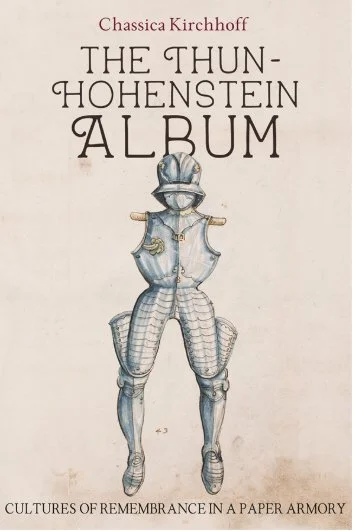
This week, I spoke with Dr. Chassica Kirchhoff about the Thun-Hohenstein Album. Chaz is associate curator of European Sculpture and Decorative Arts at the Detroit Institute of Arts, and the author of many works on arms and armour. Her new book is The Thun-Hohenstein Album: Cultures of Remembrance in a Paper Armory. Our conversation on armour as protection, art, and memorial is coming up right after this.
Well, welcome, Chaz, to the Medieval Podcast. I'm so excited to have you here because this is one of the most interesting sourcebooks I've come across in a long time. So, welcome to the podcast.
Chassica Kirchhoff:
Yeah, thank you so much, Danièle. I really appreciate the invitation, and I love nothing more than to talk about armour.
Danièle Cybulskie:
Yay! That makes two of us. So, okay, we're talking about a specific book which we're going to get to in a second. Tell us when and where we're talking about in the creation of this book.
Chassica Kirchhoff:
So, this is a book that really spans a critical moment within the golden age of armour, as well as its kind of afterglow through the Renaissance and early modern period. So, my book focuses on the Thun-Hohenstein Album, which is a bound collection of 112 drawings of armour, encasing people or in pieces. And the earliest of those drawings was created around the 1470s, and the latest was created probably around 1590. And the whole thing was bound together at the very beginning of the 1600s. So, we really do get this wide spectrum of material culture, of sort of cultural development within the concept of the knightly identity. But most of the images focus on the reign of Emperor Maximilian I. So, Maximilian was born in 1459. He passed away in 1519. And so, this is a period, as you can imagine, that is immensely important for the late medieval sort of flowering of chivalry. There are German-speaking scholars who refer to it as a kind of Ritterrenaissance: a knightly Renaissance. And one of the other things that I find really compelling about this period is not only is it rich in terms of artistic production and cultural shifts and fabulous – almost what we would call nostalgic – literature looking back at earlier periods of the medieval past, but it's also a period of great change. Maximilian is born into a world where printed word and image are relatively new technologies; where there is, you know, a single universal Catholic Church; where what is now considered the Eastern hemisphere was essentially encompassing the entire known world. And by the end of his life, all of those things have completely changed. So, it's a time period that really is, I think, a pivotal moment in our understanding of the kind of continuities of the medieval past, right? Because Maximilian would have considered himself to be the heir apparent to the great medieval emperors and even going back to Charlemagne, but at the same time in his lifetime, and then in the bound collection that we're looking at that goes through the end of the sixteenth century, we can also see the ways that there are these echoes of medieval knighthood that get picked up and sort of celebrated even into the early 1600s. So, it's kind of a longue durée study, but I think it picks up moments that are extremely, extremely salient for both the study of visual culture and arms and armour, but also just general cultural history.
Danièle Cybulskie:
Yeah, for sure. I love the way you talked about this as being one of the last flowerings of chivalry, because I think more people who are listening to this podcast are familiar with the English period that we're talking about, right? So, we're talking about, like, Edward IV and he's sort of redoing tournaments, and then, you know, even towards Henry VIII, he's enjoying having tournaments, and armour, and things like this – trying to look back towards the Middle Ages, and – as you say – sort of continue this. And I think it's so interesting that even as we're looking at – on the actual battlefield, there's more gunpowder and things like that – there's still a real interest in armour.
Chassica Kirchhoff:
Absolutely. And I think... I think frequently we think about the genesis of firearms technology as sort of the end of armour. But in reality, plate armour – as we sort of imagine the knight in shining armour, this quintessential medieval body – really existed completely continuously alongside firearms. Now, we have to acknowledge that those firearms were becoming increasingly accurate and useful in that they were not so much. In the fourteenth century, if you died of gunshot, you were a very unlucky person. But when we think about plate armour, it really was engineered to resist these kinds of weapons. And when we read receipts, for instance, for armour delivered to Maximilian I in 1480, those receipts describe, quote, “clothes of test”, which means that it's armour that's been tested against firearms, and probably also crossbow bolts. So, these were technologies that existed perfectly in parallel through the end of the sixteenth century, which I think is always an important reminder, right? Because we think of, you know, the medieval as ending maybe at 1500 or at 1517 with the Reformation. But one of the things that I always talk about when I'm leading tours in the museum or speaking to folks is that no one was looking at their watch and saying, okay, we're in the Renaissance now, we're in the Early Modern. And that's very much what my book engages with, is this idea of continuities. So, going back to your question about knightly culture on the continent in the fifteenth century, there was such a blossoming of interest in courtly culture – in knighthood – both because people were reading a lot – it's sort of relatable to us, right? People were reading the great Arthurian romances, they were reading Parzival, they were reading Wigalois. They were really interested in this idea of chivalric archetypes and sort of embodying those archetypal personae. But they also really loved a tournament. They loved to participate in this knightly culture. So, for instance, Maximilian was famous for – and very proud of himself for – developing completely new types of tournaments. So, he actually came up with new kinds of joust. Some of them involved spring-loaded shields that would fly into the air and break into pieces when they were struck by an opponent's lance. And these were aspects of his sort of martial culture – and in some ways technological culture – that surrounded him that are then remembered in the Thun-Hohenstein Album. So, the third chapter of my book is called Ritterspiele und Gedächtnis. It’s a quote from a source related to Maximilian, but that literally means “knightly games and memory”. So, it's this idea that not only are they, you know, super fun and spectacular courtly events in the moment, but they're worthy of remembrance. And the equipment used in these specialized types of tournament – these specialized types of knightly pursuit – then can be represented and encompass the meanings of that whole event. So, there are these interesting – sort of very multilayered – kinds of moments that we see at the end of the fifteenth century that create these, like, long echoes of experience.
Danièle Cybulskie:
Yes, I love that. Okay, so we've talked a little bit about this reflowering of chivalry happening at this moment. We talked about Maximilian and his innovations when it comes to armour and especially tournament and things like that. So, it sounds like a good time to get into what the actual book is, because you call it in your subtitle a “paper armory”. Tell us about this book.
Chassica Kirchhoff:
Yeah, so as I, as I mentioned a bit earlier, this is a book that is essentially a bound collection. So, it's made up of 112 drawings. And those drawings were made over a course of over a century. They were created by about eight different folks. And these are artists who we call book painters. So, they were professional artists, most of them, I think, working in the city of Augsburg in southern Germany. And book painting is one of those interesting in-between types of art making. So, they were not quite illuminators. They weren't using gold leaf. However, they were using gold and silver washes, which are really fabulous, because when you look at the drawings of armours in this book, they really do sparkle. And you can see bits where they've picked out rivets or passages of decoration with gold. So, they're really sumptuous, beautiful images. And the images themselves represent armoured bodies, both standing fashionably – very much like fashion plates – and also in motion. So, fighting, charging in the joust, all of these interesting little vignettes. And many of the images in the album also represent disassembled pieces of armour. So, they become what I call object portraits. So, they're very meticulous, often recognizable images of armours that were the height of luxury production at their time. And many of these objects, because they were so special, survive now in princely armouries in places like Vienna or Madrid. So, it's this fabulous book that for a very long time was assumed to be the sketchbook of armors, but the new analysis that I was able to undertake after the book sort of reemerged from a long absence following its loss after the Second World War – I was able to actually identify it as this composite work that was made over a period of decades. And I was able to identify most of the images of armours and armoured bodies as being retrospective. So, these are drawings that were made years, or decades, after the armours were made and originally worn. So, as you mentioned, you know, the subtitle is… refers to a paper armoury, but the full subtitle is Cultures of Remembrance in a Paper Armory. And that was something that I wasn't necessarily intending to write about when I began the project. But as I followed the clues that the work and the objects that it represents gave me, I started to realize the extent to which, you know, armours were really important sites of memory for people during the period. So, this idea of a paper armoury – a collection of paper armours that can be seen as windows into moments, or personae, or types of art making that have existed before – is something that is really central to the project.
Danièle Cybulskie:
Well, let's say more about this because this is where you start in your introduction, especially – talking about memory and how armour is specifically a really beautiful way of remembering people. So, tell us a little bit about how armour is a great way of remembering somebody.
Chassica Kirchhoff:
Yeah. So, really, more than almost any other medium of artwork, armour creates this kind of persistent echo of a person, because steel plate armour was fitted to its wearer's body. So, if you ordered a luxury armour, it wouldn't just be like an off the rack piece of clothing – it would be a bespoke suit. So, every measurement would be fitted to your body in that moment. So, I often say that standing in front of an armour – standing in front of what we historically would know as a harness, a head-to-toe armour – is the closest we can come to standing in front of a person who lived in the fifteenth or sixteenth century. It really does create kind of an index for that person's physical presence. So, in that way alone, it echoed medieval and Renaissance conceptions of how memory worked. So, you get this fantastic sort of Aristotelian and Platonic discussion of memory as the impression upon a wax tablet. And this is something that we encounter in the medieval era frequently in texts related to the ars memoriae: the art of memory. So, as I was thinking about armour and thinking about this practice of collecting and displaying ancestral armours which was super popular throughout the fifteenth and sixteenth centuries, I started to realize the way that it paralleled how people who viewed these objects would have considered their own process of making and recalling memory. So, it was kind of… It was one of those aha moments. And it was a discovery for me that was, like, kind of poetic and beautiful in the sense that, you know, I've always found armours to be extremely charismatic. You handle something like a gauntlet, and you think about not only the movement of the hand, but the scale of a hand. And again, this idea of a kind of ghostly presence of the wearer comes through. And so, to find a primary source, foundation for a period understanding of that feeling, I think was really magical.
Danièle Cybulskie:
Well, I wanted you to speak about this a little bit more because I think that that is the sort of feeling that you get when you stand in front of displayed armour, when it's all put together and all of a sudden you get a sense of the dimensions of that particular person in a way that, as you're saying, you really don't get – even if you see something that is maybe a miraculously preserved piece of cloth, rarely do you get that same sense of, like, this is the entire person and how they would have fit within this object or series of objects.
Chassica Kirchhoff:
Yeah. And I think we see that also with child armour. So, that's the other thing about armour is that contrary to the Game of Thrones show – there's no breastplate-stretcher. So, the armour really is an index of a particular moment. Now, there are things that you could do to expand it. I have a breastplate in the collection of the Detroit Institute of Arts that actually has had strips added along the sides. It was probably made for Maximilian I when he was about twenty years old. And so, you can imagine – you know, not everybody retains that svelte silhouette. But ultimately there was only so much you could do to make armour adjustable. So, it really has this sort of almost photographic quality of being able to recall a certain person in a moment of his life. And I'll circle back to this idea of child armours because frequently we get childhood armours, you know, made for princes. It was a huge flex to even make armours for children because they would outgrow them and it's a huge expense. I mean, they were sometimes as expensive as a small middle-class home at the period. So, it really was conspicuous consumption. But frequently, we also see that childhood armours get saved and displayed by the family for generations afterward. And I talk frequently – when I give tours or discuss this with audiences – I talk about how these are sort of the bronze baby shoes of the period.
Danièle Cybulskie:
Yeah.
Chassica Kirchhoff:
You can point at them and say, oh, you were this big when you were ten years old and we got you this armour. So, they have sort of a sweet quality to them that we don't necessarily always think about when we think about martial objects.
Danièle Cybulskie:
So, when we're talking about the Thun book, it's interesting because one of the places you start in the book is talking about it in the context of fight books, because – especially in the German-speaking lands – we have a lot of fight books at this time, where people are drawing what it looks like to fight. But this is not the same thing. So, can you tell us about this book in the context of the fight books?
Chassica Kirchhoff:
So, fight books are such an interesting and actually increasingly well-researched part of medieval visual culture. So, we also call them martial treatises. And they were essentially instruction manuals for different systems of fighting, frequently based around a longsword. So, maybe a hand-and-a-half longsword, if people want to envision the kinds of weapons being used in these texts. There were also types of instruction for wrestling, which was considered kind of the base of all martial practices, as well as discussions of mounted combat; how to fight against a mounted opponent, if you were on foot; combat in both armour, and without armour. So, they're this really wide-ranging and interesting type of sort of didactic literature, right? But they become really image-first during the fifteenth century. So, they grow out of a tradition that is text-based – both in Latin and the vernacular – that sort of becomes more and more laconic as it moves on. Because, as you can imagine, it's really hard to learn to sword fight by reading descriptions of how to sword fight. So, we think the way people were using these was as a mnemonic device. So, they were going to the fechtschule – going to the fencing school – and learning from the master. But then they would go home and try to recall that information. And they would use what we call zedel, which means notes. And they were these little, sort of easy-to-remember verses that described different maneuvers. And ultimately, what happens with the fight books is that some of them become completely atextual. And instead of using those little notes, they use images. I mean, I can imagine that that was – at least for the way that I think – quite a bit easier for thinking about how to move with the sword, whether in armour or not. But we don't think that they would have been useful as a didactic source in their own right. They would have had to have been paired with physical practice – with physical learning. So, in many ways they became sort of an art form that celebrated martial identity, that advertised the knowledge of certain fencing masters – people like Hans Talhoffer, or Paulus Kal, or Peter Falkner – but also were highly collectible by people in the princely classes. Obviously in the knightly classes, but also by people in the urban patriciate, and even upwardly mobile middle-class folks could commission these books. And frequently, they commissioned them alongside participation in fencing schools in cities like Augsburg. So, these became a super popular, and sort of broad-ranging type of visual culture. And the same book painters who were working on these fight books were creating the kinds of drawings that we find in the Thun Album. So, we know that they were sort of using that fight book tradition as a way to visualize what an armoured body in motion should look like. And then we get conversations between the corpus of fight books or martial treatises and other representations of the armoured body, not only in the Thun Album, but in illuminated manuscripts, in paintings and sculpture. So, we can start to see the kinds of dialogues between different artistic media during the period.
Danièle Cybulskie:
Well, it's so interesting because you do have, as you were saying, some people looking like fashion plates in this, in that they're posing with their arm bent or, like, one foot out, or some of them... I think one of the ones that really struck me was there is an image of armour as if the person is sitting astride a horse, but they're sitting astride a stool. So, it looks almost like there's a person who's actually posing for this. So, it begs the question, where are people getting their sort of inspiration? Where are they getting the sources for creating these pictures?
Chassica Kirchhoff:
Yeah, so that's kind of a six-million-dollar question. And in some cases, we know, and in some cases, we don't. So, you mentioned the fashionability of some of the images and the ways that they look. They look very much like a GQ photo shoot currently – these really modish poses. And I think it's important to underscore the extent to which armour is always fashion. There is always a dialogue between the forms of armour and the forms of fashionable menswear during the period. So, I think it's really important to think about: the ways that it functions not only as a defensive surface – as this kind of carapace of steel – but also as haute couture. In many ways, it's an object of display, but also – beyond that display capability – some of the images in the Thun Album I think really relate to direct experience of armoured bodies. So, that image that you reference of the person sort of sitting on the stool that looks… looks a bit like a hobby horse. It's kind of funny. It's this little three-legged stool that is very similar to the types of stools that we would see jousters sit on in between tournament runs. So, while you're waiting to mount your horse and participate in your joust during the tournament, you're seated on a stool like this. And the person in that image is wearing a type of armour made for a joust called the Rennen, which is also known as the Mock Joust of War. So, it's a type of joust using sharp lances. It was quite dangerous. Maximilian famously loved this type of joust. And it's actually one of the ones that he proliferated into different types, including the one with the flying shields. So, there's this aspect of the experience of a tournament that you start to get as you flip through the pages of the Thun Album. And one of the things that I absolutely love is that image of the jouster seated on his little wooden stool – maybe waiting to enter the lists – is followed by an image of the same armour hanging on a wooden peg as if in an armoury. So, it's like it's been worn in the tournament, and then it's been hung up and put away. So, that's one of the other things that I find really poetic about the album is not only the way that it represents all of these interesting facets of armour, and the armoured body, and how it moved through space and was perceived by artists, but also the way that the compiler made intentional choices that sort of tell us a story.
Danièle Cybulskie:
Yes, I love that. Of course, the ones that really speak are the ones that involve a human figure, whether they're doing something or they're posing. But there are so many images in here that are deconstructed armour. And this is really interesting in its own right, I think, in that it reminds me – and I think that you're gesturing at this when you're talking about paper armouries – it looks like a paper-doll-type picture in that you have the armour as if it's been unfolded, so you could just cut it out and fold it onto your paper doll. So, tell us about why you'd want to have these pictures of deconstructed armour next to the pictures of people in motion, in action.
Chassica Kirchhoff:
I think it's because they come from different parts of the sort of world of visualizing armour. So, deconstructed images of armour, I think, look sort of strangely modern to us. They have, like, a satisfying mechanical quality. It's almost like an IKEA instruction manual. Something for your armour.
Danièle Cybulskie:
The layout on the page, I think, is very satisfying.
Chassica Kirchhoff:
It is. It is. And I think that paper doll relationship is something that we very much see. One of the things that I love about the images of disassembled armours is that they show you all the parts. So, it's not just a schematic breastplate or gauntlets, but it shows you, you know, potentially a little set of threaded bolts for you to use to add the reinforcing elements onto the armour if you want to use it in tournament. All the little pieces. In some cases, you even get images of the matching spanner that would be delivered alongside the armour so that you could get in and out of it. So, there are all these beautiful glimpses of the kind of mechanical elements of the armourer's art. But I also want to emphasize that those also connect to a wider visual tradition. So, that's the beautiful thing about the Thun Album is that this bound collection of drawings has all of these possible little tendrils of connection that extend outward to other parts of martial visual culture in the fifteenth and sixteenth centuries. So, one thing that luxury armourers would do when they were working with a patron is that they would create these schematic drawings. And so, we actually have some that survive from the sixteenth century, where armourers would sort of sketch up what the different elements would look like, and they would send them to patrons and say, oh, what do you think about this? Please send me your doublet back so I can take your measurements from it and make sure that everything fits correctly. And similarly, we see these images of disassembled armours arranged across the page in other contexts. So, we see them in inventories. And I speak at length in the book about the illuminated inventory of Charles V, which is this amazing collection of images that, like, perfectly document not only the armour, but also the banners, and clothing, and tournament equipment that belonged to Emperor Charles V. And in those instances, we also see these kinds of images of objects – these object portraits, right? – that we see throughout the Thun Album.
Danièle Cybulskie:
Well, I love that – having sort of a commissioned picture, because when you're talking about how much effort, how much money, how much time goes into creating bespoke armour, you know, you want to make sure that you have it right before you start building it, right? So, sending this out and saying, what do you think of this design? I think is such a human part of that whole process. And it's so nice to see these images right in front of you.
Chassica Kirchhoff:
Absolutely. And one of the things that I really love about it is the extent to which the artists who created the Thun Album drawings – so, I mentioned, there were eight of them, they were probably an Augsburg – of those eight, two appear the most frequently. And one of them, at least, seems to have been involved in an inventory project similar to the inventory of Charles V. The other one seems to have been a very talented book painter who had quite an awareness of imperial commissions from the period, so commissions like the genealogy of Maximilian, created by the great printmaker and painter Hans Burgkmair. So, both of these artists really had a deep awareness of the kinds of visual culture, and also maybe the mechanisms of patronage, that were activating art making at this time. But one of the things that I love the most about them is that they represent armour – whether it's on a body or disassembled in pieces – they represent it with such care and sensitivity. And we can imagine the ways that, you know, Augsburgers at this time – particularly Augsburg artists, who probably knew armourers, maybe lived down the street from them – would have really been aware of the skill, and the expense, and the effort that went into creating these kinds of objects. So, in some ways, what we see in the album is this kind of love letter from one type of artist to another.
Danièle Cybulskie:
Yes, that loving recreation of these things, because, you know, you see things from one type of art to another where you have an artist who's maybe amazing with paint, and would love to be a sculptor, but is no good at doing sculpture, so they can paint what the sculpture looks like. So, it feels a little bit like that sort of artistic community of mutual admiration, perhaps, that you're getting it.
Chassica Kirchhoff:
Absolutely. You know, one of the things that I really love about this idea of artistic dialogues in the period is that I think they're really exciting for us because, I mean, we have friends who are in other fields who we really want to celebrate and uplift, but also because they expose the connections that existed during the period that we might not otherwise make. So, one of the things that I'm working on currently is a new research project that really focuses on the experiences and cultural and artistic networks of armourers themselves. And I love discovering the ways that the armourers were connected to all these other crafts in Augsburg. In particular, they were in the same guild as not only the blacksmiths and the goldsmiths, but the clockmakers, and the painters, and the printmakers. So, everybody sort of knew each other. And it's kind of amazing to envision all of these amazing artists whose works we have in different media surviving today in museums, you know, kind of hanging out in the... in the guild hall, having a beer in early sixteenth-century Augsburg.
Danièle Cybulskie:
Well, I was just talking about medieval pubs a couple weeks ago and how everybody meets there and talks. And I think, from looking at the pictures in the Thun Album, you can really see that it's not just about working with one plate and shaping that plate. If you wanted to make it beautiful, you had to learn all sorts of additional skills, like how to work with different metals, or how to engrave. And these are all things that, you know, you have to build up over time, and learn from other people, as well.
Chassica Kirchhoff:
Absolutely. And also, to collaborate. For instance, many of the sort of what we consider engraved images on armourers are etched. So, they're etched using acid. And that technique, which we now associate mainly with printmaking – etching on copper plates – actually grew out of the decoration of arms and armour – originally sourced, and then plate armour. And that sort of cognitive leap from the metal plate to the printed page, we think took place in and around Augsburg at the end of the fifteenth century in these same circles of makers. So, for instance, one of the earliest known etchers is a guy named Daniel Hopfer, who was close friends and collaborators with Lorenz and Kolman Helmschmid, who were the armourers to Emperor Maximilian I, and whose works are represented extensively through dozens of drawings in the Thun Album. So, as I mentioned, these kinds of tendrils of connection even come through in this idea that you mentioned in terms of not only awareness of other types of making, but deep collaboration between artists, where you're finishing up the armour and then you're passing it down the road to Daniel to etch it, and then he's going to give it back to you so that you can maybe fire gild it, or do other finishing work.
Danièle Cybulskie:
Yes. So, for people who have the image of it just being a flat… a flat plate, these things… I think as... as we're talking about, you can see the real beauty and skill that goes into it. And especially – as you're saying – collaboration. So, if this is happening in Augsburg, I can see why you're so excited to talk about this particular nexus. And one of the things that we're getting at here, but I want to sort of dig into a little bit more, is that the pictures are so detailed in this particular album that you have actually found armourers, and examples of armour, that are pictured in the manuscript, which is so rare. So, tell us about some of these examples.
Chassica Kirchhoff:
Yeah, so I think the examples that are recognizable in many ways very much sort of embody this ideal of the apex of the armourer's art – the skill, and also the innovation, and the creativity that are involved in making these things. So, there are over thirty armourers in the Thun Album that we can connect to surviving, actual objects that exist within museum or private collections today. And I anticipate that with time and with more study, that number will grow. And it's so amazing to be able to look at these things. And many of the ones that I write about in the book are works that are kind of much beloved by the arms and armour studies community. So, for instance, my fifth chapter focuses on an armour made by Lorenz Helmschmid, who is this great, celebrated late fifteenth-century armourer in Augsburg. His last name literally means “helmet smith”. I love these things where people's names tell you what they do, which is very common in the period. And he became an imperial armourer, first to Emperor Friedrich III, and then to Maximilian I. His works were so deeply valued by Maximilian that he was actually given special permission by the city council of Augsburg to travel up to the Netherlands in 1480 and deliver this amazing matching set of armour for man and horse that included a horse armour that encased the entire horse, from its head to its hooves. So, imagine armour that is able to move with the legs of a horse as it prances in procession. This is so technologically challenging to create, and so expensive because it would have cost, in that instance, more than a small house in the city of Bruges, which was an extremely expensive metropolis. This is like an armour that costs the same as a flat in New York. And so, it would have been hugely, hugely luxurious. But the armour that was created by Lorenz Helmschmid at the beginning of the 1480s, like the one that I talk about in chapter five, is an armour that still exists in Vienna in the Hofjagd- und Rüstkammer at the Kunst Historisches Museum. And it is sort of the perfect embodiment of what we think of when we think about the Gothic body. Because when we think about, you know, late medieval visions of male fashion, we think about this long, extended leg, these long, pointed shoes, or poleyns that are very courtly and sort of extend the body even further – these very elegant proportions, a svelte silhouette – but also elaboration in terms of surface, and in terms of pattern. And that's what we get with this object. So, not only does it have these very beautiful, elongated lines that emphasize the svelte body of the then early-twentysomething Maximilian, but one of my favorite bits about it is that Lorenz Helmschmid takes the steel and transforms it into something more like Gothic tracery, or lace. So, the edges of the plates where they overlap one another are actually pierced into these beautiful, sort of curling tendrils of tracery that look quite a bit like decorated Gothic architecture. So, you can imagine maybe the traceries that you would see in a place like York Minster and think about how you would translate that into a steel armour. And that's what you get with this thing. So, they are so enchanting, and so elegant. And so, I think the ability to sort of tease out not only the drawings and their meanings, but how absolutely impressive these martial objects were, has been really fun for me.
Danièle Cybulskie:
Yeah, And I think that every time you... you collect another one – another example of this is the real object that was the inspiration for this drawing – it must just be so rewarding. And so, you know, for people who are in our community listening to this, maybe they can also trace some more, and we can all have more examples of the real objects that these drawings are based on. So, we might as well put the call out to other people, see if we can crowdsource more of these. But as we're talking about these really beautiful objects, the beautiful drawings that are examples of people in motion – or people not in motion – you've said right at the beginning that this is a collection of drawings that's brought together. So, I need to ask the question, why do you think this collection is brought together? What is it making when it's together?
Chassica Kirchhoff:
So, my conclusion, essentially, which is – hypothesis is a better word, I think, because, you know, it's always hard for us to know historical realities. But one of the connections that I make at the end of the book is that this paper armoury is essentially a hero's armoury in virtual form. So, this concept of the hero's armoury is something that we encounter at the end of the sixteenth century, and it's related very deeply to ideas about collecting that we encounter during the period. So, I spoke earlier about memory and how fifteenth and sixteenth century people would conceptualize the formation of memories. And similarly, when we think about collecting, you know, this is the time where we encounter the noble studioli of Renaissance Italy and we start to encounter the first collections, the first Kunstkammer – or “art rooms” – in the German-speaking lands. And those are all collections that really are ancestors of modern museums, but they were collected for different reasons. So, it wasn't just, you know, people picking up this or that thing that they thought was cool and sort of putting it on their shelf, although that definitely happened. But it was about sort of conceptualizing knowledge. And in some ways, they were described by period writers as theatres of knowledge. So, it was this idea of, how do you create a collection that can physically embody all the things that you know and remember? And the hero's armoury was a collection of armour amassed at the Austrian castle of Schloss Ambras by Archduke Ferdinand II of Tirol. And this was an armoury that encompassed not only Habsburg armourers – so armourers from Habsburg emperors like Maximilian, like the one I just talked about – but also armourers of all manner, of eminent and famous military leaders and nobles all across Europe. So, what Ferdinand did was he actually wrote to contemporaries and said, oh, can I have the armour that you wore in such-and-such battle? Or can I have your dad's armour from this very famous campaign? And if you send it to me, I will send you back the published catalogue of my armoury of heroes. So, it was a bit like an NPR subscription service. Instead of a coffee mug and a tote, you get a printed catalogue. And so, I think this idea of the mnemonic collection – the collection that encompasses memories of the individuals who wore these armourers – is something that grew out of not only Ferdinand's heroes armoury, but other ancestral armouries at the time. So, we get these in Dresden, associated with the Dukes of Saxony, we get them elsewhere. And what we see in the Thun Album is very similar. So, it's an album that really focuses on the House of Habsburg. The first four images that one encounters when you open it up are actually seated portraits of armoured Habsburg emperors, and princes, and allies. So, it really kind of sets this tone for this celebration of the imperial family, but of the imperial family as ideals, or paragons of knightly identity. In many ways, it's an accessible version of the heroes’ armoury. It doesn't have to incorporate all the armourers of all the noble families that exist in Europe at this time, but instead it's a paper version. So, maybe it would have been accessible to a different type of audience. And those are other things that I think are really exciting because we can consider the ways that this concept of chivalric identity is interesting to princes and archdukes like Ferdinand and Maximilian, but I think it's also interesting to upwardly mobile patrician and merchant families – like the Fuggers in Augsburg – who want to lay claim to those ideas. So, we get all of those sorts of concepts circulating in the paper armoury that is the Thun Album.
Danièle Cybulskie:
So, we talked about it disappearing for a while, which imagines that we have, like, a single copy. So, you're saying who the audience potentially could be. Do we have… do we have a sense of how widely it was seen or shown?
Chassica Kirchhoff:
We do not. And that is one of the mysteries that remain. And it's one of the interesting things about the Thun Album is that, you know, it was in a baronial collection in what is now the Czech Republic – at Schloss Děčín– for at least a couple hundred years, beginning in the eighteenth century. And that's as far back as we can trace it. And we know that various arms and armour scholars knew about it at the end of the nineteenth century. It was published in a German language journal of the Kunst Historisches Museum. It was actually borrowed by a curator in Augsburg, who brought it to the city and made photographs of it in 1924. And then, sadly, in the wake of the Second World War, it completely disappeared alongside many works from what had formerly been the baronial library of the Thun Hohenstein family – from which the name comes – at that castle. And so, for many, many decades, twentieth century scholars thought that it had just completely vanished. My mentor and friend, Pierre Terjanian – who now is the director of the Boston Museum of Fine Arts – felt like it probably existed somewhere. And he spent many, many years looking for the Thun Album, and finally discovered it, sort of uncatalogued, in the storerooms of the Museum of Decorative Arts in Prague. So, his announcement of that discovery and the sort of facsimile of the album that he published in the journal of the Kunst Historisches Museum was the first scholarship – the first really deep scholarship – on this work. And that discovery facilitated my then more than ten years of work with the album. So, the two of us really are the first to sort of start delving in to this amazing, multivalent source. And as some of the things that I've discussed today probably allude to, this is an object that has so much potential, and so many different possible facets of exploration. So, I think I – and I'll speak for Pierre and say I think he, as well – hope that other scholars will engage with this work, because I think it still has a lot to tell us.
Danièle Cybulskie:
Well, this is one of the reasons you're here today, and hopefully other people will answer the call and get in touch with you, and talk more about this. But for people who are at home just interested in armour – and maybe they're living in North America and feel like, oh, man, I'm so far from what was the Holy Roman Empire – you have good news, because people can go visit you in Detroit and see some really cool objects. So, tell us about your day job when you're not writing about armour. What is it that you do?
Chassica Kirchhoff:
Yeah, so in my daytime hat, which is very closely related to my scholarship, I am a curator of European sculpture and decorative arts. Currently I'm at the Detroit Institute of Arts, which has a small, but globally important, collection of around 250 European arms and armours. Those include works by Lorenz Helmschmid, who I've mentioned several times, as well as successors of his in the Augsburg armour industry, and fabulous Italian Renaissance armours made for the Medici family in the fifteen– and very early sixteen– hundreds. So, we have a spectacular collection in Detroit for folks who are elsewhere in North America. There are also absolutely stunning collections of arms and armour in the Metropolitan Museum in New York, in the Philadelphia Museum of Art, in the Cleveland Museum of Art, and in the Art Institute of Chicago. So, there are many fabulous, shiny things to be seen on this side of the Atlantic. You know, I think these are objects that can really spark inspiration and excitement. And as I said, standing in front of one of them is the closest that we can come to standing in front of a medieval or Renaissance person now, four or five hundred years later.
Danièle Cybulskie:
Yes, and I have to give a shoutout to the Royal Ontario Museum here in Toronto, as well, because you can find so many interesting objects if you just start to look at what you have in your local community. Thank-you so much, Chaz. This has just been a fascinating discussion. I could talk about armour with you all day, but we need to wrap it up. So, thank-you so much for being here because this is such exciting work and I hope more people will pick it up and have a look.
Chassica Kirchhoff:
Yeah, thank-you so much. It's been a delight.
Danièle Cybulskie:
To find out more about Chaz’s work, you can visit her page at academia.edu. Her new book is The Thun-Hohenstein Album: Cultures of Remembrance in a Paper Armory.
As you know, I’ve been working to post a little more often on Patreon and on Instagram, and this week I came across a truly motivational quote for those times when we feel a little intimidated about being judged by other people. It comes from The Pillow Book of Sei Shōnagon, a tenth-century Japanese woman. It starts with a sentiment we can all relate to which is, “There is nothing in the whole world so painful as feeling that one is not liked.” But here’s the best part. She says, “It always seems to me that people who hate me must be suffering from some strange form of lunacy. However, it is bound to happen.”
I definitely need more of this attitude in my life, and I hope it will help you feel a little more confident in just being yourself out loud.
You can find this translation of The Pillow Book of Sei Shōnagon by Arthur Waley on Project Gutenberg.
Thank-you for supporting the podcast as you do each week by sharing, letting the ads play, buying yourself some sweet merch, and especially by becoming patrons on Patreon.com. I hope all you patrons are enjoying the new ad-free RSS that allows you to listen on the go on your favourite podcast platform. If you’d like to be one of the cool kids listening ad-free and reading exclusive articles each week, please check out patreon.com/themedievalpodcast.
For the show notes on this episode, a transcript, a collection of the books featured on The Medieval Podcast, and more, please visit medievalpodcast.com. You can find me, Danièle Cybulskie, on social media @5MinMedievalist.
Our music is by Christian Overton.
Thanks for listening, and have yourself an awesome day.