Comparing Women’s Work with Nena Vandeweerdt



The Medieval Podcast uses affiliate links
Episode 334
Last week, we talked about a woman whose work was to support her husband’s dreams of conquest – and her son’s dreams of rebellion. But what about the medieval women whose work was a little more ordinary? What was the 9-5 like for the women who kept households, shops, and towns running? And how did that work differ from place to place? This week, Danièle speaks with Nena Vandeweerdt about women's work inside and outside of guild structures, how it was regulated, and how opportunities changed for women across time and space.
-
Danièle Cybulskie:
Hi, everyone, and welcome to episode 334 of The Medieval Podcast. I’m your host, Danièle Cybulskie.
Last week, we talked about a woman whose work was to support her husband’s dreams of conquest – and her son’s dreams of rebellion. But what about the women whose work was a little more ordinary? What was the 9-5 like for the women who kept households, shops, and towns running? And how did that work differ from place to place?
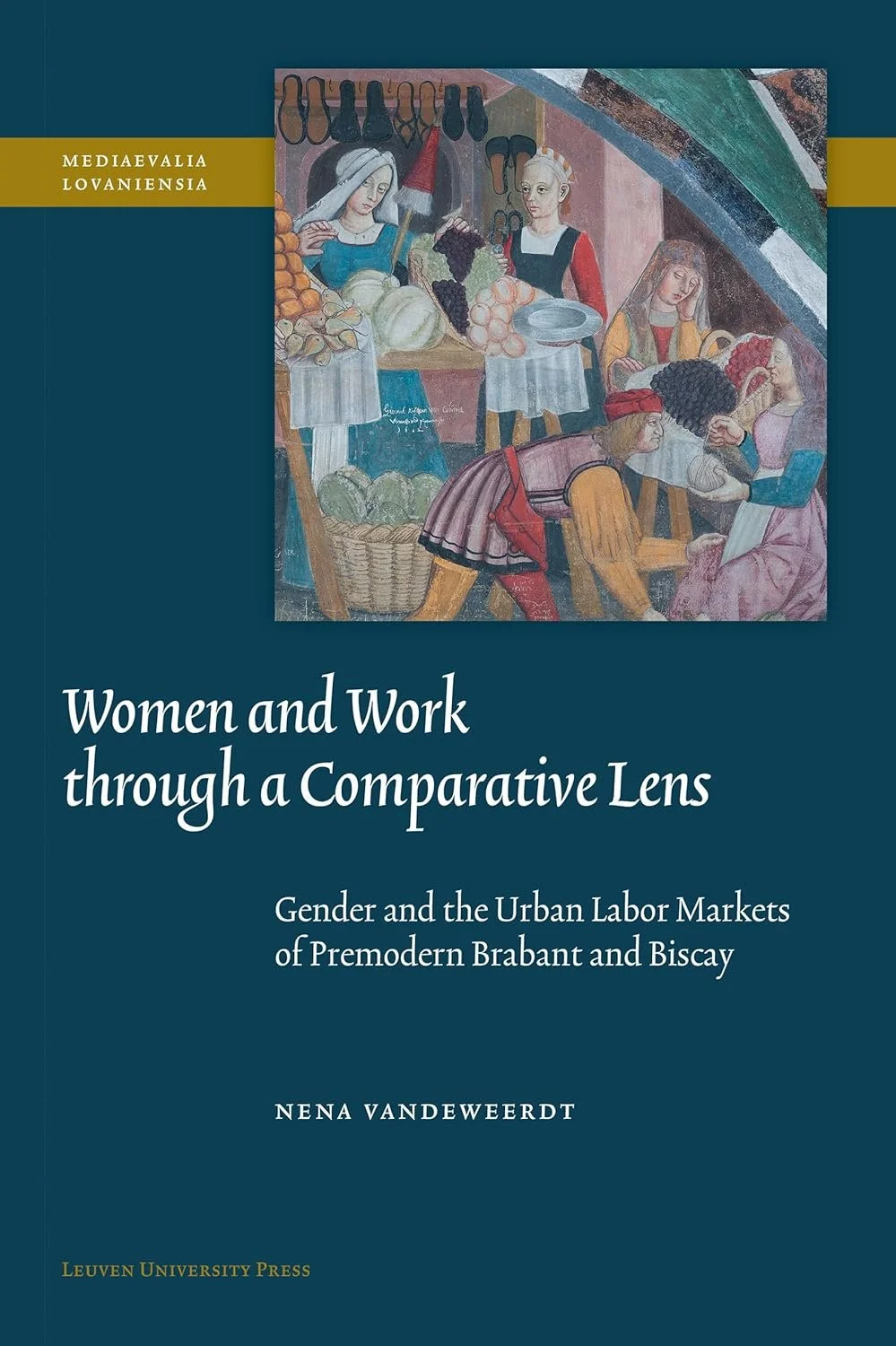
This week, I spoke with Dr. Nena Vandeweerdt about working women in two very different areas of medieval Europe. Nena is an independent historian who focuses on work in medieval cities in the modern-day Low Countries, Belgium, and Spain. Her new book is Women and Work through a Comparative Lens: Gender and the Urban Labor Markets of Premodern Brabant and Biscay. Our conversation on women’s work inside and outside of guild structures, how it was regulated, and how opportunities changed for women across time and space is coming up right after this.
Well, welcome, Nena. It's so nice to meet you and to talk about women and work, and I think this book that you've worked on has such a unique perspective on it. It's a pleasure to have you here. Welcome.
Nena Vandeweerdt:
Thank you, Danièle. It's very nice to be here, as well.
Danièle Cybulskie:
So, we are talking about women in work, and you've decided to compare two different regions, which I think most people don't think to compare. So, tell us about the regions that you decided to study when you were looking at women and work.
Nena Vandeweerdt:
Yeah, so in my book, I compare women's work in small-scale trade – so, not all women's work, because that would be really a whole lot to compare. And I compare that in Brabant, which is a region in what is now Belgium, and then in Biscay in northern Spain. So, it's now a part of the Basque Country, which is in northern Spain. So, I study specifically women's work in small-scale trade in urban contexts. So, that means in cities; that is, the cities of Antwerp and Mechelen for Brabant in what is now Belgium, and then Bilbao, in Biscay, in Spain.
Danièle Cybulskie:
So, how did you come across these sources and decide to put them together?
Nena Vandeweerdt:
It started during my master's thesis when I did a study on women's work in Leuven, which is the town where I'm from in Belgium. So, that started kind of as a logical location, and I got just very fascinated by the topic. I think, for me, it was also just a surprise to find so much activities that women were doing, even if within the research field this is already a well-known thing. For me, it was a surprise, and I didn't learn anything about that in my courses – or not that much, at least. So, I really just stumbled into the topic and fell into the rabbit hole. And then after my master's thesis, I managed to get a grant for a PhD scholarship, and then I decided to do this comparative study mainly because within the works that exist in these research fields, there's always this mention of regional differences and the need for comparisons, but then no one was actually doing them. And so, I started very logically from my own region in Belgium, which is in Brabant. So, that's how I got to those two cities. And then I got to Northern Spain out of… the main reason was that this was a region that I knew I was going to find women at work in the same type of work fields, in these small-scale trade fields. Because, of course, if you want to compare something, you have to have something to compare. Circle argument there. And so, I knew, okay, I'll have to find a type of occupations and a region where I will find them. And that is how I got to Bilbao.
Danièle Cybulskie:
Well, what I love about what you've said just now is that there's always a moment where I think you're studying stuff about the Middle Ages in university, and then you're like, well, I didn't know we knew about this stuff. It's so exciting. And then that sort of touches off where you decide to head for your research. And I think that that's such an exciting moment, and I love that this happened for you with women's work. And then also, I think that what you said was really important, too, where sometimes you just have to go where you know the sources are, and that is where you build, and everyone can build from there. And so, you've told us a lot in just a short amount about how research should go and how it does go. So, you've decided to concentrate on the later Middle Ages. So, I need to ask, why did you concentrate on this period rather than try to do the whole thing, or an earlier part? What was it about this part that spoke to you?
Nena Vandeweerdt:
I think partly it's… it's a personal fascination for the later Middle Ages, because… I think I really love the Middle Ages because it's this period that is just far enough to be a bit unknown and a bit weird for some people, as well. And then just well-known enough to still recognize a lot of things from our own society in that society, as well. And that is mostly visible, I think, from the fourteenth, fifteenth century onwards, at least in Belgium. And also – for those who might have been in Belgium at one point – growing up there, you're surrounded by the Middle Ages, by that fourteenth, fifteenth century all the time, because all the city centers are from that period. So, that's the personal side of it. And then the academic side of it, which also has to exist to get the research grant, right?
Danièle Cybulskie:
Yeah.
Nena Vandeweerdt:
There is actually a very interesting whole body of research about women's work in that period specifically, because you get a lot of very important changes in society in the fifteenth, sixteenth century. For example, centralization of governments, more written administration as well. So, you go from verbal contracts to written-down contracts. So, society gets a more strict form, maybe, in a certain sense. And that has an impact on women's work as well. And so, a lot of researchers have focused on that transition and on that impact over time. I decided to not do that on top of the geographical comparison because that would really be a lot. But it is a very interesting period to study because of that.
Danièle Cybulskie:
Yeah. Well, I need to ask this question as well, and this is a question I ask everybody because I think that when we are trying to trace things, it's important to figure out where to look. And so, some of us maybe need some guidance. Where do we look? So, when it comes to women's work, again, we were talking just before we turned the mics on about how a lot of people think women just, like, sat down in their houses and they just spun and that was it. We know that women worked, but how do we find this? How do we prove this? Where do you look for evidence?
Nena Vandeweerdt:
Yes, this is of course a very interesting question because women themselves did not write those things down. So, you have to go and look for a source where men found it necessary to write about women's work. And for me, the main type of documents where I found that and where a lot of historians have also searched for that before are town ordinances. So, these are regulations – local regulations. Back then, cities still had a lot of independence in making these laws, so they were called ordinances. And it shows all the problematic aspects of organizing a town economy or organizing people's daily lives, because if you need a law, that probably means that something happened that there was a need to write it down. And so, in the town ordinances, you can find a lot of stipulations about how trade had to be conducted, who could conduct it, when it could be, where they could trade. There were very strict regulations about all of this, and there you find a lot of references to women, either in a casual way – that you see it's not because they're women, it's just because they're trading and that has to be regulated – and sometimes also in a very gendered way, in which you see that the town councils or the town governments actually did decide things because it was women that were doing those things, or doing those trades, or certain practices. In these types of regulations, you can also see certain changes. Like, if you, in a regulation of 1450, see that the town council still included women in their regulation, and then in 1550 they decide, and now women cannot do that anymore, that says a lot about society, as well. But of course, a law is also just a law, and that can be broken. And especially in the Middle Ages, there was a very big informal trade, so the tradition of not working within the regulations or trying to avoid those, as well. So, then you have to kind of go and dig into other sources a little bit. It's a bit of luck what is there, as well, to kind of complement what you get from your normative framework that these regulations give. And in my case, I found especially a lot, for example, about the fishmongers of both regions – different documents from courts, from craft guilds, which were the associations – occupational associations – that organized the fish trade in the Low Countries, so in Belgium. And there you get a little look into the daily practices of those trades as well.
Danièle Cybulskie:
Yes. And to supplement this stuff… I do think that your work in the ordinances takes up much of the book in that this is really where you can find sort of the actual activities of people. But you also looked into guild lists to see, are there any women there? And then you also looked into tax documents, which I think are so important as well, because one of the things that you looked at was how successful are these women at business? And I… I mean, the bad news is many of them were at the bottom of the food chain, but it was an important place to look, I think, as well to supplement what you have. And so, I think that the range of sources that you pulled together to pull this stuff out really revealed a lot about what you were talking about.
Nena Vandeweerdt:
Yes, I do want to nuance that a little bit because I don't think it's… indeed in the tax registers, especially of Bilbao, I found this group of women at the lower end of the social strata. I don't think that means they were not successful in business. I think actually that made them more eager to be successful in business because it was not a very wealthy society, the urban societies of the Middle Ages. But of course, they had to – they had to find an income because they were already from a lower social class to begin with. That is more, I think, the direction of that argument. But indeed, it's a very important thing to see why are people doing something, and that might have to do with what they have, right? What possessions that they have.
Danièle Cybulskie:
Yes, the book definitely gets into all of those nuances because there are a lot. And one of the things I liked about your scholarship in particular is you spent a lot of time reminding us as readers within the book, we can't make assumptions about this – it could mean this, it could mean this – because, I mean, not all of these things will point in a direct line, especially when we're talking about women who are the ones that you are looking at – especially for this book – working sort of on the fringes of formal work. So, this is the point at which I think we need to establish: what did you mean by formal work and informal work?
Nena Vandeweerdt:
Yes. So, I defined formal work as work falling directly under an institution that had the capacity to regulate that work. So, that means that there is an institution kind of going over the work and also controlling all that work. And informal work is kind of all the work that takes place on the margins of those institutions or just outside of them. It's not illegal – that is very important. I think a lot of people nowadays think that because you're not paying taxes, that means that it is an illegal activity. Back then, that was definitely not the case. There were regulations about informal work, as well, but it wasn't organized directly by a socioeconomic institution.
Danièle Cybulskie:
Right. So, let's get into the regions then. When we're talking about institutions, the Low Countries are big on this. So, tell us a little bit about the guilds, especially in the regions that you were looking at and what their effect was on the economy and how women might have fit into this.
Nena Vandeweerdt:
Yes. So, now we get really to the… the whole body of scholarship that already existed before my study – before my book, as well. Guilds, and in this case it's craft guilds, they were associations that organized work. They were groups of people with the same occupation that then associated themselves. But the guilds, especially in Brabant, in the Low Countries, they went a lot further than that. They were very intrusive on every aspect of people's lives because they had political power, they had economic power, they had religious – or a part of them was a religious aspect – cultural, social. So, they were really involved in the whole lives of their members. And I think that's then the next very important thing. There were members in the guild. So, that means that you had this group that was included based on their occupation to start with – but not only on occupation, because there was also sometimes a heritage aspect to that. And also, the social class played a role, their network played a role. But if there were people that were included, that of course also means that there were people that were excluded. And in the case of guilds, those people excluded were the majority of the urban populations, and they were also often women, because guilds were flagships of patriarchy. So, they really carried a very masculine identity and they carried out the patriarchal society that was the Late Middle Ages into the core of their organization. And so, women played a role in those guilds, they played an important role even, but that was usually through a man. So, through a husband, through a father, women played very important roles, and I can tell more about those roles later. But, of course, not all women and not in every circumstance a woman could play a role in those guilds. And so, it meant that a lot of the regulations that they made were to protect the membership – to protect the exclusivity of the guilds. And that means that a whole group fell out of it and that often they could point their arrows directly to women that were trying to do the work that the guild was also doing. So, trying to limit the competition from informal outsiders. And then to the insiders – so, wives of guild members, daughters of guild members – they held very important roles because guilds were based on something that we call a family production unit or a family economic unit. And this means that there was a nuclear family – so, a married couple and their children and their servants and some apprentices – and everyone in that unit played a role in making the unit work. It was kind of the… the smallest institution of economic organization that you had in those cities. And so, since everyone played a role, women also played a role. And I think that is where we immediately have to go against this idea of the woman sitting by the fire, maybe cleaning the house, and that's kind of it. Because she had to do a lot more than that. She had to do administration; she had to help her husband in certain tasks and also take over certain tasks of her husband. So, they really cooperated together, even if the man was the household head. The man was still considered the formal guild member, and she was kind of an addition to him. And then, if he passed away – which happened quite frequently in the Middle Ages, as well – then she became a widow, and then she had to kind of take on both roles; both that of the man and of herself. So, then she got rights to become a guild member as well, because she was recognized as a substitute for her late husband. And that is how we find women everywhere in all layers of those guild networks.
Danièle Cybulskie:
Well, I think this is so interesting because – especially with the widow example – a widow is taking over the business for her husband, but she doesn't have all the rights of a guild member. She can't contribute to the politics. She can't really be a part of the governing structure of the guild, or anything like that. And sometimes it feels like these women are encouraged to remarry, but then they'll be shoved out of their guild role. Or, they might be encouraged to remarry, but if they remarry someone outside of the guild, then they have to drop out of their guild because they're going to be associated with their husband's guild. And so, it becomes very complex for these women who have to make decisions – not just based on what is best for me in a relationship, for example, or for my kids, but also economically. These are big decisions that these women have to make.
Nena Vandeweerdt:
Yeah, I think so. Indeed, when it comes to not taking up all the aspects of guild life, that is definitely a situation that nowadays we would maybe call cringe, because, indeed, politics was not a women's thing. That was men's business. And the same for… I mentioned earlier that these guilds had all these different functions in society or in the lives of their members. They also had military functions, and this was also something that women didn't have access to. So, a widow in a guild could be problematic, but I do think that that was not the case for all widows in the guilds, because also not all men in a guild would have these direct political functions or these direct military functions. So, there were actually a lot of widows – they were also prepared for it because they had worked together with their husbands side by side for such a long time, so they knew how to take up parts of the job and they – in certain circumstances – they did this for a longer time, as well. In my book, I cannot look that much – follow an individual's life path – so myself, I don't have examples of this, but other studies have shown these widows to stay widowed for a long time, or even forever, and just run the business as long as they lived, with the support of apprentices and sons and daughters, such as guild members would also have had to do. But, of course, in other circumstances, widows could indeed feel that friction between the guild and themselves. I do have examples of that – of guilds trying to ban widows, trying to limit the time that they could stay on as a guild member after their husband's death. And there you see this tension between the masculine guilds and the role of the woman in it. So, it was definitely not always a stable position.
Danièle Cybulskie:
Yes, exactly. I think that people are starting to get the impression that it's complicated because it is complicated. All of these decisions, all of the rules and ways that you have to navigate. And, of course, one of the things that is, I think, coming out in… in this complication is that there are a lot of guilds. And so, their regulations are very different. And I think we come up against – as you were saying a little bit earlier – the guild rules, and then the women who are working sort of within the rules and sort of without the rules when we come to the fishmongers. So, let's get to the fishmongers and the herring sellers of the Low Countries. What's going on there for women?
Nena Vandeweerdt:
So, the fishmongers are definitely the occupational group that I found most evidence for. I think fish was… first of all, it was a very important product for the medieval diets, and also it was traditionally more a female job. We will go through that when we go to Bilbao later, probably. Fishmongering in Bilbao was mostly done, on smaller scale at least, by women. It is still an accessible role in a certain sense in the Low Countries as well, in Mechelen and Antwerp. But you have those guilds there, and so that means that you get indeed these complications to how women move within this trade, and you can very beautifully see this distinction between fishmongers – women fishmongers that are wives of guild members, and so, they have, to a certain extent, a certain stable position – recognized position, as well. They sold fish together with their husbands, or instead of their husbands, as well. They would manage the business, as well. Some fishmongers would also own a boat, and so, be fishermen as well. So, they might be gone for a while out of the city and then their wives would have to take over, as well. Some of them just bought fish that was brought in bulk to the city. So, you already get this diverse image there. But then on top of that, of course, you have this informal market – this informal trade – that went parallel with the formalized guild work. And that is… I wouldn't say dominated by women in the Low Countries, but they definitely have a more visible role there. And indeed, one of the groups that I found in Mechelen are the herring women. That's what they are named in the sources. These were, of course, women selling herring and also some other, let's say, lower quality or lower price type of fish. These were women that were not guild members. Some of them were also the wives of fishmongers and others were wives of other people – or single women, as well. They existed, as well. They were allowed to sell informally. So, as I said, it wasn't illegal, but they were literally pushed to the margins of the fish trade. So, they couldn't sell this on certain locations – on the central locations where the fish market was. They had to kind of go in what they called the backstreets of the city, or at the gates of the city. They could only sell certain types of fish on certain days, as well. So, there was definitely an attempt to limit what they could do, so that they wouldn't form a direct competition for the guild members. And then there's a very interesting transition also within Mechelen that I found for this fish trade – for fishmongering – in which you see that women are actually kind of pushed to the margins more and more throughout the sixteenth century. And that is quite a surprising thing to find because usually the role of the wife – of the widow – is a stable position in this guild framework. And the government – urban governments – doesn't touch upon this role, either. They accept that, and it's a very important part of the guild framework. But then, within the fish trade, you see that wives of fishmongers are little by little… get limited in what they could do independently without their husbands, and that there are… first, there are some punishments – some sentences – for women that were selling informally, or for the husbands, because, of course, they were the household heads, so they could be punished, as well, for their wives' actions. And so, little by little you see that it goes from these sentences towards a formalized ban – limitation of the role of wives. And I think it has to… there you then have to go and look outside of the guild framework and to the economic, or the socio-economic, context of the city. In that period, Mechelen was in an economic decline, and probably those fishmongers felt that their income – their stable and powerful position – was being threatened, and they tried to limit – because that was a reflection of the guild when it went bad – they tried to limit membership as much as they could. They tried to be as exclusive as possible. And then women, of course, were the first to be pushed out.
Danièle Cybulskie:
Yes. Although you have at least one example where this woman was getting fined on the regular and she just decided she's just going to keep selling fish. And she was a wife – as you were saying – where she and her husband were getting in trouble for her taking over the business. But it seemed, like, worth it to her to just keep risking the fines and the pilgrimages and the punishments. Because it made the most sense to their family, I suppose, economically. So yeah, that's a really interesting woman right there.
Nena Vandeweerdt:
Yeah. And I also think, in her case – so for people who haven't read the book, she's called Gheertruyde van den Broeke. Might be a difficult name in English. And so, she's definitely one of my favorite women, as I say it in the book. And so, what you see with this recurrence of the punishments that she and her husband get is that probably – what I read out of that is that she was just a very well-established member of the fish trade. They all get into trouble – all the fishmongers in this source that I have where they are punished, this sentence book – they all get into trouble all the time. And so, you see her also getting into trouble in the same way that some other male members of the craft guilds are punished, as well. I think, indeed, this recurrence doesn't show that they were trying to directly push her out, but that she was really pushing against the framework and trying to really extend it as much as she could – indeed, to generate an income for her and her family.
Danièle Cybulskie:
Well, there is that quote that says, “well-behaved women don't make history”, and this woman did make history. She is in all the documents. So, we have this sketch of what it's like in the Low Countries with guild rules and how women are working within and without them. We have women who are sort of selling independently. Outside of the guild. And so, this seems like a good moment to transition over to Bilbao and see what things are like, because it's very different there when it comes to the structure of the economy in the marketplace. So, tell us a little bit about what it's like in Spain.
Nena Vandeweerdt:
So, that is the most important part of the book, and it's… it's comparative approach, as well. In Bilbao, work was not organized by guilds. And this, of course, has a huge impact because I mentioned they were these institutions that had impact on all parts of people's lives – of members' lives – and you didn't have them in Bilbao. So, what you did have in Bilbao were these groups of women that were responsible for the daily provisioning of the town. So, you have fishmongers, you had bread sellers, also bread bakers, you had sellers of textile ware, fruits or vegetables, that were all women. And these were all women that worked informally, so they were not allowed to form a recognized institution, they had no formal capacity to decide on the regulations – on the organization – of their own work, but they were all women. And these are all women in these – what I mentioned – these traditionally female positions, female occupations. And so, what you see in Bilbao, then, is that some of these women – and especially, again, the fishmongers – you see that they do form kind of a collective occupational mindset, because they are all the fishmongers and they're an important group in the provisioning of the town. And so, they do operate a little bit together, but then at the same time, they're not recognized as a collective group. So, they were not allowed to operate together – or not formally, at least. So, they tried to push back against – in Bilbao, that's then the town council, because, of course, there were also limitations on women's work in Bilbao. It was a very patriarchal society, as well, and they tried to push back, but they had very little to stand on because they had no occupational recognition whatsoever. So, what you do see is there's a lot of regulation in Bilbao about the work of these women – about what they were allowed to do – and they were clearly allowed to do a lot, and they weren't limited because they were women, usually. But then you also do see that there is a certain… maybe suspicion, or a certain reluctance to these women taking up important positions in the town economy, and so there's a tendency to centralization of control. So, the town council, they were responsible to organize the town economy in Bilbao, and they try more and more to get the control to a male position, or for men, right? That was in their hands, of course. They wanted more control, and these women flocking over all over town selling things, that had to be limited, as well. So, you do see a very interesting thing by the fact that there are no guilds, which gives a certain sense of independence to women that you cannot see so easily in the Brabantian case study. But it's not… I wouldn't say that it is an easier position to be in.
Danièle Cybulskie:
No. And I think this is one of the arguments that you make clear in the book, too, is that there is no better, there is no worse, there's just different, here. And because we have women who are working in informal structures, it doesn't mean that they're not very successful. In fact, the fact that people are trying to control them maybe suggests that they were pretty successful in what they were doing – that they were able to make a good living. Because these are, as you say, the staples of the town's diet and everything that it needs. So, fish and bread and all of those things – this is women's work. And so, they can be pretty successful at it, which is why maybe we need to not let them have too much power. But there was a certain snobbery that I did see in one of the examples of a woman named Mayora who was becoming pretty successful as a fishmonger. And they… they sort of revealed their hand – their sort of misogynistic hand – in the way that they were complaining about her by saying, because she's a woman, she'll never be able to cut good fish because she's just going to mangle it. She just can't possibly have the skill that we have as men. That made me laugh as I was reading this book, where they were trying to be very, like… sort of neutral in the way that they were talking about how she shouldn't really be able to sell all these things, but then it really sort of slipped out that they were judging her based on patriarchal rules, as well.
Nena Vandeweerdt:
Yeah, so like we have Gheertruyde van den Broeke as my woman in Mechelen, we have Mayora de Iturribalzaga in Bilbao. So, she was a fishmonger, and she was probably a well-established fishmonger. I can trace her work for at least twenty years as a fishmonger. She was a married woman, as well, but she kept on working as a fishmonger. We actually do not really know what her husband was doing then. And so, she was selling sardines – lower quality fish – and then probably also normal other types of fish. But these women, they didn't have the right to weigh the fish because that came together with collecting taxes on those fish that were imported into Bilbao. And so, Mayora starts to, let's say, search for the limits a little bit, as well, and starts to sell whole fish, which means that she was probably avoiding paying taxes. And she wasn't the only one to do so – probably all these women were doing this all the time. And then at one point in 1530, the town council of Bilbao was kind of tired of it, and they introduced new regulations – new ordinances to limit the possibilities of these women. And then Mayora, she represents the whole group of fishmongers, but she's definitely the leader of that group, in this case. They go to court. They start a court case that rises higher and higher up to the level of the Castilian kingdom to try to change that regulation back. This is already such an amazing thing to find – like, this group of women, as I mentioned, not necessarily high-class women, that were really pushing back against the town council. And what happens then, in that court case, you get a lot of arguments from Mayora herself, why she should be allowed to sell those whole fish and to cut the fish. And then, indeed, you get the town council that gives a whole lot of arguments to tell why she shouldn't. And the town council is in a very privileged position there because, one, they have the law on their side; they have the capacity to make decisions about the town economy, and those women have not. So, they give a lot of economic arguments of why women should be limited, but then they also get to a very personal level. They also start to attack Mayora personally – on her character, on her reputation – which was a very important thing for a tradeswoman in the Middle Ages, that she enjoyed a good reputation. And then, indeed, they get to this gendered argument, which is a type of formulation that you almost never see in the sources in Bilbao, which is that she cannot do something just because she's a woman. And apparently that was a valid argument. And I think in that little sentence there's a lot to discover and to conclude about, which is that this was a patriarchal society. Women were limited in things just because they were women, even if there was this group of recognized saleswomen that were making a full-time occupation out of their job, probably. Even like that, they were still only women, so they couldn't do certain things. And it was easy to use that argument, whereas Mayora couldn't use that. She couldn't say, they're counselors, so they cannot make a regulation. That was especially what they could do, of course.
Danièle Cybulskie:
But again, like we're saying, it shows the power and the momentum that they had behind them where they had to throw the whole book at her, right? They had to find all the reasons why she couldn't do it. Which means that they were probably under quite a lot of pressure, I think. And so, you know, reading between the lines, it looks like these women had a pretty good case, in which case they needed to be shut down by any means necessary. And so, we do have this in the court case.
Nena Vandeweerdt:
Yeah, because I didn't mention it now, but, indeed, they failed already once. The town council, I mean, already failed once in limiting those women. So, they had already made an order, the women had already gone to a high representative of the king in Bilbao, and already had that ordinance cancelled again. So, indeed, the town council were prepared to go quite far to get their wish implemented into the town economy. But even then, in other court cases in Bilbao, we also see that they go through all these arguments, through all these efforts, and then twenty years later, the court case… it just starts up again because the women just kept on doing that. So, regulation is a relative thing, I would say.
Danièle Cybulskie:
Yeah, because you had another case in here where it was the linen workers that were coming in, and they were staying in the town so that they could do their work, and they were getting exploited by the people they stayed with. And so, they, they got together and they said, we are all having this problem – trying to change the regulations. And so, as you're saying, even though they were not supposed to together, create a union or anything like that, they're still banding together when they know that togetherness is going to get them all a benefit. And I think that's really cool to see.
Nena Vandeweerdt:
Yeah. I also do think it's quite a normal thing. Like, just imagine a big group of people doing the same thing. They're going to find each other and try to do something together eventually, right? And you have this tradition – this long tradition in Bilbao – of women doing that work. So, I think it’s… it's normal that they're together. It is surprising that they can be successful in this, as well, because we cannot find that in other regions. But then at the same time, it shouldn't get too much weight either, because they were still not a formal institution. So, it was very limited. At the same time, it existed, which is such an amazing, surprising thing. But also – every time – we have to keep in mind that this doesn't mean that this was a powerful group of feminist women, because that didn't exist.
Danièle Cybulskie:
Yes. And that's something that you did bring up that I think is worth mentioning. And that is that we can't make the assumption that the women who are pushing back against the town council – or a guild or anything like that – that they wanted the sort of independence that we have now – that that was a goal – because maybe it wasn't a goal of theirs. So, can you tell us a little bit about what you meant by bringing this up within the book?
Nena Vandeweerdt:
Yes. So, indeed, I mentioned it in the comparison, as well, in which you see that that in Brabant these guilds provide this limiting framework for what women could do. But then, at the same time, it might also be a rather stable framework, and it might be a very predictable life that some of these women led because of the existence of that framework. And then in Bilbao, you don't see those heavy limitations that the craft guilds put onto the urban economies. But then, you also do see that they have to push back all the time to keep their income. And that was such an important thing for them – their income, their livelihoods, right? So, I think we should be very careful with judging… judging in general –
Danièle Cybulskie:
Yeah. Yeah.
Nena Vandeweerdt:
– but with putting a judgment from our own perspective on that time period, because for a woman, it might have been easier to be married, to have a husband that was the head of a household, to not have to search to change her environment all the time, and to just have a predictable life. That might have been something that more women preferred. And also, the idea of a woman trying to amplify her framework of operations because of gendered reasons – that was also not something that most people would have fought for. There are examples of medieval women that you could maybe call feminists avant la letter – before it existed, the word. But most women in the towns, they were just trying to survive, and that was not something they did out of gendered reasons. So, they were definitely pushing against the framework and seeing how much they could circumvent regulations and how far they could stretch their possibilities. But I think we have to put more socioeconomic reasoning behind it.
Danièle Cybulskie:
Yes. You need to have food on the table before you can push any further, right? And so, as this whole episode has been talking about, there are so many reasons why people do things, and they are individualistic, and trying to trace them and pull them out of guild records and tax records… I think you've done a wonderful job with this, considering the difficulty and the… This careful way that you're looking at and trying to reserve judgment about the decisions that people are making, I think, is what makes this book really strong. So, I hope that people will read it because you really got into the weeds – and I mean this as a compliment – where you're… you're looking so deeply into these lives of these women as closely as we can. Because I do think that the previous scholarship that you're building on really leans into things like guilds, and you're looking outside of these guilds, and I think that that is such a necessary contribution to this part of the work. So, as we wrap up, what do you want people to look for if people are following in your footsteps, they're looking at women's work in the Middle Ages, what do you think they should be looking for?
Nena Vandeweerdt:
So, first of all, I would definitely like to see more scholarship following the comparative approach. I think, as you mentioned, there's a lot of focus on microhistory, so, like, only the guilds, or only one situation, and that is such valid scholarship, as well, that has taught us so much about what women can do – what they can reach – and look more at that individual level, as well. But if you never place it in a bigger picture, then you can miss a lot of things. And I think that's what the comparative approach has done now in this book. So, that is something that I really hope that will happen more. And then, I think where I stopped was at the individual level. I went as deep as I could in the lives of those women without actually being able to identify their personal lives – which is a very hard thing to do. You have to be very lucky with what… what the sources that you find for this – especially for the small-scale trade, which was not the higher-class people, right? But if you can get, for example, more into the workings of that household, that little economic unit that I described, in a comparative sense, then I think we can learn so much more, as well.
Danièle Cybulskie:
Well, thank you for showing us the way, showing us one example of how to do this, and especially taking the time to look at the nuances because this is such an important part of the scholarship. So, thank-you so much for being here and telling us all about it. I really appreciate it.
Nena Vandeweerdt:
No, again, thank you for having me. I really loved the conversation, here. Thank-you.
Danièle Cybulskie:
To find out more about Nena’s work, you can find her on LinkedIn. Her new book is Women and Work through a Comparative Lens: Gender and the Urban Labor Markets of Premodern Brabant and Biscay.
It just wouldn’t be right to wrap up a month of name-dropping saints without giving a moment in the sun to the saint everyone leaned on to explain pretty much everything, and that is bad-boy St. Augustine.
As Vance Smith mentioned in our podcast earlier this year, Augustine was an African saint, born in the fourth century in Algeria. Although he was familiar with Christianity, Augustine was a skeptic – especially when the tenets of Christianity would have interfered with his lifestyle, or with his relationship with his mistress. He was apparently a very gifted speaker and teacher, netting himself a job as imperial professor of rhetoric in Milan, where he began to be influenced by the thinking of St. Ambrose. After returning to Algeria, Augustine found himself joining the church, where he quickly rose through the ranks to become Bishop of Hippo.
Augustine’s giftedness shone through his new Christian works, as he tackled all the thorny questions of developing Christian theology. His arguments were so compelling that they became the backbone of pretty much every theologian’s work in the Middle Ages, giving them a starting point to argue either for or against Augustine’s conclusions. According to Encyclopedia Britannica, “more than five million words of his writings survive.”
And here are just some of them that might speak to us in our current moment as much as they’ve spoken to millions of people in the time since. Augustine says, “Bad times! Troublesome times! this men are saying. Let our lives be good; and the times are good. We make our times; such as we are, such are the times.” I think it’s easy sometimes to feel like everything is out of our hands, but I like this quote by St. Augustine, because it reminds us that we still have agency over our own lives, how we see them, and how we can make them a reflection of our values.
You can find this translation of Augustine’s words by Philip Schaff in St. Augustine: Sermon on the Mount; Harmony of the Gospels; Homilies on the Gospels.
Thank-you to all of you for your support in keeping this podcast running every week, by listening, letting the ads play, sharing your favourite episodes, and becoming patrons on Patreon.com, where in just a couple of days, I’ll be hanging out with the Hardcore History Buffs for our monthly live Ask Me Anything. There’s still time to level up your membership and join us March 27th at 1pm EST, and I hope to see you there. If you’re not on Patreon yet, you may want to consider jumping on it, as starting next week, I’m going to have a special treat for all paid members. To find out how to become a patron, please check out patreon.com/themedievalpodcast.
For the show notes on this episode, a transcript, and a growing collection of the books featured on The Medieval Podcast, please visit medievalpodcast.com. You can find me, Danièle Cybulskie, on social media @5MinMedievalist.
Our music is by Christian Overton
Thanks for listening, and have yourself an awesome day.