Patterns of Plague with Lori Jones




The Medieval Podcast uses affiliate links
Episode 335
There are some very entrenched cultural ideas about the plague these days, involving big, beaky masks, and agonized people flagellating themselves in the street. But the way people thought about and treated plague changed over time, as the disease revisited populations regularly over the course of centuries. And just like our imaginings of plague today can tell us a lot about how we see the medieval world, so the changing way people wrote about plague can tell us a whole lot of interesting stuff about medieval and early modern culture. This week, Danièle speaks with Lori Jones about the evolution of the plague tract, who was considered qualified to write about plague, and some surprising ways religion fits – or doesn’t fit – into the picture.
-
Danièle Cybulskie:
Hi, everyone, and welcome to episode 335 of The Medieval Podcast. I’m your host, Danièle Cybulskie.
There are some very entrenched cultural ideas about the plague these days, involving big beaky masks, and agonized people flagellating themselves in the street. But the way people thought about and treated plague changed over time, as the disease revisited populations regularly over the course of centuries. And just like our imaginings of plague today can tell us a lot about how we see the medieval world, so the changing way people wrote about plague can tell us a whole lot of interesting stuff about medieval and early modern culture.
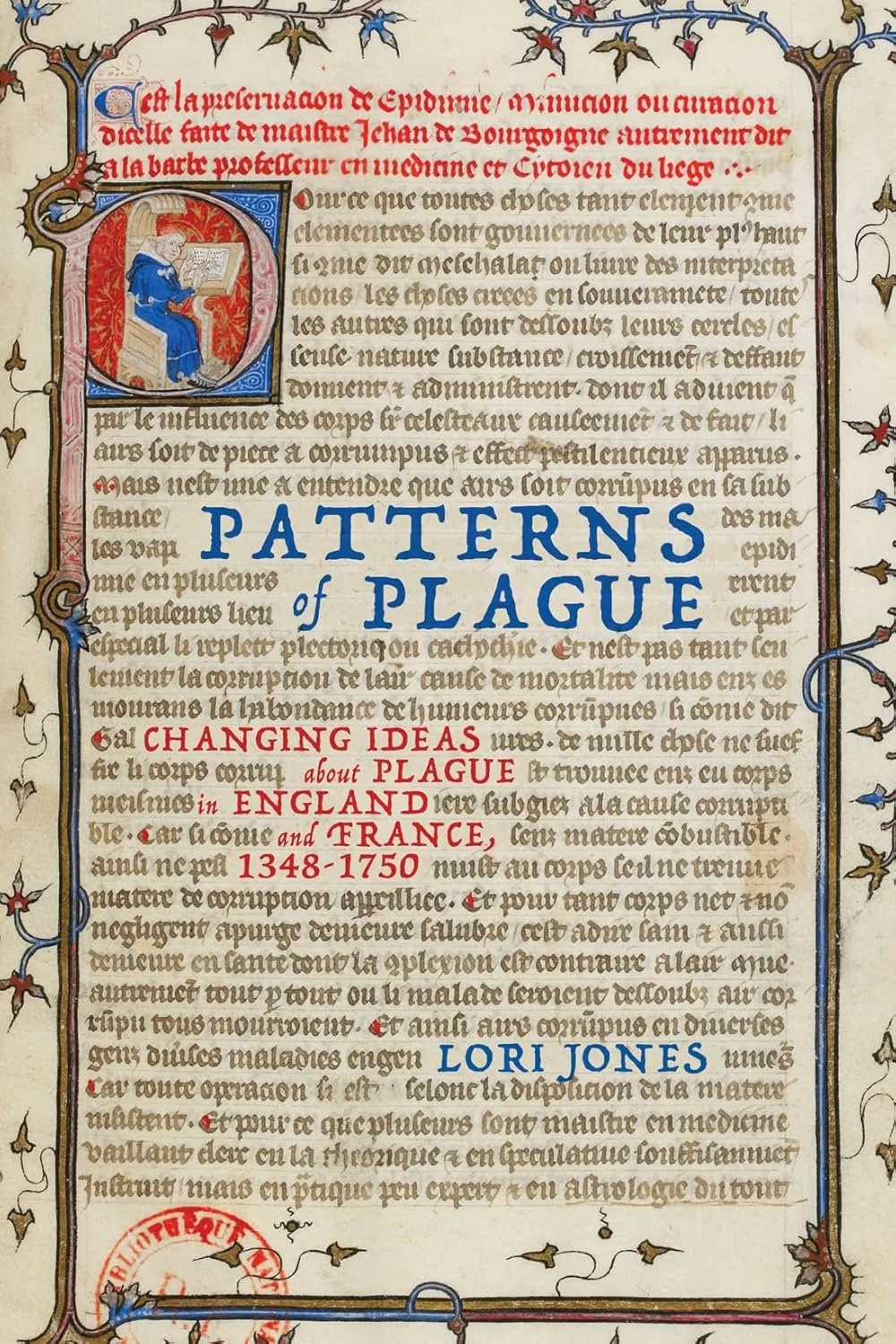
This week, I spoke with Dr. Lori Jones about the evolution of the plague tract. Lori teaches history at both Carleton University and the University of Ottawa, as well as being the editor of Disease and the Environment in the Medieval and Early Modern Worlds and the co-editor of Death and Disease in the Medieval and Early Modern World. Her most recent book – and the one we’ll be talking about today – won the Margaret Wade Labarge Prize for the best book by a Canadian medievalist in 2023. It’s called Patterns of Plague: Changing Ideas about Plague in England and France, 1348–1750. Our conversation on what people thought about plague over the course of centuries of recurrence, who was considered qualified to write about it, and some surprising ways religion fits – or doesn’t fit – into the picture is coming up right after this.
Well, welcome, Lori, to the podcast to talk about the plague: everyone's favorite subject. It is nice to meet you. Welcome to the podcast.
Lori Jones:
Great. Thanks, Danièle. I'm really happy to be here to chat with you today.
Danièle Cybulskie:
Thanks. Well – and I just realized that this is kind of a good time to be talking about it because we've just passed the sixth year anniversary of the time when the world shut down for Covid. So, this might be the perfect time to revisit the plague and how people have talked about it over time.
Lori Jones:
Well, you know, it's actually really funny that you mentioned that because this very week, six years ago, I was set to teach my course on the Black Death. Like, that was the topic that week and we got shut down and we had to do it online. So…
Danièle Cybulskie:
Yeah.
Lori Jones:
I mean, it’s perfect.Danièle Cybulskie:
I've been thinking a lot about it. Yeah. Because there is so much that I think is familiar and that we're going to see as we talk about your work over the next little while. So, you took people's plague treatises – so, the texts that they wrote about the plague – and compared them. So, the first question I want to ask you is where do you find these? Like, if you're looking to find writing about the plague, where should you look?
Lori Jones:
That's a great question. I mean, there are several scholars who have put excerpts of these texts into their own, you know, secondary source books about plague and what have you. I actually went to a whole bunch of libraries in Britain and in France and looked at them firsthand so that I could put my hands on them, because, you know, looking at what other people have written that somebody in the past said is great, but when you actually can see them for yourself and hold them in your own hands it's so much more interesting.
Danièle Cybulskie:
Yeah, it's a totally different experience. So, do you find them written within their own manuscripts or do you find them in miscellanies mostly?
Lori Jones:
Mostly in miscellanies. What I found is quite a lot of… I mean, the particular tracts that I was looking at were often just interspersed in with other things that people were writing about – especially the John of Burgundy one, which is probably the most popular of all the medieval plague treatises because it was so widespread. So, people would copy it and just put it in between other documents that they were copying out. Some of the longer ones are written in very… very clearly, very nicely, very planned into the manuscripts. But I think a lot of them were just sort of dumped in as people found them.
Danièle Cybulskie:
Well, that makes sense. You know, if it suddenly occurs to you, you need to write this stuff in there so that you have this information for later. Which brings me to the question: you have determined plague tracts have a few patterns in them. What does every plague tract basically contain?
Lori Jones:
So, in a nutshell, most of them will give some type of explanation of what the writer believed had caused the plague, then ways to prevent getting sick from it, and then ways to treat it if you did, in fact, you know – or if you're unfortunate enough to – actually get sick.
Danièle Cybulskie:
Well, one of the things that we're talking about before we leave manuscripts and print behind is that some of the plague tracts that you found are really lavishly illustrated. And this is kind of interesting to me because when it comes to medical advice, I don't necessarily find myself gravitating towards the most beautiful book. Do you know what I mean?
Lori Jones:
Yes. Yeah. I would say that in those cases, the ones that are the most beautiful were obviously owned by very wealthy patrons. So, we have some that were owned by Margaret Beaufort, who was King Henry VII's mother. We have King Charles of France, who had a couple of copies. It's hard to say whether they actually read them or not, or just had them because, you know, it was a good idea to have this kind of stuff available in case you wanted to use it. The ones that are definitely used and well worn are very plain and kind of very bad handwriting in them.
Danièle Cybulskie:
That makes sense to me. A practical book that you could carry with you. And I think one of the ones that you had… one of the explanations – and I can't remember if this is a late manuscript, an early print one – saying one of the reasons that this particular tract is good is because it's portable.
Lori Jones:
Yes, that was actually one of the ones in print, I believe, and it was a fairly small book that could be easily carried around in the hand and referred to, you know, if you're walking down the street and thought, I need to know what to do to prevent plague right now.
Danièle Cybulskie:
Yes, exactly. And so, the thing that we're kind of getting at here is that after the massive outbreak that we call the Black Death, there were recurrences of plague for hundreds of years afterwards. So, can you tell us a little bit about how this happened – what it may have looked like after the Black Death?
Lori Jones:
Sure. So, what happened is that basically about every ten to fifteen years, another epidemic wave would happen. Sometimes, they were very widespread, especially in the fourteenth century. So, they tended to still keep being fairly widespread across Europe and the Middle East. But then after that, they often tended to be sort of more localized. So, you could say, well, England was getting hit, but maybe not some of the other places. Or, very specific cities would see outbreaks happen on a fairly regular, timed basis. But none of them were ever as big and as widespread as the Black Death was. So, the epidemic waves seem to be generated by something more local that would start it up again.
Danièle Cybulskie:
Right. So, the plague treatises that we have here are always going to be relevant for a very long time, because you may need them at any time. You can't tell when it's going to be, but it seems to still have been with some regularity, depending on where you live.
Lori Jones:
Yeah, exactly. And so, as I said, at least every generation would see an outbreak of plague, and that's through the fourteenth century, the fifteenth century, the sixteenth century, and it wasn't really until the seventeenth and eighteenth centuries that it really started to wane, especially in Europe, but definitely not in southern Europe, not in the Ottoman Empire, and not in Russia, where it continued into the nineteenth century.
Danièle Cybulskie:
So when the Black Death hits – 1346, ’47, ’48 – how are people talking about it at that moment? Because we know now that there was an epidemic of plague that had happened a long time before that, but it seems they didn't know about it at that time. So, how are people talking about the Black Death at the moment that is happening?
Lori Jones:
It's actually a great question because it seems from – again, from the plague treatises and other things that I was reading – that people would hear rumors that it was coming, and they would be preparing for it coming, often writing about it before it appeared right on their own doorstep. Others were writing about it after the fact and would talk about, you know, all this massive death and people lying dead in the streets and all kinds of things. So, it really depended on whether they were anticipating it or having just gone through it. But there certainly was a sense that it was coming from the east, it was coming from the south, and everybody was just waiting for it to arrive.
Danièle Cybulskie:
Yeah. And one of the things that you noticed will change over time is that people will start to write about their own experiences with it. And one of the – I think the great quotes that you have in your book was saying that medical knowledge “was ruled and often overruled by ancient knowledge” about the medical world. So, how were people integrating their medical knowledge at this time when they're starting to write about the plague and it's just happening?
Lori Jones:
So, as it's just happening, there was a very strong sense that even though we don't recognize this specific disease, it must have happened before, because the ancient authorities know everything, and everything that we do is based on what they tell us. And so, there was a real attempt by medical writers to fit the disease into what they were already trained to know – but then also saying, you know, they don't tell us exactly what to do about it, so we're going to improvise. And therefore, these buboes that we're seeing growing on the sides of people's necks or in their groins, that must be the same as the growths that our ancient authorities have already talked about. So, we're going to treat it in the same way that they tell us to treat it. What's really interesting is that by the 1360s, we start to see medical writers like John of Burgundy saying, you know, all those ancient people – and they listed twelve or fourteen of them – they knew about the epidemics that they experienced, but we today are experiencing things that they didn't write about, so they must not have known about it. And so therefore, we are the experts, and we have to rely on what we are seeing and what we know to be true.
Danièle Cybulskie:
Yes. And I love that you've pointed this out. And one of the things you also pointed out was that there's a bit of a reticence to be specific during the initial wave of the Black Death, because people are like, well, I can't really reconcile it with the ancient sources, and I don't want to look stupid, so maybe I'll be a little bit hesitant to label it.
Lori Jones:
Exactly. And that's absolutely true – because medical authority was so entrenched. It's not about what you see with your own eyes. It's what you've been taught. What you've been taught is correct, and therefore what you see has to be reconciled with what you know, rather than the other way around. But that does really start to shift after – like I said – after the mid-fourteenth century and especially later in the fifteenth and sixteenth centuries. Then they start to say, you know what? Those ancient guys are completely wrong. So, we need to do it the way that we know is right and is working.
Danièle Cybulskie:
Yes, it's all about learning. And one of the things that I think is also really, really important in the way that we think about the Black Death – in the way that we understand people at the time thinking about the Black Death – is that you notice that people will say, well, yeah, of course God's involved, because God's involved in everything, but it's not really the most important thing about this disease. Right?
Lori Jones:
Right. And especially – I mean, that's one of the things that I find really interesting about the early European plague treatises, that they do not talk about God. I think it's there and it's assumed, but they don't specifically talk about it – not the way the Islamic plague treatises do, where it's so intertwined that there is no separation between the religion and the medicine so much. But in the European context, it's not until probably about twenty-five years, fifty years before the Reformation, that they really start to talk about, you know, it being God and sin, and plague is because of sin. And before that, they don't talk about that at all.
Danièle Cybulskie:
Yeah. I mean, I remember reading the report by the Faculty of Medicine at Paris – and this is before they had experience of it. But they're like, yes, definitely, pray, but let's also figure this out.
Lori Jones:
Yes, exactly. Exactly. And I really like to use examples like that when I teach, because students tend to think that everybody thinks that everything is about God, and it's not, necessarily. They're trying to be rational and they're trying to understand what it is they're seeing. They do have the understanding that, of course, for them, God creates everything and rules everything. And so, it's kind of a given that they don't need to keep repeating that.
Danièle Cybulskie:
Yes, exactly. And so, the last thing that I want to establish – because again, this is another thing that will change over time – is who is writing these early plague treatises. So, we're talking the 1340s, 1350s, 1360s.
Lori Jones:
The earliest ones are almost entirely medical. So, university-trained physicians, mostly around the Mediterranean. There are no native English ones until much, much later, which is a whole other topic of conversation. But university-trained physicians. Much later, then they start to become… there’s surgeons, there's civic administrators, there's people just generally interested in what's going on. But from the outset, they are very specifically university-trained medical writers.
Danièle Cybulskie:
Well, I think this is so important as we look at the evolution of the way that these are being written and translated and disseminated, because it does very much change over time. So, we've looked at that huge asteroid of the Black Death happening in the middle of the fourteenth century. Tell us how things start to change in the way people are writing about the Black Death – or the plague, the actual plague – as things are happening towards the end of the fourteenth century, as we head into the fifteenth. What have you noticed changing already?
Lori Jones:
Well, the whole… the medical aspects of it stay fairly similar throughout: the ways to prevent the disease, the ways to cure the disease. But they would start talking a little bit differently about whether this is something that the whole world has seen or whether this is something really local. So, I'm starting to see… late fourteenth, early fifteenth century it's a shift to when they start talking about causes being a little bit different than they do earlier on. So, for example, who is affected, why they're being affected, and then that kind of affects the prevention a little bit as well – like, stay away from certain kinds of people, stay away from certain kinds of places – that that's not really there in the very early ones.
Danièle Cybulskie:
Well, I think that this is important to point out, as well. One of the things I want to make clear is that this isn't because people are suddenly becoming more rational as time goes on, but they needed – because during the Black Death of 1347, ‘48, it is the whole world, it is everybody that everyone comes into contact with. And so, when people are thinking about it slightly differently later, it's not that they're suddenly more rational, it's that they have decades and decades of resurgences and information to work with.
Lori Jones:
Yeah, exactly. Exactly. You see some of the same plague treatises being copied over and over, and over again. But then you also start to see a whole lot more people writing about it. And every one of them says, you know, all those other treatises, they're so convoluted and they're hard to understand, and they're too theoretical. So, I'm going to tell you the way it really is. And almost every one of them says that, and it's really quite funny. But the other thing that they start to get rid of by the end of the fourteenth century is this whole discussion about, you know, the theoretical causes of what caused the plague in the first place. They don't really worry about that anymore. The treatises become a lot more practical and a lot more focused on how to prevent it, how to cure yourself. We don't really care about the theory anymore.
Danièle Cybulskie:
Yeah. And one of the things that I think might be so relevant to us, people who are living in this… this world in which Covid exists, is that when people – and this is something that you say in the book as well – people within a generation or two of the actual biggest part of the Black Death are using it as a cultural touchstone, like you would not believe what we saw, what we experienced. And then people start to understand – almost normalize it later, because it's just a part of life, and they can't just keep focusing on that one touchstone of a moment. Right?
Lori Jones:
Mmhmm. And it's true. And I found certainly in the fourteenth century and maybe a little bit into the… the fifteenth century – at first they were talking about them as, you know, the Great Mortality, the greatest one ever. But then there was the second one, and then the third one, and then the fourth one, and then the fifth one. And then after that, they didn't need to even number them anymore. They just said, you know, the last. The last, most recent one that we went through. And so, there's this whole idea of a chronology that starts to develop, but then later, even that doesn't matter anymore because it's really focused on what's happening right now. The past is less important until later, when they start to feel the need to put it into a bigger context again, which they start to do in the… in the sixteenth century.
Danièle Cybulskie:
Yeah. And one of the constructs that you found was that people stop saying, I'm writing this down in case. If it returns again. People start saying, I'm writing this down for when it returns again, which is a totally different mindset.
Lori Jones:
Yeah, exactly. As you said, it becomes such a normalized part of life. We know it's going to happen again. We don't know when, but we're going to be prepared.
Danièle Cybulskie:
Yes, exactly. Okay, so we're into the fifteenth century, and one of the things that you noticed – and maybe it's a moment to take a moment to talk about this for a second – is there's a lot of plague treatises still being written. And the ones that are really popular, and the ones that are being spread a lot, are French ones. Do you want to tell us about why there might be more French ones than English ones?
Lori Jones:
Sure. So, this is something I tried to figure out, at least from the early part, of why there was almost no English writing. I mean, they would make copies and translations of continental treatises. And I think a lot of it just has to do with the nature of English medicine. At the time, there were far fewer university-trained physicians. The faculties of medicine were very, very small. And so, most of the information that they had was actually still coming from the continent anyway. France, by contrast, is a huge kingdom. And especially once we start getting into the printed text, you see this massive proliferation of French texts from all these different cities. Because in England, manuscript production – professional manuscript production and printing – was very centralized in London and Westminster. So, you see – almost – things only being produced there. They'd be copied elsewhere, but the actual production would be London, Westminster. France, by contrast, had huge manuscript and printing facilities all around the kingdom. And so, you start to see each one of these cities producing its own sets of works that then, you know, they would maybe circulate fairly locally, but it just meant that there were so many more of them.
Danièle Cybulskie:
Yeah, population has such a big role to play in this. And also, there were quite a lot of people that died of plague, and so they couldn't be writing anymore about plague. That needs to be remembered, as well. Okay, so we are… we are heading in the direction of the printing press. What difference did the printing press make in the way that people are writing about and receiving these plague treatises?
Lori Jones:
I think that the biggest thing is that they were a lot more available and not terribly expensive. Some of the most popular ones in England, for example, probably sold for very little amount of money. They would be produced as little booklets, and you could buy them at any book stall, you know, for a few pennies – or less, I guess, at the time. So, instead of having to track down a manuscript copy and then copy it out yourself – which takes a lot of time – and literacy was starting to increase, so more and more people would be able to read, not necessarily able to write. Whereas with the printing press, you know, they could produce hundreds of copies of the same thing in a very short period of time. So, suddenly there were a lot more of these things available, which people could then buy and then annotate themselves – put in their own comments where they wanted to.
Danièle Cybulskie:
Right. And so, the audience for these written texts starts to change as well, right? People start to be very intentional in their prefaces about who these are for.
Lori Jones:
Right. Yeah, exactly. And it also then opened up the ability for a lot more writers to have their work put out and published as well. So, in the manuscripts, I mean – I'll just stick with England for a minute – there are a few medical writers, and I track down their manuscript copies. You know, not that widely circulated. They might have just written it for themselves, or a small family or friend group. But now with the printing press, pretty much anybody could write something and get it printed and then it would be out there circulating.
Danièle Cybulskie:
Which is the good news and the bad news.
Lori Jones:
Yeah. Some of them are quite funny because, you know, even there – they would pretend that they'd written this whole thing. And then I found, well, you know, actually that is originally a French tract that was written fifty years ago, and you just copied it, and translated it, and changed a few words here and there, pretending that it's yours.
Danièle Cybulskie:
Which is not something that ever happens these days.
Lori Jones:
No, never, Never, never.
Danièle Cybulskie:
Right. Well – and one of the things that I think is sort of significant in this switch over from manuscript to print, especially, is that you do get some of the experts at the time – the university experts – sort of being lifted away from the attribution of their work. There's John of Burgundy, I think, is the biggest example that you had here. He starts to be called the bishop of a different name completely.
Lori Jones:
Yeah, actually, that was Johannes Jacobi, but –
Danièle Cybulskie:
Oh, okay.
Lori Jones:
– yeah, it's the same concept: that somebody who is known and produced this tract in the 1300s – during the Black Death, or shortly thereafter – had these widely-circulated manuscript copies. Then, suddenly, once they get picked up in print, the printers will go, yeah, nobody knows who that is anymore, so we're just going to give them a new name. And that one that you mentioned is actually one of the funniest ones, because it was attributed to a bishop from Denmark somewhere. And there has been a lot of scholarship trying to figure out who this person is – and, like, created a whole biography for him – and the truth is, he was really just a figment of a printer's imagination,
Danièle Cybulskie:
Which I think is also kind of familiar. When we… when we look at where we get information from these days – you're always trying to trace it back to who the authority is, and can that authority be trusted. And so, it's interesting when the printers are just running roughshod over this whole authority thing in a way that the actual authorities would have been really upset by.
Lori Jones:
Yeah, exactly. And I mean, some of the things that they've made up are quite funny because you saw one that was attributed to some guy named Attila and, you know, they just… they make things up in order to sell to a particular audience. And so, in – again, in the case of the one that you mentioned – there are different versions of it for an audience that could read Latin versus an audience that could read French. And so, very different sort of clientele. And so, they would tweak them – who they attribute them to, what the contents are – depending on what audience they're trying to get to buy these things.
Danièle Cybulskie:
And do you get a sense of – it's always hard to speculate on these type of things, but – do you get a sense from the numbers in which these are being printed and bought that they are being read widely by an ordinary public?
Lori Jones:
Some of them, yes. I mean, some of them I only found one or two surviving copies, which, I mean, means absolutely nothing. It just means that's what survived. In the case of the John of Burgundy one that you mentioned in England, whose identity was basically stripped out of it, because in 1475 somebody sort of rewrote it and assigned his name to it, and that was Thomas Moulton. That particular copy was then picked up in the 1520s and printed, and it kept being reprinted. A slight… very, very slightly modified. But mostly printed verbatim up until the 1580s. So, that's a good sixty years that this same plague treatise – originally John of Burgundy's from 1365 – was printed over and over, and over again. So, it must have had enough selling power to entice printer after printer, after printer to keep reproducing it.
Danièle Cybulskie:
Well, and this is a... this is an interesting moment. In the late fifteenth century, heading into the sixteenth century, England is having problems with the sweating sickness, as well – which is not the same as plague. But did you notice an uptick in the way that people were writing and talking about the plague at this moment?
Lori Jones:
So, what's really interesting… 1485, is… So this – the very first plague tract printed in England – happened right after the sweating sickness. And it was a tract that was actually the one that I mentioned that was sort of cribbed from Johannes Jacobi, assigned to a bishop from Denmark. King Henry VII seems to have asked for it to be produced to show that he was dealing with a sweating sickness, even though it was a plague treatise – very different disease, as you mentioned – but this was his way of putting out there the fact that I am dealing with disease, and here's some information to keep yourself protected. So, 1485. Sweating sickness ended in 1550s, but it was in between that period that print production of English plague treatises really took off.
Danièle Cybulskie:
Well, I think this is so interesting, especially because something we haven't touched on yet is that a lot of the information on how to keep yourself safe from plague, for example, tends to be consistent from the moment that people are writing about it – at that moment of the Black Death – throughout. For the entire bit of research that you've done. There's a lot of really consistent advice, right?
Lori Jones:
Yeah. I mean, in terms of preventing it, it's: keep your mouth and your nose covered when you're around people that you think might be contagious. Stay away from people that you think might be contagious. Stay away from places that emit foul odors – so, sewers, butcheries, tanneries, stagnant water, things like that. And, you know, get your regular monthly dose of bloodletting to keep your humors intact. Stay away from foods that will upset your humors. Stay away from drinking too much. And this is actually a point that I really like to emphasize with my students: that as much as there seem to be a whole lot of weird and crazy remedies – and we always pick up on the really funny ones – the basic medieval advice for avoiding plague was to eat properly, don't drink too much, get enough sleep, get enough exercise, stay away from bad environmental spaces, and keep your emotions in check. And use your toilet facilities as appropriate. So, kind of very much like our general how to stay healthy today.
Danièle Cybulskie:
Which is so rational, so important. And it's really worth emphasizing to your students – and here on the podcast as well – because there is this idea that all of the remedies are nuts. We saw some of this with Covid, as well. Some of the remedies that people came up with were kind of bananas. So, it really isn't necessarily a medieval thing to come up with wild ideas about what's going to keep you safe.
Lori Jones:
Well, exactly. And I absolutely don't deny that there were some weird remedies. One of them involved plucking the feathers out of a chicken and putting the chicken's anus on your buboes to help suck out the poison. I mean, that is kind of weird. It probably was more theoretical than actually practiced. But those are the kinds of things that people – oh, this is what medieval people did. And look at all the crazy, weird things that they think of. But the whole idea of, you know, just living a generally healthy life was absolutely at the base of everything else that they… they talked about.
Danièle Cybulskie:
Yes, for sure. So, as we're heading into the early modern period, this is the point at which you see God coming back into this – or God coming into this sort of for the first time in a big way. So, can you tell us about the way that people are starting to talk about plague in the early modern period, as religion is just everywhere in Europe?
Lori Jones:
Mmhmm. And so, I think a lot of this really has to do with the Reformation and the whole Protestant/Catholic battles that were going on, and the attempts to say that one way of thinking was better than another. A lot of the writers that put that kind of emphasis about sin and everything into their plague tracts were not necessarily medical writers, but were actually religious writers. So, you know, priests, reverends, clerics of whatever sort. And then the medical writers picked it up because they saw that those kinds of inclusions in the tract were making them more popular. And so, I did see evidence of medical writers saying, you know, I don't really want to talk about God, but hey, if I don't: a) I'm going to be branded as an atheist, and b) it'll make this sell better, so I'm going to talk about God, too. So, I think – and of course, some of the medical writers were actually quite religious themselves, so I won't take that away from them – but it did become a selling feature rather than automatically seeing it as a shift to being more religious, if that makes sense.
Danièle Cybulskie:
So, we're looking at a time where there are these wars of religion. You did notice some differences between the way that Protestants are writing about the plague, and Catholics are writing about the plague. So, what did you see there?
Lori Jones:
This was a really interesting split that I really noticed in the sixteenth century. And in England, for example – again, most of the writers were Protestant and some very puritanical by this point – they're really starting to point a finger to the poor in the urban settings as being the cause of plague. You know, the dirty living conditions, the poor food that they eat, their unhygienic habits started to be very specifically blamed for generating plague outbreaks. You never see that in the Catholic writers. And, at first, I thought, well, maybe this is a… an English versus a French thing. So, then I separated out some of the French tracts by whether their authors were Catholic or Protestant. And even the French Protestant writers tended to blame the poor for generating plague outbreaks. The Catholic writers never did that. They kept theirs at a much more general, societal sin kind of level, rather than it being very specifically targeted.
Danièle Cybulskie:
That is really interesting. One of those things where… you are in poverty, so you can't take the steps that you might normally take to be clean, do laundry, bathe yourself, because you just don't have access to the tools that you need for that. And then you're getting blamed for causing the plague for something that you can't control at all, anyway.
Lori Jones:
Exactly. Yeah, exactly. I mean, I found that really stark, and it was... It surprised me. And again, I started to think, well, maybe this is just a general trend that I'm seeing everywhere. But as I mentioned, when I compared the Protestant writers to the Catholic writers, it was very definitely only on the Protestant side.
Danièle Cybulskie:
Yeah, that's really interesting. I mean, beyond the scope of The Medieval Podcast to really dig into that. But I hope that somebody will spend some time on that, because I think that is so important. In fact, there may be scholars who are already doing that that I haven't come across. And maybe… maybe they'll be reading your work, Lori –
Lori Jones:
I hope so. Yes.
Danièle Cybulskie
– and we will all learn more about that particular period.
Lori Jones:
– and maybe they'll prove me wrong –
Danièle Cybulskie:
Yeah.
Dr. Lori Jones
– which is absolutely fine. But I just… I think it was an interesting sort of thread that I picked up on that I think deserves more looking.
Danièle Cybulskie:
Yes, for sure. And then we do see sort of blame shifting again for the plague. As we move into the seventeenth century – and even into the eighteenth century – people are pulling God out of it more, they're starting to connect it back historically, and there's also some blame shifting to certain other groups of people. Right?
Lori Jones:
Yes, exactly. So, now we start to see the Turks being blamed for plague, which is... It's almost like it has come full circle, because during the Black Death, itself, there was this whole pervasive idea that it came from the east – very vaguely defined what that actually meant. But by the seventeenth century, they're definitely pointing a finger at the Turks. The Ottomans. “Turk” was a term that they used – again, very vague – but basically meant anybody from the eastern Mediterranean. So, there was this whole belief – completely false, based on propaganda circulated by the Habsburg ambassador to the Ottoman Empire – that the Turks, as they called them, believed that everybody was born with their fate written on their forehead, so they had no need to do any type of plague prevention or treatment because, you know, God's already decided who's going to live, who's going to die, so, it makes no difference. He wrote that down in a letter, which then circulated all around Europe. So, everybody believed that the Ottomans were doing nothing to prevent plague. And so therefore, every epidemic that they had – regardless of the fact that they'd already had centuries of local outbreaks – everything now came from there.
Danièle Cybulskie:
Yes, well, like so many other things, it is very convenient to blame The Other. And then you don't – like you say – have to do anything about preventing plague within your hometown – you can just blame it on someone else, and then nothing has to be done. How very convenient. And also, I mean, it stirs up that enmity that nations sometimes like to build up against an Other.
Lori Jones:
Yeah. Yeah, exactly. And I mean, it is really interesting because you really see them talking all the time about it coming from ships from Turkey, from Cyprus, from Egypt, from, you know, anywhere in the eastern Mediterranean. And yet if you look at maps of London, for example, where the plague outbreaks actually started was not near the port, so it was not brought in by ships. But they didn't… they didn't pay attention to this. And of course, by the late seventeenth century in England, they started to record plague deaths as being from something else because they were just done with it. You know, it's like it doesn't – it's not here anymore. We're done. You know, you died from something else.
Danièle Cybulskie:
Yes. Well, I think you're bringing up two really important things. One being that they're tracing where the outbreaks are coming from. And at this point, it's localized within the communities – it's within Europe, and it's just going to keep flaring up. Again, it is not a foreign source at this point. This is what our research has shown – Medieval Studies research, archaeology, textual research – has shown so far. And then the other thing that I think that is really important that you're bringing up here is that people are suppressing information about plague outbreaks because they're afraid of what it's going to do to the economy. And this sounds very familiar.
Lori Jones:
Yeah, exactly. And so, you definitely see by this point, attempts to suppress it, attempts by local authorities to basically turn a blind eye to whether it's a plague outbreak or something else. Because it does. Anytime that there's an outbreak, there's economic impacts. Before this period, sort of looking at the economic versus other impacts was not such a big thing. But certainly, you know, as you think about empires and a lot more ships coming in and things, you don't want to talk about it, you just… you know, if we don't talk about it – we assign some other cause of death – then it didn't happen and we can just carry on the way we always are.
Danièle Cybulskie:
Yes, because they have realized that things like quarantine will reduce the spread of plague. But that seems like something that they don't want to implement because it might have an impact on trade. I mean, this is a question that just keeps coming up in human history. And so, I think it was an important one that you brought out.
Lori Jones:
Yeah, and I actually don't talk about it in the book, but one of the things that I talk about with my… I have a course on sort of globalization and disease. And the whole emergence of attempts to create international quarantines in the eighteenth century were constantly shut down because the empire leaders didn't want to restrict their trade. And so, trade always trumped public health.
Danièle Cybulskie:
Yes, it is an ongoing question. So, one of the things I think is really important that I briefly mentioned a second ago was you notice that people, especially in sixteenth, seventeenth centuries, are starting to connect – because they're starting to... to have access to materials that show – the Justinianic Plague was the same thing. And they're starting to connect these dots. But one of the interesting things you notice is that because of a prejudice that people have built against the Middle Ages, they skip over, like, the fourteenth century when they're talking about the best medical advice for dealing with plague. Can you tell us more about this?
Lori Jones:
Yes. So, our modern whole idea about the Middle Ages being backward and dumb is not a modern invention. It's actually an invention of the early modern era, where they started to see the Middle Ages as being stuffy and too restricted on taking things literally and what have you. So, yes, they make their list of: these are all the major epidemics that have happened. They name the Black Death, they name a few others after that, but pretty much most of the fourteenth and the fifteenth centuries just disappears from the discussion. And they go back in time and say, let's revisit the ancients because they knew what they were talking about. These medieval people, you know, they corrupted the knowledge, and we can't believe anything they say. So, we're just going to go right back to the source and reinterpret it and go on from there.
Danièle Cybulskie:
It's just so completely wild to skip over these things and then to justify it to yourself as being because the people who actually lived through it don't know what they're talking about. It's just… I mean, it is familiar when people look back to the Middle Ages. It does get skipped over often when people talk about history still, because for some reason they're thought to be people who don't know what they're talking about.
Lori Jones:
Exactly. And I mean, on that note, I always tell my students, don't ever write in your essays that they didn't know, or they didn't understand, because they did know and they did understand. It's just that their way of understanding the world was different than ours, and so they did understand according to what they could understand. So.
Danièle Cybulskie:
Yeah. And that… that's incredibly sophisticated, the way that they were able to trace, for example, the spread and how it might spread. And you do have a quote in your book from somebody who wrote in 2011 that they couldn't have understood the travel of disease between humans until the sixteenth century at the earliest. Which is, again, a really strange statement.
Lori Jones:
Exactly. Especially when I see plague treatises from the fourteenth century talking very specifically about staying away from people who have the disease because you'll catch it from them.
Danièle Cybulskie:
Yeah. I mean, there's so much observation that's happening. I always find these things just incredibly strange, these assumptions that some people still hold about the Middle Ages. So, we've talked a lot about the differences that we've seen between the way people are writing about the plague from the [fourteenth] to, well, the eighteenth century. Is there anything we've missed that you want to bring up that you found really interesting in the way that people changed the way they spoke about the plague?
Lori Jones:
I mean, we did talk a bit briefly about this whole shift from it being a local disease that it's affecting us locally, to one that, you know, came from somewhere else. And I think that whole shift really stands out to me because we do the same thing. Again, as I tell my students, human technology changes, but human behavior and thinking really doesn’t. This whole need to blame somebody else for something that's going on locally is something that we see through time. But the early plague treatises don't blame anybody else. That really comes later. So, if anything, I can say that the medieval writers were much more attuned to their local environments and to what was happening right around them. And that's something that seems to have gotten lost over time.
Danièle Cybulskie:
Wow. I think that is such an important statement and something that hopefully people will see when they look at your book, is just how responsibly people in the Middle Ages were reporting about this because they felt the weight of responsibility when they were describing this. And you do see it in the way that they're writing about it, even though this is a hugely traumatic and difficult-to-understand event – the actual Black Death and then its resurgences.
Lori Jones:
Yeah, exactly. And the whole idea, too, that people at the time really went after medical people in a harsh way, saying everything they're doing, they're just trying to profit off us, and they can't make this better and they can't treat this disease. And again, people now pick up on that – say all these medical physicians, they were doing all these crazy things, and they didn't know what they were doing. But the reality is, without having any understanding of bacteria, viruses, and things like that, they could not have ever treated it in a way that we could today with antibiotics, because it was just impossible for them to do that. So, they did what they could, based on the knowledge that they had at the time.
Danièle Cybulskie:
Yeah. And then they did what they could to make sure that everyone else knew and that everyone was working together to find a solution. Even if they weren't able to find a solution for this, you see that the intent is there. And I think that that's so important. And for people who have not come across plague treatises, your book is a great place to do that. So, thank-you so much, Lori, for being here and telling us all about it.
Lori Jones:
Thank-you. Thanks so much for reaching out. This was fun.
Danièle Cybulskie:
To find out more about Lori’s work, you can visit her faculty page at Carleton University. Her latest book is Patterns of Plague: Changing Ideas about Plague in England and France, 1348–1750.
Well, here we are in April – or almost April if you’re listening early on Patreon – and April means it’s been ten years since the publication of my very first book: The Five-Minute Medievalist. And I’m really excited about the celebratory offer I’m going to drop in just a second, but first, I figured a big book anniversary calls for a month of great medieval quotes about books.
The first of these quotes may be the most famous, which is the same tiny prayer that every author breathes out – just as I do every time – the moment they send in their manuscript. At the end of his poem Troilus and Criseyde, Geoffrey Chaucer says, “Go, little book, go!” He follows this by a hope that no one fills his book with typos, and ends with, “wherever you are read, or sung, [may] you be understood.” I think it is certainly our deepest wish, as authors, for our purpose to be understood, and this is one of the great miracles of books – that they can bring understanding across the world, and (as Chaucer demonstrates) across time.
So, in celebration of my first little literary miracle, I’m offering all paid members on Patreon a free digital download of The Five-Minute Medievalist. This month, I’ve reinstated the $1 tier, to make this accessible to even more people, so yep – you can get this little book for as little as $1. So, get on it, get downloading, tell your friends, and share the love at patreon.com/themedievalpodcast. Because honestly, it takes a whole lot of love to keep this podcast going every week, and I can’t tell you how much every little bit you that send my way helps. So, thank-you, everybody, for being my patrons, and I hope you enjoy this little gift.
Thank-you also, to all of you who diligently hold yourself back from skipping the ads because you know I don’t get paid unless you let them roll on through. So, make sure you give yourself a pat on the back today. And thank-you to all of you who share episodes with your friends, and to those of you who rate this podcast with all the available stars on your favourite podcast platforms. I truly appreciate each and every one of you.
For the show notes on this episode, a transcript, and a growing collection of the books that I feature on The Medieval Podcast, please visit medievalpodcast.com. You can find me, Danièle Cybulskie, on social media @5MinMedievalist.
Our music is by Christian Overton
Thanks for listening, and have yourself an incredible day.