Self-Help and The Seven Deadly Sins with Peter Jones




The Medieval Podcast uses affiliate links
Episode 336
We’ve all been there: suddenly face-to-face with our ugliest selves, wrestling with pride, envy, anger, sloth, avarice, gluttony, or lust. AKA the Seven Deadly Sins. In the Middle Ages, Christian thinkers divided moral missteps into these seven familiar categories, allowing them to ponder the many ways humanity can fall into sin – as well as how to get out of it. All these centuries later, we might ask ourselves: are the seven deadly sins still relevant? This week, Danièle speaks with Peter Jones about how people grappled with the Seven Deadly Sins in the Middle Ages, some pretty fun confessions, and how the medieval perspective might just help us better navigate the modern world.
-
Danièle Cybulskie:
Hi, everyone, and welcome to episode 336 of The Medieval Podcast. I’m your host, Danièle Cybulskie.
We’ve all been there: suddenly face-to-face with our ugliest selves, wrestling with pride, envy, anger, sloth, avarice, gluttony, or lust – AKA the Seven Deadly Sins. In the Middle Ages, Christian thinkers divided moral missteps into these seven familiar categories, allowing them to ponder the many ways humanity can fall into sin – as well as how to get out of it. All these centuries later, we might ask ourselves: are the Seven Deadly Sins still relevant? Can they still teach us anything about human nature? My next guest dives deep into medieval sources – and his own brushes with sin – to take on these questions.
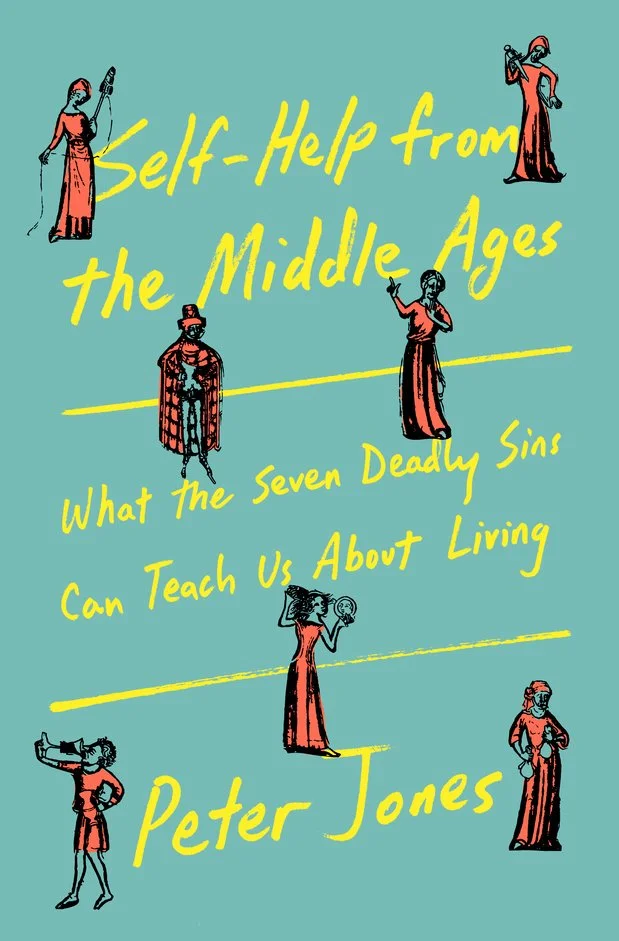
This week, I spoke with Dr. Peter Jones about the Seven Deadly Sins. Pete teaches history at Saint Louis University in Madrid, and is the author of Laughter and Power in the Twelfth Century. His new book is one after my own heart. In fact, I even gave it a blurb because I liked it so much. It’s called Self-Help from the Middle Ages: A Journey Into the Medieval Mind. Our conversation on how people grappled with the Seven Deadly Sins in the Middle Ages, some pretty fun confessions, and how the medieval perspective might just help us better navigate the modern world is coming up right after this.
Well, welcome, Pete. It is so nice to meet you. And I loved your book, and we've just had the best chat already so far. So, welcome to the podcast. It's great to have you here.
Pete Jones:
It's terrific to be here. Longtime listener, so this is just such a treat for me. Thank you, Danièle.
Danièle Cybulskie:
Well, thank you. And so, your book. Let's just jump right into this. This is a book that is almost as personal as it is research. So, what made you want to do a confessional like Augustine here?
Pete Jones:
What possessed me? So, look: the topic is the Seven Deadly Sins, right? Essentially. And, you know, I've been teaching the Deadly Sins. I was teaching in Siberia at this rather strange but wonderful institution, and I taught a class on the Seven Deadly Sins. And it was... I realized it was a great gateway to understanding so about the Middle Ages. You know, through discussions of anger, we can talk about the Crusades, through envy, we can talk about the universities and rivalries there, and so on. So, I love the topic. And then coming to write about it… I mean, as a historian, I felt, what is my role here? Am I pretending I don't have any of these things? I don't have any of these urges? I'm – I don't suffer from pride or anger? And so, it was quite important to me to put myself in it because I think I didn't like the idea that a historian would be above all of these things and surveying them from the outside. And I think it's such a personal topic, like, to write about, particularly something like sloth, which I guess we'll come to, which shades into something we understand as depression or listlessness or, you know, and things like that. Envy, pride. Do you know what a lot of it just sounded like to me? This has kind of been my academic backing track to a sort of precarious academic life. I've gone through all seven of the sins so many times now. I just thought: more fun to put the person in it and to show. Because the message of the book really is that. And I think the message of some of the best theology which we can talk about is that it's quite forgiving. You know, these aren't really so much “Deadly Sins” as things we all go through and all struggle with in a lifelong way. So, I thought it was important for the historian for me to show that I'm implicated in that, that I'm not sort of outside it. And I suppose I was also thinking about the confessional model. Augustine, Dante. There's a lot of hubris in that, I know, but… you know, I wanted to make Dante a kind of unconscious model for the book. So, he threw himself in, so I thought I'd throw myself in.
Danièle Cybulskie:
Well, I love that. And we do start with pride, which is something that you wrestle with right there.
Pete Jones:
I know. Look, I've already been too proud, haven't I? And we're only four minutes in.
Danièle Cybulskie:
I love it. So, we're talking about confessions, we're talking about theology, we're talking about how to live better. And this is a book called “Self-Help”. So, if we're talking about help, why did you go for sins? Why didn't you go for the best advice, like, how to – I don't know – win at life. We went straight for the sins. Tell me about this.
Pete Jones:
Well, I think the idea is that… well, in the medieval sort of confessional practice, you begin, you know: how do you recognize yourself? How do you understand yourself? In order to improve, you have to begin with the sins. There's this idea that you… if you're working through confession, it's like looking in a mirror, right? The sort of… the form of confession sometimes thought of as a kind of mirror of confession. You are learning about yourself and reflecting in total honesty on all of your flaws. And I think that is certainly, I think the best place to start with self-help is not so much what are the best things to strive for. Let's recognize the kind of… some of the habits we have. But on the other hand, I think it comes down to the message of what I think is the most compassionate kind of advice on the sins – Thomas Aquinas, and Dante, and people in that tradition – is sort of recognizing that these things are redeemable. You know, so your… my – I'll put it in my term, shall I? – my pride, you know, here I am writing such a book and believing in myself to do such a thing. You know, there's something redeemable about it, right? You know, pride, for example, becomes hubris and sort of a terrible egotism when you don't recognize – and this is… Thomas Aquinas talks about it in these ways – when you're not recognizing your own limitations, where you're extrapolating and expanding beyond what you're actually capable of. Someone like Aquinas, though, doesn't think we should therefore slip into a total state of humility where, I think, I can't do anything. Oh, I shouldn't write this book because I'm a worm and I'm useless at everything. This is what Thomas would call pusillanimity or, you know, weakness of spirit. And I suppose the point there is that you can't be useful to anyone if you don't recognize your own abilities. So, the idea or the advice on the sins that I found most inspiring that I came across in the research was one that recognizes your sins and sort of works with them rather than kind of shoving them to one side and then just getting on with all the virtues. So… And I suppose – come on. I have to also say the sins are more fun, aren't they? It's much more fun to write a book about sin than virtue.
Danièle Cybulskie:
I think a lot of us recognize ourselves perhaps more in sins than we do in virtues. It depends on the day. It depends on the day. Well, one of the things I really like that you put at the end was that talking about the sins – the way that medieval people talked about the sins – was not supposed to make you pure. And that's kind of what you're getting at now. But, you know, the next part of this thinking is that you said it is a way of mapping the mind. And I think this is really interesting and something that I sort of wrestled with when I was writing my book about monks, where it seems to me that naming the sins was sort of a way of categorizing so, that you could deal with it. Is this sort of what you're seeing, too?
Pete Jones:
Absolutely, yeah. And I think that that goes right back to the origin of this system, which is, you know, Evagrius Ponticus in the late 300s CE, you know, this politician who's had a sex scandal and has kind of had to find himself and has quit his life in politics and he's drifted down to the desert just outside Alexandria. And Evagrius becomes one of those cell-dwelling – we call them monks now, don't we? But I think it was a kind of a form of life without a rigid template even at that time. And, you know, it's basket weaving in the day and meditation, reflection. And Evagrius is quite unique because he decides to document all of his thoughts. And I think this is the point, right? So, Evagrius, in doing so, decides that all kind of tempting, negative, disruptive thoughts can be sorted into eight categories. And he calls those the Eight Generic Thoughts. And, you know, they are very similar. It's vainglory and pride. There's no envy, but there is sadness. And acedia, which is lack of care. And then the other ones as we know them. And I think the point there Evagrius makes is he's kind of creating a map. I mean, because these thoughts are so basic that – oh, I miss the cup I used to hold in my hand and how it used to feel in my hand. I miss my family's olive grove back in Ibora, you know, on the Black Sea. They're basic thoughts. They're not necessarily horrifying things like, you know, I wish I was the president of the world. Who would want to be that? So, it's... There's something so sweet about that, that actually what I think Evagrius was doing there – and I think he was quite conscious of it – was just creating a map really of those excessive thoughts which, I think – really the things that make us human. This is what it is to be human. And I think Evagrius did want – let's be clear – to purge himself of all of these things, or to reach a state that he called apatheia, where he wouldn't feel. He'd feel them, but not be disturbed by them. He would kind of continue. And I think there's something… I describe it in the book as like, there are several different traditions on the Seven Deadly Sins, and some say – some writers, and there are many medieval writers I read who believe that the right thing to do is get rid of them all (Peter Damien is one example) – you know, they're all awful. They all lead to very bad places and you shouldn't feel any of these things. So, there are writers who’ll write like that, and a lot of anonymous treatises will say that. But the more compassionate end kind of sticks with the spirit of Evagrius’ diagnosis that these are the things that make us human. So, to lose them were to not be human anymore – you'd be an angel. I think Dante kind of captures that really well in the Commedia because, you know, Purgatory – everyone is working through those seven sins one by one. It's only really the saints who've gone straight to Paradise. And a lot of Dante's heroes are on the terraces of Mount Purgatory. And there's an assumption that, you know, that's the default because we're never rid of these things because they are the seven pathways of thought that make us human.
Danièle Cybulskie:
Yeah. And I think that it's such an interesting way of organizing the way that we are naturally thinking about things, and they don't necessarily have to be bad. And I think that that's one of the beautiful things about your book and the self-reflection that you have in there as well is how do you actually grapple with these things? One of the things that you actually say is that medieval self-help shouldn't make sense.
Pete Jones:
No.
Danièle Cybulskie:
What do you mean by this – that it shouldn't make any sense?
Pete Jones:
Well, I suppose… We live in the twenty-first century. There are so many other forms and avenues of self-help that we would assume to be much more enlightened, informed by imaging of the brain, informed by a study of hormones, informed by the most up-to-date works published on psychology, and so on. So, medieval self-help shouldn't make sense? You know, should I really turn to what Bernard of Clairvaux wrote in his sermons on The Song of Songs? When I'm… you know. And so, yeah, I mean I'm very conscious of that. And of course, it's not either/or, you know. The medication still works. The insights from modern psychology, brain imaging are still fantastic. But I suppose the point of the book is – you know, look: it's a history on the one hand, so it's great to document how these things were thought about and it's great to feel like, you know, actually, wow, there has been a self-help industry for thousands of years and it really, really was popular and in fact it was mainstream to be talking about your listlessness, and your anxiety, and your kind of sense of pointlessness – you know, these things. It was a mainstream conversation to have, not just for monks, but people taking confession in the kind of thirteenth century. But on the other hand, there is that kind of actual application. I mean, should history be self-help? I mean, this is one of the questions I had myself before writing this book. It's a strange thing to think, and I know a lot of historians would think the answer is no, it should not. It should be, you know, it should be history. But I can't deny – and I think anyone who's ever sat down with a good novel and felt better after it, no matter the subject, or sat down, you know… for me, reading Jacques Le Goff or, you know, reading Mark Bloch, or reading Caroline Walker Bynum and understanding things about the shift in attitudes and assumptions throughout the twelfth and thirteenth centuries, I felt something. Something spark, some wonderful insight, some sense of not being alone, some sense that human minds have gone through all kinds of things similar to what I'm going through in this – what I thought to be unique – twentieth, twenty-first century, you know. There's a great comfort in that, and I've always found comfort in history. So, I didn't feel so strange making a book that was kind of history and self-help tied together. So, self-help from the Middle Ages, strange idea, but I like to think there's something in it. I hope there's something in it.
Danièle Cybulskie:
Well, I mean, you're preaching to the choir, because I've done the same thing.
Pete Jones:
Yes, yes, of course.
Danièle Cybulskie:
And I think that there's something there for sure, which is definitely one of the reasons why I wanted to meet you and have you on the podcast. Okay. So, there's one thing that I thought was really vulnerable – I think that the whole book is very vulnerable, but especially when you're talking about the sin that you're categorizing under sloth, which, you know, may be fair, may not be fair. But you're really talking about this concept of acedia, especially as somebody who was teaching in Siberia, which can be a very lonely place. In fact, that is… you know, a lot of Russian literature talks about this being a lonely place, a place that might inspire some of these sad feelings. And I feel like this is some of the deepest work that you've done in the book. So, can you tell us a little bit about this particular sin that you're categorizing as sloth, but it's really more complicated than that.
Pete Jones:
Yeah, of course. I mean, yeah, Siberia was a difficult place to move, I suppose, and, you know, the associations of exile and everything else. I ended up absolutely loving it, I have to say. But it was a struggle. And yes, there's something... The way I put it in the book, I suppose, is that this book is a kind of a tale of an escape from Siberia. But it's not necessarily the actual landscape itself, which I ended up loving. It's more the kind of the inner Siberia I made for myself by getting kind of lonely and kind of lost. I don't know. I think the academic life can be like this for some people, right? You take jobs in places that you don't necessarily… you didn't want to move before you went there. You don't have friends there or networks there. I've been a postdoc since 2014 and just on short contracts, moving around. And, you know, I've been lucky. I have a family and I've always got company in that way. This time, in Siberia, I was without my wife. She was back in Dublin for that time. This was very difficult. So, it maps on. The sin itself – acedia… Acedia is… what? I mean, to call it depression is of course, to reduce it. But nevertheless, how is it described in medieval texts? I use the example of Elizabeth of Schönau in the book. In the twelfth century, in the Rhineland. She documents her experiences with acedia as the following: as, she loved attending mass. She loved singing, she loved reading. These were the things that made her life move. She loved being a nun. But one day she's late for mass and when she turns up, she discovers that her lips move, but nothing comes out. She doesn't want to sing. She goes back to reading and she can't get through a page. She realized she doesn't want to do any of these things anymore. Nothing seems to move her like it used to move her. Acedia is often described like this. William Peraldus in The Summer of the Vices from the 1230s, describes it as standing in the middle of a freezing river. The water's rushing at your legs, but you haven't got the will to move forward. Bernard of Clairvaux describes it similarly. You know, you just – in Sermon 54 on The Song of Songs – describes it as a rut whereby you can't… You feel nothing. And all of those missions that you'd made for yourself, mission to improve yourself – and he's talking to a monastic audience – but he describes it as, you know, it's all hollow to you now. This is acedia, and so, you know, a lack of care, withdrawal of the heart. Dante describes it as when your heart stops firing or stops working. Purgatorio – I think it's Purgatorio 15 where he describes the sins and their relationship to love. So, this is kind of… the withdrawal of your love is acedia. So, that's the sin. I mean, for me in Siberia, I have to be honest. Yeah, I did question, what am I doing? You know, I was doing four ninety-minute lectures a week, all with PowerPoints and then multiple seminars. And I was doing this thing where I would teach public speaking to sixty students at once. And all sixty students wanted to run through their presentations. And their presentations were fiendish. It would be things like they had to match three books in different subjects they'd read that year. So, it might be Foucault plus a physics textbook, plus something they read about from Jane Jacobs on New York City. And I love teaching and I love – and of course, medieval history has been my love since I was a child. Or history more generally, and the Middle Ages, too. But there's that moment where it's… I thought I loved this and I know I love this somewhere deep down. But it all just feels like a sick joke to me now as the thermometer ticks down to minus twenty-five and it's lecture number eight. And I've still got these nine meetings to go later on. Yeah, well, I mean, I'm very frank in the book. Yeah, of course this is depression. I mean, I felt something... I felt depression while I was in Siberia. It was very difficult to sort of get out of bed at times. But I'm not going to say that there was a simple answer to something like that. But one thing I learned was – perhaps the wisdom was learning two things. Number one, there's not a simple answer and accepting that, that you can't click your fingers. More importantly, you can't just move. Like, the answer wasn’t to just leave Siberia, as easy as that would be. The other thing I learned was… was really to do with – Bernard says this in that sermon I mentioned – you know, sometimes these moments can be a bit of an awakening for you. Like, they lead to a point where you question your life, question what you're doing. And, you know, actually I kept... I thought, well, hang on, I need to just maybe give more of my heart to history and to teaching than I have been. Maybe the problem is I've drifted too much and I'm kind of not paying attention and I'm kind of listless. It was a difficult situation. But in the end, that time in Siberia inspired me, particularly that class I was teaching on the Seven Deadly Sins. It sort of woke me up a little bit and I realized… I remembered a little bit why I'm doing this. Which is to sort of to inspire people that there's more to history than passing exams, that you can find a universe in the Middle Ages, and that universe can speak to you and, you know, awaken all kinds of things in you. And, yeah, I know that's a certain kind of philosophy of teaching, but, yeah, that's what helped me. So, yeah, sorry, that's a bit of a jagged story, but it was a strange place to teach. I suppose I had to go into a lot of detail there.
Danièle Cybulskie:
Well, I mean, this is what the book is. People are getting a taste of the book. And the reason I love the book is all of these things that you're connecting here, where you're talking about an experience that you had and getting into it for us, explaining this, how it actually feels, and then finding examples in the past. And I think that something that you said just a little bit earlier is so important, where it really helps you feel less alone. And especially when I was looking into this phenomenon that was really expected of monks and nuns, the fact that it was expected was kind of a relief to come across. When you come across these big emotions that everybody has felt from time to time – but you feel very alone in these moments, especially in moments of acedia – to find that in other people's work is very helpful, I think. Maybe not a bullet, like we're talking about – magic bullet – but it is very helpful. And so, you know, people are getting a taste of this from what you're speaking on just now.
Pete Jones:
Oh, yeah, that's wonderful. Yeah, it's true. Isn't it comforting that, okay, acedia is one of the Seven Deadly Sins, right? So, if you're confessing every year – mandatorily, after the Fourth Lateran Council in 1215, you are – and if you're working with priests who are using confession manuals, acedia is one of those Seven Deadly Sins. So, it's structuring that confession, or part of that confession. So, you are having – everyone, therefore, is consequently having – to have a conversation in which they confront this. Which is kind of eye opening, really, that there could be such a... That that could be an organic part of everybody's year, that they will reflect on their listlessness, their kind of restlessness, their inertia. I suppose it sounds quite negative when I put it like that, but it's... Yeah, it is kind of refreshing to think that that was a standard part of your calendar, to have that kind of difficult conversation.
Danièle Cybulskie:
Well, I think that the reason that spoke to me so much – both when I was doing my research and then coming back to this again when I was reading your book – is that I think that today there is so much… I think people are calling it, like, toxic positivity, where when you feel something that doesn't feel very comfortable, like a long stretch of acedia, people are like, I need to fix this. And so, it's kind of nice to come back to these medieval sources that are like, maybe you just need to sit with it and work it through until it's finished. It's something that we all expect to have to do at some point as humans.
Pete Jones:
Yeah, absolutely. And that's what I love about this kind of Seven Deadly Sins template. It is so forgiving in the sense that you're not supposed to master any of these, you're supposed to keep coming back. And it's not a self-help culture of here's the fix. The fix. You'll be happy once you get the fix. It's totally not that. And yeah, sitting with your acedia, and it's accepting – okay, I guess this is one of those spells I have to go through. Yeah, it's refreshingly different in that sense.
Danièle Cybulskie:
Well, speaking of people who haven't mastered all their sins, even though they're supposed to, you have Thomas Aquinas coming up. I mean, he was going to come up at some point and you have him coming up in the chapter on gluttony. So, tell us a little bit about Thomas Aquinas and gluttony.
Pete Jones:
Poor Thomas. He – you know, I mean, he's like Bernard and Dante. They could have gone in every chapter, any chapter, and they probably are in those chapters. Look, I was just… On the one hand, those thirteenth-century debates about what happens with food and the body – I know this was covered well by Caroline Walker Bynum, Holy Feast, Holy Fast, and other places, resurrection of the body – but they're so fascinating. And I thought it was just an interesting way to approach gluttony was to think about the question, are you what you eat? You know, does the food substance transform into your essence as person? This whole debate, which is in scholastic theology in the thirteenth century. Aquinas has a kind of ambivalent position on it, but ultimately sides with the yes, the food is converted into your body. It does make you grow, therefore it is part of your essential self. It will be resurrected with you. I found that just such a fascinating debate, you know, in terms of Thomas's life. So, why is Thomas in gluttony? I also thought the moment, the little tiny moment – I love it. The… you know, this book is supposed to be about really bringing to life these medieval people and recognizing ourselves in them, right? So, for me, Thomas Aquinas, it's interesting, right? He's the medieval computer. He is his philosophy. He is this edifice of absolutely exquisite theology that we refer to and we revere, and it's fantastic. But the little detail of him falling sick and then his one indulgence: could he have some herrings just like those ones he used to have in Paris? And I just think it's lovely and humanizing, and we see the person of Thomas rather than just the hand with the pen. But it does speak to a question, what is gluttony? And in the Middle Ages, as we say – I mean, as Thomas describes it himself – gluttony is, of course, not just eating too much. It's also a few other things. It's eating too hastily, okay, and wanting it at the wrong times of the day, and so on. But it's also fixating and fussing about your food. As I say in the book, you know, today, me obsessing for twenty minutes about making some Yirgacheffe Ethiopian coffee, that is excessive fuss at some level. And that probably counts as gluttony. But for Thomas, it's that fuss. Like, could I have this? Not that this is, you know… Look, I'm sick. I know I'm sick, but could you just, you know, go twenty miles down the road and find someone to get me some herrings? It would count as a form of gluttony. And I thought it was interesting because that's not a typical way for us to think about a sort of food issue today – or certainly not think about gluttony – but it opens up that question about… Well, I mean, Gregory the Great – the pope – said that gluttony isn't so much about the food, it's the thinking about the food that makes gluttony. So, I thought, what Thomas thinking about his herrings in that moment is such a small slip. And of course, it's not a deadly, deadly sin, but it reveals the attitude to food that I think is different, that I think is valuable for us to think about – this idea that it's about how much you think and obsess with food, not so much how much you eat, that kind of makes you a glutton.
Danièle Cybulskie:
Yes. Well, this was such a good moment to pull out, because I can never really put my finger on what bothers me about Thomas Aquinas. I remember having a conversation with Dan Jones, and he was like, what is your beef with Thomas Aquinas? And I think it's just that he does not allow himself these slips. He does not allow himself to be human or have any fun. So, you know, in this story, he gets the herrings that he's really been craving, and then he can't even enjoy them because they are sinful.
Pete Jones:
He hates himself. He hates himself for doing it. It's terrible. You know, so. Okay, right. Oh, I didn't realize you had this beef. Now, we –
Danièle Cybulskie:
It's just that he is no… He's just no fun. He does not allow himself to have any fun. That is my only problem with Thomas Aquinas. He's a brilliant man, but he really… He has a thing against fun. And of course I love it. So, maybe that is a sin of mine.
Pete Jones:
Oh, no. He rebelled, though, didn't he? Rebel. He was a mad rebel as a youth by going off and joining the Dominicans, I guess. Yes, that's his idea of having fun. Take that, mom and dad.
Danièle Cybulskie:
That's right. I'm going to be a Dominican and I'm going to make sure no one can have any fun for centuries. That is a rebel right there.
Pete Jones:
Fair enough. Fair enough.
Danièle Cybulskie:
One of the chapters I thought was really interesting is – well, they're all very interesting – was talking about avarice, because you pull up a couple of really interesting examples – again, complicated examples – because you… you bring up the pilgrimage of Mansa Musa, who I've talked about a couple of times on the podcast with a couple of different people, and the way that Europeans really kind of struggle with the amount of wealth that somebody else is having. Can you tell us a little bit about how avarice works?
Pete Jones:
Yeah, I mean, so I was fascinated by Mansa Musa, you know, and the... the billions in fortune and so on. But it was more about the European prejudice and the strange attitude and coming across these moments where… So, on the Catalan Atlas, Mansa Musa's holding this golden orb and the gold comes to symbolize him. And, you know, in a certain way, he's fixated on it, staring at it in a slightly manic way. And then in the manuscript of Guillaume de Deguileville, he's kind of… Mansa Musa’s conflated – or at least a figure, a sort of Muslim king like Mansa Musa at a similar time – is being conflated with avarice itself. The sort of creature of avarice which has six arms and is all kind of rapacious and thieving character of avarice. Yeah. I don't know. I mean, my sense was that there was an exoticization of avarice, and I was interested because it turns out that this becomes more of an interesting topic for preachers in the thirteenth century. Right at the time we get this kind of commercial revolution, more money flowing in, growth of the bourgeoisie, money in the economy. And yeah, at that point – well, avarice, well that's something exotic, isn't it? And so I think this fixation on someone like Mansa Musa and his putative avarice – which doesn't seem to actually be so avaricious when you dig into it by their terms – it's easy to poke fun at him as a sinner of avarice because he's not like “us”; he's Muslim, he looks different and he's far away. And those things make it okay to sort of… The terrifying thing is to say, we ourselves: do we suffer from avarice? And so, I think it's convenient. I suppose I saw a modern parallel with that one, as well. Although, of course, I think there is also a lot of self-flagellation about avarice. But I felt it was interesting because this is something kind of new. Lots of people can consider themselves guilty of possessiveness and hoarding money, or seeking after more and more exquisite items when you have a money economy, when you have a growth in bourgeoisie and bourgeois culture that can afford these things, and access to markets with growth, and expansion of roads where these things can be desired. So, it's an up-and-coming sin in the thirteenth century. Yeah, I think Mansa Musa doesn't deserve the reputation. I think these stories about his servants spreading gold dust in front of him on the road – well, I mean that just can't be right, right? Handing out the gold bars, crashing the economy of the places he would visit because he would hand out gold bars to people. These seem like fantastical stories. They are from the Arabic sources, however. But you know, I think that they get warped and taken out of proportion. And he just seems to have been really generous and prudent and decent with it. Like, the wages he pays to people is… you know, they're wonderful wages. He seems to have spread the money around. If anything, he seems profligate. He's the opposite. He's not so much avaricious as profligate. He was an interesting character to research, certainly.
Danièle Cybulskie:
Well, it's interesting because it's certainly easier to talk about other people's sins than your own. And so… when you distance yourself from it and say that's too much, that person has too much. It's an interesting thing that people do: distancing themselves from their own sins. And so, I brought this up because also in the same chapter, you're comparing it with a really rich Grail. It's supposed to be the Holy Grail. And so, when is it too much for us to have? When is it too much for them to have? This is a really interesting discussion that people are wrestling with.
Pete Jones:
Precisely. Yeah. Not okay for Mansa Musa to have too many gold bars, but it's okay for us to want the Holy Grail, or things like it. What I hit upon in the Holy Grail is quite interesting because, you know, there is obviously a subculture – if we want to call it that – in medieval theology, which, you know, reveres the object. And we think of Abbot Suger and, you know, through these beautiful things, your mind will be raised up to the thought of beautiful things. And obviously, Bernard didn't like – Bernard of Clairvaux – didn't like this sort of thing, famously. But it's there. And I was thinking about this. When I think about avarice, I think the Holy Grail fits into it. And there's certainly the kind of stories about the Grail. Wolfram von Eschenbach's story of the Grail is interesting because, you know, the problem that Parzival has is he doesn't recognize the valuable thing when he sees it. You know, there it is in front of him, shining, and he's not able to recognize its beauty and its value in the literal sense in the Grail story. Okay, he's made a mistake because it has a spiritual value beyond its material value. But I do think that behind that story, there is also a sense of the – objects do have value that are intrinsic to them, that, you know, they can't be neglected or wasted. And I think, you know, I think this is another story that makes sense in a consumer society, in a growing commercial culture, valuing and respecting objects for the value they have and not being wasteful or dismissive or tasteless, if you like, with them. So, I was interested in that. I would like to explore that even more. I was actually quite influenced by a modern work of anthropology by Daniel Miller, this book called Stuff, which kind of makes a point about objects having soul. It's heresy to bring up modern texts. I've made a mistake there, but. No, but I certainly… I found it. I was interested in that alternative view. Like, we're all too familiar with the you should own nothing – the Franciscan poverty kind of view. Possess nothing. But I think the other side of that debate – possess things and value them as things – I mean, certainly for a culture that's producing fantastic and wonderful illuminated Bibles, books of hours, the idea of an object which has a beauty, which is intrinsic to it, which leads you to somewhere else, is a very important part of medieval thought. So, I felt that had to be in avarice. I thought it was important to counterbalance the more radical Franciscan view.
Danièle Cybulskie:
Well, it's important to talk about this because there is no one view on pretty much anything ever, really. Even in medieval theology, when people think that there is only one way to do things – like, the… people are supposed to be impoverished, they are not supposed to own anything – and that's only one way of looking at things. And so, I think that it's good to have this discussion in your book, especially because people may come to a place like a medieval cathedral and look at the way that there are some beautiful objects that are rich objects and be looking at them and saying, I thought the church wasn't supposed to have anything. And so, like, these are discussions that are lively at the time. And so having it in here, I think is really worthwhile.
Pete Jones:
Oh, yeah, I'm glad. Yeah. No, and it was. And it's so much fun. And yes, hopefully it can go some way to explaining the incredible material culture in the Middle – you know, why there is so much fixation on the objects themselves. And so much care and love went into building, creating, caring for beautiful objects in the Middle Ages that are… have a religious value. So, you know, it's important that that's there.
Danièle Cybulskie:
Well, I don't think we're going to get to every sin. If we do, that's amazing. If we don't, I need to ask, how did you decide to come at the deadly sin of lust? And this is the last one. Like, if you're writing a confessional, there are many medieval confessionals that will get really deep into the exact lusty thoughts they were thinking. Like, this must have been a daunting chapter to write.
Pete Jones:
Oh, it really was. Of course it was. The way the book is framed, here I am experiencing the sins as we go, right? Or at least, I mean, confronting them in myself. For envy, I am… I'm kind of reflecting on, you know, a friend being more successful than me and kind of being a bit jealous and, you know, for anger, I'm kind of in a faculty meeting and I'm very worked up. All of these things are real, by the way, obviously. But I could have chosen loads of moments. I kind of condensed them down. Lust was always... I knew it was waiting for me. It's the last chapter I was going to write. So, what… So, I wrestled with it so much and I eventually… Well, there's an aqueous kind of theme to this chapter, right, because we've got Bernard of Clairvaux jumping in the freezing lake to avoid his lust. We've got some fabliau tales where one character is having a hot bath before sleeping with somebody, you know, in a kind of swindle. And then we've got the sort of the pools of Hieronymus Bosch's Garden of Earthly Delights. So, you know, I thought, well, the hot springs in Tyumen – this is the perfect place. Bernard of Clairvaux jumped into a freezing lake, you know, I'll have myself in the hot springs in the opposite of that. It was important to me, as I say, to admit, you know: look, these are just fleeting thoughts. Lust is a pretty terrifying thing in contemporary culture. And I think if we were making a ranking of Deadly Sins, I don't think today we would put it seven out of seven, the lowest ranked. I think we would have it much higher. I don't think that they were wrong in the Middle Ages to… you know, I don't think they treated it disdainfully. It's still a deadly sin. How did I go about it? I've given myself the mildest, the mildest temptations, you know, in the hot springs, glancing at people. It's fine, it's fine. There's nothing… nothing I can't show to my mother-in-law. But still, for that chapter, yeah. There's so much material, isn't there? I mean, what… what to choose? I'd been holding Bernard of Clairvaux back for that because I think his writing on love is his most explosive feature of his theology. And I think, actually, I've always been convinced that he's somebody who never lost that lust that made him jump into the lake. And I think he was so motivated and, I think, so telling, you know, that he's accused of writing all these, you know, lusty songs as a young man. It makes perfect sense to me that this is an extremely sensitive person who feels desire really strongly. And that makes so much sense of his theology and those… The sermons on The Song of Songs, but, you know, on loving God, as well. So, I think he had to be in there to show that lust has this other side and then the fabliau have to be in there because there's so much, I know, quasi-pornographic material to choose from. The fabliau are just so sensational. I always loved – for the students, we would read the fabliau and just a few of those often, actually, at the start of class – you know, before we started – you know, just to surprise them. The kind of sources that are available in the Middle Ages. Because some of them just feel so modern. Some of them feel like they could be a modern standup comedy or something like this. But also, they're so bizarre. I mean, to have a quasi-pornographic tale where people get dismembered, you know – there's something genre-defying about them. And I think to have a discussion, you know… I'm thinking of the one where – is it a husband? – comes back and discovers his wife's been sleeping with a lover. The lover's disguised himself as a crucifix because the guy is a carpenter. And he says, I just need to adjust one of my sculptures. And he chips off the crucifix's penis. Strange for a pornographic tale to have that resolution. I don't think… would so many people click on pornography if that's how it ended? I mean, it's not... It doesn't match our modern expectations of genre. And so, I thought it was fun, therefore, as a way in to understand that, okay, lust exists in a different universe in the Middle Ages. And then Bosch is a good place to finish. Because they're all naked, aren't they, in that painting? And there are no old people, there are no children. It's just like a big orgy, or a big party or some sort. And there's something unsettling about that painting. I live in Madrid, as well, so where Bosch's painting is. So, I visit a lot and, you know, for me it's very unsettling, that central image. But I'm aware – I've brought so many guests who've come to visit over the years to look at that painting, and they all see different things. But, you know, if you ask them what do you think this painting tells us about lust or sexual desire? You get all kinds of different answers. I kind of feel like, oh my God, I'm in the prudish spectrum. I find it unsettling. Other people have given… but I thought that was a fun place to end. Because I also think that that painting kind of sums up the sins as a whole in a sense that insofar as I found it unsettling, it's a lot of people shutting themselves away in booths, and boxes, and bubbles. And if I think Bosch's painting is kind of a vision of humanity gone wrong, I think it's precisely because there are no children, no old people, and also because these people are shutting themselves away and kind of cocooning themselves in, like, a prawn shell, or in the head of an owl, or in a little toll booth, or whatever else they're doing in that painting. That speaks to the larger problem, I think, that I found with the sins as a whole – that a lot of medieval advice about the sins is that they are when you turn your back on other people. That they are a kind of antisocial mechanism of the mind. And so good place to end it, I thought.
Danièle Cybulskie:
Yes, well, and then the way to get past them often – these moments that make us feel shameful, all of these sins – the way to get past them is often with other people, through other people. So, I know I've put you really on the spot with the lust thing, but I do… I'm not going to ask you any more about personal examples. But one of the things I think is really interesting – and something that is still in debate when it comes to this particular sin – is what's the difference between lust and love? And you have some really beautiful stuff in here, too, which I think shows this is a confusing thing for people and something that they always have been wrestling with since forever.
Pete Jones:
Oh, you're very kind. Yeah. Well, I thought – again, I think I was reading William Peraldus, really, where one of his comments on what lust is, is that it's out of time – or it's jumping into things with no regard, I think he says, to past or future. It occurs to me that that is the thing. Duration is the difference between lust and love, you could say. That, you know, that lust – in the writing about it at least – is this momentary thing. It has seconds to live. It's all about now. This configuration, right now. And if I have lust for a person, the theory is that I don't care about their past and I don't care about their future. I don't want to hear their story about how the job interview went last week or you know… or you know, the job interview they might have next year. I just… It's all irrelevant to me. I'm only really interested in the next few hours – that's kind of lust. And I think that that's… That kind of makes sense that love is... is duration. Love is a commitment. I think… Obviously, look, this takes us beyond the scope of the Deadly Sins. It takes beyond the scope of the book. But the writing about love in the Middle Ages is, you know, some of the most beautiful writing. And Bernard of Clairvaux does it best. But there's something self-alienating about love, you know, that I… I'm so interested in you that I lose myself a little bit. And Bernard of Clairvaux describes that. Of course, he's talking about loving God, but he describes it as dissolving, like a drop of water dissolves into wine. This is what falling in love is like. And that's not present in lust. I think you're still you, aren't you? You're a bit hypnotized, but, you know, you're throwing yourself into an encounter. You're not necessarily losing yourself in another person in a way that takes longer to achieve. And it's more about kind of long-term commitment. So, yeah, I mean, I'd love to write more on medieval love, but I'm just relieved now I don't have to give any more personal examples. But there you go.
Danièle Cybulskie:
Well, I think that is actually really beautiful. And one of the things that I wanted to pull out is that there is a constant discussion right now – especially with the new documentary on Netflix – about when does somebody actually love you and when do they just want to use you? And so, I think that this discussion that people are having in the Middle Ages is super relevant. And it's… I mean, it comes up in all sorts of sources. And so, I think that it was a good place to finish. It was a good... a good sin to finish on, there. So, we are coming to the end of our time, which is… which is a shame because I think we could talk about this for pretty much ever. So, I need to ask you, do you have a favorite sin? What was your favorite sin to write about? I don't need to ask you which one is your favorite one to live, but which one is your favorite one to write about?
Pete Jones:
Well, I loved writing about envy, and that's the one I was looking forward to writing about because it is so sort of nasty as a sin. And, you know… So, envy is not “I want what you have.” If you have a beautiful guitar. I don't want... I don't want to have your guitar. I want your guitar to catch fire. I want it to burst into flames. I want you to not have the things that you have – that was fun to write about. And why was it fun to write about? Gosh, is it? Am I learning something about myself right now? 45 minutes in? Look, it's a fun one because it's so unpleasant and you can't – you know what? This is one of those sins, as well, like, oh, you know, I glanced at someone in the hot springs, but I didn't mean to, you know... You know, I'm just interested in faces, or whatever. Or, like, oh, you know, I kind of believe in myself – you can explain away other sins and say, well, isn't it just a bit… You know, I'm just a human, like you. But envy is… Just to admit to it is so unpleasant and difficult. I mean, especially when it comes to the – I want someone else to be crushed. I don't want them to be successful. Writing about it, I thought it was fun. Okay, so, reflecting on my own experiences, you know, this was one part, but writing about it in terms of... I found Giotto was just so marvellous because, as a painter, I think he's someone who really paints envy fantastically. And studying his Scrovegni Chapel images, you know… Giotto is a very expressive painter. Of course, there's a kind of austere simplicity to that expressiveness. You know, it's not too over the top, right? The subtle detail says everything in Giotto, I thought, you know, this particularly… It's where Joachim and Anna are kissing. And there's one woman who's just overjoyed because they discovered they're going to have a child. Fantastic news. So, they're kissing and this one woman is overjoyed. And then there's a person who is pulling a veil over her face. Her face has gone white, almost. The blood is drained and she's averting her eyes. She's not looking at the kissing couple. I can't think of any work of art that gets that so simply and starkly as that. That kind of envy being the thing of something beautiful is happening for someone else. But I just can't look. I can't watch. It's too much. Oh, my God, they're signing their mortgage papers. I can't look. I can't look, you know, and it's... It's unpleasant. I'll admit to that envy, will I? It's unpleasant and that's why it's fun. So, I like writing about Giotto. I loved... I loved the sort of Judas – the stories of Judas – which are just horrifying. The backstory of Judas, it's horrifying and it's... and it's really – it's x-rated in places – not for children– but in places it's… Yes, it's antisemitic, it's vile writing. And then it's just surreal writing. Jesus going down to hell and meeting Judas. You know, there's St. Brendan meeting Judas on a rock because he gets to spend one day a year on... Oh, is it? No. Every Sunday does he get…? I don't know if you remember this one. He gets to spend – every Sunday, Judas gets some special time where he gets to be on a rock out of hell. Just… I don't know, it's compensation for at least being a good apostle for those other days that he was. And then he has to go back into hell, making hell even worse for him. I think that's the real reason he gets his day off. So, some of the writing about Judas is great. And I think that that also made that chapter fun. And, yeah, Petrarch, and who doesn't love writing about Petrarch? And scholars who fall out with each other, blackening each other's reputation. What I didn't know about Petrarch is how sensitive he was to being compared to Dante. This is interesting. We come full circle to my accidental I-want-to-imitate-Dante thing at the start. Petrarch’s asked, you know, well, why did you never own a copy of Dante's Commedia? You know, it's the great work of literature of our time, of any time. You don't own a copy. And they say, you know… He says, well, I just didn't want to accidentally imitate it or be accused of imitating it. Which is just, I don't know, flimsy. It's flimsy, isn't it, Petrarch? So, yeah, I… What's not to love about discovering these kinds of perverse little moments? And if the mission of writing history was, in this case, to humanize and to connect with people from the past, then envy is really a place – it's a junction where I met them all in really interesting ways.
Danièle Cybulskie:
It's true. It's true. And I think that there are a lot of academics that are going to read this and really feel that one. And for people who are haven't seen the book or are not really familiar, envy is the second – the second sin from the top. It is an important one. I've just realized there's only one sin we're missing. So, let's just take the time. Let's get to the last sin, which is anger, because it would be… It would be remiss of me to just leave one out. So, tell us about anger, because I think that anger is one... It's got a bad reputation. I think it's number three in the hierarchy of badness. And it's not always bad, is it?
Pete Jones:
It's interesting that it's number three, isn't it? It seems a little high in the listicle. Anger is one of the spiritual sins, right? So, it relates to our intellectual faculties. So, if avarice, gluttony, and lust are the bodily – you know, they relate to our more simple impulses. And sloth is kind of marooned in the middle because it's kind of no impulse. Then anger is, you know, the lesser of those intellectual ones. Yeah, I found it interesting researching it because, yes, there's an acceptance in a lot of theological writing that some anger can be a good thing. Obviously, you have the Stoic writers who think all anger is wrong no matter what – and Boethius maybe downwards, you know – so there are those kinds of writers who argue that you should feel nothing. So, I found that interesting, mapping the spectrum of writers, and I sort of do that through a look at the Judith and Holofernes story. Judith beheading Holofernes. It's righteous anger, right? You know, she has every right to do it. There's no international court or tribunal at the time, her town has been surrounded. Holofernes... his plan is to starve all the children to death and therefore to force the town to surrender. You know, look: in this instance, anger is completely justified. Beheading Holofernes as an act of war is justified, you know, asterisk. There we go. But Judith, nevertheless… We have these wonderful images of Judith doing it with just a smile on her face because she, you know, she's absorbed that anger, but she's not feeling it, right? And then you have others that show her, like, with this frantic golf swing where she's really – you know, blood's up in the cheeks and she is going for it. And I think this is a good way to map the spectrum. For some writers, anger is never welcome. You're better than that. And for others, anger is okay. It's okay as long as you've got perspective. I found it interesting because, you know, I look at Thomas Beckett – Henry II's famous angry outburst, Thomas's assassination. They both had a lot to get angry about. And it was interesting the way writers of the time document and explain away and excuse their anger. And Henry II in the end says, look, I'm… I'm a son of nature. Isn't it right to be angry? So, he takes a sort of a quite a simplistic human nature view on it, whereas Beckett, kind of his crew have more of a Stoic view on anger in the end. What I found most interesting about anger as it's described, and this actually comes from one of Augustine's letters – I think it's Letter 14, I think – is that anger is a kind of addiction. It becomes a problem when you start to enjoy the anger in itself. So, if we want to think about anger in ourselves, it's not a problem when you're solving problems, and there's an appropriate amount of anger required to solve certain problems. Obviously, if you're a crusader and you're, you know, in the middle of a campaign, some anger is going to be expedient there, but also just, you know, the law functions on a certain amount of anger. I think writers are sensitive to that. Medieval writers accept that there's a kind of functional, useful anger. I think they call it effective anger. One – I think it's Thomas of Perseigne, the Cistercian, calls it that. Yeah, the problem comes when you slip beyond, when you're enjoying it for the sake of enjoying it. And this is what one writer, John Ayton and many others actually call rixa or quarrelsomeness, which is the capacity of… Of I'm doing this because I'm an argumentative person, because, in other words, I get a certain amount of pleasure from winning an argument, and that's why I'm angry. Not so much because I want to solve a problem, but because it feels right. In the book, I apply this – and this one was obviously very easy. I mean, how many angry moments could we pick out? I was in… A faculty meeting moment. But I would recognize – I hope no one listening gets angry in faculty meetings. But, you know, it can happen. And it was an interesting point. You know, I loved that particular colleague and still do, as a friend and everything else. But those moments where you're angry and you feel right, you know, I'm right on this, I need to raise my voice. It's an interesting moment where I'm enjoying being right. And kind of that is the essence of anger, is a certain enjoyment in being right. And I think that that was the revelation for me, because otherwise, anger seems to be quite straightforward. We all know what it looks like and feels like. But I think the medieval view that it's kind of an addiction to being right that goes beyond solving a problem, I found that really illuminating.
Danièle Cybulskie:
Well, it is very illuminating and I think relatable in ways that might be uncomfortable for a lot of people. You know, looking at that especially. Well, I'm thinking the Internet culture right now can have a lot of righteousness in it. And so, it might be something that many of us try to come to grips with in the wee hours of the morning.
Pete Jones:
Okay, yeah, just pick up the book, chapter three. You'll be okay. And then don't write the post you were planning to write. Always keep it in draft before you send.
Danièle Cybulskie:
Yes, keep it in drafts. That is the safest way. Or just delete it the next day. You know, you never want to hit send by accident.
Pete Jones:
That's true. Good point. Good point. Very good practical advice.
Danièle Cybulskie:
So, how are you feeling at the end of digging through all of these emotions, looking at some of your worst feelings? How are you feeling by the time you finish writing this book? Where did it leave you? This is kind of a personal question, but the structure of the book invites this question. So, if you're comfortable, how are you feeling by the time you finished writing this?
Pete Jones:
Well, no. Exhausted, vulnerable. I've exposed myself in all kinds of ways. Worried about my mother-in-law reading the book. No, I think, of course delighted. Because, you know, there's something so cathartic and therapeutic about working through these things. And I mean, for me, I wrote this book very much as a kind of goodbye to medieval history in a way, because I ended up quitting the job in Russia for no reasons to do with the place. And I'd reconciled myself to the job there. I loved it, actually, by the end. But politically, it was becoming more and more difficult to live in Russia, 2021. I quit in 2021, so before the war with Ukraine, but already I was finding it difficult. I think there was a moment where a journalist was... His plane was grounded and he was arrested. And I just thought this was the straw that broke the camel's back for me. So, I left Russia and I thought in many ways… I had no medieval history job after this, no academic job. And I was thinking, well, look, it's over for me. I want to write kind of the things I loved and write them down. And that can be my project now. And so, I'm very, very lucky. I'm extremely lucky that I got to do it and I got to write it to the end. And it wasn't just another project that I start and then give up the next month. So, I felt an enormous amount of satisfaction about that. I could put down the things that I've loved about the Middle Ages in the last twenty years of studying it in terms of going through the sins. Well, you know, I'm not cured of any of them, that's for sure. And I feel, you know… So, sometimes I feel, you know… I see that the book is being published next week, but you know, I have the copies now and you know, yeah. Do I sometimes think, can I really put my name on a book that's… that's self-help, you know, if I don't feel helped? But I do feel helped. I feel helped. But not… but not cured. You know what I mean? I think that there's something incredible about diving into this writing on these extremely personal and yet so commonplace things. It's marvellous to confront them all. And I think it's a bit like cleaning your house, right? You know.
Danièle Cybulskie:
Yeah.
Pete Jones:
You know – you know there's stuff under that sofa. You know that if you go in all those bathroom drawers, there are things you need to throw away. For me, this was like that, you know, it really was. It was… it was taking up the couch, the drawers, everything, and thinking through what are my experiences of all these things, and just also confronting some of the best writing, I think, that's ever been written about it. You know, Bernard of Clairvaux, you know, Dante's writing on this, you know, Margery Kempe's writing. It's just a treat to read such texts and to go through them and to think about it in these personal ways. So, yeah, it was a thorough, deep clean. But then, like anyone who cleans their house, you know what happens next, don't you? There's more dust under my sofa now. There are more useless rusty razors in my bathroom drawers. So, like it's… it's a never ending process. But writing this book has given – I feel like it's given me a map, and it was a great excuse to tour through some of the great texts of the Middle Ages. So, I can't deny writing it was one of the most fun things I've ever done. So, I don't know, what do I do? What do I do now? I mean, I don't know. I don't know. How can you have that much fun again? But, yeah, it's been wonderful.
Danièle Cybulskie:
That is wonderful to hear. I'm so glad because it was a joy for me to read and it really made me think very deeply, and I think that it's going to be the same for other people. That you have left a map for people to discover themselves, to discover the Middle Ages and all by looking at the Seven Deadly Sins. So, thanks so much, Pete, for being here and walking us through it.
Pete Jones:
Oh, thank-you, Danièle. It's been marvellous. It's been such a pleasure. Thanks so much.
Danièle Cybulskie:
To find out more about Pete’s work, you can visit his page at penguin.co.uk. His new book Self-Help from the Middle Ages: A Journey Into the Medieval Mind.
Last week, I quoted Chaucer’s wish for his little book to be understood by readers, and I mentioned how truly incredible it is that we get these little markings from so long ago and can be transported into a completely different time and place. So, it seems fitting this week to bring to you a quote from Isidore of Seville, an incredible sixth-century scholar, on precisely this miracle.
This quote appears in Isidore’s Etymologies, a book in which he explains where words come from, and where they get their meanings. But first he starts with letters. He writes, “letters are tokens of things, the signs of words, and they have so much force that the utterances of those who are absent speak to us without a voice, [for they present words through the eyes, not through the ears].” And just in case you’re wondering, Isidore says the word for letters comes either from the Latin for road – “because they provide a road…for those who are reading” – or from the word for to repeat “because they are repeated…in reading.”
Like this example, so many of Isidore’s etymologies are pure, absolutely delightful speculation. This particular translation is from the Cambridge edition of the Etymologies, by Stephen A. Barney, W.J. Lewis, J.A. Beach, and Oliver Berghof.
And speaking of reading, just a reminder that I’m offering all paid members on Patreon a free digital download of The Five-Minute Medievalist this month, in celebration of its ten-year anniversary, and in gratitude for all you amazing patrons out there. So, get downloading, tell your friends, and share the love at patreon.com/themedievalpodcast. Because without your patronage, this podcast would just not be possible. So, thank-you. I really hope you enjoy the book.
Thank-you also, to those of you who let the ads play, share your favourite episodes with your friends, and rate this podcast with all the stars on your favourite podcast platforms. I see you, and I appreciate you.
For the show notes on this episode, a transcript, and a growing collection of the books featured on The Medieval Podcast, please visit medievalpodcast.com. You can find me, Danièle Cybulskie, on social media @5MinMedievalist.
Our music is by Christian Overton
Thanks for listening, and have yourself an awesome day.