Medieval Musical Romances with Nigel Bryant and Matthew P. Thomson




The Medieval Podcast uses affiliate links
Episode 337
It’s always a great moment when you’re watching a play or a movie, and suddenly one of your favourite songs appears to heighten the mood. All of a sudden, you’re even more deeply emotionally invested in the lives of the characters, and what’s going to happen next. Believe or not, the hit music of the Middle Ages also appeared for some of the very same reasons in medieval romance. This week, Danièle speaks with Nigel Bryant and Matthew P. Thomson about how these romances integrate music, why villains don’t always get a song, and the incredible culture of medieval top hits.
-
Danièle Cybulskie:
Hi, everyone, and welcome to episode 337 of The Medieval Podcast. I’m your host, Danièle Cybulskie.
It’s always a great moment when you’re watching a play or a movie, and suddenly one of your favourite songs appears to heighten the mood. All of a sudden, you’re even more deeply emotionally invested in the lives of the characters, and what’s going to happen next. Believe or not, the hit music of the Middle Ages also appeared for some of the very same reasons in medieval romance.
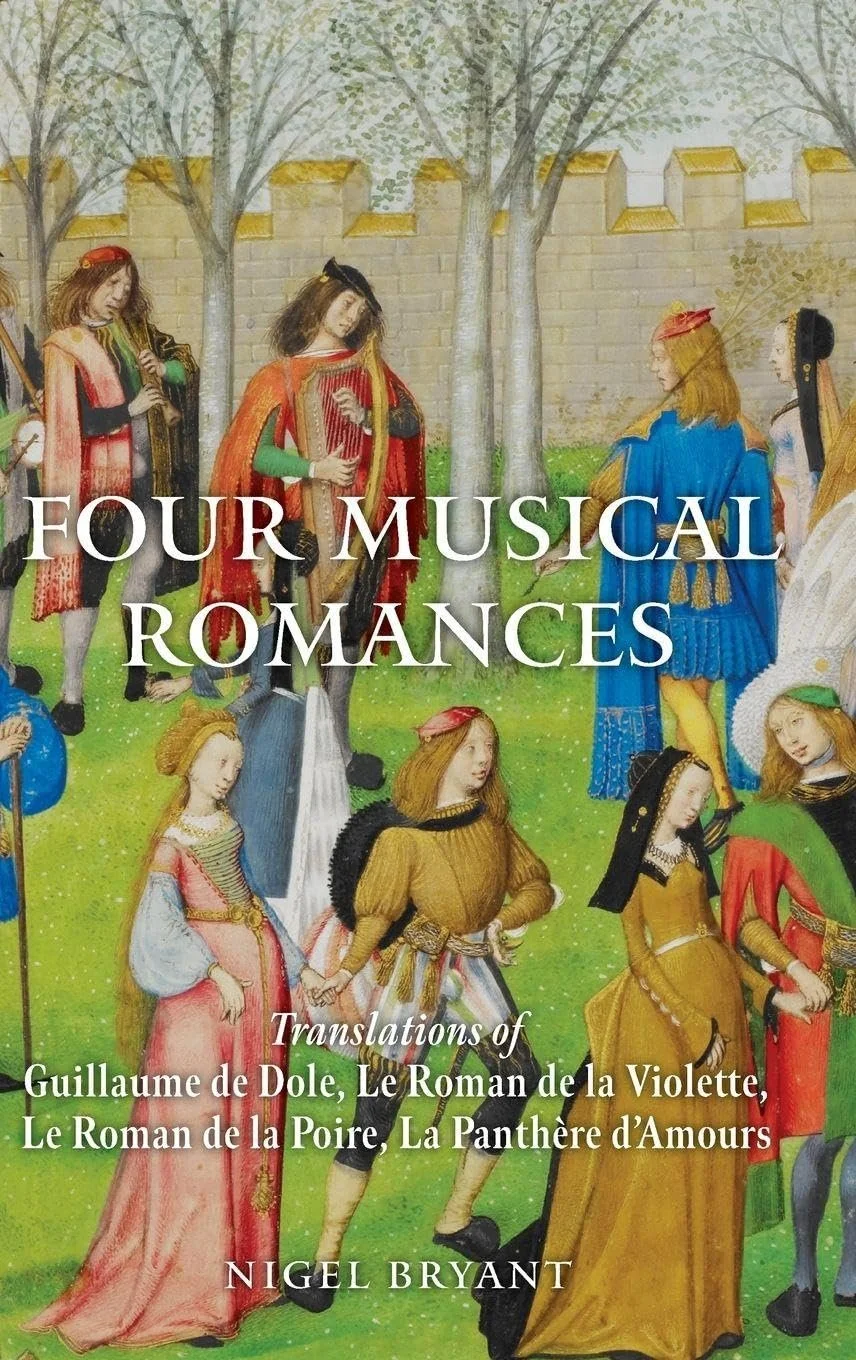
This week, I spoke with Dr. Nigel Bryant and Dr. Matthew P. Thomson about medieval musical romances. Nigel is one of my favourite translators of medieval French, with a couple of standouts being Perceforest and The True Chronicles of Jean le Bel. And if my endorsement isn’t enough, he’s also the winner of the 2019 Norris J. Lacey Prize for outstanding editorial achievement in Arthurian studies. Matthew is Assistant Professor in Early Music at University College, Dublin, and the author of many articles on medieval music – especially trouvère music – as well as being the co-editor of A Medieval Songbook: Trouvère MS C. Nigel and Matthew’s new collaboration is Four Musical Romances: Translations of Guillaume de Dole, Le Roman de la Violette, Le Roman de la Poire, and La Panthère d’Amours – and yes, that does translate to The Panther of Love. Nigel provides the translation, and Matthew provides the musical notation, so that readers can sing along. Our conversation on how these romances integrate music, why villains don’t always get a song, and the incredible culture of medieval hit music is coming up right after this.
Well, welcome Nigel and Matthew. It is so great to have you on the podcast. And as I was just saying before we turned on the microphones, Nigel, you're one of my favorite translators, so this is a great time for me. And Matthew: so nice to meet you because I rarely get to meet people who are working with medieval music. So, this is really a great opportunity. Thanks so much to the two of you for being here.
Nigel Bryant:
Our pleasure.
Matthew Thomson:
Thank-you.
Danièle Cybulskie:
Well, we are looking at four romances, and I always like to set up for the people who are listening when and where we're talking about. So, Nigel, you brought these four musical romances together. What century are we talking about and where are we talking about?
Nigel Bryant:
The thirteenth century in France. And we can't often be very specific about dates because they're often very contentious issues. But probably the first two of them, Guillaume de Dole and The Romance of the Violet, were written about 1230. Probably The Romance of the Pear was written probably in the 1240s. And the fourth of them, The Panther of Love, was probably written about 1290.
Danièle Cybulskie:
Well, you have these four different romances, although they have similarities between them. What made you want to bring these ones together? Because there are so many romances popping up in the thirteenth century. What made you bring these ones together?
Nigel Bryant:
Well, in brief, I've got the professor of music at Oxford to thank for that, Elizabeth Eva Leach, who Matthew knows very well. And in fact, she introduced me to Matthew and she drew my attention to the need for translations of these. She'd initially introduced me to the need for translations of something called Renard le Nouvelle – The New Reynard – which was one of the Reynard stories, which introduced and used a great deal of refrains – musical refrains – and I translated that and became so interested in the whole concept of romances which included songs, that I wanted to do more. And it was Elizabeth Eva Leach who directed me in direction of these. I have to say, they are unusually interesting for numerous reasons. I should make clear, first of all, what a romance is – what it means – because originally the word “romance” simply meant that it was written en romans. In other words, it was written in the vernacular, as opposed to Latin. The reason, interestingly, why romance has come to mean something romantic – to do with love – is because in most of those romances, love is a crucial theme. Why was love a crucial theme? Because for the society for which it's being written, especially the noble end of society, loving presented daunting problems. Because, of course, marriage was usually arranged in noble society for purposes other than love. It was arranged for dynastic reasons or whatever. And there was almost no privacy in that world, either, so that to have genuine, refined, real love was extremely difficult. And it becomes almost an obsession. In fact, in all these romances, what is happening is that love is almost becoming a quasi-religion. And the reason why song is so important in them is that song in that milieu was not simply for entertainment. It wasn't simply to embellish things and to sound nice. It was actually a repository of very specialized knowledge. If you were a complete human being and a noble human being and a chivalrous human being, you understood song. And what the songs sing about is not banal emotion. It's a way of trying to tell you how to love and how to respond to being loved. And they are deeply interesting. I could also talk about why I find the use of song in the romances so interesting. It's inspired. The way these writers use song is, again, not just to embellish. It's not just to provide a nice little interlude. It's crucial to the storytelling. It's crucial to expressing the characters in their thoughts. And they use it in very real ways and real context. What I mean by – real is a very dodgy word, isn't it? What I mean by real is that I personally can't stand most musical theatre. I find the moments when people burst into song faintly embarrassing and ridiculous. And I'm always reminded of a dictum of Bertolt Brecht, who said, “there is nothing more revolting than when characters burst into song because of an excess of emotion.” This never happens here. They are deeply emotional, but that's not why they're singing. In fact, they very usually are singing because they're exchanging songs with each other, which they evidently did in that society a very great deal by way of entertainment. They sing because they're traveling – well, of course they did. And we have radios on in cars now. As they ride along, they sing. They entertain each other by singing. Very often the songs are sung in these romances because a character will ask a minstrel to sing a particular song which will express his feelings at that time, or, fascinatingly, they actually reply to one another in song. There's a moment in The Romance of the Violet where the villain of the piece is trying to seduce the heroine of the piece and she replies to him by saying, “if you've any sense, you'll hear my refusal loud and clear in the verse I'll sing right here and now.” And she sings to him, “so leave me be and plead and woo me no more. I tell you, fool, it's wasted breath. I say enough.” Now, you might think that sounds sort of semi-operatic and maybe even a bit naff. It's not at all, because it's quite clear that in that society they sang all the time. Another of the things I've translated is two poems about tournaments, one of which is a very famous poem called The Tournament at Chauvency. And the participants in the tournament sing while they're getting ready to joust. They sing as they're charging into violent melees. And what are they singing? They're singing love songs as they ride back after the tournament, covered in wounds, cut and bruised all over. It says they're merrily – that's the word that's used – merrily singing love songs.
Danièle Cybulskie:
I love this because it is such an entrenched part of this culture. And I think this is – especially when I was reading this – it seemed that Guillaume de Dole was really a good example of how this worked within society, because they do have those moments, as you're saying, where we're going to have a picnic, so we're going to sing, or we're going to travel, so we're going to sing. And it really fits very well into, I think, that idea of the ideal of what it's supposed to look like at this moment. And one of the things that is, I hope, going to get me into talking with Matthew, as well, in a second, is that you mentioned musicals a second ago. This seems like the type of musical that's really all the rage right now, where they're recycling very popular songs from Queen, or Michael Jackson, or Alanis Morissette and integrating them into a plot. Is this sort of what's happening here?
Nigel Bryant:
Yes, it is. That's exactly right. And, in fact, a couple of the exceptions to my general loathing of stage musicals are exactly that. I really, bizarrely, really like the ABBA musical Mamma Mia. Because there you've got these fantastic pop songs that are put into very specific contexts. They're known songs that we know because they're put into a particular context. They assume far more meaning and are far more moving, actually, in many ways. I also recently saw a brilliant musical based on the music of the Kinks called Sunny Afternoon. It's fantastic. It's brilliantly constructed. And those songs, again, assume far more meaning because they are put into a particular narrative context. And that's exactly what's happening here, because these writers are using largely existing songs which assume great significance and great power because they're put into a particular context.
Danièle Cybulskie:
Yes. I want to come back around to how this works, sort of societally, in a second. But, Matthew, this is the key to figuring out how you would actually sing these, right? The fact that these songs are popular. How did you figure out the music that would go with these? Tell us a little bit about this, because we talked about medieval music about a month ago or so on the podcast, but I think for people who didn't listen to that one, where do you even find notation, for example, in the medieval world?
Matthew Thomson:
Yeah. I mean, one of the really interesting things about these literary texts is that actually, the manuscripts of the literary text themselves often don't have notation in them. So, they do provide a challenge that we have to go somewhere else to find our notation. So, as Nigel said, lots of the songs that these texts use are songs that people would have known, and a lot of them are songs by groups of poets and musicians that we often call trouvères and troubadours. So, troubadours were writing songs in a language called Occitan, mostly in the south of France. And trouvères are writing songs in Old French, mostly in what's now the north of France and Belgium. And especially for trouvère songs, we have a lot of these manuscripts – some of which are really deluxe – which kind of act as repositories of that repertoire. And a lot of those manuscripts copy the melodies for these songs. So, sometimes finding a melody for one of the songs in the literary text was relatively easy because you looked at it and it started a particular song and you think, oh, I know that song. And I looked it up and it's in this manuscript. And you compare the different manuscript versions of the song, choose one, and then you simply edit it. Sometimes, it's not that easy in that, for example, there might be three manuscripts of this song, and they all might contain different melodies. So, you might have to choose one that you think fits best. And sometimes, unfortunately, there are some of these songs in the literary texts which don't have any extant versions with melodies at all. So, we actually weren't able to provide melodies for all of them. But in some cases, we might not have all the melody, but we have some fragments that we can then reconstruct a viable version out of. So, there were kind of a variety of different processes that enabled us to get the melodies for a lot of these songs. Because we thought it was really important, I think, to be able – for readers of this translation to be able – to sing these songs for themselves, as well as being able to read the text – the literary text – that surrounds them.
Danièle Cybulskie:
Yes. Well, one of the things we were talking about – with Jonathan Berger – we were talking about, in this case, it was medieval music that was performed in churches and how the metre can be very difficult to figure out. So, the two of you – I want to know – did you have conversations sort of over the phone, over Zoom, about metre? Because I think, Nigel, in the book you said this is when you really notice the difference between English and French is when you need to translate it into metre for song.
Nigel Bryant:
It's fascinating, actually. You realize that just how different French and English are. Because English is so heavily accented as a language, and we expect a very strong rhythm. French doesn't. And translating it…. Translating it was a nightmare, frankly. But with Matthew's help and much poring over piano keys together, we reached decisions about how it might or might not be rhythmically presented.
Matthew Thomson:
There's a really interesting question about rhythm generally with a lot of these songs. So, the rhythm of a lot of these songs has been hugely debated over scholarship in the whole twentieth century, with some people thinking that they have relatively strict rhythms, and some people thinking that we have relatively free rhythms. I, at least, tend to go with the kind of mostly free rhythm theory. So, that's how we presented them in the notation in the book: with kind of note heads that don't really show very much rhythm. And what was nice about the process of doing the translations with Nigel is it meant that we could be relatively flexible about how we set the melodies to the music. And, actually, it was fascinating for me as a scholar of these songs to get kind of almost practical experience as to what it's like to put words to these melodies – where you can fit words, where you can't fit words. What happens when you put a stress in a particular part of the melodic line. So, it was a really interesting process to do that. But as Nigel says, it was very, very interesting to deal with the difference between French and English. And it kind of... Translating the songs into English, I think, in some ways gives them a different feel. But it also really makes them really well accessible for all the readers of the translation, which I think is just such a valuable thing.
Nigel Bryant:
A particular difficulty was melismas. Music melismas in French sound great. In English, they sound very, very strange and strained. And the other thing is that the English ear expects rhymes. Very strong, definite rhymes. French doesn't. And in fact, that applies to the poems themselves – to the romances themselves – which are written in octosyllabic rhyming couplets. Now, in English, octosyllabic rhyming couplets –
dee-dum, dee-dum, dee-dum, dee-Dum
dee-dum, dee-dum, dee-dum, dee-Bum
dee-dum, dee-dum, dee-dum, dee-Dee
dee-dum, dee-dum, dee-dum, dee-Bee– rapidly become tiresome and heavy-handed. They become either unintentionally funny, or they unavoidably remind you of the rhymes in Rupert Bear. In French, they don't. Because the rhymes are much freer and happen en passant. Literally, there are endless enjambements between one line and another. Which sounds great in medieval French. It sounds pretty terrible in English, which is why I've translated them into prose. I'm not copping out. It's because I want to translate them into decent English rather than having a soporific octosyllabic rhyming couplet in English.
Danièle Cybulskie:
Yes, that would be exhausting. I think at the length at which these romances are written –
Nigel Bryant:
Yes.
Danièle Cybulskie:
– it would be exhausting.
Nigel Bryant:
It would be exhausting. And one other thing that I thought was very interesting – what Matthew was saying about them being familiar songs – is we shouldn't overlook the extent to which the audience in the Middle Ages would have known the songs and therefore joined in with them at times. There are moments when they're… they're sung as part of celebrations, so the audience joins in with the celebration and feels it so much more. Likewise, I mentioned The Tournament at Chauvency when those knights charge into a melee singing a musical refrain about love. If the audience knew it, they’d join in with them and join in the charge. It's absolutely fascinating.
Danièle Cybulskie:
Yes, this collective breathing together is what I'm thinking about that's really making people be part of the story. And also, that real sentiment that we always feel when we're involved with music where – oh, this is my favorite one. And you're really, like, involved in the story and maybe probably feeling more inclined to have good feelings about not only the minstrel, but the characters that are involved. Okay, so I'm thinking about this singing collectively and how when people are really into a song, especially when there's a whole bunch of them, they start to, like, add their own harmonies and stuff. We don't tend to see this, to my knowledge – when it comes to medieval sort of secular music – we don't tend to see a lot of harmonies as much as we do in sacred music. So, Matthew, do you have a sense that there is a sort of collective way that people might have been singing their favorite songs, or do you think that there is sort of encouragement to follow – everyone follow – the same melodic line? I know I'm asking you to go way out on a limb here, so just like, leave that as a warning, but what do you think about this?
Matthew Thomson:
Yeah, it's really interesting. I mean, so there is a huge repertoire of secular songs which have more than one voice part. So, people are singing in harmony. We often call them motets. It's relatively uncommon – in fact, I can't think of any examples in which a whole kind of motet with more than one voice part gets incorporated into a literary romance. And most of the things that we hear in literary romances are what we call monophonic songs. So, as you say, songs with one melodic line. We obviously can't rule out the fact that someone may have been putting harmonies while they were listening to it. And it's certainly true that people, as far as we can tell, interacted with the tellings of these stories really… well, interactively. There's a passage from a couple of romances – not ones that are translated here – that I really love, where someone… it's kind of a meta-situation where someone in a story is telling a story, and in the story, the audience of that story react by saying things like, “no, you're saying it wrong. That's not how it goes. There's a much better ending to this story.” So clearly, it seems that people did interact with things, and I'm sure that at points people may have joined in. And the musical elements of these songs were clearly very important to the writers of these texts, because they stress them again, and again, and again. At the beginning of both Guillaume Dole and The Romance of the Violet, they both say, you know, these texts are wonderful because there's parts that you can sing as well as read. And who knows? Maybe sometimes they did use kind of polyphonic settings that they were singing together. There are these things in the literary text called refrains, which are often short, catchy snippets of song. And they sometimes get used on their own in the literary text, or they sometimes get used as part of a larger song. In some motets – these kind of polyphonic pieces with more than one voice part that I talked about a little while ago – some of those same refrains are used. So, perhaps when someone used a refrain in a literary text, it made some of the audience think about one of these polyphonic motets, and then maybe they sang that. So, there is a kind of loose association here that people are thinking of all the other places they've heard that song, and all the other places they've heard that music, and that contributes to the meaning that the song is bringing to the story as well.
Nigel Bryant:
I think very often we underestimate the extent to which medieval writers were inviting their audiences to question what they'd written. In the context of having songs that you already know, it makes you reconsider why you like that song and what that song means for you. More than once, there are actual comments about the songs after they've been sung, where one of the singers will say, “that was a tough song to listen to, wasn't it?”
Danièle Cybulskie:
So, all four of these romances are quite long, which makes me wonder: how are they performed? Because it would be difficult to perform, for example, the Guillaume de Dole or Romance of the Rose over the course of one evening, especially if you have all these songs. So, how are you imagining these being performed?
Nigel Bryant:
I'd like to change the subject and talk about the third of them, actually. The Romance of the Pear.
Danièle Cybulskie:
Sure.
Nigel Bryant:
Which I find especially interesting because it makes no sense at all on the page – either on the manuscript page, or on the page of the edited French text – the modern French edited text. It only makes sense when you realise that multiple voices are involved and expected to be taking part. And in translating it, I've often put characters’ names in square brackets as though it were a play script, to make it quite clear this is a different voice. I'm sure some people would disagree with that and say, oh no, it'd be perfectly possible for one person to adopt all the voices. No, it wouldn't. If you read through it, it becomes completely baffling because new characters are not introduced. They suddenly speak. They appear out of the blue. And coming back to what we were talking about before, they often interject and ask questions about what's just been said or what's just happened. I'm convinced that The Romance of the Pear is very nearly a play, which I think would probably have involved as many as fifteen or twenty performers, some of whom might have been in emblematic costumes because they represent personifications like Courtesy, or Beauty, or whatever. And there's even one fantastic possibility of a costume in the form of the god Love, who appears with six wings. You're not telling me they didn't put that on stage. And the fact that it appears, on the face of it, to be something written by pen on parchment and the central character – the author – says, “I'm sitting down now with pen in hand and I'm going to tell you about my love for this lady.” Yes, but then all the other characters whelm up around him on stage before the audience. I'm convinced that's the case.
Danièle Cybulskie:
I would agree with you. Having read this, it would be, well, exhausting to have somebody interrupt themselves all the time. It would make no sense. It would be very confusing. And unless you were doing it with weird puppets on your hands, it wouldn't make any sense to do it by yourself. It's just too much. Too long for people to be interrupting themselves like that. Unless they're doing, you know, a hundred different voices, like some standup comedians. It otherwise doesn't make any sense. And so, that is an interesting case in that you would need to have a lot of performers to make this work, which means that it is a production that takes a lot of thought. So then, you know, you wonder where this is going to be appearing to be performed.
Nigel Bryant:
I would love it to be performed. I think… I'm really, really hoping this inspires people to experiment with the performance of romances.
Danièle Cybulskie:
Yes.
Nigel Bryant:
Another question that interests me is to what extent there was instrumentation. I think it's almost impossible – it's obviously impossible to know, and it would have been different probably in different circumstances. But years ago, in my time as a theatre director, I twice did productions of The Beggar's Opera, John Gay's famous ballad opera of the eighteenth century. I mentioned Brecht earlier, didn't I?
Danièle Cybulskie:
Yes, you did! That's what made me think of it.
Nigel Bryant:
Yeah, very, very… Now, interestingly, there again, you have new lyrics put on existing, very well-known tunes, and that, as well, has a very strong effect on the audience of making them listen with great intensity to the lyrics and their satirical import. What I was going to say, however, is that in doing these two productions, on one occasion, I discovered quite by chance that John Gay – the writer – was astonished when the theatre manager decided to hire an orchestra. Decided to hire musicians. He said, “but no, I intended it to be done unaccompanied.” And there's a lot to be said for this because – I discovered in performing this twice – it's actually better without instruments because people in The Beggar's Opera burst into song very suddenly – just for two lines quite frequently. And to have a musical intro – even if it's only one note – was actually interruption to the flow of their thought, and the flow. and the impact. And, actually, there's something inherently delightful about just listening to somebody sing to you. But I don't know what Matthew would think about that.
Matthew Thomson:
Yeah. I mean, like rhythm, this is another one of those ones that could get me into trouble with various people. So, better be careful about what I say. There is a whole range of whether we think that people were using instruments for some of these songs or not. So, it seems possible that – especially for some of the more kind of high style love songs, a lot of the ones where they're talking about love – that maybe they were accompanied on a stringed instrument like a vielle, or something. Possibly, with people accompanying themselves. It's possible. But also, possibly they were performed unaccompanied. There's perhaps maybe a slightly stronger case for instrumental accompaniment in some of the dance songs. And I think that, in some cases – in some performances – that could really add a kind of… kind of festive, dance-like element to some of the dance songs, especially as these dance scenes are kind of quite an important use of music because they pull in a lot of cultural meanings of music in the Middle Ages. Especially in some of the scenes like in Guillaume de Dole or at the beginning of the Violette, where we have these – what we call chorale dancers, which are kind of public dancers with special types of songs, which – in a lot of commentary in the Middle Ages – a lot of people who were employed by the church got very worried about the effect of music at these dances. They were worried that they were kind of seducing people into immorality because the songs were a bit too sexy. So, there is a sense in some of these dance scenes that maybe actually having some of that accompaniment would work. But I can certainly see what Nigel's saying. In some of the very emotional love songs – especially the ones which are cast as kind of soliloquies, which give us an insight into characters’ own interior, emotional worlds – having a kind of musician sat on stage with them doing something else would feel a bit weird. So, I think you would have to think very carefully about what the song was doing in that part of the text, and whether you would want to use something there. So, it would be kind of a creative engagement with the evidence that we have from the Middle Ages for instrumental accompaniment or not.
Nigel Bryant:
I agree completely. I think in different contexts in these romances, you would either have musical instruments or you wouldn't. And when, as you said, it's virtually a soliloquy… The piece I mentioned earlier – where the attempt to seduce is rejected – would sound bizarre if music joined in because she is simply singing straight from the heart, straight to him. And it would have the same effect as the aforementioned revolting effect in stage musicals, where, inexplicably, there is music from the spheres.
Danièle Cybulskie:
Well, I mean, it's an interesting question. It's one that needs to be engaged with, because, you know, you're talking about the theatre. Some of my background is in theatre, as well. And there's no... There's no evidence that people are expecting sort of a fourth-wall illusion – that you're not meant to notice that the audience is there. But at the same time, it's almost a natural part of storytelling – human storytelling – I think, where you get so invested that if you have a musician sort of appearing, it might pop you out of the story in a way that you don't want to. Which is, I think, what you're getting at here. And then it's also, I think, an interesting question… As I'm listening to you speak, I'm thinking about the moment – I think, in Violette – where it specifically says that Gerard has a vielle with him. Which means that if they're mentioning that he has it with him, does he not have it in other places? Is he not expected to have it in other places? So, it's really an important question to engage with when you're thinking about performance – which, like you, Nigel, I'm always doing. Thinking about performance, how this would work. And so, I think that the way that the two of you have really thought about this makes a lot of sense to me.
Nigel Bryant:
Thinking realistically – “realistically” is always a dodgy word – but thinking realistically. Guillaume de Dole sings with a vielle when he is disguised as a minstrel. Similarly, in the same romance, the emperor Conrad asks his minstrel Jouglet to sing a particular song for him. Of course, you'd probably have a musical accompaniment with that, but not for people who are singing straight from the heart in a real context, in a real place. Riding a horse. What are they doing playing an instrument while they're riding a horse?
Danièle Cybulskie:
Very strong thigh muscles. What were you going to say, Matthew?
Matthew Thomson:
Yeah, just exactly the same thing, really. That, actually, the interesting thing about Gerard having a vielle in that episode of the Violette is that he's in disguise. And it portrays him not as the aristocrat that he actually is, but more as a jobbing performer, someone who kind of goes round courts and sings and plays for their supper. And he's doing that on purpose because he wants to go to his enemy's house and find out all of the nasty things that he's been saying about him. So, it's kind of part of his disguise. And so, again, we get this really nice sense that music has a lot of cultural meanings, both for the characters and for the people who are listening. And that as soon as you say Gerard has this vielle, you're like, okay, so he's not who he normally is. He's not an aristocrat now. He's someone who's traveling around playing songs for money.
Danièle Cybulskie:
Yeah, I love that moment because he shows up and the enemy's like, “Play us a song.” And he's like, “Right now? I just got here.” He's like, “it's the worst for minstrels. When you're at your” – I think – “most tired, your most wet, that's when they want a song. When you have to sit in a draft” – I think – “you play a song.” It's a really nice aside there.
Matthew Thomson:
Yeah, that's one of the things I love about – especially Guillaume de Dole and Romance of the Violet – they have all of these really fun asides that just kind of give you a really strong sense of a performer who just kind of says something funny in the middle of his story. And that comes back to this thing that we're talking about: performance. I think a lot of these texts are written as if they were performed. And they have a really strong sense of being performed, even when you just read them as a text. So, I think, you know, being able to think of them as texts that are performed is really useful.
Nigel Bryant:
Yeah, there's some great intentionally comic moments when people sing, too. When, for example, the Duke of Metz has found Euriaut devastated by the fact that she's been abandoned by her love. He falls madly in love with her in an instant. And then, to cheer her up, he sings this impassioned love song about how much in love with her he is. And she, of course, is in floods of tears. And the contrast between the two is wonderfully dramatic and funny.
Danièle Cybulskie:
Well, I love this because – like we're talking about – when you have a performance like that, especially in the middle, it might sag. So, you have to throw in a joke, or you have to throw in something. Shakespeare did this all the time, right? In the middle of the tragedies. So, you do have these moments that seem only there to sort of wake the audience up. And I think there is a moment – that I actually put a little Post-It note on because I thought it was so funny – in Guillaume de Dole, where he's describing the picnic feast that they're having. Their feast is so amazing. And it's… He says, you know, “the only thing that they lacked was a sense of lack.” It's just like… it comes out of nowhere. But it's just a quick joke to sort of wake you up so that he can continue on with his story. These moments – these are really wonderful romances. And I hope that people will pick them up. As we're talking about them, I hope they can hear our enthusiasm because they are really great. So, one of the things that I think is important and noteworthy about these ones, as well – so, we're in the middle of the thirteenth century. There's this huge ferment of these troubadour songs and these romances. And there's a real sense – sort of like you see in medieval scholarship – where people are talking about the other people that they've read. And you really see a conscious way that these writers are saying, “here's a song by your favorite troubadour and mine: This Guy!” And they're just throwing it… And it's kind of a way to preview it so that you're ready – the song is going to come out. But it's really showing how intertwined this culture is and how much people know of each other's songs. Can you tell us a little bit about how this would be happening? Because we're talking about a time where, you know, there's a big distance between cities, for example. How is this happening that people know these hit songs so well?
Matthew Thomson:
Yeah, absolutely. I think there is a real strong culture of trouvère song collection. So, a lot of these songs get collected into manuscripts, and a lot of those manuscripts order their songs by the author. So, they will first of all have all of the songs by Thibaut of Champagne, and then they will have all of the songs by Gace Brulé. So, we get a really strong sense that people have actually quite a wide knowledge of the repertoire. And so, I think some of this is being achieved by kind of traveling performers who would go round and perform some of the things. Some of it is being achieved by people sending written copies of songs from one place to another. But we do get a sense that among kind of a courtly culture, there's a relatively well-known set of songs that people know. And what's actually super interesting to me is that so sometimes they do exactly what you say in these romances, and they say, you know, “and now I'm going to sing this beautiful song written by my lord Gace”. And then they will sing a song by Gace Brulé. And sometimes they don't do that, kind of almost seemingly by choice. And one of the interesting things at that point is what changes between the version that we have in the literary text and the version that we know from elsewhere. So, Nigel's talked a couple of times about that really fascinating scene where the hero of The Romance of the Violet, Euriaut, kind of persuades the villain of the piece, Lisiart, to stop trying to seduce her by singing at him. And what's really interesting is the version of the song that she sings is actually quite different to the version of the song that we find in lots of other manuscripts. So, she sings this song that basically says, “leave me alone. I'm a loyal lover. I only love my boyfriend. I just want you to go away. Please stop seducing me.” But the version that we find in other manuscripts is actually a tale of an adulterous female lover who is saying to her husband, “please go away. I just want to spend the time with my lover.” And what's really interesting is Euriaut seems to be in control of her song. She seems to be kind of changing it and revising it so that it does exactly what she wants. But then, suddenly Lisiart manages to trick her – and manages to trick everybody else – into thinking that she's had adulterous sex with him. So suddenly, this song that she thinks she knows what she's doing with kind of turns back and bites her, and does something that she doesn't want it to. Which really plays into a lot of medieval narratives about song having a lot of power to change people's behavior – behavior and emotions – but being a bit unpredictable in the way that it does that. You know, we can't quite trust that when we use a song to do something, it will do it. So, the kind of differences between the songs that we have in the literary texts and the way that they're preserved in other manuscripts has been, for me, really interesting.
Nigel Bryant:
Likewise, the writers seem to have had encyclopedic knowledges sometimes of each other's work and assume, as well, that the audiences knew the work really well. Because the way they cross-refer, or the way that they retell a story with a twist, implies they knew that their audience would understand that they were playing games. Possibly. My single favorite medieval author is Raoul de Houdenc, who works wonders with a couple of his surviving Arthurian romances, in which he takes characters like Sir Gawain and openly makes them look ridiculous. For example, Gawain – the great lover – falls madly in love with a woman who is manifestly fickle and completely undependable and dizzy. And when she makes a complete fool of him, he responds by launching into this misogynistic rant about how terrible women are. And then Raoul asks the audience, “well, it's no surprise that he was raging. Tell me: what advice would you have given him?” And there are these games being played all the time in which you ask audiences to reconsider characters that they already know.
Danièle Cybulskie:
Yes. Well, I like what you're both saying, and what Matthew has brought up about having these songs that you know very well, but they have been turned so that you're looking at them differently. And I do think that this is something that is happening with, Nigel, your saying your favorite musicals now, where people are applying these songs maybe in a way that's different or a way that makes you think differently about them within performance, within a musical stage. Because the thing is about songs: once they're out there, people can do what they want with them. Which is the good news and the bad news, if you've created this for yourself. So, it's interesting. One of the things that you said right at the beginning, Nigel, as well, is that you have love being sort of a religion, and he's this godlike figure in several of these romances, where he's also very untrustworthy. And what he does with songs, what he does with instructions to people, could go either way.
Nigel Bryant:
Yes, the God of Love is tricky as long as you are true. The constant theme is that true lovers will always get the reward. It's the ones who claim to be lovers and in fact are not – who are faithless – who really come unstuck. This is true – that the God Love is a fascinating figure in these romances – because he's far more important than God. In fact, God is an irrelevance. I've got a distinct feeling that in the Middle Ages, more and increasingly people were thinking of God as being this... He was a creator, yes, but he doesn't actually do much, does he? He's rather fickle. He's rather aloof. He's not even fickle – he's aloof and nebulous. And they needed intermediaries, the chief one of whom is the God of Love, who, in a magnificent passage in The Panther of Love, he introduces himself as, “I am the one who makes the proud embrace humility. There's not a town or city in the world, no castle, stronghold or any house where I do not have lordship. I bring down the vainglorious and raise the humble to sit on high. I make cowards bold and the brave craven and bring those at war to make peace. I bring riches to the penniless and make the wealthy needy. No one can withstand my wrath. Such is my power. I can instill largesse in the mean, can make the healthiest suffer pain. I can do as I wish with one and all. I'm capable of more than you'd ever believe. All make way before me when I decide to go to work. I perform true wonders. So now you see who I am, and know in truth that I can do anything.”
Danièle Cybulskie:
Which is really how everyone is thinking about love during this moment of fin’amors, right? This is how everyone is thinking of it. It could just take you over and make you do crazy things.
Nigel Bryant:
Indeed. But you'll get your reward if you're true.
Danièle Cybulskie:
That's right.
Nigel Bryant:
But as I was saying earlier, these are written for a society in which there's no privacy, and in which loving is almost an impossible task. Real loving is almost an impossible challenge. And these four musical romances discuss that and give advice about it. They are an aid to lovers. That's one of the things that they refer to themselves as: they're an aid to lovers.
Danièle Cybulskie:
Yes. You kind of wonder what lessons people are learning from this because not all of the plots go the way you want at the beginning. They do have a lot of happy endings. But I was thinking about... We were talking about true lovers, who gets the chance to have love and enjoy it. And there are several people in here that are villainous. Not a lot of them get songs. As I'm looking back over it in my mind, there's a lot of mean old ladies who are nursemaids that are always a problem in such romances. And I don't think that they get any songs. But we do have the noble evil villain in the Violette who gets a song.
Nigel Bryant:
No, they don't sing because they don't understand song.
Danièle Cybulskie:
Okay, tell us about this.
Nigel Bryant:
Song is an embodiment of knowledge. Song reveals the depth of your initiation into courtly love and literary practice, and it's treated accordingly. Lyric poetry was a privileged form of knowledge about courtly civilization. Now, those villains wouldn't have understood courtly civilization. They didn't even belong, didn't deserve a place in courtly civilization. So, of course they're not given songs.
Danièle Cybulskie:
Yes, exactly. I was thinking about what qualifies a person to be able to have a song. And some of the best songs from places like Disney are villainous songs. But those villains are usually pretty refined as well, come to think of it. So, you really do notice a difference between who is allowed to have a song and who isn't. There's so much to think about there, as well. Matthew, did you want to jump in here about where you see songs coming out, maybe even more broadly from these ones, but where you see songs… Well, actually, that's a weird question because there are a lot of pastoral songs, right? That are meant to be sung by shepherdesses, or whatever. Tell us what… what you're thinking about when you think about who is allowed to have a song.
Matthew Thomson:
Yeah. I mean, it's really interesting. And then we have different styles of song that might be associated with different kinds of people. I mean, a lot of these songs are being sung for a relatively aristocratic audience, but some of them have different kind of class connotations. So, especially in these literary texts, a lot of the people who are singing the high-style love songs are the aristocratic characters. And usually – I hadn't actually thought very much about this before, but now you've pointed it out – it is true that it's usually not the villainous characters. So, usually the baddies don't get the good lines – like Gaston or something. But we do get this sense that a lot of the kind of high- style love songs are reserved for aristocratic characters. There are other kinds of song. So, in these literary texts, we get these kind of refrains that I've talked about before – these short, catchy snippets of song – and those are, in some ways, spread out a bit more evenly. So, we get, for example, the scene in Guillaume de Dole, where – to celebrate the beginning of May – we have normal people in the city singing refrains to celebrate the beginning of May rather than aristocrats. And then – exactly as you say – we have this genre of song of which there aren't that many in these romances that we've edited here called the pastorelle, in which usually it's a situation of a knight riding out into the country and meeting a shepherdess. And there there's a huge class play that is sometimes about domination and sometimes about the avoidance of domination. But there is a really interesting dynamic in a lot of these literary texts about the songs, especially of the aristocracy being bound up with their class identity, especially. Yeah.
Danièle Cybulskie:
Yeah. It's such an interesting thing because you do see songs that are integrated into romances elsewhere outside of these four that you have chosen. And it would be interesting to look at them and see who gets the opportunity to have a song. Because, yeah, this is a much more complicated topic than I thought about when I brought it up a second ago, which, you know, happens to me a lot on this podcast, I think. So, we're coming close to the end of our time, so I need to ask… These are four brilliant romances. I think my personal favorite is Guillaume de Dole. I just love the language in it, the way that it… is so very clever and funny, and has these beautiful descriptions of life as it was supposed to be for this idealistic, chivalric class of society. This type of adventure. So, I need to ask, do you have personal favorites in this collection?
Nigel Bryant:
I agree with you about Guillaume de Dole being exceptionally delightful, because it is, essentially – and again, I'm going to use a very dangerous word – realistic. He's interested in painting the world as it very nearly is, or could be, if only we tried a bit harder.
Danièle Cybulskie:
Yeah.
Nigel Bryant:
And it's rather… I think it's wonderful. I love the way he only breaks into his main plot halfway through – he spent the first half painting this gorgeous picture of an ideal court – is great. I like others for a different reason. I'm fascinated, as I said earlier, by The Romance of the Pear being very nearly a play. I think The Romance of the Violet is a fantastic piece of work by a great writer of whom – alas – only two works have survived. But he's a tremendous storyteller, Gerbert de Montreuil. But, yes, I like them all.
Matthew Thomson:
Yeah, I think a lot of these texts are fantastic. I would have to say I have always harboured a personal liking for The Romance of the Violet. And it's partially because I've worked on it a lot. And it’s partially because I think it's very interesting. It's also partially because I kind of always want to root for an underdog. So, there was – historically, in scholarship – this thing that Guillaume de Dole was the excellent one, the first one, and then The Romance of the Violet was kind of... its slightly less-interesting, slightly more drab counterpart that had just come after it. You know, he didn't really know what he was doing. And I've always thought, like Nigel, that that's absolutely not true. I think it's an incredibly vivid story with incredible – incredibly vivid characters and really interesting uses of song. So, yeah, for me, the Violet has always been my favorite, but I still have a lot of affection for all the other things, as well.
Nigel Bryant:
Yes. The Violet, as well, should not be underestimated. It appears, on the face of it, to be a collection of random motifs and adventures. No, they're not. I've written in the introduction – I've tried to explain in the introduction – how concerted and brilliantly constructed it is, to tell a fantastically coherent story, an underlying story. I don't like the word allegory, but there's a distinct allegory going on that is ingenious and very, very interesting.
Danièle Cybulskie:
Well, and the thing is, everybody – at this time especially, but in all times – is borrowing from other places. And just because you've borrowed from somewhere else, it doesn't mean that you're not creating something amazing. And I always throw out the example of how many times have we rebooted Spiderman or Batman, right? And they're all different, and everyone can pick what they like from it. So, as we come to the end of our time: when people are coming across romances like this, what do you want them to look for or think about – when they come across a song in a romance? After this – after they’ve read your brilliant book, and as they read more romances into the future – what do you want people to be thinking about?
Nigel Bryant:
The irrelevance of God.
Danièle Cybulskie:
Alright. That is a very important theme that is throughout here. And I think now that you've put it in people's brains, I hope they will look for that. Yeah.
Matthew Thomson:
Yeah. I think, for me, like, the really interesting thing about a lot of these songs that people should be thinking about is it really helps us to think about what the cultural meanings of music are, and why we use music. Because one of the really fascinating things about these romances is that – in a relatively unusual way for a lot of medieval texts – we see people using songs interpersonally, as Nigel was talking about. We see people using songs to communicate with each other, and it tells us what people thought that song did, and what music did, and what people… music meant, and why it was important. So, I think people can get a lot of that information from just thinking about the narrative context that these songs are in. And then, I'd encourage them to think about whether those meanings of music are different or similar to what we have. You know, do we use music in a similar way? Do we use it in a different way? And I think a lot of times they have some similar understandings of why we use music, but sometimes they have some fascinatingly different ones, which I think can really help us to highlight what those often implicit understandings of music that we have are.
Danièle Cybulskie:
Yeah. I mean, you've really said it there, in that music tells us so much about society, and the closer we can get to understanding the music – the work that the two of you have done here, I think, is going to get us as close as we could get to the medieval world. So, thank you so much to the both of you for being here on the podcast and telling us all about it. It has been a pleasure for me, and I hope it has for you, as well.
Nigel Bryant:
It has. Thank-you.
Matthew Thomson:
Thank-you.
Danièle Cybulskie:
To find out more about Nigel’s work, you can visit the book’s page at Boydell & Brewer, and to find out more about Matthew’s work, you can visit his faculty page at University College, Dublin. Their new book is Four Musical Romances.
This week’s medieval quote about books is one from a letter by Petrarch in 1346 that I think a lot of us will be able to relate to. He writes,
I am still in the thrall of one insatiable desire which hitherto I have been neither able nor willing to check…. I cannot get enough books. It may be that I already have more than I need, but it is with books as it is with other things: success in acquisition spurs the desire to get still more.
Petrarch compares hoarding books to hoarding treasure, but says that treasure is superficial. Books are different. He says,
Books delight us through and through, they talk with us, they give us good counsel, they enter into a living and intimate companionship with us. What is more, not only does a book win the reader’s affection for itself, but it mentions the names of other books, so that it stirs a desire for another.
So, if you’re one of those people who considers yourself a book addict, just know that you’re in good company. You can find this quote from Petrarch all over the internet, or in The Medieval Reader, edited by Norman Cantor.
And on that note, let me feed your book addiction by reminding you that all paid members on Patreon this month can get a free digital download of The Five-Minute Medievalist to celebrate its ten-year anniversary, and to thank you for being patrons. This means, that you can get the book for as little as $1. So, tell your friends, join the community, and share the love at patreon.com/themedievalpodcast. Because without your truly vital contribution – yes, every single dollar – there would be no Medieval Podcast. So, thank-you. I hope you enjoy the book.
Thank-you also, to those of you who let the ads play every week, share your favourite episode, and rate this podcast with all the stars on your favourite podcast platforms. You are also very appreciated.
For the show notes on this episode, a transcript, and a growing collection of the books featured on The Medieval Podcast, please visit medievalpodcast.com. You can find me, Danièle Cybulskie, on social media @5MinMedievalist.
Our music is by Christian Overton
Thanks for listening, and have yourself an awesome day.