Early Medieval Crowds with Shane Bobrycki




The Medieval Podcast uses affiliate links
Episode 355
One of the more popular clichéd images of the medieval world is an angry mob with torches and pitchforks, ready to cause wanton destruction. And while there were rebellions on occasion, the truth is much more complex. This week, Danièle speaks with Shane Bobrycki about how the nature of crowds – and how people spoke about them – changed, and how crowds, themselves, point to the uniqueness of the Early Middle Ages.
-
Danièle Cybulskie:
Hi, everyone, and welcome to episode 355 of The Medieval Podcast. I’m your host, Danièle Cybulskie.
One of the more popular clichéd images of the medieval world is an angry mob with torches and pitchforks, ready to cause wanton destruction. And while there were rebellions on occasion, the truth – as always – is much more complex. Attitudes towards crowds can tell us quite a lot, not only about what people value, but also about the way a society itself works.
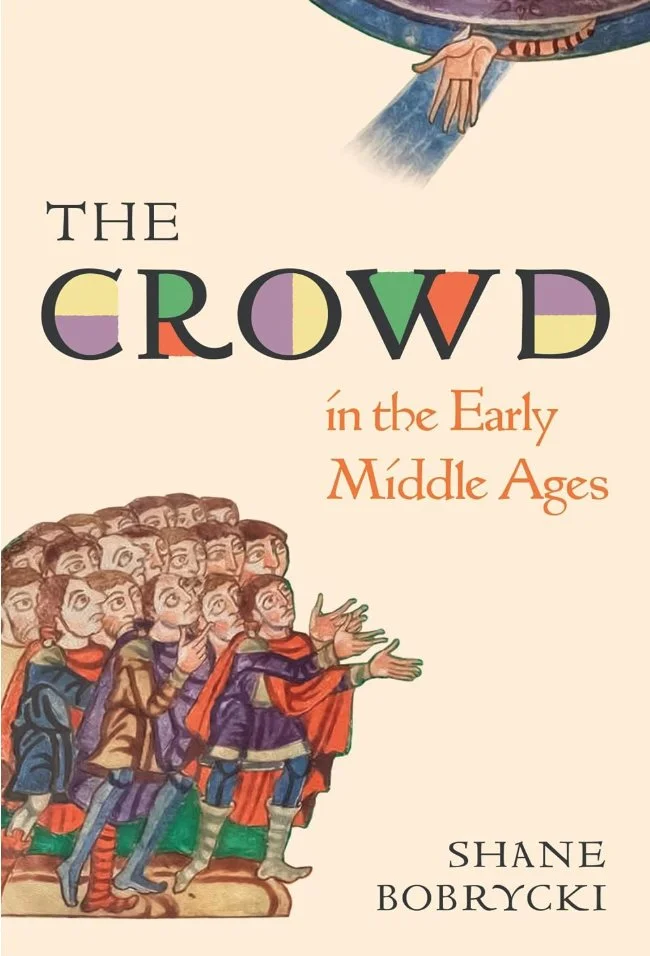
This week, I spoke with Dr. Shane Bobrycki about early medieval crowds. Shane is Assistant Professor of History at the University of Iowa, and the author of a range of articles on rebellious behaviour and words. His new book is The Crowd in the Early Middle Ages. Our conversation on how the nature of crowds – and how people spoke about them – changed, and how crowds, themselves, point to the uniqueness of the Early Middle Ages is coming up right after this.
Well, welcome, Shane, to the podcast. We were just talking before we turned on the microphones that it took us a while to coordinate, but now it's perfect timing. Welcome to the podcast.
Shane Bobrycki:
Thank you so much, Danièle. I'm really honored and pleased to be here.
Danièle Cybulskie:
Okay, so your book is about crowds, and when I saw the title, I immediately had to have a look at it because I think crowds are such an interesting part of human history. But before we get into how they acted within the period that you're looking at, what do we mean by crowds for the sake of your work?
Shane Bobrycki:
Yeah, that's a great question, and my answer to it is that it may be different in different periods of history. I think there's this traditional division in looking at distant periods and transhistorical phenomena between, like, the Ecclesiastes version where nothing's changed and the L.P. Hartley version where the past is a foreign country. And I think that the way collective behavior worked and was talked about in the Early Middle Ages is so different that My definition of it is very vague and neutral. In the book, I talk about gatherings, assemblies of small numbers of people in reality or in imagination, and start with that very basic definition – a couple of people – and ask what is the overall ecology of gatherings in this period?
Danièle Cybulskie:
Right. Because I mean, the basic rule is three's a crowd, right? So, we're talking like three-plus people, right?
Shane Bobrycki:
Yeah, yeah. Three plus people. And that is actually something exegetes in the Early Middle Ages talk about. They say, “where one or two of you are gathered in my name, I am there also”, right? Christ's promise. And early medieval interpreters of the Bible say, so that means that there is a quorum when you have even such a small number.
Danièle Cybulskie:
Yes. And I think that the definitions… they become more important later on in your book and later on in your argument. So, it's important to really figure this stuff out. And, as you say, when Christianity really comes into it, the way that people think about it changes a little. And I love the way that you have theologians who are always arguing about these small, tiny points, right? It is sort of the hallmark of medieval theology, these really small arguments that get huge.
Shane Bobrycki:
Absolutely. Absolutely.
Danièle Cybulskie:
Okay, so you start your book in ancient Rome. Why do we start in Rome?
Shane Bobrycki:
Well, the book is about how ideas and practices of collective behavior change in this period – from about 500 to 1000 – of European history. And what is driving the change in collective behavior is demographic and urban decline. So, there's a much smaller world, much less populous world than the Roman Empire. But of course, all the people are living with Rome in their hearts. They think they're Romans, they want to be Romans, they're trying to replicate religious, and political, and cultural behaviors that emerged from this really densely populated, really urbanized world that was Rome. So, it's important to start there and then see what happens to a world where there aren't huge crowds regularly available.
Danièle Cybulskie:
So, in order to give us this picture… give us a picture of what Rome looks like, because I think you said something like – this is a great quote – Roman cities were designed to accommodate crowds. And I think this is so true. So, how did this work in the Roman Empire?
Shane Bobrycki:
Well, Rome is unusual, just to give the example of the city itself, in achieving a population thought to be around one million people in the pre-modern world. Chang'an gets there a few centuries later, in Tang China, but it's one of the first places where you have a population that size. And it's also a very dense urban population in general, in the West and in the East. So, they're big cities, they have these public facilities, baths, entertainment centers like theaters, and circuses, and coliseums, lots and lots of large-scale religious sites, temples, and the kinds of things that are attached to temples. So, often you would combine a religious experience with the public sale or distribution of food and a political ceremony all at once. And that's a very typical feature of Roman civilization. Of course, civilization itself comes from the Roman word for a city: civitas. And it is central not only to that earlier classical Roman experience we often think of, but the late Roman, Christianized experience that's so important to the Early Middle Ages. And, you know, the scale of Roman urbanism really, really is going to decline in our period. So, Rome, the city, had two ports, and one of the port cities – Ostia – has something… you know 50,000, maybe 80,000 people. The population of early medieval Rome is half that size. So, it goes from one million all the way down to maybe 25,000 or 30,000. And that type of scale shift is what we see across the West.
Danièle Cybulskie:
Yes, absolutely. And one of the other numbers that I was glad that you pulled out was that you could have a moment in the Roman Empire where the Circus Maximus contains 150,000 people, which is getting close to what Paris – the entire city of Paris – was in the middle of the Middle Ages, right? When the population has bounced back. So, it's, it's an incredible shift, as you're saying.
Shane Bobrycki:
Yeah, and I think that's the key to the story I'm trying to tell. It's not just that this is a period of relative depopulation in Western Europe. Probably the population is analogous to what it had been in a lot of the Iron Age. The difference is that they're constantly thinking about this huge legacy of Rome with its big cities, and also its huge armies. There's a ton of huge gangs of workers who are working in the fields in order to supply cities with food. They did everything at scale.
Danièle Cybulskie:
Yeah. And so, when you have these big crowds as part of the just regular mechanics of the Roman Empire, how are people thinking about crowds? Because this is one of the parts of your argument: the way that people think about crowds changes over time.
Shane Bobrycki:
Absolutely. And they hate crowds, and they love crowds, and they love to hate crowds, and they hate that they love crowds. The Romans are very ambivalent about collective behavior. They don't think any aristocrat, any patrician, is worth his salt if he doesn't have a big crowd of clients. But they also disdain large crowds. An emperor's bad if he likes being too involved in the games, you know, like a Commodus type. But an emperor's also bad if he ignores the games and stays aloof from them, like a Tiberius type. So, there's a kind of middle way toward collective behavior the Romans are obsessed with. And they also have really strict laws against rioting, but then again, they're quite used to riots. And there's a little bit of social allowance in riots. So, that, I think, is one of the essential characteristics of collective behavior in ancient Rome, that it's very Janus-faced.
Danièle Cybulskie:
Yes. So, by that you mean it's two-faced. There are two faces, right? For those who are not Romans, right?
Shane Bobrycki:
For non-Romans, it's the two faces, one looking out, one looking in, one approving, one disapproving. That's the way that Romans often regard collective behavior. They're very anxious about it. Seneca, for instance, says to a young man he's writing very public letters to, there's one thing you should avoid above all else: the turba – the crowd, the roiling, violent crowd. And then he goes on in the same letter to say, but that's because you're young. I'm an old guy. I have to go to the games. I have to make a public appearance, but I've experienced Stoic training so I can withstand the power of the crowd, which makes anyone a little less human by being too associated with humans.
Danièle Cybulskie:
Yes. One of the quotes that you pull out – not Roman quote, but this is about… well, maybe it is a Roman quote. I'm forgetting now – about the madding crowd, right? This is about people feeling like they are a different version of themselves when they're part of this mass together.
Shane Bobrycki:
Absolutely. And it gets to, I think, what for me is important about that definitional question. We share a lot in common with the Romans. We also have a big, dense, specialized, gigantic economy and huge cities, and lots of people live in cities. So, sometimes I think the way we conceptualize crowds are very familiar to the way that Romans conceptualized crowds. And for that matter, the early modern period of European history, which gives us a lot of our own ideas. They also have that kind of... crowds are really, really terrible, crowds are really, really great. There's no legitimacy with a huge mob, but there's no political or religious legitimacy without some kind of crowd.
Danièle Cybulskie:
Yeah, I think you're so right about that because I think about the way that people talk about sheep, right? Everyone who follows a trend is a sheep. At the same time, everyone wants to follow the trend because they don't want to be left behind. So, yeah, I think you're right about that.
Shane Bobrycki:
Yeah. And that's… And there are some little differences. Your bringing up sheep reminds me of this. Sometimes the Romans, they see the crowd as a non-human force, but they'll often compare it to things like wind, and fire, and roiling water. And sometimes the binary of the manly man – the Roman vir – and the crowd ends up being almost more important than other Roman binaries like the man and a woman, or a man and a beast. So, there's a very, familiar, but also at times unfamiliar way that the crowd is used to make judgments about people and societies and groups.
Danièle Cybulskie:
Yes, very convenient. So, many human concepts are convenient like this. So, of course, as somebody who had to start with Rome and then get to the Middle Ages, you had to contend with the question about the fall of Rome. So, what happened between these two periods that reduced the population so much?
Shane Bobrycki:
Well, no aspect of the demographic question is uncontroversial.
Danièle Cybulskie:
Yes.
Shane Bobrycki:
The extent and nature of the demographic decline and urban decline, the causes of that decline, and the effects are all constantly and hotly debated. So, I'll say I think most historians would agree that the archaeological evidence suggests some significant demographic decline and urban decline. That's not a total decline, right? There's still some places that are densely populated, particularly in Southern Europe. As for why it happens, that's, you know… One doesn't want to get in trouble. Really, people get very fierce about this question. And to a significant degree, it's not solved. One explanation is essentially raised mortality factors. So, things like plague – bubonic plague – which strikes in the Mediterranean and Europe in the sixth century into about the eighth. There's also climate change, which again has a similar timeline. But then there are questions of increased violence, the breakdown of the Roman Empire as an administrative and political structure in the West. A lot of what the Roman Empire is able to do is supply food water to large armies, to large cities. And once you lose a bit of administrative organization, the pressure of war or climate change can be greater on those societies. So, there's really probably a lot going on. Another argument looks at fertility, and there may be reasons that fertility rates became lower. To be honest with you, there's a lot of different explanations. And we're just talking about the demographic side. We're not talking about the political or administrative decline. I think to some extent in the book, I try to stay neutral about the causes. And that's because I think it's multifactorial. Demographic change rarely happens because of one single factor. And in this case, I think a lot is happening all at once, both things that are increasing mortality rates, maybe reasons for lowering fertility rates. And I also think there's a kind of much slower change in migration that's happening in the Roman Empire. The Roman Empire is uniting these vast regions from Britain to Iraq, and there's a lot of internal migration. Some of it people looking for a better life, some of it coerced – enslaved people. So, you have a constant influx of people coming from the East or the South to what's now Western Europe. And it's probably a lot more people than came in during the so-called Age of Migrations, when Vandals, and Goths, and Huns come into the empire. And the end of that internal migration, I suspect, plays a big role in the story. But, like I said, this is kind of a next project question. And I'll say that we have solid evidence for this decline, but there is a lot of debate about how it happens.
Danièle Cybulskie:
Yeah, as you say, next project – this is going to be, like, an eternal project. But one of the things that –
Shane Bobrycki:
That's true.
Danièle Cybulskie:
One of the things that did jump out at me in your discussion of the possible causes, or probable causes, or the multiplicity of causes was human trafficking. And I think that that is something that doesn't get talked about all that much when we're talking about actual populations, demographic populations, because the Romans are bringing in a huge number of people from places outside of Europe, as you're saying, and that… all of a sudden that drops off. And I think that that is significant and maybe worth remembering more often than we do.
Shane Bobrycki:
It's one of the weird things about demography. It's such a crypto-normative topic. People feel that a judgment is being made. Some people think it's great, you know, civilization. It's great to have a big, dense population and without it you're ruined. But it's also true that some people see rural, thinly-populated life as the best, the noblest life. And so, it's hard to have the conversation without people feeling that you're making a value judgment. It's helpful to remember that sometimes the grandeur that was Rome, and maybe the population density that was Rome, is built on the backs of a lot of suffering, and things that we might lament as people, even though we find it interesting as historians.
Danièle Cybulskie:
Yes, absolutely. I always think about that when people are like, it's such a tragedy that Rome fell. And I'm like, well, not if you were a slave, maybe it wasn't, you know? So, anyway, leaving that aside – because I know we're going to get comments on YouTube about this – leaving that aside, give us an idea of what it starts to look like within a few centuries. We're looking at the period that you're really studying here between 500 and 1000. What does it look like in Western Europe?
Shane Bobrycki:
Yeah, so it's a much more rural world. Even in the traditionally more urbanized regions of Southern Europe, cities have grown a lot smaller. And in Northern Europe, and in places where the Roman Empire didn't have much sway, we're talking about societies with relatively small cities or towns, and populations largely dispersed in the countryside. Populations that are disproportionately made up of farmers – mixed farmers – peasants, and populations that are in a mix of different political organizations. So, initially you have our… what are called the successor kingdoms or the barbarian kingdoms after the downfall of the Western Roman Empire, starting in the 500s and picking up in the 600s. And then you have in the 700s Populations are beginning to recover. That's going to become really visible in the twelfth century. And then we have this high medieval efflorescence of cities and populations. And as you mentioned, you get Paris with its 150,000 people by the thirteenth century, which will be the biggest city in what we call the Latin West – outside of Constantinople. Then, for me, marks a new demographic moment in Europe's history.
Danièle Cybulskie:
So, by comparison, we have the picture we were just looking at of the Roman Empire: people going to the Circus Maximus, or people going to the Forum, or places like that. When we're looking at the Early Medieval Period, where are people gathering? What are the places that cause or encourage people to gather when we're talking about three-plus people?
Shane Bobrycki:
Yes, I think it… it's manifold. There's lots of different reasons that people are still gathering and some of them are in similar places. Of course, in a highly Christianized society, an important place are churches and also shrines – places where relics of saints are assembled. You also get large assemblies of people… There are important rural sites of assembly in the labor of the countryside, especially when you're talking about lords with lots of dependent peasants. One venue for assembly is agricultural labor, particularly at times of harvest, where lots of people are necessary for work in a quite quick speed, right? The harvest requires a lot of hands, and it requires work that has to be carried out rapidly to avoid loss. And then there are, it's true, some urban sites still that matter. Early medieval kings and bishops and counts do their best to maintain the Roman armature, as one historian calls it, of the post-Roman cities. There are a lot of good maintenance projects. They build new churches and new palaces for assembly. And there's a good case that monasteries and nunneries are designed to be little cities of God that will have ceremonial entrance places that intend for people to gather there. So, there's a lot of venues for assembly in the early medieval world. It's just that it's a bit harder to get the numbers together.
Danièle Cybulskie:
Yes. Well, I want to stick with the church for a second, because – well, first of all, I think it's the place where people imagine gathering. But when we're talking about the monastery, I think that an important aspect of this is not that there are just so many monks and nuns that it's overflowing, but part of the mandate is hospitality. So, you're always going to have people there, right?
Shane Bobrycki:
Right. And one of the distinctive features of the early medieval church, or shrine, or church attached to a monastery is that it tended to subdivide crowds. So, you want a lot of people, but then you want them split into groups: men and women, elites, non-elites, lay clerics. And there's a lot of attention in early medieval ritual documents – sort of liturgical texts – to making these kind of finicky differences apparent in the church rituals of the year. And that's also visible in the archaeology of churches. Sometimes we think of… Often the way they survive, churches will have these big open spaces, and you have the big nave, and you can walk down and see the apse. But early medieval churches were much more subdivided. Spaces were clearly blocked off. They used both built fabric, and then they also had lots of tapestries and hangings to split parts off. And this is, I think, just as important a part of early medieval gathering as trying to get numbers in a number-poor environment. You really want to make your vision of how society is supposed to look apparent in a large group in a place. And the churches, alongside with palaces, may be the most important venue for that kind of work.
Danièle Cybulskie:
Yes, exactly. And this is where I was hoping that you would go with this, in that the church is divided up. So, it's not just a cocktail party where everyone just arrives and is milling around. They have to be, you know – this is your section, right?
Shane Bobrycki:
That's right. That's right. And there are interesting marching orders. So, we have one Carolingian text in which certain women and certain men are supposed to instruct girls and boys respectively in the proper chanting of Psalms in this big collective – but highly divided – ritual of processions into and out of church spaces that are attached to a big monastery. So, it's monks who are supposed to be separate from the world, and yet there are these important places of contact that then involve crowds.
Danièle Cybulskie:
Yes, you're getting at something – another place where I wanted to go – which is that people in the Middle Ages, they loved a procession. So, can you tell us a little bit about processions and how they are affecting – well, I'm thinking about towns, mostly, in this case.
Shane Bobrycki:
Yeah, processions are a big part of early medieval spirituality. They're also a part of ancient Greek and Roman spirituality, too, and of course late medieval and, and early modern Christianity as well. It's one of those things where… where even the most L.P. Hartley historian is willing to admit people do tend to like to form giant lines where there are visible distinct differences. I think that's one of the useful things about a procession is that you can put certain important people at the front, you can pass them through space, you can give meaning to a space. So, in early medieval Rome, there are all these big processions through the city in which different groups of people… they might split up and all meet together at Santa Maria Maggiore. So, there's both an attempt to demonstrate the different orders of society and to inscribe difference, and then to emphasize that we're all in it together. There's a lot of what we call rogation processions that are designed to mitigate against danger. So, ad hoc rogations against bad weather, against enemies like Vikings, against plague or epidemics will involve huge penitential processions of people. And even in the Early Middle Ages, you see this beating of the bounds, so large groups of people moving around either fields that are communal, or a territory that's meant to be communal, to acknowledge its existence and to protect it. So, yes, processions are a really important part, both kind of ad hoc ones and then repeated ones like the Greater and Lesser Rogations, which come into existence in this period as fixed rituals that then will be important throughout the Middle Ages.
Danièle Cybulskie:
Yeah, and I think that you pulled out a bunch of things in the book that show that there are planned rituals, as you're saying, or planned crowd events where you're looking forward to this. Every year, we do this thing. And so, you know, you're planning your outfit for a long time, you know you're going to be with these people, it's going to be like this. And then you have the ones that are kind of spontaneous. And one of the ones that's probably worth pulling out for people who came to the Middle Ages through The Canterbury Tales is travel. So, tell us a little bit about travel.
Shane Bobrycki:
Yeah, yeah. I mean, the idea that people don't travel at all in the Middle Ages is one of those great lies, and that's true early in the Middle Ages as well as in periods like Chaucer's day, where we think of big pilgrimages, and also armed pilgrimages like Crusades. People do move around, and there are sites – Rome is a really important one for this period – that get swollen in certain points of the year by large numbers of pilgrims. So, anywhere where there's an important set of relics or a religious shrine, you're bound to get certain numbers of people. And also, on feast days, monasteries will anticipate large numbers. So, at least in one monastery at Fulda, the monks actually have to plan to vacate some of their rooms when they're preparing for all of the guests they anticipate on Boniface's feast day. And the same is true of big feast days like Saint Denis' feast day. These will often be made to coincide with an economic event like a fair, so that religious ceremony, and a fair, and often a political ceremony can work together. It's one of the ways that early medieval societies worked around the logistical constraints that they had on crowd assembly. If a crowd is something nice to have, if it's useful to have, and it is useful to get information in a crowd and to exchange goods in a crowd, having moments in the year where people are likely to be in the same place at the same time is a solution to the problem of not having density.
Danièle Cybulskie:
Yeah. I'm also thinking about travel… sort of just a regular occasion for travel. Like, you need to go to the next city for whatever reason. Some people are going there for commerce, maybe you're going on pilgrimage, and then you… you sort of wait to see who's going, and when they're going, in order to have a bit of that safety in numbers. I was talking with Thomas Carlson about, you know, two monks who are traveling from Beijing over to Western Europe and the dangers that they're going to be facing. And so, it's kind of the same thing where, like… are you heading over to York on this day? Because I'm heading there. Let's go together because it might be a bit safer that way.
Shane Bobrycki:
Right. And it's something you see in the countryside, too, in the Early Middle Ages. Groups of peasants will plan a big trip to a market. Together. So, they'll all go at once. And you – the stories of it are often… You get them mostly in miracle tales and saints' lives. So, it's often a group of peasants, and then something bad happens to them, and they all learn a lesson together. But the historian finds the information useful because you see how when a group of peasants are going to market from one place to another, they tend to grow in large numbers. And lords, too, will coordinate movement in order to get people from, say, one estate to another to do important fieldwork there. So, that's another big venue for mobility in the Early Middle Ages, is in the context of these large-scale lords. We know the most about ecclesiastical ones who are moving peasant dependents from one place to another, and they do seem to be traveling in groups in that context, too.
Danièle Cybulskie:
Yeah, might as well. Might as well do this together. As I'm saying, there's safety in numbers, right? So, you could do that as a group and plan it that way. And also, you get a little vacation from your normal life.
Shane Bobrycki:
And you talk, you get – it's an opportunity to share information, and to gossip, and maybe to meet new people. To meet people from communities that are close-ish, but a little bit far away. There's a lot of fun in collective behavior and travel, and that is very clear to anybody who reads The Canterbury Tales. But it's true even of this much earlier and less… less densely-populated period.
Danièle Cybulskie:
Yeah, because I think people are always wondering: where do you meet people? Because you're not just marrying the person from the next farm over. Like, where do you meet people? Sometimes you meet people on the road when you're traveling.
Shane Bobrycki:
Right.
Danièle Cybulskie:
And speaking of romantic assemblies, you were mentioning lords just now. One of the aspects of crowds that you talk about in the book is entourage. So, these collective gatherings that are meant to be part of ritual, part of status, all of that stuff. Tell us a little bit about entourage.
Shane Bobrycki:
Sure. Any elite, whether secular elite, a lord, a count, a countess worth their salt, and any upper-level cleric, like a bishop, is going to need a small entourage of people. That will be a combination, usually, of dependents – followers in some capacity. In a personal capacity. Often, there will be unfree people or servants. And there's an equally large debate for the Early Middle Ages about what unfreedom looks like in this post-Roman period. But there will be these large groups of people. A lot of our religious legislation from the Early Middle Ages worries about feeding them when you get assemblies together. And there are a couple of regulations actually limiting the number of followers that, say, a count or a bishop is allowed to take with them to an event, because it's a lot of mouths to feed. But indispensable for status, and as you mentioned earlier, for protection. There's lots of stories of the careless count, or the careless bishop, with enemies who goes out on a journey with an insufficient number of goons and is waylaid by some other goons, particularly in moments of violence or civil war. The Viking period at the tenth century – after the Carolingian Empire is falling apart – the tenth century historian Flodoard of Reims is just, like, a storehouse of stories of ambushes of the insufficiently guarded. So, it's a crucial aspect of elite identity. You're not really an aristocrat in the Early Middle Ages unless you've got your entourage.
Danièle Cybulskie:
Yes. And we're starting to head into the territory of the unruly crowd, or the crowd with bad ideas. So, we're talking about groups of bandits. But also, there are sometimes uprisings. But one of the things that you found that was really interesting in looking at crowds in this period is not very often, and they're tiny. So, tell us about uprisings during this period.
Shane Bobrycki:
Yeah, so this is one of the curious things about early medieval crowds, and it – I think unless you start with this vague definition of gathering as crowd, you could be forgiven for assuming there are no crowds in the Early Middle Ages worthy of the name, because it's not… it's not a very rowdy period when it comes to crowds. And the most noticeable absence here is the absence of non-elite, and especially peasant, crowd resistance to lords. In other periods, like the Roman period or the high medieval and late medieval period, there are plenty of cases of peasants – and especially city dwellers – more or less actively resisting elites. We're talking about pitchforks and brands – that kind of imagery. And the Roman world is very used to that sort of thing, hence all of their imagery about winds, and fire, and so on. In the Early Middle Ages, there's so few peasant revolts that they actually lose the specificity of the Latin word for a riot. So, the word turba really ceases to mean a riot or a mob, and it can be used of any gathering of people. And maybe you could potentially count about six peasant revolts in the period from 500 to 1000, but you could probably whittle that down to five. And even then, the closer you look, the more often these events appear to be peasants acting in ways that lords don't like, and then our sources on the side of lords describing what we might think of as passive resistance in terms of violence. So, it is an incredibly rare phenomenon, the pitchforks and brands resistance. It's maybe the most distinctive feature of the crowd regime of the Early Middle Ages. Instead, what peasants tend to do is they tend to use collective behavior in other ways as a source of resistance. So, if lords need lots of peasants to do agricultural work at a certain time, or if they need them to do something unpleasant like carrying marl to – heavy, heavy limestone-derived fertilizer – in order to fertilize croplands, they just don't go, right? They bail. And it works especially well if you're peasants close to mountains, because you can just run off into the mountains. And that is much more the common peasant response to elite pressure. But if you notice, it does involve a crowd. It involves either leaving or not participating. So, there's a way in which collective behavior is still implicated, but you don't have the big, hostile conflict.
Danièle Cybulskie:
Yes. And there are so many important parts of this argument that you're making that I really want to get to. One of them being that at this moment – because it's sort of a chicken and egg thing, is that the impression that I got from this, where the Romans are like, well, the crowds are just going to get unruly, and sometimes they're going to get upset, and we just are used to that. And so, we just kind of roll with it. Whereas in this period, there is a huge, like, crackdown that you notice. Like, if people start to rise up, they get just absolutely smashed. And so, you're saying that passive resistance is much more effective. It's a lot safer, as well. So, tell us a little bit about how, like, the opinions changed as to whether you should roll with this crowd or not.
Shane Bobrycki:
Yeah, sure. I mean, maybe the best way of answering this question is to look at a case. So, one of the – maybe the most famous case is the Stellinga Revolt that happens in Saxony – so, it's modern Germany – in the 840s. It's in the middle of a civil – it's a region of Europe that has relatively recently been incorporated into the Carolingian Empire and only relatively recently Christianized. And there's what our multiple sources describe as a big revolt, and it's described as a non-elite revolt. So, our sources agree that there's lots of peasant and unfree participation. And the response to this uprising against lords in recently Frankicized Saxony is really over the top. One of the Carolingian kings, Louis the German, comes in and decapitates a hundred-plus people, and hangs some on gibbets, and then mutilates a ton of people, probably cutting off limbs, or mutilating their nose or their ears. And all of our sources – which are incredibly hostile to this revolt – crow about it. The slaves are put back in their place, is often the way they describe it. He nobly puts down this ignoble revolt. And it lacks, as you say, a certain live-and-let-live attitude you can find in the Roman world. Roman sources will sometimes talk about a degree of license permitted to the crowd, particularly in certain spaces, right? Like in the circus, the crowd's allowed to shout insults at you. They're kind of escape valves that exist in the Roman world. And I think part of the vehemence of the early medieval response to things like the Stellingas has to do with the rarity of these events. And the closer you look, there's no real evidence that the – it says that they almost kicked their lords out, and they insult them, and humiliate them. It doesn't actually say they killed anybody. So, although it looks like a violent uprising, there's a case to be made that the resistance is not even that direct. And I think it gets to a point that was made by the great crowd historian of the eighteenth century, E.P. Thompson, which is that riots are most effective as a deterrent. So, a riot usually ends in the eighteenth century with all of the participants being punished, some being transported, some being executed. But in the next town over, the gentry decide that they don't want to risk the social calamity that is a riot. And so, there's this kind of indirect way that collective violent behavior is effective, but only in a system where there's a language for it. And I think that's what's different about the Early Middle Ages. They don't really have an experience of riots, so when they see one, they just come down on it in this incredibly violent way, even if it doesn't actually look so violent or resistant to us.
Danièle Cybulskie:
Yes, and a huge part of that is the demographics that we were at pains to explain earlier, because you don't have that same anonymity, right? And I think this is something that – I'm thinking especially of Justine Firnhaber-Baker talking about the Jacquerie.
Dr. Shane Bobricki
Right.
Danièle Cybulskie:
Right? And how the peasants were not hugely violent to their own lords. I mean, they know who – these are people that they see every day, right? And so, the fewer people that you have involved in a riot, the more exposure you have. And so, passive resistance seems like a much better idea in this sort of demographic climate.
Shane Bobrycki:
Right. And in that casem too, right, like with the Jacquerie or the Ciompi, there's often these mixes of rural and urban elements that allow for that anonymity through travel – through people outside of their own little normal territory. One of the frustrations of this period is that the sources for the Stellingas are so much less detailed than her sources for the Jacquerie, or really any sources of collective unrest in the fourteenth century. You just don't have that level of granularity. And you're always kind of suspecting that it's not just the lords who are doing violence to these uprisings. It's also the historians who are reporting on them. The closer you look, the more you're like, wait, did they actually – was there a pitchfork that they raised up? It sounds like they assembled in a little assembly and said, we'd like to change our water rights, and you came down on them as if they attacked your castle.
Danièle Cybulskie:
Yes. Yes. And that is such an important point that you're making, in that the chronicles are almost always from the elites. Well, I can't think of an example where it's the people who are involved writing about it later. It’s always the elites. I mean, history being written by the winners-type thing. So, it's so hard to look at these things and see what it would've been like. What were they doing? Were they just insulting the lord and that's when it all went south? It's hard to know.
Shane Bobrycki:
Right. But of course, the sources also struggle because they've lost some language. A Roman could describe a bad crowd versus a good crowd because they have the terms for it. Turba is a bad crowd. But if you're using the word turba to describe that nice, orderly group of people who assembled, each person in their own proper place in church, what do you call this thing? How do you attack it and delegitimize it? And that ends up being a big problem for writers – elite writers – in the Early Middle Ages, is: when a crowd goes bad, how are you supposed to delegitimize it?
Danièle Cybulskie:
Yeah. And that's exactly where I was going, because we are getting to the end of our time. And one of the things that you started to notice was as time went on and the demographic – the population – started to rebound and there started to be more gatherings, more crowds, and more expectation of crowds, there started to be more legitimization of the crowd, so that it becomes sort of a reason to accept something as being popular, or being right, or being correct. And especially – and this is one of the things that I thought was so relatable – was that it has to be spontaneous. Like, you can't pay a crowd and have it be legitimate. It has to actually be sort of organic or it doesn't count.
Shane Bobrycki:
Right. It's true. And it gets at their fundamental anxiety because it's a society where spontaneity is hard to come by in collective behavior. So, probably, most early medieval gatherings are fundamentally unspontaneous. So, naturally, they'd insist that they have to be spontaneous in order to be a good witness to the holy, or a good evidence of somebody being, you know… If a new bishop – how do you prove that the bishop really should be the bishop? A huge gathering of people assembles quasi-miraculously. But how do you delegitimize the bishop you don't like? Oh, well, he paid for those people to come. So, there are these ways in which they pull in discursive mercenaries, like they paid for them, or often they'll use misogynistic language to say a crowd is bad. It's mostly, or disproportionately women. Or they'll call them rustics. They'll emphasize the peasant nature of them. Or occasionally, they'll talk about foreign crowds, crowds of outsiders. That's the little toolbox for delegitimizing crowd behavior. But you're right. I think most of the time, what's strange about the early medieval crowd compared to the Roman is that… that the Janus-faced difference – the good and bad, the love and hate – diminishes on the bad and hate side, and crowds become almost default positive, legitimizing, orderly – exactly the qualities we don't associate with the word crowd today.
Danièle Cybulskie:
Yes. And for people who are interested in learning more about this, you have so, much about words in this book. And I think that the words, as you were just demonstrating, tell us so much about how people conceptualize the crowd, and then how we, in turn, are given this information later. So, one of the arguments you make right at the end of the book is that looking at crowds makes a case for this period – 500 to 1000 – being a really distinctive period in history. So, I'm going to give you the microphone here. Tell us about this being a distinctive period in history and why you think that this is the case.
Shane Bobrycki:
Yeah, I think from the benefit of hindsight, the Early Middle Ages always looks like a transition from the Roman antique world to the High Medieval world. And it often suffers from this kind of transitional fate: a very long, long, late antiquity that keeps on going and going, or a very long prologue to the more familiar story of castles, and knights, and cathedrals, and Crusades that people often think of with the Middle Ages. And I think, at least as far as crowds are concerned, there is something unique about this period. It's deeply engaged with the Roman past, but it's also economically and demographically very, very different. So, different that in attempting to be very Roman, it can't help but be something else. And that something else will, of course, sow the seeds of high medieval culture. I wouldn't want to deny the continuities in either direction. But I do think one reflection of the difference of this period from the ones before and after in European history is that that ambiguity of the crowd is going to return in the High and Late Middle Ages. And they loved the old Roman sources. You know, they loved their Seneca, of course. And they enjoy citing those love-hate descriptions of crowds in the twelfth century and the thirteenth century. So, for me, you know, it's not the only part of society, but at least as far as demography and collective behavior are concerned, this does look to me like a very distinctive moment and one that we should try to take on its own terms as much as possible without letting the two periods on either side of it crowd in our attention.
Danièle Cybulskie:
Which is tough to do. I think we are heading in that direction collectively, as a crowd, and hopefully… hopefully your work will contribute to this because I do think it is a very valuable book So, thanks so much, Shane, for being here and telling us all about it.
Shane Bobrycki:
Thank you so much for having me, Danièle. I really appreciate it.
Danièle Cybulskie:
To find out more about Shane’s work, you can visit his faculty page at the University of Iowa. His new book is The Crowd in the Early Middle Ages, which, as of this week, you can now get in paperback.
It seems fitting to be talking about crowds just a few weeks before the latest medieval movie comes out – even though we’re talking about moments which are a few hundred years apart. In September, Andrew Garfield stars in The Uprising, which is based on the English Peasants’ Revolt of 1381. I will admit I don’t know a lot about the film, but I do know about the revolt, especially one of the phrases that it’s famous for. At the time, a priest named John Ball is quoted as saying, “when Adam delved and Eve span, who was then the gentleman?” In other words, in the Garden of Eden, there were no lords, so is lordship really what God intended? When people these days think about crowds – especially medieval ones – there can be a temptation to minimize them as being mindless, but I think John Ball’s catchy little soundbite is a good one to help us remember not only the power of catchy slogans in inciting action, but also that medieval people weren’t mindless sheep who accepted everything without question. It’s going to be interesting to see how The Uprising works with these ideas.
And while you wait for it to come out, why not share this episode with your friends? Because sharing is caring – not only about medieval history, but about keeping this podcast on the airwaves. Each time you share, and let the ads play through, you are making a difference. And if you’re a patron on Patreon, you have my special thanks because without your contributions, this work would just not be possible. If you’d like to become a patron and listen ad-free, read exclusive aritlces, and join me live each month, please check out patreon.com/themedievalpodcast.
For the show notes on this episode, a transcript, a collection of the books featured on The Medieval Podcast, and more, please visit medievalpodcast.com. You can find me, Danièle Cybulskie, on social media @5MinMedievalist.
Our music is by Christian Overton.
Thanks for listening, and have yourself an awesome day.