Europe’s Last Pagan Peoples with Francis Young




The Medieval Podcast uses affiliate links
Episode 344
A couple of weeks ago, we looked at the practices of ancient and medieval Celts, and how those practices were transformed and integrated into Christianity over time. Today, we’re shifting the lens eastward to investigate some of the last Europeans to accept Christianity. What did these people believe before the missionaries arrived? And how did their pre-Christian beliefs shape their eventual practice of Christianity, itself? This week, Danièle speaks with Francis Young about who the last pagan holdouts on the continent were, why Christian missionaries struggled to convert these regions, and how pagan traditions were integrated into this new faith.
-
Danièle Cybulskie:
Hi, everyone, and welcome to episode 344 of The Medieval Podcast. I’m your host, Danièle Cybulskie.
A couple of weeks ago, we looked at the practices of ancient and medieval Celts, and how those practices were transformed and integrated into Christianity over time. Today, we’re shifting the lens eastward to investigate some of the last Europeans to accept Christianity. What did these people believe before the missionaries arrived? And how did their pre-Christian beliefs shape their eventual practice of Christianity, itself?
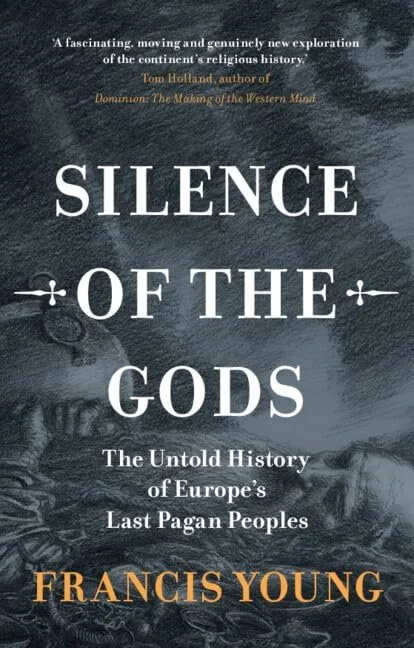
This week, I spoke with Dr. Francis Young about Europe’s last pagan peoples. Francis is the author of more than twenty books, including Pagans in the Early Modern Baltic, Magic in Merlin’s Realm, and Twilight of the Godlings. His new book is Silence of the Gods: The Untold History of Europe’s Last Pagan Peoples. Our conversation on who were the last pagan holdouts on the continent, why Christian missionaries struggled to convert these regions, and how pagan traditions were integrated into this new faith is coming up right after this.
Well, welcome, Francis. It is so nice to meet you. I am familiar with your work from social media, so it's nice to meet you in person. This is great.
Francis Young:
It's lovely to be on the podcast.
Danièle Cybulskie:
And this latest book has a wonderful title: Silence of the Gods. This is amazing. And you're talking about what you have here as the last “pagan peoples”, Europe's last pagan peoples. So, we need to start at the beginning, which is: who do we mean by pagan peoples? This is a loaded word. Tell us what you mean.
Francis Young:
Yeah, it is a loaded word, and it's a word that I have mixed feelings about using. It appears in the subtitle of the book, and the main reason for that is that most people have a fairly clear idea – or think they have a fairly clear idea – about what pagan means. But once we start to drill down into that word, we find that it's not particularly useful for describing people who are practicing religions before the coming of Christianity in Northern and Eastern Europe, which is what Silence of the Gods is about. And part of the reason for that is the sheer variety of those religious traditions. So, for example, if you're comparing the shamanic practices of the Sámi in the far north of Scandinavia with the practices of the Guanche people in the Canary Islands, for example – who are also in the book – or you're comparing that with the animism that's being practiced in the forests by people like the Finno-Ugric peoples in the Volga-Ural region, again, you know, there's not much commonality there. And is it fair to kind of lump all these religions together and put them under this label of paganism? And in some ways, I think it's a good label to use because it's a label that people identify with. It's a label that people use themselves today. But in other ways, I'm not so keen on it. So, a lot of the time during the book, I won't use it, and I'll use alternative terms like unchristianized peoples. And the reason I use that term is that – all these peoples – the thing they had in common was that they had to negotiate some kind of relationship with Christianity. That was often a hostile relationship, but nevertheless, it was there. And so, defining them in terms of their rejection of Christianity or their, if you like, adaptation to Christianity, that seemed – from a historical point of view – the best way to approach this.
Danièle Cybulskie:
Well, it's a tricky thing to think about, because when you have a word like pagan, it means sort of “other”, “not us”. And then when you have the us-and-other thing, it becomes quite a complicated thing. And so how did you have to think about this when you were thinking about Christianity and other? Because, as you're saying, there's a bit of worth to that in that a lot of these people sort of became Christianized over a long period, a much longer period than we might imagine. But, like, how did you have to think about this when we're thinking about “us” and “other”.
Francis Young:
Yeah, absolutely. It's a pejorative term, you know – originates from Christian polemic against people who weren't Christians. And it's a kind of wastebasket taxon where we shove all the people that we disagree with and we don't like and call them pagans. But having said that, it's also a term which has been redeemed by people since who have seen it not as a negative term, as a positive term. And, you know, you say the word today – not everyone will have negative connotations with that word pagan. And I think that something which made me want to talk about all these peoples together, you know – whether we call them pagans or not, whatever we call them – is that they have been neglected. And, you know, when we look at the history of religion, when it comes to Europe and medieval Europe, the focus is always on Christianity – maybe on Judaism, maybe on Islam in Umayyad Spain or wherever. But very, very seldom is the focus on these people who did not want to be Christians and didn't want to be anything else either, and wanted to continue practicing their ancestral religions. And because those people were so split, and so geographically dispersed, and so small in number, they just get turned into a foil. And so, you'll read books, for example, about the Baltic Crusades or the Northern Crusades, and it will talk about the pagans. And never do we get any kind of attempt to describe who these people are – what do they believe? They're just the other. And I just wanted to turn the tables on that. And I wanted to say this is one of the… the great religious traditions of Europe. And it's not a single tradition, of course, it's a whole ecology of traditions. That's how I prefer to think of it. And it's something we don't know a great deal about often, but what we do know is so precious. And I wanted to kind of bring that back into the mainstream of European religious history.
Danièle Cybulskie:
Well, one of the things that I hadn't realized until digging into this because I – a lot of the pre-Christianized study is earlier than the period that I tend to study on my own. And so, I hadn't really thought about this. But one of the things that you engage with when you're doing this introduction – telling us what the terms mean in all of this – is that so often when we think about paganism, people think about this… It's really Greco-Roman. And I hadn't really thought about that – about sort of privileging certain types of quote/unquote, pagans over other ones. But I could see definitely, when you pointed it out, see how this actually works when people are talking about the past.
Francis Young:
Yeah, that's right. I think there are certain kinds of pre-Christian tradition in Europe which have a privileged position because they had writing. And so that Greco-Roman tradition informs classical Christian culture and therefore flows directly into medieval Christian culture, to the point where when medieval churchmen are encountering people who don't want to be Christians, the default assumption is often, well, they must be pagans in the sense that the pagans encountered by Augustine, for example, were pagans, or, you know, the pagans who were, you know, written against by St. Paul were pagans. And so, there's this kind of interpretatio Romana, this attempt to interpret everything through a Roman lens where, you know, the gods and goddesses that people are worshipping – there'll be this desperate attempt by outside observers to force them into the names of the Roman gods and God. This is Jupiter, this is Mercury, this is Venus, this is Mars. And the other type of paganism that gets to some extent privileged is Norse paganism because of course, we have the Eddas written down in the Middle Ages, which give this quite detailed description of Norse mythology. And so, when missionaries are going to Lapland, to Sápmi – you know, the area in the far north of Scandinavia where the Sámi people live – they will start talking about the Sámi gods and goddesses and deities as Thor or Odin, which is equally inappropriate. This is a totally different culture, totally different language. It might be geographically close to the Norse world, but it's totally culturally different. So, yeah, there are certain kinds of paganism that get privileged, and these forms of paganism that have no written tradition whatsoever – so, Slavic paganism, Baltic paganism, Finnic paganism or animism or whatever you want to call them – they don't have any kind of written tradition other than what outside observers write about them.
Danièle Cybulskie:
Right, exactly. And so, your book is focusing on sort of later periods. So, not when the Romans are encountering these pagans, but when people who are actively Christian in terms of medieval Christianity, they are exploring or encountering peoples. So, that my question is, when we're talking about the medieval world – sort of like the high and late Middle Ages – where are we still encountering pagans? So, what is the geographical region that we're talking about? You've sort of gestured at this, but where are we finding pagans and Europe in the middle of the Middle Ages?
Francis Young:
The most famous incident, really, when it comes to an encounter between the Christian medieval world – or Christendom and pagans – in this period is what we call the Northern Crusades or the Baltic Crusades. It’s a kind of subset of the Northern Crusades. And the Northern Crusades refers to all those areas of resistance to Christianity in the northern world, mostly clustered around the Baltic. So, it includes Sweden. Parts of Sweden were quite slow to come to Christianity. It includes the southern Baltic coast of what's now eastern Germany and Poland, but then was inhabited by a group of West Slavs, known collectively as the Polabians. And then going along that kind of north Baltic coast – or south Baltic coast, because we're looking at facing north, but we're on the south edge of the Baltic – you then reach the Baltic peoples themselves. So, these are the Prussians – not to be confused with the later Prussians who wore spiky helmets. Germans. These are pre-German Prussians, who are in fact a Baltic people. And then you've got peoples like the Lithuanians and the Latvians. And then you move even further north, you're still on that Baltic coast. You've got the Estonians. And then crossing over the Gulf of Bothnia, you've got the Finns, who are ethnically and linguistically very closely related to the Estonians. Just on different sides of the water. And all of those peoples put up resistance. You've also got peoples in what we now call Russia. So, you've got the Ingrians, the Vepsians. They live around kind of where St. Petersburg now is – you know, many centuries later would be built. Lake Ladoga region. And then, even further east, we've got in kind of the inland areas of European Russia – close to the Ural Mountains – you've got peoples, as well. So, all of these peoples, they have an encounter with medieval Christians in the form of warfare. Now that has been written about a lot by lots of people. So, I didn't want to start there. I wanted to go for a later period after the official submission to Christianity has taken place all over Europe. And that happens in 1387. The last nation state or sort of proto-nation state to submit to Christianity on an official level in Europe is the Grand Duchy of Lithuania in 1387. So, I begin on the 14th of February, 1387, the official baptism of Lithuania. But the thing about an official baptism is you might get a few hundred people turn up because they're being offered, you know, a free baptismal robe made of white wool. Who wouldn't want that? But they are only representatives of that people. The reality of what's going on in the backwoods is very, very different. So, what my focus is – not on the political process of conversion or those kind of set-piece theatrical events which often get described in hagiographies where somebody turns up and preaches and, you know, miracles happen or whatever. But I'm focused on the people themselves. What did the people actually think of this? And so, I go through the different peoples who put up resistance or showed reluctance in one way or another to adopt Christianity. So, we look at the Lithuanians, the Latvians, the Estonians, the Finns. We look at the Prussians. We look at peoples who are in the far north, like the Sámi. We look at the peoples in the Volga-Ural region, so like the Chuvashes, and the Maris, and the Udmurts, and so on. And many of these peoples, you know, most people wouldn't have heard of because, you know, we don't read very much about the Udmurts and the Chuvashes and so forth. But that's part of what the fascination is for me that, you know, we've forgotten these… these stories of people choosing a very different relationship with Christianity than the one we expect. You know, the history of Christianity is often told in this very kind of stereotyped way where Christianity moves out from its heartlands in the Mediterranean and gradually convinces or forces people in Northern and Eastern Europe as this sort of unstoppable wave – this inevitable wave of Christianization. And the reality is it wasn't inevitable and it wasn't unstoppable, and it does suffer these setbacks. And for example, in the Grand Duchy of Lithuania, although it's theoretically converted in 1387, the reality is you've still got pre-Christian religion as a very active force there at the end of the eighteenth century. So, my question is why? You know, that's the question I'm trying to answer. Why do we get these areas where Christianization does not take hold?
Danièle Cybulskie:
Well, let's try and answer that question now. Well, before, before we get to the why, I'd like to ask you, how do you know? How do you find this out? Because I think a lot of people – and I think, rightfully – when they hear a historian talking about something, they want to know how you know this. So, how did you find out that people weren't just immediately Christianized? And that was that.
Francis Young:
And absolutely people should be asking that question. I think, as a historian, that should make you glad when people want to know, where are you getting this? What's the sources? And yeah, the sources, as I've already said, we face this overwhelming problem that all the sources are written down by outside observers. But having said that, the outside observers themselves had very different perspectives. And so, you will have sources which are written down by Christians, but they will range from those who are so hostile they want to portray these people as being essentially animals rather than human beings, to – at the other end of the spectrum – people who are quite philo-pagan. You know, they are… They have a deep curiosity about these cultures. They have perhaps an idea that by studying these cultures, something can be recovered about the things that really interest them about the classical world. So, for example, you have Jesuits who go out into the backwoods in Lithuania, and they will be studying at the University of Vilnius, you know, which is one of the great universities of Europe at this point. And they want to know about people worshiping snakes because they've been reading about the cult of Aesculapius, you know, in ancient Greece and Rome. And, you know, they're fascinated by the idea that this might still exist, you know, somewhere out in the… in the backwoods. And so, while theoretically their job is to stamp this stuff out – get rid of it – the reality is they're sometimes more sympathetic than you might imagine. And the main reason for that is the Renaissance and the kind of humanist movement which encourages an approach to history that is not purely based on, you know, scriptural or doctrinal imperatives, but is kind of rooted in this genuine curiosity. And I think what's really incredible about these pagan peoples is that they survive for long enough to have experienced that kind of humanist renaissance in terms of the people who are going there, the people who are interested in finding out about them. Whereas earlier pagan peoples who sort of, you know, survived into the twelfth century or the thirteenth century – the writings about them are so hostile because that's the kind of the high point of aggressive, Christian evangelization before we get the Renaissance, before we get the humanist movement, before we get that kind of turn to a genuine curiosity. But these peoples, you know, even though their religious traditions don't survive to the present, they do survive into this period when we get a more sympathetic appraisal of them. So, yeah, the missionary accounts are one source. We also have church records like… like synods where people are being brought before clergy and questioned. These, to me, are the most interesting accounts because they are actually verbatim records of what illiterate people from the countryside are saying when they are questioned. So, for example, somebody has asked, you know, why do you believe in many gods? And why won't you submit to the true God? And the guy says, well, many people can get more stuff done. Many gods can get more stuff done than a single God. Which, you know, gives you an insight into vernacular reasoning. You know, this is how people are thinking. They're thinking of the gods as anthropomorphic beings, and therefore the Christian God must be an anthropomorphic being. So, why is there only one of him? That's useless. And so, you get these kind of little glimpses. You know, it doesn't happen often that we get these verbatim accounts, but sometimes we do. We get hagiographies, you know, describing what saints were up to. They can be quite distorted, but they still give us valuable information about where they were traveling and what they were doing. We get, you know, records of church foundations which give an indication of, you know, where paganism might still be considered a problem by the church. In Sweden, for example, and Norway, the government gets very interested in enforcing Christianity, you know, by force. And so, they will be sending out soldiers. They will be sending out instructions for people to be compelled. In other countries, that doesn't happen. So, in the Polish Lithuanian Commonwealth, for example, there's no compulsion in religion, so there is a degree of tolerance. But you get travelers, as well, you know, coming from other countries, you know, like, like Germany or England who are traveling through these countries. And from an outsider’s outsider perspective, they're kind of giving another perspective on this. So, yeah, there's… there's a – there are a lot of sources, but yeah, they always have this problem that they are from outsiders.
Danièle Cybulskie:
Well, if people are thinking as they're listening to this, that we are straying beyond the Middle Ages, we are. And the reason that I wanted to have you on – even though you do stray beyond the Middle Ages – is because a lot of the way that we read onto pagan peoples in the Middle Ages is informed by all of these sources that you're talking about that happen later. And the fact that people are extending their systems of beliefs for so long, I think is definitely relevant to our study of the Middle Ages. So, let's get into the why, now. What did you discover when it comes to people who are being sort of actively Christianized? You have people who are missionaries, sometimes soldiers, trying to impose this faith on people. Why did it not work all the time?
Francis Young:
When you look at the history of Christianization that was successful in Europe, what you tend to find is that it's a step-by-step process, like crossing the stepping stones across a river. So, for example, if you manage to convert the Anglo-Saxons, the Anglo-Saxons speak a language which at that time is mutually comprehensible with the language being spoken in the Low Countries, and the language being spoken in Saxony – North Germany – and the language being spoken in Denmark, for example. So, you send then Christianized, you know, English missionaries – Anglo-Saxon missionaries – who then go to those places and carry the faith to them. Or, for example, we have these two brothers from Thessalonica, Cyril and Methodius, who've grown up speaking both Greek and a local Slavic language. They are able to mutually comprehend all the Slavic languages of Central Europe. So, they end up in Moravia, and they end up preaching because they already know a Slavic language. And so then, they translate the liturgical books into a Slavonic language that then enables the evangelization of other Slavic peoples – like the Poles, for example, and the Bohemians, and so on. And so, we end up with this kind of step-by-step process. But the key thing to that step-by-step process is mutual comprehensibility of languages. What happens when you encounter a language where there's no Christian people or there's no Christian missionaries who speak that language? How do you break through that wall? And this is the problem encountered in the Baltic. So, the Baltic languages are a separate language sub-family compared to the Slavic languages. They are still Indo-European languages, but they are not of the same family as the Slavic languages. There are no Christians who speak those languages in the Middle Ages. So, how do we preach to those people? Likewise, the Finnic languages – you know, you've got Finland, you've got Estonia. There are no Christians who speak those languages initially. And so how do you break through that? This is a problem, I think, which explains some of the resistance – or some of the delay – in the Christianization of these peoples is the language barrier. I think another factor is geographical remoteness. These are very difficult places to get to. These are places with very dispersed populations. Even if missionaries do get to these places, which are cut off by marsh or by mountain or by vast distances, they can only visit once every couple of years. You know, they can baptize people, they can instruct people, but then they've got to trust those people to carry on being Christians when they leave. And there isn't the infrastructure. There aren't the priests who want to stay there. These are purely missionary efforts. There is no kind of parish system, or building of churches, or anything like that because there isn't the money for it. You know, these people are not a priority. And another factor is the political situation. So, you know, whereas there are strenuous efforts in some countries to convert these people. For example, the Russian Empire is very, very keen on mass baptisms and soldiers forcing people into rivers and declaring they're now Christians. The Swedes are very keen on forcing the Sámi to become Christians. But in the Polish Lithuanian Commonwealth, as I mentioned, there's no compulsion because it's a democracy of a sort, because it's this kind of quite tolerant republic with a... with an elected king. There's no scope for enforcing religion because you've got a mixed population of Catholics, and Orthodox, and Jews even before you get to the pagans. And so, the pagans are just left alone. And left alone, they thrive. They continue to exist. And so, yeah, there's a whole load of factors, I think. And the other factor I would say is that there's no buy in. You know, what gets buy in from peoples who are successfully Christianized is that their elites – their kings, their leaders, or whatever – will see that Christianity will give them something that they haven't got. That doesn't work in Lithuania. And that's partly because Lithuania is in a geographical position where it's trying to play off the Russians, and the Poles, and Germans against each other. And it doesn't work in places like Lapland and places like the Volga-Ural region because these peoples don't have leaders or kings or anything like that. They are just tribal peoples, nomadic peoples, semi-nomadic peoples. These political considerations make no sense to them whatsoever. And the stories in the Bible probably make no sense to them either. I mean, if you're a nomadic reindeer herder, are you going to understand the Parable of the Sower? Probably not. You know, and so, you know, this faith which developed in an agrarian society in the Middle East, it doesn't mean much to people in the... in the… in the Arctic Circle. So, yeah, I mean, there's loads of factors, but those are just some of them.
Danièle Cybulskie:
Well, I think all of these things are definitely on the right track. I'm with you. I'm on board with all of these things. And one of the things that came out that I thought was really interesting was – even in this book, you're looking at all of these different peoples, and if people are listening and they're like, there are so many different peoples, you get to all of them, which, you know, I applaud you. That is a lot of work and careful research. But when you're talking about the Sámi people, for example, you're trying to explain one real factor of their belief system, and there is no way to do it in English. So, it's still happening in that there are systems of belief that are really tied to language, and it can be very hard to translate those things, as you've discovered yourself.
Francis Young:
Yes, absolutely. And, I mean, I speak some of the languages – or understand some of the languages – of the peoples that I described in this book. Mainly Lithuanian, which – my specialism is in the Baltic region. But I don't speak any Sámi languages. I've been to Sápmi and I've spoken to people of Sámi heritage. And, yeah, they themselves have said to me – although they're, of course, all fluent speakers of Swedish, and Norwegian, or whatever country they technically happen to live in – they will say that there are words like, for example, the word sieidi, which is untranslatable. A sieidi is usually an outcrop of rock, or an unusual piece of wood, or some feature of the landscape which is a focus of sacredness. And, you know, missionaries sometimes tried to say, oh, the sieidi is an idol. It's not really an idol. It's not in the shape of anything particular. You know, it's not an attempt to kind of create a facsimile of a living thing. Yeah, it's sort of… it's in the landscape. Some of them can be moved, some of them are movable, some of them stay where they are because they can't be moved. Sacrifice is offered. Or is it sacrifice? I mean, again, that's our terminology from Greek and Roman religion. Sacrificium. It's a Latin word. Does it apply to Sámi cosmology? Well, the Sámi people I've spoken to say, no. No, it's not the same. It's not a sacrifice. So, it's almost as if you have to be in that culture and embedded in that culture to understand what's going on. And I think, you know, very much the same is true of Indigenous beliefs throughout the world. I think that's why we have to be rather suspicious of what people say about, you know, First Nations and Native American belief, for example, because it's all being translated into these Western concepts which immediately distance it from the actual experience of those people. And even in Europe, we find that. So, yeah, translation is always a... is always a problem.
Danièle Cybulskie:
Yes, exactly. Even grammatical concepts which seem like law, they don't always apply to every language on Earth. And so, you really have to be careful. And so, this is, again, why I applaud you for working so carefully in these systems, and for thinking so carefully about the language that you're using when speaking about them. So, there was one question I wanted to ask that's sort of an aside – we’ll come back – is that you've included the Canary Islands here. Why did you include the Canary Islands? Because geographically, you know, we might say these are African, but you've included them in terms of Europe. Why did you include the Canary Islands?
Francis Young:
Yeah, the Canary Islands are geographically an outlier because all the other peoples in the book are located in Northern and Eastern Europe. But the reason I included them was to provide a link with a question that I think a lot of readers are going to be asking, which is how does this relate to what then happens in the sixteenth century in the New World? Now, I don't go to the New World in the book because that's beyond its scope, but I felt that I had to provide a link of some kind. And the link is the Canary Islands, which – yes, they're geographically part of Africa, but they are effectively colonized during a very early period of Iberian expansion, although the French also make an attempt to… to colonize them in the fifteenth century – well, in the four- in the fourteenth and fifteenth centuries – which creates a template for some of what's going to happen in the… what we call the Age of Discovery – whatever we want to call it. After 1492. So, yeah, they are there to kind of provide that link. Now, whether there's any kind of link between what's happening in the New World and what's happening in Northern and Eastern Europe, that's more doubtful because these are rather different kinds of encounters in that people in the Canary Islands didn't really have any idea that anyone else existed. Rather like the people who, you know, Christopher Columbus was encountering. But the people who were in the Baltic, or in Finland, or wherever, they had been, you know, having commerce and dealings with Christians for generations. They hadn't chosen to become Christians, but they were very much aware that the Christians were out there. And I think that in itself gives quite an interesting perspective when we look again at the New World, because there are people in the New World who are very resistant to Christianity, as well, and spend quite a long time gathering information about this new faith, and these new people, before they actually have the face-to-face encounter. So, I think sometimes we're given this narrative – which is a rather outdated narrative – of First Contact, which is totally kind of without presuppositions. That doesn't always happen in the New World, and it certainly doesn't happen in… in Europe. So, yeah, they're kind of… The Canary Islanders are in there just to give an example of how there is that link with what happens in the New World.
Danièle Cybulskie:
Well, I love that you've brought this idea up about First Contact because it seems like something that has to be turned into a legend, or it has to be turned into a story. And really, many times it could be just pretty pedestrian, I think.
Francis Young:
Yeah, that's right. I mean, the first contact with Christianity in northern Europe often takes place in the form of trade, in the form of objects. So, if you go to somewhere like Vaygach Island – which is in the far, far north of Russia, the sort of the icebound seas, the Arctic Ocean beyond the Arctic Circle – you will find there hoards of metal objects that were traded between the local people – the Nenets people – and Novgorod, this great kind of trading republic in medieval Russia. And some of this stuff is crosses. And there seems that to be evidence that the Nenets people regarded these objects as – in some sense – sacred. Doesn't mean they were Christians, of course, but it does mean that there's this sense of a sphere of influence – a kind of spiritual sphere of influence – developing from the Christian world, which is spreading out towards these unchristianized peoples. And sometimes, that results in the creation of these religious creoles. And that's a key theme of the book, where I talk about how we shouldn't make this sharp binary distinction between Christianity and paganism – it's not like that in these borderland regions. What it's more like is a situation where people are creating community religions that serve their own purpose, which draw upon elements of the pre-Christian, elements of Christianity, but effectively create a third religious tradition which is a mingling, and a new synthesis of those elements, which is what I call a creole religion. So, yeah, we see that, for example, a lot of the time when pagan practices are being described – or allegedly pagan practices are being described – they will actually contain these rather incongruously Christian elements. So, you end up asking, well, why are you calling this pagan? You know, this is a rite which is performed on the feast of St. John the Baptist and involves an invocation of St. John the Baptist. But you call it pagan because it involves an ancient, prehistoric, cut-markedpopa stone, but it's also Christian. So, you know, what is it? And I think, yeah, this kind of idea of a creole religion is what bridges that gap.
Danièle Cybulskie:
Well, exactly, and that's where I was hoping to go with this because, as you mentioned, sometimes you will have a missionary impulse – Christians will go out, they will find a remote community, they will talk about Christianity there, and then they will leave. And then you see people that are adopting elements, but not other elements. And one of the things I thought that you said that was really interesting, as well, was that some people are thinking that they're doing it right, but they're not really doing it right – like “right” in quotation marks. According to the Catholic doctrine, especially Catholicism in the Middle Ages. They're not really doing it sort of quote/unquote right. But they think they are. And so, what is this? Is this paganism? Is this Christianity? And so, I think that this emphasis that you have on this creolization is so interesting.
Francis Young:
Yeah, that's right. I mean, you'll get these communities where there's a popa – a kind of a… an elder – they’re usually male, but sometimes female – who is leading the community in matters both secular and sacred. And this is some kind of isolated village community, you know, in Latvia, Lithuania, or elsewhere. And they have received missionaries at some point who've told them, you need to baptize all your children. And of course, in Catholicism, lay people are allowed to baptize. And so, these… these elders are entrusted with that. But they forget the formula. So, they're no longer baptizing in the name of the Father, and of the Son, and of the Holy Spirit. And they forget one of the persons of the Trinity, or put the Virgin Mary in there, or whatever. So, they've made that mistake. But they also, of course, have some sense that Catholicism involves sacrifice because of the idea of the mass as a sacrifice. But they don't have the mass because they don't have any priests, and they don't have any churches. So, maybe they will get some grace from God if they make a sacrifice to God under a tree. And if they draw on those pre-Christian traditions where, you know, maybe you slaughter a chicken, or a goat, or whatever. And that's not necessarily a pagan survival – that's perhaps the wrong way to think of it. It's more their interpretation that that's the best way to fulfil the instructions that they've been given by the missionaries, or the best way to please God. And these sacrifices, maybe they're being made to the Christian God, maybe they're being made to Perkūnas, you know, the Baltic sky god, thunder god. But I mean, what's the difference anyway? You know, the Christian God is supposed to hurl thunderbolts from heaven. Perkūnas does that. They both have a beard. Same difference. And so, you get this kind of synthesis, and this creolization, which makes it very hard to say, I think, with any clarity, what is Christian and what is not Christian.
Danièle Cybulskie:
Well, this is so important because as we get especially into the nineteenth century, you have people that are trying to find roots, and it is so much a project of nationalism – which we've talked about on the podcast before – but people trying to find roots and trying to reestablish or… or make contact with this paganism that was part of the culture of the region before that. And it's very difficult to do. So, how are people doing this in the nineteenth century?
Francis Young:
In the nineteenth century, there's very much this feeling that in order to be a nation you need a language, you need a territory. And, you know, even better if you've got a religion. And that might be a distinctive form of Christianity that's a bit different from your neighbours, or for some people, maybe the idea that you had an original religion which has been erased by Christianity. And if you recover that religion, then that's real nationalism. You know, that's real national distinctiveness. And I think the earliest attempts to do this – it's not that people really believe these religions, or that they even really are religions. They're a sort of ritualized nationalism where people will put on garments and cloaks and they'll go to some, you know, site which has a storied significance within the national pantheon and they'll… they'll invent some kind of ritual in singing and, you know, dancing, or whatever. It's not really… it's not really religious. You know, it's ceremonial, but it's not… It's… it's ritualized. But over time, you do get the development of genuine religious movements. So, one of the earliest would be in the 1920s. You get the Dievturi movement, which in fact is a hundred years old this year – 1926 in Latvia. And the Dievturi movement – they're inspired by the idea that Latvia only became Christian because of the Baltic Crusades, under the threat of invasion. And therefore, Christianity has no real place within Latvian culture, they argue, and therefore we need to recover some kind of pre-Christian Latvian religion. The trouble is you then have to reconstruct it. How do you reconstruct a religion that is dead? Well, the Latvian answer – and the answer that many people come up with – is to look at the folklore which had been being collected by that time for about a century. You know, huge amount of nineteenth century ethnographic work, folklore collection. What if you can reverse engineer that folklore? What if you can purify it, pass it through a strainer, extract out the elements of that folklore which are in fact a pre-Christian belief system? And people in the nineteenth and twentieth centuries – especially the early twentieth century – had this indefatigable belief that ethnographic material can be treated in such a way that you can extract prehistoric belief systems from it. Now, we might be a little bit more skeptical about whether that is possible, but at the time – mostly under the influence of scholars like Sir James Frazer, who saw the primitive everywhere – they believed it was possible to extract that kind of primitive core from the ethnographic material. And in fact, a lot of the native faith movements that you find in Eastern Europe today derive in one way or another from that idea that you can extract that material. And often they don't make much use of the earlier records, which are the core kind of source for my book, which is mostly looking at records that were written down between the fifteenth and the eighteenth centuries. I tend to ignore the nineteenth century material, partly because, to my mind, it has kind of been infected by this belief that you can take ethnographic material and you can extract prehistoric knowledge from it. People in the eighteenth century and earlier didn't have that belief. And therefore, I tend to think of those records as being a bit more reliable, simply because they don't have that sort of weird ideological baggage that often comes with the sort of the nineteenth-century anthropologists.
Danièle Cybulskie:
Yeah, absolutely. And this is exactly what I was hoping you would say, that when we're looking at things – especially because a lot of the ways that I think that we encounter things like folklore, things like paganism – come from nineteenth-century sources. And so, to look at them we need to understand how they've been constructed. And many of them are constructed with ideas of nationalism, or trying to create an individualization from, you know, one place to another. And so, that's such an important part of what we're seeing in the… sort of the first layer of looking backwards towards people from the past. And it can be quite messy.
Francis Young:
Yeah, absolutely. And I mean I'm very respectful towards these traditions, and I find them very interesting in and of themselves. You know, native faith movements, and neopagan movements, you know – some of them are now pretty old. You know, they go back to the early twentieth century, to the nineteenth century in some cases. And I don't think they're any less worthy of respect as, you know, for example Methodism, which emerged in the eighteenth century. We don't therefore say that Methodism is not worthy of respect. So, you know, these are new, newer religious movements, but they are still religions. I think what we have to be careful of as historians is to say this is not necessarily to be taken at face value in terms of the claims that its original founders might have made. You know, contemporary adherents of these traditions are often a lot more cautious, actually. They won't make these more problematic claims of continuity. But the original founders of these movements would often say, yeah, you know, our religion was preserved in the form of folklore. All we've done is we've just purified it, revived it and now it's carrying on as it always has been. The reality is that there is a gap. The only place that we won't find that kind of gap is if we go really, really far to the east of Europe. If we go to that Volga-Ural region. So, these are peoples living within European Russia, like the Maris, for example, in the Mari El Republic. They do have more of a claim to continuity in the absolute sense of never fully having relinquished their pre-Christian traditions. And so, when, you know, people say the last pagans in Europe are to be found in the Mari El Republic, there's a degree of truth in that. I mean, there's elements of revival, too, but there's also that continuity. Whereas if somebody in Lithuania says that, you know, Romuva, for example is indirect continuity with pre-Christian Lithuanian religion, that's not really the case. There was a break by the end of the eighteenth century, and there was a revival in the twentieth century. So, it's a little bit different. But yeah, there are places where you can find it. And likewise, you know, among the Sámi people, you know, the practices that happen there, you know, whether they are religious in the way that we would understand religion, that's another question. But yeah, depositions of animals, objects – that still happens at sieidi sites, for example, in Sápmi. So, yeah, that's… that's, again, got this kind of continuity.
Danièle Cybulskie:
Well, as we come to the end of our time – and I want to be mindful of your time: you have places to go, people to see – I wanted to ask you: for the people who are interested in finding out more about pre-Christian peoples, what would you say to them – given all the givens that you've told us about with, with revivals and potential breaks – what would you say to people who really want to get in touch with these long-ago roots?
Francis Young:
Well, there is a new tradition developing of historians who are eager to return to primary sources, to sort of stay away, perhaps, from that more ethnographic approach which dominated until recently. There are, you know, other books very similar to my books. For example, there's a book about pre-Christian Slavic rituals which is by [Álvarez-Pedrosa] and others, which, you know, if you're interested in Slavic paganism, that's a great one to look at. I specialize in Baltic paganism. Similarly, there are excellent books by scholars about Sámi practice and so on. I think the difficulty is that some of this material is not available in English. Some of the material is available in English, but it's a little bit obscure because the scholars themselves don't have much of a reputation outside their own countries. I think the entanglement with nationalism that you mentioned is still something which can hamper international knowledge of these traditions. And that's partly why in Silence of the Gods I tried to tell the story all together because very often it's told in a regional or national context. And that's great, but the trouble is only people with a vested interest in that nation or region will want to hear about it, or will be interested, or will be in the kind of the potential audience there. And I think that this history deserves a much larger potential audience. So, yeah, that's why I've kind of brought it all together. But yeah, there's plenty of material out there and there are scholars who are… who are working on this.
Danièle Cybulskie:
Well, excellent. I'm so glad that you are here to tell us all about this because I do think that your book is a great place to start because you do spend time on all sorts of distinct peoples. So that, if people are interested in learning more about the pagan peoples of Europe, this is a great place to start. And you can look at Francis' notes in the back and find even more for people to look into. So, thank-you so much for being here. This has been so informative and just a great conversation. Thanks for being here.
Francis Young:
Thank-you very much. It's been great to talk to you.
Danièle Cybulskie:
To find out more about Francis’ work, you can visit his website at drfrancisyoung.com . His new book is Silence of the Gods: The Untold History of Europe’s Last Pagan Peoples.
This month, for our weekly medieval quotes, I thought we could go with some helpful phrases to keep us motivated as we finish out the school term and look forward to summer. I came across this week’s quote in Carmina Burana, an absolute treasure of a source, full of pithy opinions as well as religious verse, and love poems. The lines that jumped out at me will be somewhat familiar to many of us. They go like this, “The man who has begun / has half of the work done.”
I think it’s comforting at times to know that humans have always had the same trouble that I sometimes do, where starting is at least half the battle. I hope this bit of medieval wisdom helps you get started on that thing that you just know will be so rewarding once you begin.
This comes from the Dumbarton Oaks translation of Carmina Burana, Volume I, by David A. Traill.
This week, I’m so pleased to announce that a TV show I worked on has just dropped on the History Channel. It’s my very first time being a talking head for the History Channel, and I’m delighted to inform you that you can, in fact, find my face on your screen with that iconic little yellow H in the corner. The show is called History’s Greatest Warriors, and I’m one of the historians featured on Episode 4: The Knights Templar, talking about where these legendary knights got their name, deadly medieval warhorses, and a few more interesting tidbits. So, if you’re into the Templars – or just medieval history in general – keep your eyes peeled for History’s Greatest Warriors: Episode 4 wherever you get the History Channel.
Thanks for watching, and thanks for listening – and for sharing your favourite podcast episodes with your friends. And thanks, especially, to all the patrons on Patreon, who are, as ever, the wind beneath my wings. I hope you enjoyed last week’s Ask Me Anything video, as well as all the exclusive articles, and ad-free listening. If you’d like to become a patron, check out patreon.com/themedievalpodcast.
For the show notes on this episode, a transcript, and a collection of the books featured on The Medieval Podcast, please visit medievalpodcast.com. You can find me, Danièle Cybulskie, on social media @5MinMedievalist.
Our music is by Christian Overton
Thanks for listening, and have yourself an incredible day.