Medieval Mass Expulsions with Rowan Dorin




The Medieval Podcast uses affiliate links
Episode 343
The medieval period is well known for several large-scale and horrific persecutions, especially ones based on religious grounds. One of these is a succession of expulsions of the Jews from one kingdom after another. Persecutions like these don’t just come out the blue. So, if we’re going to understand them – and hopefully prevent them – we have to dig deep into the cultural ideas and purported justifications that they spring from. This week, Danièle speaks with Rowan Dorin about what usury is, how changing ideas of sin and foreignness shaped Europe, and how mass expulsion went from unthinkable to acceptable in the late Middle Ages.
-
Danièle Cybulskie:
Hi, everyone, and welcome to episode 343 of The Medieval Podcast. I’m your host, Danièle Cybulskie.
The medieval period is well known for several large-scale and horrific persecutions, especially ones based on religious grounds. One of these is a succession of expulsions of the Jews from one kingdom after another. Persecutions like these don’t just come out the blue. So, if we’re going to understand them – and hopefully prevent them – we have to dig deep into the cultural ideas and purported justifications that they spring from. And that’s where my next guest comes in.
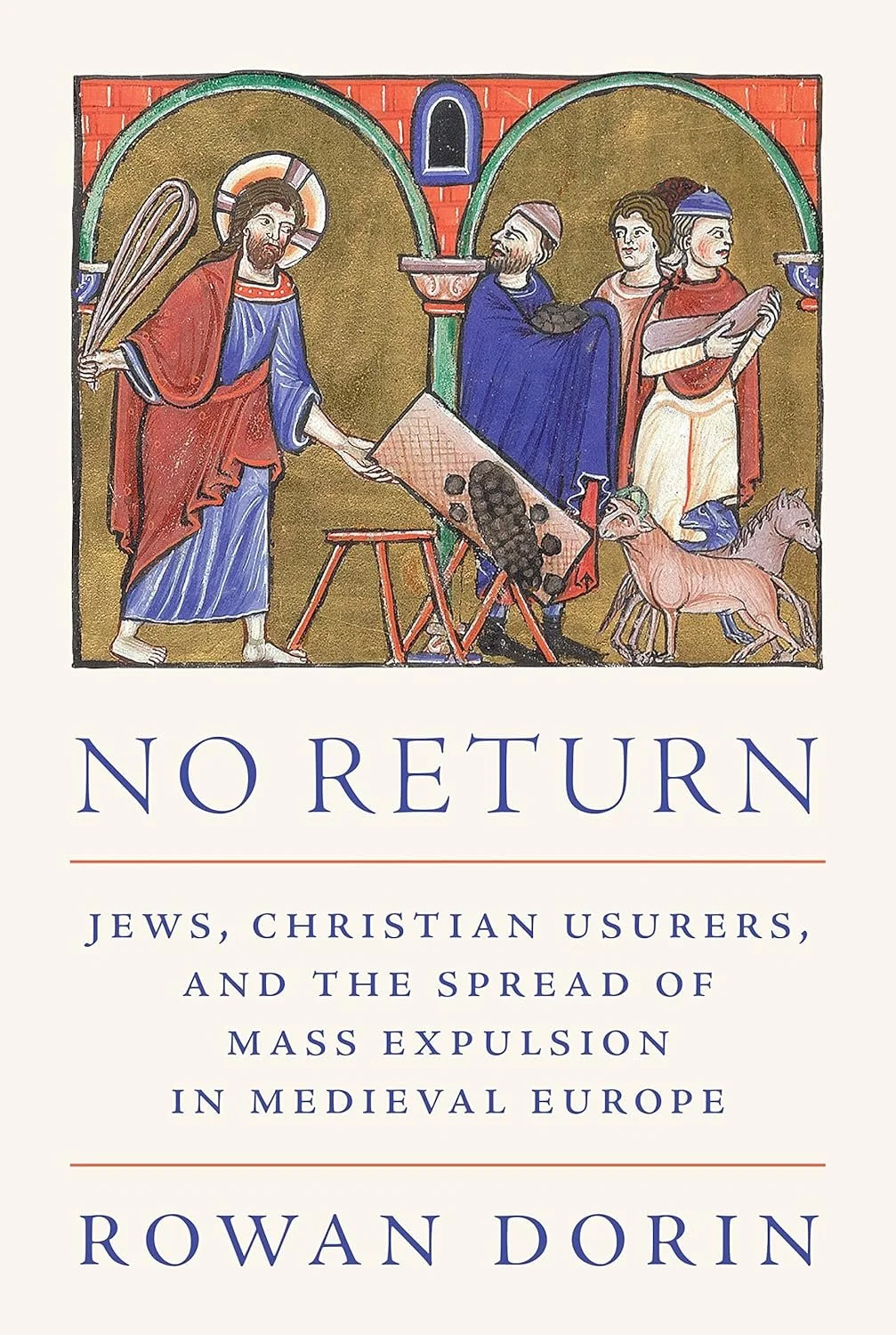
This week, I spoke with Dr. Rowan Dorin about mass expulsions in the Middle Ages. Rowan is an Associate Professor of History and the Director of the Center for Medieval and Early Modern Studies at Stanford University. His book won awards from the Medieval Academy of America; the American Academy for Jewish Research; the Canadian Historical Association; the Canadian Society of Medievalists; the American Historical Association Pacific Coast Branch; as well as being a finalist at the Association of Jewish Studies. It’s called No Return: Jews, Christian Usurers, and the Spread of Mass Expulsion in Medieval Europe. Our conversation on what usury is, how changing ideas of sin and foreignness shaped Europe, and how mass expulsion went from unthinkable to acceptable in the late Middle Ages is coming up right after this.
Well, welcome, Rowan, to the podcast. I really enjoyed your book and I have wanted to have you on the podcast for a while, so I'm glad we're making it happen. Welcome.
Rowan Dorin:
Thank-you for having me. It's really exciting to be here and to get to talk about the Middle Ages with someone who does so much to share knowledge of the Middle Ages with so many people. So, this is really exciting for me. Thank-you.
Danièle Cybulskie:
Oh, thank-you. This is such an important book, and I think it's one that is going to be really important for a lot of people who are studying not only this particular period that you're studying, but also the relationship between politics and religion and all of that stuff. So, you're looking at expulsion, and I think we really need to start kind of at the beginning because it seems like what you found was that people were getting threatened with expulsion and actually being expelled over usury. What is that?
Rowan Dorin:
What is usury? So, that's a good question. It was uncertain in the Middle Ages. It's unfamiliar now. Basically, usury is – then and now – any sort of illicit interest on a loan. But what counts as illicit? That depends on who you're talking to – in the Middle Ages and now – and who's doing the lending in the Middle Ages, like now. So, in the modern day, for instance, payday lenders can charge different rates than people who are doing sort of private contracts with each other, who have different limits often than banks. In the Middle Ages, depending on whether you were speaking to a churchman, a municipal official, an ordinary person sort of on the street, they all had different definitions of what usury is, was, and might be. So, it's a hard question to answer, but that ambiguity is one of the things I think is important in my book – of showing sort of how people can manipulate different understandings of usury to target different people that they don't like.
Danièle Cybulskie:
Yes, exactly. So, it's loaning stuff out at interest. Who's doing this? Because it seems like pretty much anybody could do this. Who's lending out money at interest in the Middle Ages, especially at the beginning of your book?
Rowan Dorin:
So, there's a widespread assumption and a misconception that in the Middle Ages only Jews could lend at interest because the Catholic Church forbade lending at interest. But as with most things, the fact that the Catholic Church forbade it again, and again, and again, and again suggests, as we know, that repeated condemnations are a sign of persistent practices. So, there were lots of Christian moneylenders in the Middle Ages, some of them doing it sort of low-scale, informally, others doing it professionally. And they come from northern Italy, they come from southern France, they come from the Low Countries in terms of those who are doing it professionally and actually sort of work as professional moneylenders. Particularly, we see them in the eleventh, and twelfth, and early thirteenth centuries getting going, which is a period of considerable economic expansion. So, there's lots of demand for credit, and some people decide to turn this into their professional activity. And of course, alongside this, we see a number of Jews and Jewish communities who also begin to get involved in money lending, although it takes a long time for that to become a dominant part of their economic livelihoods as well.
Danièle Cybulskie:
So, when it comes to usury, it seems to be a problem that the church has, and it seems to be something that the church is trying to suppress. So, what does the church have to do with this at all? It's a financial thing. What's their involvement?
Rowan Dorin:
So, of course, in the Middle Ages, the church governs all sorts of areas of life that we might be surprised by. You know, there's things like marriage – like, of course, it says something about marriage – or burials, where you get to get buried. Of course it does that. But the church regulates all sorts of aspects of life – or at least tries to in its legislation. And then also in its – let's say – the whole normative world of things that say you should do this, you shouldn't do this, and if you want to be a good Christian, you do this, you don't do this. So, usury falls into. Into the broader range of economic practices that medieval churchmen – particularly from the eleventh century onward – begin to sort of think about, and argue about, and figure out, well, what is the appropriate sort of economic behavior for Christians. If it's not just a matter of being sort of a, you know, a peasant farmer, or being a knight, or being a monk, or a priest, and there's these people who are engaged in commerce, what should they be doing? How should they be doing it? What are the limits on that? And lending becomes a pretty fraught area within that.
Danièle Cybulskie:
So, when it comes to the interest part of it, my understanding is that the church is upset in part because this is creating something out of nothing, and only God can do that. Do I have that right?
Rowan Dorin:
Yeah, there's a couple arguments that the churchmen come up with because they have a tradition that comes out of part of the Old Testament, a little bit the New Testament, and then a lot of early Christian writings that generally says usury is bad and thinks about how to define usury, but comes with various definitions. And they're trying to grapple with, well, why is this the case? So, one of them that I like is – so, the one you talked about actually comes from Aristotle, and it's an Aristotelian claim that money is sterile and things that are sterile shouldn't be able to reproduce. And so, to have money beget money – to have money produce money on its own – is seen as against nature. Another argument that I love is that time belongs to God and that interest is basically selling time. You're charging for time, and that to sell time is to sell something that belongs to God. And so that's another argument against it. And then there were just other general arguments about the fact that this is ungenerous, it's unchristian, it's not… You should lend sort of – you're expecting nothing in return, the classic gospel phrase. So, there's a number of other arguments they come up with. But I like the one that you started with. Because that one goes really back. That goes all the way back to the Greeks, that one, so this is an established one.
Danièle Cybulskie:
Yeah. This is the one that I've heard most often when it comes to this, because it does lead to such horrific events later – which we're going to get to – and so, you want to understand: why is this a problem in the first place?
Rowan Dorin:
But I'll admit, though, I've been thinking about medieval usury for, I don't know, twenty years now. Really, since I was an undergraduate. I wrote one of my undergraduate papers on – I think maybe my very first undergraduate paper – on the topic of medieval usury. And I never thought I would still be thinking about it now. And, you know, for all that I've thought about it, I still can't really pin down why it is that people get so concerned about it. I think about it sort of in the vein of a lot of, like, moral panics now, where a particular issue just sort of takes hold in a particular community and they decide like, this is the thing we really need to be worried about. But for all that I've thought about it, for all that I've read about it, it's still never clear to me why people get so exercised. But they do. They get really – churchmen and eventually secular writers, as well – get really, really concerned that usury is the root of many, many evils and all that is destroying society.
Danièle Cybulskie:
You’ve got to wonder if it's the people who are holding the pen – who are elite – and then they get upset about it because they're the people that borrow the most money. I don't know. It's one of those things, right?
Rowan Dorin:
And it's interesting that we don't see these complaints being articulated nearly as vociferously from the lower classes who are, in fact, indebted. There seems to be a major distinction between sort of people who think about this as a necessary part of life and people who think about it in the abstract, which, again, fits with what we know of modern moral panics. That there can be a big distinction between how people who are living with their neighbors, encountering those daily realities, think about issues versus people who are very distant writing about these things – or podcasting about these things, or appearing on radio stations about these things, or appearing on television about these things – talk about them when they're not sort of directly affected by them. So, I think usury might be a similar case in how it relates to actually ordinary credit and debt.
Danièle Cybulskie:
Well, then – as you say – it gets to be everybody's problem. So, again, if we were starting at the beginning – sort of when people are thinking about this – we're starting to think about it more in the eleventh century. We're saying that it's a bad thing. How do people deal with it when they come across usury? How is it dealt with?
Rowan Dorin:
You get excommunicated. Maybe the church starts to work on various tools and develops new punishments. It's always something you're not supposed to do, and you're supposed to apologize for it, and make confession, and be contrite, and do penance. If you're a Christian who is engaging in usury, and then the penalties start getting stiffer. So, if you are a cleric, then you face particularly harsh penalties starting in the early twelfth century. And then when we get to the later twelfth century, if you are a layman engaging in usury, according to canon law, you should be deprived of burial. Your alms – your oblations, as they're called – the gifts that you give to the church should not be accepted. And, of course, you are excommunicated. And some of this certainly deters a lot of ordinary people from lending, but it certainly doesn't stop a lot of professional Christian money lenders from going about their business. And they figure out how to navigate the church, the prohibitions, in the way that lots of people figure out how to navigate things the church tells them not to do, and they keep on doing it anyways.
Danièle Cybulskie:
Well, one of the things I don't remember if I came across in your book or not, so I'm going to ask you now is that usually when it comes to a church crime or a church sin, there is escalation as to, if you do this once, you get this punishment. If you do this again, you get this punishment. Did you find that this is sort of escalating, as well, for, like, the number of times you're caught doing it? Or do you find that there is, like, sort of a sweeping generalization, like, if you get caught doing this, you get in trouble. It's the big punishment right away.
Rowan Dorin:
The big distinction is that sort of theology just says, like, usury is bad. So, if you're talking to a theologian, their view is, like, all usury is bad and it's all terrible. And they don't begin making distinctions between, like, little usury and big usury at this point. But for the lawyers, the canon lawyers, who are thinking through the legal architecture of the medieval church, they come up with a distinction between just ordinary usurers – or people who engage in usury – and manifest, or notorious, or public usurers. So, the people who are doing it really openly, repeatedly, publicly, professionally. And there's a lot of debate about what makes you a manifest usurer, what makes you a notorious usurer. But certainly, if you have a shop, and you have an open table in front of you, and people can show up there, and you're doing it publicly, that normally seems to fall firmly on the side of the: you are a manifest usurer. And so, all of the church's legal penalties – the deprival of burial, the refusal of alms, even formal excommunication – all of that falls on those who are considered manifest usurers. And they're the ones who can be, in fact, theoretically taken to court, and tried in a court as falling afoul of these legal restrictions.
Danièle Cybulskie:
Well, one of the things I thought was really important that you mention in the book is that the church handles it as a crime, as a sin, but the king gets the money. After a usurer dies, the king gets the money. So, there's a… there's a certain point at which the king might not want to crack down on it too hard, because the more money they make, the more he gets at the end of life.
Rowan Dorin:
Yeah. In England, if you are found to be a usurer and you die, basically a good part of your estate goes to the monarchy. So, theoretically, it's meant to deter people from becoming usurers because their children will be disinherited, as it were. But from the point of view of the secular rulers – as you just said – there's no reason for them to be that enthusiastic about stamping it out, because they can profit pretty considerably from this.
Danièle Cybulskie:
Yes, absolutely. And when it comes to profit, this is getting into sort of the territory where it gets dicey, because we're talking about – for the most part, we've been talking about Christian usurers, Christian lenders. When it comes to Jewish people, the jurisdiction is completely different for them, right? So, tell us a little bit about how the Jewish community functions under kingship, and especially – you were studying mostly England and France.
Rowan Dorin:
Sure. So, in England, this develops over time, but by the middle of the thirteenth century, the end point is that Jewish communities are firmly under royal control. They are regulated by royal authorities. Their lending practices are monitored by royal authorities. Much of their lives is under the purview of royal authorities. And often, that becomes a point of tension with local authorities that takes some time to develop. There's a long process over the course of the twelfth century, and into the thirteenth, where certain local lords have what they think of as “their” Jews or “their” Jewish communities, and they exercise lordship. That the increasing control of the Crown over Jews is one of the things that sort of really maps onto the increasing power of the Crown in general in the twelfth and thirteenth centuries in England, and the same is more or less true in France – that for a long time, Jews will be under the control of a particular baron, and when the king happens to be that baron, he has control of Jews. But a series of French kings – starting really in the early thirteenth century – begin to make increasingly strong affirmations of royal authority over Jews as a whole. So, much of the earliest legislation that we have from the French kingdom – legislation of the sort of… sort of the king saying this is a law that applies to the whole of the kingdom, not just to my little part that I control directly – much of that actually concerns Jews. So, as a lot of wonderful scholarship has shown over the last half-century, royal claims first, and then the actual exercise of royal power over Jews is really a constitutive element in the formation of the French monarchy, as well as – to a slightly lesser extent – the English monarchy in the twelfth, thirteenth centuries as we imagine them.
Danièle Cybulskie:
Which is such an important point because it means that the Jewish communities are under the protection of the king. So, if you mess with them, you are reporting to the king. So, they are supposed to be protected, which is going to be relevant in a minute.
Rowan Dorin:
Alarming, right? Because the flip side of protection is that if you're subject to the protection of someone, they can also withdraw their protection and remove you. So, it is both advantageous to be under the direct protection of someone, but it also makes you vulnerable if they have a change of heart.
Danièle Cybulskie:
Right, exactly. What we're gesturing [at] here is that later, people have probably already heard there is mass expulsion of the Jewish population in both England and France. And we're not quite there yet. But what you started with – your… your whole study starts with – is expulsion. It doesn't just start with these Jewish communities. It doesn't just come out of nowhere. You trace expulsion as sort of a punishment, as something that's being played with as a punishment early on. So, how does this start to happen? We do know about, like, banishment and stuff in terms of some crimes. How does expulsion fit into this picture?
Rowan Dorin:
Sure. So, as you just pointed out, when most people think of mass expulsion in the Middle Ages, they immediately think Jews and Jewish communities. And there's good reason for that, because the most spectacular examples of sort of mass expulsion in the Middle Ages do end up affecting Jews and Jewish communities. But there's lots of other groups who end up being expelled. And I think it's a fuzzy borderline. But I tend to think of banishment essentially as being about one person and then sort of expulsion – whether you think about it as sort of collective expulsion, or mass expulsion, or various other terms that modern scholars use to think about the phenomenon – it involves a whole class of people, a whole group of people. So, it's not just you three over there, it's all of the such-and-such. All of the heretics, all of the prostitutes, all of the Jews, all of the usurers, all of the foreigners, all of them. Name your group that gets expelled in the Middle Ages. And so there is, in fact, even before we begin getting large scale expulsions of Jewish communities, in both England and in France, there is a tradition – an established political practice – of expelling other groups. So, in England, in the mid-twelfth century, we have expulsions of foreign mercenaries. We then have expulsions of Flemish merchants, we have expulsions of certain Italian communities heading into the thirteenth century. So, there's already a tradition that we can see of: this is a group we don't like. We'll expel them from the realm. And in France, there's a similar dynamic. A lot of it is about moral purity. Louis IX – St. Louis, the famous St. Louis, who builds the Sainte Chapelle, and goes on crusade twice, and dies on the second one – he gets really concerned about the moral health of his kingdom. And we can talk more about Louis, but in his reign, you see, for instance, prostitutes being ordered to be expelled from cities. And at one point, it's sort of from the cities and the countrysides. Then it's clear that it's kind of just the cities into the countrysides. But there are other groups. And the heretics, as well. He orders that all heretics be banished from the realm, or driven from the realm. And it's not entirely clear with his language whether he's thinking of just expelling them or exterminating them. There's an ambiguity between that, but he's certainly trying to rid that from his realm. So, there is a tradition that we don't tend to think about, of other groups being expelled and then eventually, obviously, that will come to target Jews as well.
Danièle Cybulskie:
Yes. And so, you start to see this happening when it comes to foreigners. And again, this becomes part of that formula that people are going to be using a bit later. So, tell us about the Lombards. What's going on with this?
Rowan Dorin:
Sure. So, Lombards – there's a lot of different meanings. If you're an early medievalist, Lombard refers to sort of a… invading community that takes over large swaths of Italy. And that is why part of northern Italy is still called Lombardy. And the Lombards that we then know of from the high and late Middle Ages can mean either just somebody from northern Italy, or it can also be a technical term that means a professional Christian moneylender – usually a foreigner – who's doing this. And it sometimes gets fuzzy because if someone’s called a Lombard, we don't actually know, like, are they talking about Italians? Are they talking about professional Christian moneylenders? Where are they coming from? But in general, many, many Lombards – or people who are called Lombards in the thirteenth and fourteenth centuries – are professional Christian moneylenders who are coming from northern Italy. Places like Piedmont, certain places near Milan, in some cases even around Tuscany. And they are crossing the Alps, and they are setting up shop in France, in the Low Countries, in England, as moneylenders. And they're also engaging in trade, as well. But much of what they're doing is built around moneylending. And sometimes, they're also called Cahorsins, after the French town of Cahors in southern France. And sometimes texts will say Lombards and Cahorsins. Sometimes it goes back and forth. The German vernacular word still now is Kawertschen, but interestingly, the Yiddish word for pawnbroker remains Lombard. So, the word persists. And then, of course, we have all the other influences of the word Lombard, like Lombard Street in San Francisco, and Lombard Street in London, and Lombard Street in, I think, Philadelphia. And that refers to kind of a mix of the Italians who are moneylending and the Italians who just happen to be in England doing other mercantile stuff. It gets fuzzy. It gets confusing. But, you know, the ones I'm mostly interested are the ones who are moneylending.
Danièle Cybulskie:
Well, it's interesting how human society likes to conflate things so that they can just, you know, use a term in a derogatory fashion whenever they feel like it. It's just, like… common to humanity. And I think this is what's coming up here. So, we have – a lot of professional moneylenders are arriving in places like England. I'm thinking especially Henry III's reign ends up being important in your book. And then they start to get expelled en masse as kind of like a practice: “let's see what happens. Can we manage this? Is it useful?” Tell us what's happening in Henry's reign.
Rowan Dorin:
Sure. So, Henry III rules for a very long time. He takes over just after his father, Bad King John, dies. And that's right in the wake of Magna Carta, so he begins his reign in tumultuous moment. He ends it almost sixty years later, having had sort of two baronial rebellions. So, it's a tumultuous reign. He's a very pious figure. He's also consistently broke. And that ends up being important to the story because he's always desperate for money, but he's also known for being pious. So, what we see in his case is that he begins to squeeze these Italian moneylenders who are active in London and elsewhere. And sometimes he'll say, you need to give me a gift. And if you don't give me a gift, you need to give me a loan. And if you don't give me a loan, I'm going to kick you out of my kingdom. And then, sometimes they pay up and sometimes they don't. And then, he'll basically kick them out and say, on the grounds of usurious lending, I'm kicking you out of my kingdom. This is terrible. It kind of has that wonderful sort of atmosphere of the Casablanca movie when it's like, you know, the inspector comes out. He's like, I'm shocked – shocked – to discover that gambling is happening here. And it's like, You're winning, sir. It's kind of that exact same moment here where the king is like, I'm shocked – shocked – to discover that usury is happening here after I've just been trying to squeeze… squeeze you all for money. And then you didn't give it to me. So, on a couple of instances throughout his reign, he threatens Italian communities, and in some cases, actually enforces expulsion against these Lombard, or Cahorsin, or Italian moneylenders. And in some cases, they pay up. In many cases, they leave – and then he welcomes them back a little bit later because, in fact, England is profitable to them, and they have been profitable to him. But usually, coming back involves the payment of a fairly substantial fine to the crown to be able to be active once again in lending markets.
Danièle Cybulskie:
Well, it seems like when they're building this case against – squeezing – these people for money and then kicking them out, there's two strikes against them. One, they're foreign, and two, they're usurers. So, this ends up being an important part of building the case against other people. And it's important because Henry also starts to see what he can get from his Jewish community. It's something that his dad did as well. How is this sort of similar? How's it different?
Rowan Dorin:
So, with the case of the foreigners, because to be a foreigner in England… The definition of foreigners gets really confusing. You can be a foreigner if you're just from a different town and not from London, then you're a foreigner when you're in London. But for these sort of, you know, Italians who are coming to the kingdom, they're definitely operating under royal protection in order for them to have certain privileges, to be able to trade safely, to be sort of safeguarded in their persons and their property. They all depend on royal protection. So, for them, if the king threatens to withdraw that, it'd be very hard for them to stay in the realm. So, he can exercise control over these foreign merchant communities in a fairly direct way, in ways that go far beyond what he could do to, let's say, ordinary English merchants. And in a similar fashion, for Jewish communities, when the king – who is their official protector – sort of threatens them and says, you need to pay up or else I'm going to imprison you, or worse, you don't have a lot of recourse. There's no one else you can appeal to. The king is sort of the sole point of reference. So, what we find under John, for instance, is threats to Jews that if they don't pay a certain amount, they might be expelled from the realm. And then this continues under Henry and persists afterwards. But then in cases where Jews do, in fact, try to leave the realm voluntarily, the king says, no, you're not going. Because his ultimate goal is to, in fact, extract wealth from them. So, expulsion is used as a threat. But then, if you want to leave voluntarily, you can't do that. And that's certainly true for the Jewish communities in a way that, at least, isn't true for the foreigners who have the freedom, if they want, to leave the realm. So, they have an exit strategy, an exit option – the foreign Christians – that the Jewish community really doesn't have in this period. But in both cases, Henry is looking... He's desperate for funds, and he's just arbitrarily imposing taxes and fines on these communities to kind of cover his debts.
Danièle Cybulskie:
Well, it's interesting because, for me, this seems like the genesis of starting to really – not quite legalize – the idea that Jewish people are “foreign”, sort of in quotation marks – even though they've been there forever, they've been born there, they’ve, like, established their families there for generations – there is a “foreignness” that start to be coloured sort of on top of this. It seems... seems to me like it's around this moment. Because if John can expel you like a foreigner, are you part of the community or not? Then, on the other hand, you have Henry who's like, you're not going because you belong to me and you are one of mine. And so, it feels like this is sort of an important point in that argument, that maybe Jewish people are “foreign” in that sort of quotation way.
Rowan Dorin:
Absolutely. I think the question of, you know, whom can you expel? definitely aligns with who do we think as being separate from “us”? And the king very, very rarely, for instance, tries to go after ordinary secular usurers, except occasionally on their deathbeds. He'll do inquests to find out whose property should be mined, but he's not launching large-scale efforts to kind of crack down on local, Christian moneylending. But he is using this discourse of concern around usury and other things to attack both the Italians in his realm and also Jewish communities. Although the king is always dicey around condemning Jewish usury – and in fact refuses to ever condemn it in the way that a lot of popular pressure is pushing him to do, precisely because he depends on it for a great deal of his revenue. So, the king is regulating Jewish lending rather than trying to criminalize it, even though there are calls already from the church in this period saying that the king should be doing more to crack down on this.
Danièle Cybulskie:
Yes, and this is exactly where I was going, because I think this is such an important part that you bring up in the book, as well, is that theologically, it starts to shift, as well, between: this person is a usurer. That is bad. And then it starts to take on a narrative kind of like heresy does around the same time, that this is contagious, and that this is going to spread. And so, one of the things that you point out that I think is so valuable is that if the king is in charge of the Jewish population, and they are believed to be all moneylending, all moneylending, then it's his responsibility to sort of contain the contagion. And so, this to me seems a little bit different. Seems to be sort of something that is really speaking to King Louis IX, as we're talking about here. Is that something that you… you saw, as well?
Rowan Dorin:
I'm so glad you picked up on this, because this is one of the things that I really tried to bring out in the book is that ideas about usury are changing in this period, and that ends up really mattering. So, you know, in the twelfth century, eleventh century – even before that – usury is something that's bad for you as a sinner. So, you know, the usurer is doing a bad thing, they should suffer. And it's… Maybe we decide that lending is bad for communities, but it's not really contagious, the sinfulness. But starting in the late twelfth century, thinkers at the University of Paris begin to argue that, in fact, the sin is somewhat contagious, in that whoever profits from usury – even if you aren't lending directly – is, in fact, guilty of the sin. So, if I make money off of moneylending, and then you tax me, then you are also guilty. You are also engaging in sin because you are profiting from my moneylending. And to a certain extent, a number of secular rulers ignore this for a time. This is kind of new academic vogue. They're like, okay, we're hearing this, we're ignoring this. We're going to keep on doing things we've already done. But certainly, it seems that for Louis IX in France – again, who'll become sainted for his piety – he's definitely picking up on this new vibe and is definitely concerned about it. And so, launches in his kingdom systematic efforts to account for all the usury that is being supposedly extracted. So, there are inquests into Jewish lending, in which he then says, all of this… usurious revenues should in fact, be paid back to the people who paid the loan. So, he doesn't want to keep the money for himself. He's like, I'm not going to be tempted by this. This goes back to the people. And in the case of the Lombards, he basically says, leave my kingdom. You need to get out of here. Because, again, he's worried that the taxation that he's getting from these – as he imagined – the usurious moneylenders, is in fact going to be tainting his own soul. So, it's clear that he's concerned very much about this. But again, this is… these are all new thinking. This is all new ideas that's coming out of academic contexts and seeping into broader consciousness.
Danièle Cybulskie:
Yeah. I don't see this affecting Henry's conscience to the same extent. Do you think so? No?
Rowan Dorin:
No, Henry doesn't seem... I think Henry's just so broke that he's just willing to find any way he can, and find some way to make it better. But he doesn't seem to be nearly as affected by these new ideas coming out of Paris. There certainly are people in his kingdom who have been studying in Paris who are making the case to him that he should be caring about this. But right until the end of his reign, he continues basically finding ways to extract money from these Italian moneylenders. And there's no sign that he is giving all of it to pious purposes, somehow. I mean, he gives a lot of money to pious purposes, but he doesn't seem to be earmarking this particular money for that. It's like, no, he's got debts to pay, and their money is good to pay it with.
Danièle Cybulskie:
Priorities.
Rowan Dorin:
Priorities. Priorities, here. Exactly. I've got bills to pay. None of this moral purity stuff. So… I feel badly for Henry III, because he's probably just as pious as St. Louis, but he doesn't go on crusade twice, so that counts against him. And his reign is kind of a mess, so that counts against him. So, even though his personal life – he's so pious, he does all these wonderful pious things like rebuilding Westminster Abbey – he doesn't become a saint and Louis does. So, I always feel a bit badly for poor Henry.
Danièle Cybulskie:
Yeah, he really tried hard with the whole –
Rowan Dorin:
He tried so hard. He tried so hard. He just wasn't all that good at being a king.
Danièle Cybulskie:
He wasn't. I mean, let's be real. Well, and it is under his reign that you see Simon de Montfort – who has all the audacity – kicking Jewish people out of his region for being foreign. Again, using this word, foreign, when he's not even from England.
Rowan Dorin:
Yeah, exactly. So, Simon's one of the first to expel the Jewish community. Basically, he takes over as the Earl of Leicester, or he sort of comes to claim the Earldom of Leicester in England. He crosses over from France, and one of the first things he does is basically banish Jews from his town. And he doesn't give the specific grounds for which he's doing that. But we have letters from the period from an important bishop, Robert Grosseteste, who is clearly saying, this is about usury and this is a noble deed. And you should – essentially, telling the countess, who had just welcomed all of these Jews into her land, that, oh, no, you shouldn't be doing that. You should, in fact, be trying to suppress moneylending. So, it seems certainly that – whether Simon was directly motivated by this or not – it's certainly in the air, sort of framing his expulsion. Absolutely.
Danièle Cybulskie:
Yes.
Rowan Dorin:
And then the Queen Mother, also, later on – you know, when she goes into a convent towards the end of her life – she also decides, you know, I'm going to expel all the Jews from my towns, as well. And again, there seems to probably be some cases, as well, that she doesn't want to be tainted by the revenues from their moneylending.
Danièle Cybulskie:
Yes. And, as you say, this is all sort of like working together and sort of mixing up during this century. It's not something that happens immediately. And then, it's little pieces that it seems – from your argument – that if these pieces didn't line up, we wouldn't have had the big expulsions that we have. Like, it's sort of a watershed moment that comes from ideas of foreignness, ideas of usury, ideas of contagion that are happening sort of in this specific context.
Rowan Dorin:
Absolutely. You know, in the case of – for Jewish communities, you know, there was a strong, strong presumption from really Augustine onwards – and even some other important early church thinkers – that Jews should be protected. They should live under the protection of Christian rulers – they had to be sort of humiliated, they had to be subjugated, they had to be producing a service to Christendom – that they should be protected. And that ran, in general, against any idea of expelling them. And one of the things that I was really interested in when I was doing the research for the book was trying to understand, well, how does that presumption get overcome? And what are the arguments that people end up making to justify breaking with this millennium-old tradition of protecting Jewish communities? And usury ends up being a really useful argument here. Because the church's campaign – even though it begins against Christian usury – the church is first of all concerned about Christians. So, they're saying, don't do this. They gradually begin to get concerned about Jewish usury precisely because of this contagion question. And as they ramp that up and begin to attack Jews as moneylenders, it never gets spelled out to what extent the traditional protection for Jews that the church has been insisting on – what precedence does that have vis-à-vis this increasing insistence you need to repress Jewish moneylending? How do we actually sort of reconcile these things? And where does expulsion fall into that? Can you expel Jews because they're engaging in usury and that's damaging? Does that override the protections? And the church, you know, has different feelings on this, and there's different voices on this. But one of the things I try to do in the book is figure out, well, how does that logic become so powerful that people can use this regardless of why you actually want to expel Jews from your kingdom? This, at least, becomes an acceptable – a legitimate – logic that you can use to justify publicly the choice to expel them.
Danièle Cybulskie:
Well, this is one of the things I'm wondering, as well, is you have these theologians – these church thinkers – that are coming up with this argument, that are saying, if this is true, then this is true, then this is true. And if they're extending the argument to Jewish moneylending, is there a sense that maybe they shouldn't approach the king about this? Because this is how the king is making a lot of revenue. Like, does anyone have any hesitancy? Or they just like, tell the king straight up: this is a bad thing.
Rowan Dorin:
There's a lot who are quite happy to tell the king this is a bad thing. Much of the evidence that we have for denunciations of Jewish lending consists of clerics complaining to the king that they should be doing more about this, or the queen or the Queen Mother or other sort of figures who have authority over Jews. And it's quite clear that, in some cases, secular rulers are concerned about this. There's a famous set of letters from some Parisian theologians addressed to an unnamed noblewoman who's probably the Countess of Flanders. And it's good that she's writing to them saying, I'm concerned about Jewish moneylending. How should I, in fact, behave here? And Thomas Aquinas writes back, and John Peckham, who becomes Archbishop of Canterbury, he writes back, and another canonist writes back. So, it's clear that there is dialogue happening between secular rulers and ecclesiastical thinkers. So, there's definite movement of church ideas into secular decision spaces, for sure.
Danièle Cybulskie:
Well, and I think that's interesting, as well, because there had to have been something that would alert the countess to thinking that she has to ask this question. Like, it doesn't come from nowhere. She just didn't come up with it while she was just sitting alone twiddling her thumbs. Like, somebody must have put this idea in her mind, or she must have come up with it by interacting with different theological ideas.
Rowan Dorin:
And I always think somebody must have told her this was risky, or bad, to be potentially welcoming Jewish moneylenders into her realm. But she, at least, didn't take – whoever that was – their word for it. She's like, I'm writing to the top scholars in Paris to ask their opinion. So, again, I always wonder if the backstory here is it's some confessor. And she's like, that may be true, but I'm not making a decision based on you. I am definitely going to the top. I want the best minds to tell me. So, I kind of at least admire, I don't know, maybe – I'm an academic. I like the idea that someone's like, let's at least ask the best. Of course, I don't like the responses, necessarily, that Aquinas and Peckham end up giving, but I applaud her impulse to – don't listen to everything you hear, go find an expert, and ask their opinions. But that, of course, is wildly self-serving because I am an academic, and of course I would think this is a wonderful thing to do. And again, the result ends up being probably bad for Jewish communities. So, maybe, you know – but maybe it wouldn't have been any better if she just listened to the first person that she spoke to.
Danièle Cybulskie:
Well, I think it would have come up anyway, but it's good to have these letters – sort of several letters addressing the same question – questions – very directly. So, it's good to have the evidence. We don't have to be happy with the outcome. And, indeed, we are not happy with the outcome. Which brings us to: what changed so drastically that Edward I in England – he's getting money, he's getting revenue from the Jewish community that's under his protection – what changes to the point at which he's just like, I'm going to expel these people who are making me money, just expel them from my kingdom, no matter the fact that they've been here for several hundred years?
Rowan Dorin:
So, certainly attitudes are hardening in the later thirteenth century. The amount of anti-Jewish rhetoric is escalating across Western Europe, in England, and in France. So, everything that happens is against a backdrop where Jews are just being demonized evermore. It's also true that they have been so impoverished because of repeated government extractions that that makes them less economically useful to the crown and less economically powerful. And then, in 1275, the king passes what's called the Statute of the Jewry that basically forbids Jews from lending at interest at all. So, unlike Edward's father, who had tolerated it, and indeed sort of, you know, encouraged it throughout his reign, Edward takes a very different tack and decides that he wants to repress it. But in that same moment, he's also cracking down on Lombard moneylending in the kingdom. So, this isn't a case where he's only going after the Jewish communities. It's part of a systematic effort where he is going against Italian moneylending practices, as well. And there's even evidence that he's going against secular – let’s say, ordinary – subjects of his – Christian subjects – who are also engaging in moneylending, and he's going after them for usury. So, this is part of a broader campaign that seems to signal that he really is concerned about this. And unlike his father, who really sort of uses usury as a fig leaf to just squeeze money of the Italians, Edward actually launches really thorough investigations. He seizes the account books, he imprisons the merchants in the Tower. And so, he's really pursuing this quite thoroughly in an effort to stamp it out. So, although 1275 is often seen as just a story – as part of sort of the history – of Jews in England, it is also a moment when the king is launching a really severe, broader, usury crackdown. Now, fifteen years later, when he ends up expelling the Jews from England, he blames it on the fact that the Jewish community is continuing to violate the Statute of Jewry, and they're engaging in clandestine moneylending. And scholars continue to argue whether they actually were doing this or not, whether that's a fig leaf or not. What's clear is that there was a lot of popular pressure to expel Jews. And famously, he accepts a very large grant of taxation from the House of Commons in return for expelling Jews. So, he's profiting somehow from the expulsion in a pretty significant way. And what's interesting there – one piece of evidence that no one had noticed in all the studies of expulsions of Jews, is that in the same spring of 1290, when the House of Commons and when Parliament basically is pressuring the king to expel Jews, they also, in fact, have petitions to the king to expel foreign merchants and foreign moneylenders from the kingdom, as well. And that one, he decides to refuse. So, he says, no, these – the magnates have advised me that these are useful, and therefore, I should keep them. So, there's an interesting logic there that at that particular moment, he's decided, okay, we may not have liked their economic practices, but we've decided that they, in this moment, are useful, and the Jews, by implication, are not.
Danièle Cybulskie:
Yes. And if you're listening at home and you think this is really hypocritical, welcome to medieval kingship. Yes. It's so transparent in so many ways to see this happening, where it's based on… not everything that he's actually saying. It's based on, you know, like reading between the lines. People, I think, at the time, are reading between the lines, as well. People are not stupid back then, and they're reading between the lines. But this is a huge moment in English history and Jewish history.
Rowan Dorin:
Absolutely. What's interesting, though, even here, is that there's no sign that Edward profits a great deal from Jews when he expels them. And in fact, three years before this, he's already expelled Jews from his lands in Gascony. And there, he gives – as far as we can tell – gives all the money that he confiscates from the expelled Jews to the mendicant orders – the Franciscans and the Dominicans. So, to the church. So, he does seem to have been quite concerned – whether because he's really pious or is concerned about optics – he does seem to have been concerned about profiting from wealth that he himself thought was tainted. So, his actions with wealth – in the same way that Louis IX, across the Channel – Louis IX, is really concerned not to be seen about this. That's not the case with Philip the Fair, who's going to expel his Jewish communities in 1306. He seizes all their wealth and keeps it, but notably does not talk about usury when he expels the Jews. So, definitely you can sort of get a sense of how pious are they? what are they up to? partly in what do they actually do with the money that they're seizing? And Philip, when he expels Jews in 1306, he definitely wants it all.
Danièle Cybulskie:
Yes, and that's exactly where I was going, because Philip the Fair – well, I mean, he is one of my favorite people to investigate because he is –
Rowan Dorin:
You know a lot about Philip the Fair.
Danièle Cybulskie:
He is just so interesting.
Rowan Dorin:
More than I do. More than I do.
Danièle Cybulskie:
And again, one of those people you love to study and are not happy with the results – you know, with the historical result. But Philip is completely different. And one of the things that is so interesting about the case of Philip the Fair in 1306 is that he really seems to have drunk the Kool-Aid in that he thinks that he's going to get a lot of money – a lot more than he actually got from the expulsion. And so, this, to me, seems like all of that anti-Semitic propaganda that we're talking about – that's been increasing over the course of the thirteenth century – he seems to have really sort of fallen for his own propaganda in that he was expecting he was going to get a lot and he really didn't.
Rowan Dorin:
Yeah, he certainly makes money, but it definitely falls short of what he was imagining. Absolutely. But one thing that it does do is it establishes his authority throughout the kingdom, because all the locals who would claim to have rights over Jews – like, he runs roughshod over all of that, sort of ignores their jurisdictional privileges and seizes their Jews and banishes from the kingdom. So, what he doesn't make up in revenue, he at least establishes in terms of demonstrating royal authority in that particular moment. So, maybe he get something from that. But one still imagines he must have been somewhat disappointed from the money haul.
Danièle Cybulskie:
Yes, absolutely. And I think we also can't divorce this from the optics, as well, where he really idolized Louis IX, and he wants to look pious. But I think, as you say, you have to look at the actions after. And he certainly does not give that money back to mendicants, for sure.
Rowan Dorin:
And it is interesting because by the time we're in the reign of Philip the Fair, people are thinking back, and thinking that Louis IX expelled Jews from the realm and then reversed himself, but he actually didn't. He had an order that said any Jews who refuse to give up moneylending must leave the realm. But that's very different. And it's been conflated in a lot of modern scholarship to think that Louis IX expels Jews. But again, he's not. He's saying Jews can be in the realm, they just can't be engaging in moneylending. But even in the Middle Ages, the conflation of Jew and moneylender gets so tight by the end of the thirteenth century, by the beginning of the fourteenth century, that he's memorialized as having banished Jews from the realm, even though he didn't. Now, it's true that many Jews end up leaving the realm because of that threat, but it's a specific subset of Jews. It's Jews who refuse to abandon moneylending, not the Jewish community as a whole. There's no evidence that Louis IX ever wanted to banish Jews – the Jewish community. That's something that only happens under his grandson.
Danièle Cybulskie:
Yes, exactly. And I think that this probably has to do with what you were talking about before, where they were his responsibility. And Louis IX was very concerned with his kingdom, his citizens, and he was... he had the protection of these people in his hands. And so, I think that that had something to do with it or – a lot to do with it. Where Philip… Philip didn't get –
Rowan Dorin:
– and he's hoping for their conversion, too. Much like Henry III, who was really invested in converting Jews, Louis IX is, as well. The great act of piety – to be really pious is to succeed in converting your Jewish population, not to get rid of them. That doesn't redound to the glory of Christendom. So, both Henry III and Louis IX are much more invested in converting Jews than they are in trying to sort of suppress the community from their realm.
Danièle Cybulskie:
Yes. And I think that, again, is a really interesting and important contrast with the later expulsion under Philip the Fair. He doesn't try to convert them. He also doesn't try to convert the Templars, who… he uses the exact same playbook. And so, I think this is what really makes your work so valuable – throughout the book – is that you've managed to trace the steps that it takes to get to these points where it just doesn't come out of nowhere. And in fact, it doesn't seem to come out of just direct anti-Semitism right away. It's built on all of these other prior expulsions, or thinking about usury, about foreignness, about religion – all of these things.
Rowan Dorin:
Absolutely. I think one of the things that I try to do in the book… and, you know, it goes on to talk about all these other expulsions that happen, as well, of Christian moneylenders, because there's lots and lots of expulsions of Christian moneylenders. One of the things that I tried to start the book by saying is every place in Western Europe that expels Jews before the Black Death also expels foreign, professional, Christian moneylenders. And the history of the Jewish expulsions is often told as kind of a chain, sort of, with each one leading to the next. But I actually think it's much more of kind of a snakes-and-ladders case, sort of winding around, where expulsion against one group inspires techniques that are used against another group. And rather than just sort of looking at how expulsion is used against Jews, what I really want to encourage people into the Middle Ages to do is to think about, well, who are all the people who are getting expelled? And how are all these different instances of expulsion serving as testing grounds, experiments, precedents for expulsions of other groups? So, thinking about how do expulsions of Jews inspire an expulsion of prostitutes, or heretics, and vice versa? And then, where do people – we don't usually think about professional, Christian moneylenders – where do their expulsions fit into this story?
Danièle Cybulskie:
Yes. And I think that's so valuable, as well, because I think that you must have been a little bit concerned – stepping into this – that people are going to be like, this is whataboutism, right? What about the other guys, right? Like, minimizing Jewish expulsion – when that's not what you're doing. You're trying to understand what could have led to it, and all of those steps that made these things possible. Because they don't come out of nowhere.
Rowan Dorin:
Absolutely. Indeed. When I started this project, I didn't even actually touch Jewish history at all. The project was just about the expulsions of – as my Jewish husband likes to put it – everybody but the Jews. And then I had colleagues who said, but, you know, your work is actually really useful here in contextualizing these Jewish expulsions. And you've noted all these parallels, and connections, and influences, and overlaps. You've really got to take the time to spell these out. So, the book that I ended up writing – compared to the dissertation I had written – ended up trying to be, really, first, comparative, and then, connected, to basically make the point that we can't see these in a vacuum. These are part of a broader set of medieval practices in which people are paying attention, and listening, and copying, and learning, and reimagining, and reworking. And so, my hope, really there, is that it continues, really, a broader effort among recent scholarship to make sure that we see Jewish history as absolutely embedded. It's a necessary, it's a vital, it's an integral part of the story of Western European society in general in this period. And not something that exists somehow as its own, separate, isolated story that we can set in isolation. No, we have to understand what's happening to Jewish people alongside what's happening to everybody else in the societies around them.
Danièle Cybulskie:
Yes, absolutely. And I hope that people will read your book and be inspired by this because there's so much else in this book that we didn't get a chance to get to. And it's very, very –
Rowan Dorin:
It's a long book, and I… It's a long book.
Danièle Cybulskie:
But as I was telling you before we turned on the microphones, it's so readable. You have a really great style. I don't think people will get lost when they're reading it. And I do think that this is a fundamental book for people to read and understand. Like I said, legal cases, religion, and sin, and all of these things at the time. So, thank you so much, Rowan, for being here. It's just been a treat.
Rowan Dorin:
Thank-you, Danièle. Thanks so much.
Danièle Cybulskie:
To find out more about Rowan’s work, you can visit his faculty page at Stanford University. His award-winning book is No Return: Jews, Christian Usurers, and the Spread of Mass Expulsion in Medieval Europe.
It’s the last week of May, so our last medieval motivational quote for the month is a big one to cover all the bases. It comes from John of Garland’s thirteenth-century Morale Scholarium, a guide meant to teach students on their way to becoming clerks and clergy how to behave. It’s absolutely chock-full of advice, on everything from how you should mount your horse (from the left stirrup, if you want to know) to taking walks after meals to aid digestion. But he summarizes seven – as he calls them – “rules of polite behaviour” from the Ancient Greek Thales of Miletus, “for which,” he says, “we should be grateful.” These are:
Regulate your household soberly; do your civic duties cheerfully; have a word of greeting for strangers as for friends; do your utmost to avoid altercations with irate associates; with a smile and a witticism cover up the faults of others; be faultless at table, glad even to entertain your enemies; bear your misfortunes with fortitude and do not let your head be turned by good fortune. Make an effort to follow these seven rules of courtliness.
What I love about this advice is whether we call it Greek wisdom, or medieval courtliness, these basic rules of human courtesy are still good reminders today.
This comes from the translation by L.J. Paetow.
And speaking of courtesy, allow me to thank-you for being here every week, listening, sharing, letting the ads play – and especially, for joining me on Patreon. And if you’d like to join me live on Patreon, this is your week because on Friday, May 29th at 1pm EST it’s time for the monthly Ask Me Anything livestream, where I talk about history and books, and answer all your burning questions. And I’m looking forward to seeing you there! For more information, check out patreon.com/themedievalpodcast.
For the show notes on this episode, a transcript, and a collection of the books featured on The Medieval Podcast, please visit medievalpodcast.com. You can find me, Danièle Cybulskie, on social media @5MinMedievalist.
Our music is by Christian Overton
Thanks for listening, and have yourself an awesome day.