On the Supremacy of the Pope with Patrick Nold



The Medieval Podcast uses affiliate links
Episode 332
When the king is semi-divine and the pope speaks for God, himself, who is the boss of whom? It’s a question most of us don’t spend our days contemplating, but in the Middle Ages, this philosophical debate loomed large. Just who had the final say on planet Earth? And how did you prove it? This week, Danièle speaks with Patrick Nold about the case for the pope’s ultimate power, why it was so urgent in the early fourteenth century, and why an obscure Dominican friar came to the pope’s defense.
-
Danièle Cybulskie:
When the king is semi-divine and the pope speaks for God, himself, who is the boss of whom? It’s a question most of us don’t spend our days contemplating, but in the Middle Ages, this philosophical debate loomed large. Just who had the final say on planet Earth? And how did you prove it?
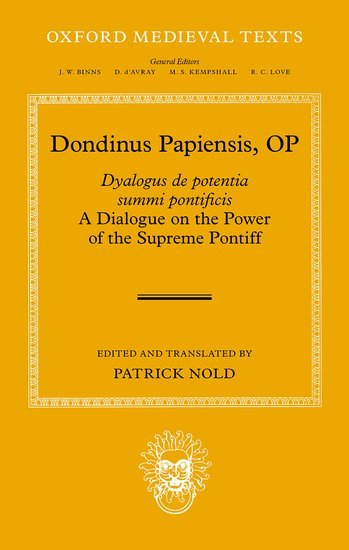
This week, I spoke with Dr. Patrick Nold about one specific author’s arguments for the supremacy of the pope. Patrick is Professor and Chair of the Department of History at The State University of New York, University at Albany, and the author of Pope John XXII and his Franciscan Cardinal: Bertrand de la Tour and the Apostolic Poverty Controversy, and Marriage Advice for a Pope: John XXII and the Power to Dissolve. His new book is a translation of A Dialogue on the Power of the Supreme Pontiff by Dondinus Papiensis. Our conversation on the case for the pope’s ultimate power on Earth, why it was so urgent in the early fourteenth century, and why an obscure Dominican friar came to the pope’s defense is coming up right after this.
Well, welcome, Patrick, to talk about the supremacy of the Pope. This is such an important topic and one that I haven't covered in depth here before, so I'm so happy to have you here. Welcome to the podcast.
Patrick Nold:
Thank-you. Lovely to be here.
Danièle Cybulskie:
So, I've invited you on because you did a translation of a whole argument that is based on why the Pope is supreme over everyone. Can you tell us a little bit about time and place? Where was this written, and when was this written?
Patrick Nold:
Well, the text was written in Avignon, so when the popes had moved to Avignon from Rome in the first quarter of the fourteenth century. So, I believe the context – the best way to situate this text – is with regard to probably the most famous papal document of the Middle Ages, and that's Boniface VIII's Unam Sanctam of 1302, in which he says that it is altogether necessary for the salvation of every human creature to be subject to the Roman pontiff. And this text is really an explanation of what that statement means. Now, I think that the statement might seem to be obvious, but it's not. And so ,you have to define your terms, and I think that this is what the text tries to do. Now, the fourteenth century – the beginning of it – is a kind of golden age for medieval political theory. So, if you look at, say, The Cambridge History of Medieval Political Thought, or Joseph Canning's Ideas of Power in the Middle Ages, a lot of time is focused on texts that were produced around the beginning of the fourteenth century, particularly with regard to this conflict between Philip the Fair, the king of France, and Boniface VIII. So, if you think of Giles of Rome on ecclesiastical power, or John of Paris on royal power, these texts are written at that time. And then for the pontificate of John XXII, which is about thirteen years after Boniface VIII, you have Dante's Monarchia, you have Marsilius of Padua's Defensor Pacis, and you have the Dialogus and other works by William of Ockham. So, it's a kind of golden age for texts on the power of the pope. Various people have positions on this, and so this text really should be seen alongside some of these other texts on the power of the pope. So, the beginning of the fourteenth century is where it's situated, and particularly in Avignon at the papal curia That would be how to situate the text.
Danièle Cybulskie:
Right. Well, a couple of years ago, I did a miniseries on Philip the Fair called The Iron King, and he's just a fascinating character. So interesting. And as you're saying, this debate about who has power was between him – mostly – and the pope, Boniface VIII, and it became, like, a huge firestorm. So, can we start there? Can you tell us about Philip the Fair and Boniface VIII and how they blew up together, because it is incredible how that happened.
Patrick Nold:
Well, the beginning of the debate really is right at the beginning of the reign, and I think the way to see it is you have two centralizing powers, if you like. Philip the Fair was attempting to reassert royal power at the time, and he had a very specific idea of how royal power was to be exercised. Likewise, Boniface VIII is doing something similar. So, they begin to clash relatively quickly. In 1296, there's a famous papal document called Clericis Laicos saying that laymen have no authority over church goods. And that's a kind of programmatic statement. The ins and outs of that… there are a lot of tracts produced and a lot of negotiations going on at the same time. One of the things that I think that it's easy to forget is that you read these rather rarefied texts on papal power, on royal power, but there's actually some diplomacy going on at the same time, of negotiation in the background. And so, one of the things that I've tried to do in my text is try to put this political text in a very precise context. So, culminating with Philip the Fair and Boniface VIII, you’ve got Clericis Laicos 1296, and then Unam Sanctam in 1302. And effectively Unam Sanctam is saying that the pope is supreme, and that temporal power is subject to spiritual power, which is higher. So, there's this idea of a hierarchy. So, the King of France said he had no superior in the Kingdom of France. Boniface VIII is essentially saying that there is a spiritual superior and that temporal goods are somehow under spiritual goods, that it's a higher good. And so, he uses this hierarchical argument of the Pseudo-Dionysius, who figures in my text as well, to say that lower things are brought to higher things through intermediaries, and the argument is that the spiritual things are ultimately higher.
Danièle Cybulskie:
Yes, well, Philip the Fair did not take this lying down, and it got heated to the point at which Boniface was about to excommunicate the King of France, but Philip got there first and sent his goons to beat up the pope, who died shortly afterwards. This is a very heated a very important argument. So, it goes way beyond just theoretical. It becomes personal, and it's something that does have a ripple effect. Like, people feel like they need to pin this down because it has real-world effects, right?
Patrick Nold:
I think so. I think that's exactly right. And one of the things that I do connect in a very roundabout way – I was going to get to this later – but this text is dedicated to Luca Fieschi, who was a cardinal created by Boniface. And you mentioned the goons going to get him at Anagni. In fact, Luca Fieschi led a citizen troop to liberate Boniface VIII at Anagni. And so, there's a really concrete connection. This isn't just a matter of, oh, this text is about a theoretical issue that peaked under Philip IV. One of the persons connected to this text was actually kind of there when Unam Sanctam was formulated, was there when the pope was arrested. I make an argument that there's a pretty concrete connection between the two, and this text, although it's dedicated to John XXII, can be seen in the light of Boniface VIII.
Danièle Cybulskie:
Well, and at the heart of this as well is the temporal concern of who can appoint bishops, for example, and where the money goes. Does it go completely to the church? Does it go to the king? And so, there are practical matters at stake, and everybody has something to say about it. So, we have this text that you worked on and translated by Dondinus, tell us about this guy. We don't know much about this guy. What do we know about this guy?
Patrick Nold:
Well, the only thing we know is what he says in the dedication letter to John XXII, the pope, and that he just says that he is a humble friar and a chaplain to Luca Fieschi. So, I spent a very long time trying to find out something about Dondinus of Pavia. So, you have thousands of papal letters, which usually, you know, mention people in some capacity. He's not mentioned. He's not mentioned anywhere. So… So we don't know anything about him at all, and that's – that was one of the challenging things about writing about this, is to provide a context when you don't really have an author. Now, I want to contrast this maybe with some of the other works of political theory I mentioned earlier. You have, really, people that are functioning at a very high intellectual level, William of Ockham, Giles of Rome. These were people who were masters, university masters of theology. They have written many other works, and so you can kind connect them to other things people have written. This person does not seem to have been a master of theology. He doesn't even seem to have been a kind of provincial lector at a mendicant studium. So, he's not functioning at a very high level. He's popularizing ideas. He's not formulating new ideas. So, one of the things about the text is that it's derivative. It's taking arguments that other people had formulated – by Giles of Rome, James of Viterbo, Ptolemy of Lucca – and rearranges them in a way that maybe is accessible – or more accessible to what I think is a wider lay audience. And I think for people who are interested in this subject, I mean, one of the things I've always found Giles of Rome very difficult to read, it's a very fat text on ecclesiastical power, it goes on forever. This is actually a pretty condensed text, short, to the point, broken up into questions, so it's highly didactic. And if somebody wants a kind of a quick formulation of arguments for papal power, you find it in this text. It's easier to access, and I think that was part of the point at the time – of having a kind of lay audience in mind, not an academic audience. And how do you popularize these ideas, make them palatable, make them understandable to people?
Danièle Cybulskie:
Well, this leads me right in the direction I wanted to go, which is – before we get into the text itself – Dondinus is a Dominican, and so… for people who are familiar with Dominicans, they're friars, they're supposed to go out and preach. So, what the heck is a Dominican doing writing about papal power? Well, how did he end up in this mix?
Patrick Nold:
Well, that's a good question because we don't – we have a couple of texts by Dominicans, right? We have… John of Paris was Dominican, but he's really writing in favor of royal power. And then we have some contemporaries, some Paris contemporaries, like John of Naples, like Hervaeus Natalis, and they are writing about papal power. Pierre de la Palu would be another one. There's texts… and they are writing because of the concerns that were about in the 1310s. All right. And so, you have a debate over mendicant pastoral privileges that are going on at the time. And this is something that started in the middle of the thirteenth century and sort of bubbled up several times afterwards. In about 1312, John of Pouilly, who's a master at the University of Paris, has a quodlibet about mendicant privileges, and particularly about sacramental privileges, right? The right to hear confessions, the right to burial, preaching. And one of the things that John of Pouilly does is he attacks it. He's a secular cleric, and he resents mendicant intrusion into the average parish priest's business of hearing confessions and preaching and so on. And one of the arguments at the time is this argument between the power of orders and the power of jurisdiction, right? And so, the power of orders is something that is common to every priest, right? Every priest has the ability to forgive sins. This is the sacramental quality of the priesthood. However, there is the power of jurisdiction that not all priests can legally absolve sins for everyone and anywhere. It's a license – or it's a faculty – that's given. So, there's this distinction here. And so, it very quickly becomes a constitutional question in the church of where does jurisdiction come from? Do all priests and bishops have equal jurisdiction, or jurisdiction as a function of their sacramental authority, their sacramental power? Or is jurisdiction something entirely different and comes primarily through the pope, that it kind of descends in a hierarchy? The pope gives the authority, say, for the mendicants to hear confessions in a particular place. So, the issues in the 1310s… one of the issues is the spiritual power of the pope having to do with, I think, mendicant privileges. The other continues to be this issue that's formulated during the time of Boniface VIII about the relation to temporal authority, secular authority. Now, Philip the Fair is dead, but there continues to be issues, not between the king of France and the pope, but between the emperor – or the emperor, the claimant – and the pope. So, you had an emperor, Henry VII, who dies in 1313. He had been crowned in Rome with papal approval. And after he dies, there's a disputed election. And the two claimants are Frederick of Habsburg and Louis of Bavaria. And John XXII, who was elected in 1316, takes the opportunity to say, because there's a disputed election, the empire is vacant. And when the empire is vacant, it falls to papal authority. So, all of the positions of power in Italy at the time – say Matthew Visconti, who is the imperial vicar in Milan, he's no longer imperial vicar according to John XXII because the vacant empire falls to the administration of the papacy. So, there is a… a debate about this issue, right? And I think this is one of the things that starts people having debates at the time, then, about what's the nature of papal power with regard to the empire, because the reign of John XXII is defined by a conflict with Ludwig of Bavaria, as it turns out. And so, if you think of them [as] similar, you have Boniface VIII – his conflict with Philip the Fair – thirteen years later, you have John XXII, another controversial pope, a conflict with Louis of Bavaria. These two conflicts spawn a lot of polemical political tracts that justify each position. I think the third wheel in all of this is – because we often think of this, you read Tierney, The Crisis of Church and State, and you often think of it… oh, it's a matter of a conflict between a king and a pope or an emperor and a pope. And in Italy, you have the issue of the Angevins of Naples. So, one of the things that John XXII does is when he says that the empire is vacant, he appoints Robert of Naples as his imperial vicar. Now the Angevins of Naples had been installed by the Pope in displacing the Hohenstaufen, right? Frederick II was the king of… of southern Italy. They are installed by the authority of the pope, but the pope must have temporal power because the Angevins would be illegitimate kings if he did not. And so, the Angevins, they are a temporal power that depend on the pope for their authority. And one of the things that I think is interesting is that a lot of the texts that are generated, certainly during the reign of John XXII, have some Angevin connection. So, one of the things that I suggest is that it's not simply a question of king and pope, it's several kings, and the Angevins are obviously keen to justify their position, and they do so by saying that there is some temporal quality to papal power, and it's been granted to them.
Danièle Cybulskie:
Very convenient. But we can see how it's high stakes, right? It's high stakes, it's worldly, so you need to solve this. And the Dominicans are actually the people who are the most educated, in general terms. They are the ones who really study theology, and they're the ones who can make this sort of argument. They're becoming increasingly depended upon to make this sort of argument. So, I need to ask the question: when you're trying to decide who has the ultimate power in the world, where do you look for those answers? So, where are people looking for the answers to these questions? Because as you say, Dondinus’ text is derivative. Where's he deriving these answers from?
Patrick Nold:
Well, one of the things about Unam Sanctam's reception is that some of the people who commented on it – the canon lawyers – said there are a lot of allegorical statements in this text. You have the reference to the two swords of Luke. You have the seamless tunic, you have the Ark of Noah, and writers at the time say, well, you can't really draw any inference from allegory. That's a comment of John of Paris and John the Monk, who commented on Unam Sanctam. So, in a way, you see that what Dondinus is doing is he's trying to find other grounds for argumentation. And so, it's a philosophical treatise in that it is looking at where power comes from, right? And of course, he sees all power coming from God. And some of the things that he uses to illustrate this point – so, it's partly historical – he goes to the Bible, of course, the Garden of Eden. Was there any authority in that? Where did political authority come from? And, you know, he goes to St. Augustine, and this is following Giles of Rome, of saying that it's a function of sin, and Cain is the first person to exercise political authority, and then the first king is Nimrod after the flood. These are not the good guys, I think, in his reckoning. So, he tells that story and he's getting a lot of it from Peter Comestor, The Scholastic History, but he's also making arguments from nature, and he says that, well, in nature you have power exercised everywhere, right? There's a hierarchy of power, and he uses some interesting examples to demonstrate this. For instance, he says, well, for instance, the stars have power over us, right, and how we act. And so, this is a notion of the heavens, right, exercise some sort of influence over humans and how they act. So, we might call that astrology or something like that. Then he talks about the food chain. He's like, well, in the food chain, there's a hierarchy, right? And he gives the examples of, you know, the pike is greater than the carp, and the falcon is greater than the duck, and the dog is greater than the hare. And so, he uses some examples to demonstrate that power is kind of diffused from God everywhere in a hierarchy, and then the ultimate idea is that it will return to God, effectively, and that's the Pseudo-Dionysian quality. So that's the argument he makes. So, it's part-historical and part-philosophical. The other thing that I wanted to say, because you mentioned the Dominicans and I have to comment on this, is that not only are they preachers, right, they're also inquisitors. And one of the things that is done at this time – so with Matthew Visconti in Milan, they say that he's illegitimate, that he doesn't have the power to rule, and an inquisitorial proceeding is started against him. And it started against him because there's claims that he had some clerics beat up, and there's some necromancy thrown in there, and all sorts of claims. And then you get a kind of procedural heresy that, obviously, he refuses to show up and testify. And then they say, well, that's a sign of contumacy, right? You're not acknowledging ecclesiastical authority. And then you move on there to, well, if you continue to be contumacious despite correction, are you a heretic? And it's interesting that the friars who are leading this procedure against Matteo Visconti are partly based in Pavia. You have some of them who are confreres. So, I think that it's not unreasonable to think that some of the things that these friars are saying are actually in the mind of Dondinus of Pavia about those people who reject the authority of the Inquisition. And of course, once you get someone declared a heretic, you can declare a crusade against them. And so, you have some spiritual ground for that. And so, I think that there's always been this aspect of, are Ghibellines – or people who are pro-imperial who are skeptical maybe of the temporal power of the pope – are they good Christians, right? Or is there some aspect of them that is heretical, right? You know, already during the time of Boniface VIII, you get people with the curia saying, I'm not sure Ghibellines can be saved. So, on the one hand, you have these two distinct areas of operation. You have people who are involved in the controversy with Philip the Fair drawing examples with Ghibellines, right? And saying, well, you know, because there's a commonality there that, you know, you have people who are versed in civil law who say that the pope has no power in temporal matters. You have Ghibellines who don't like it. You have Philip the Fair. And so, it's kind of a very broad, it's very difficult to identify exactly who Dondinus has in mind because it's a general position out there that Ghibellines are a little bit iffy.
Danièle Cybulskie:
Yes. So, for people who are like, who are Ghibellines?
Patrick Nold:
Okay. So, this goes back, you know, quite a long bit, right? So, you have this general division in Italian cities between Guelphs who are broadly anti-imperial and thus by default kind of favorable to the pope. And then you have Ghibellines who are imperialists who are partisans of the emperor. Now, these terms… I mean, my author does not use them, but they're common in historiography, and it's like a lot of concepts: they hide a multitude of ignorances. So, we use these terms, they broadly indicate some kind of political sympathies, but because then the Guelphs divide into – in Florence – they divide into the Black Guelphs and the White Guelphs, and Dante is involved in this, so everyone would say, well, Dante is a pro-imperialist, but he had been a Guelph. And it was only Boniface VIII that alienated him. So, these terms, I use them because everybody knows them. And I think that there remains partisanship in these Italian towns, that it's the Guelphs who – during the time of John XXII – who are pushing Ghibellines out of town. So, in Genoa, which is a pretty big part of this book, or the introduction, the Guelphs exile the Ghibellines so that the Guelph families are the Fieschi and the Grimaldi. And the Doria and the Spinola, they are the Ghibelline family, and they are kind of tossed out. They go to Milan and they're under the protection of Matteo Visconti. So, you have this, like, division in Italian cities, which I think is relevant to the text.
Danièle Cybulskie:
Yes. And for the people who are like, Italian politics are a mess, that's absolutely true. And you explain them very well in the introduction to your book. So, we're not going to belabour the Italian politics because they are so complicated. We're going to come back around to the arguments made for the supremacy of the pontiff. So, I want to come back to the arguments that Dondinus makes, and some of them are really – they… they strike me as funny in the way that in Monty Python they're weighing the witch – do you remember this scene? – where they're like, she weighs more than a duck and therefore… So… so these constructions are quite funny. For example, they're talking about, well, some things are first and some things are second, and if they weren't first, we wouldn't say them first. We would say them second, but if we said it first, then that means it's first. Like, we're talking about pillars, I think, in the Temple of Solomon. And so, some of these constructions are quite funny and extended, but they definitely wouldn't have been – I don't think – hilarious to the people who are trying to figure out these really thorny theological problems.
Patrick Nold:
One of the things that I think – and that example of the exposition of the two pillars in the Temple of Solomon, that one is said to represent the spiritual power, the other is the temporal, and this is based on the etymology of the names of the pillars. And as you were saying, one is described as first, and if there's a first, there must be a second. He also says one is on the right, and things that are on the right always precede those that are on the left. So, he makes these arguments, but I call some of these little expositions almost like sermons, right? I really think that they're trying to… that he's using this scripture to, I say, politically catechize a lay audience. And we can get to the two characters in the work because they're both laymen, and I think that's significant. One of the parallels that you might have to this work is one that's almost exactly contemporary called De Spiritu Guidonis (The Ghost of Guy). And it's a work in which a Dominican goes and has a conversation with a ghost, and the ghost explains to the Dominican the doctrine of purgatory. And as I said, it's probably from the 1320s, and I think it's similar. I mean, in the sense that it's dramatizing something that might be a little bit abstract for someone, but if you tell it in a story, that makes it a lot more intelligible. And so, I think that's partly what he's trying to do, is to make it more accessible, more intelligible to a wider audience.
Danièle Cybulskie:
I think this is definitely true, both in the structure in that it's a debate, but it's also a dialogue. And it seems more respectful than, you know, some of the debates that you can read in the Middle Ages. This one seems to be kind of respectful, but it is a dialogue between two people, and judged by Dondinus, who's sort of a dreamer in this thing, which is a very familiar construct for a lot of these sort of texts. And to me, that does speak to teaching in a way that maybe we'll get to in a second, but they digress and answer other questions that the pope already knows the answers to, but, you know, other people might not.
Patrick Nold:
So, it's dedicated to the pope, but it's quite clear that all these arguments were readily available in a much better form. So, he's not telling the pope anything that's new. And again, I think this relates to really just old-fashioned patronage, that you dedicate a work to someone you want something from. And I think that he would like probably a post, to be a bishop or something like that. And so, he dedicates this text to the pope in a letter that is very, very strident. So, you know, I point out that there's really a real difference in tone between the dedication letter, which casts John XXII as a… a fighter, you know, a fighter against heresy, and uses these classical tropes of ripping out the weeds or the tares and separating it from the wheat and having it burned, and that heretics are like rapacious wolves, and John XXII is like the prophets of the Old Testament, the priests and prophets who reprimanded people, who corrected them. So, it's put in this really… again, I think it's very strident. And then the text itself, which is this dialogue, between two men who are equals, and it seems, yes, respectful. There's no question that it's pro-papal. I mean, the whole thing is slanted towards the papacy. There's no question of that, but I think it's… it doesn't seem like it's a polemical text as such. So, I think that that's really important, but it contains some sharp words at various points. I highlighted in the introduction, there's this quotation from Avicenna, and Avicenna – this tenth, eleventh century Muslim philosopher, who wrote a book called The Metaphysics of the Healing – and he quotes Avicenna, and there's this sentence that nothing is more acceptable to God than the killing of he who instructs, or him who instructs, the supreme – not the supreme pontiff – the high priest, okay? Summus sacerdos. And that's a term that's sometimes used for the pope. It's not the standard word – because it's summus pontifex – but he's using it in this context. And that's the very strange thing – that Avicenna is talking about the caliph or the imam, and it's translated into Latin as high priest. And so, he uses this as a kind of a proof text, which is really curious: to have your kind of coup de grâce, a Muslim authority.
Danièle Cybulskie:
Yeah, well, that was one of the things I wanted to sort of bring forward, and I'm glad that you did, because not only is Avicenna quoted a couple of times but also Aristotle quite a lot. And so, I think that this might be sort of a surprise for people who've never come across this sort of text. Like, if you're trying to prove the supremacy of the pope, why are you leaning on pagan or Islamic sources? Like, isn't this contradictory? But it's not really for the people who are thinking at the time.
Patrick Nold:
Yes. And I think that's what – I mean, the way that he comes to these authorities are through metaphysical arguments. So, with regard to Aristotle, he's quoting things about how there must have been a first cause or a first thing is one of the arguments, or in all the elements there must be some first element that has the most intense form. Heat is used: there must be one hot thing that generates every other hot thing. So, those are the arguments. And again, the argument that he draws from Avicenna's The Healing is not from Avicenna's medical writings, which are cited as well. But it's from a text on metaphysics, and I think that's where he's getting from, and that's part of his argument.
Danièle Cybulskie:
Yes. Well, one of the things that struck me was he quotes Aristotle as saying something is perfect when it can make perfect copies of itself – and he's trying to say, like, the pope can make bishops and priests and cardinals. I told this to my daughter who didn't think it was very funny, but there is definitely Aristotle in here. So, one of the things that actually struck me as surprising and also funny, but also relative to what we're saying about this being a teaching text, was there's one sort of snippy, sarcastic-type quote in here where they're talking about lordship, right? What is natural lordship? When does this come from God and when does this come from people? And talking about Cain being in charge of a city, I think, and there's this little quip being like, well, it must have been a small city because there's Adam and Eve and their kids and that's that. And I think that, like, it's a digression, it's just a side comment, but it's a question that I think a lot of people sitting in the church, you know, on a Sunday would have. How is there a city when there's only Adam and Eve? And so, these are the type of digressions that you also find in here amongst this argument that's made for the supremacy of the pope.
Patrick Nold:
Yes, and I think that's one of the curious things that I don't know if always works, the way the dialogue is set up. So… So, we've talked before about how the author – or we assume is the author because he mentions himself in the dedication letter – but once the prologue starts, he doesn't mention himself again. He just has a first-person narrative. So, we assume that it's Dondinus of Pavia, and he says he has a dream, and two men come to him in a dream and say they had been arguing about papal power, and they've not been able to come to a solution, and they want him to be the judge or the arbitrator in this discussion. So, although we identify dialogues as something that has two people, there's actually three. There's Mensuratus, who is representing the papal position, which obviously means the measured responder. And then there is the anti-papal position, Acuens, or the sharp or provocative figure. And the judge, who we assume is Dondinus, sets the parameters of the debate and is supposed to just monitor the formal qualities of the debate so that they ask him about, like, the digressions, you know, may we digress? And… And at one point, for one of the digressions, he says, "Oh, I've often wondered about this." And then you think to yourself, okay, you're a Dominican, and you don't know the order of scripture? You know, the order of the books of scripture, or why they're placed that way? So, sometimes I don't – I think there's some element of like, the work doesn't quite come together, right? So, I think he has this idea of the dream, and again, because the work is fragmentary, the dream never ends, right? There's no resolution. And that's one of the things that I find a little bit ironic about the text, is that you have a dialogue about papal power, but it ends with Acuens, the anti-papal person, said, okay, I'm going to go make my contrary arguments now. So, in the end, he's not actually convinced after a book. He still has his reservations. And so, that's why I think the way it's set up, it doesn't really work. That's one of the things that I find interesting about the text. And like this, of… of sometimes the voice of the author – you think is the pro-papal guy, but… or, is it the judge? So, I think it's an interesting work for that reason.
Danièle Cybulskie:
Yes. Well, just for the people who are wondering why the gospel writers are in the order that they are, the answer, apparently, is that the most important senses are eyes and ears, eyes more important than ears. So, you have a first-person eyewitness testimony at the beginning of the gospels, with Matthew, and the end of the gospels, with John, and the other two are hearsay, so they're in the middle, so they're squashed in the middle. So, you have this order on purpose. And so, in case you've ever wondered, this is what Dondinus says the answer is to the order of the Gospels – which, I mean, I never learned in Sunday school, so now I know.
Patrick Nold:
Again, I can't remember in the text – I mean, I have a lot of footnotes in the text, so usually if he's getting it somewhere, I think I have identified it, and I'm not sure I did identify if he's getting that or just making it up.
Danièle Cybulskie:
Yeah, I want to say it gestures towards Isidore [of Seville], but I could be totally wrong about that. So, people can follow that up in the footnotes – and I promised Patrick I wouldn't pin him down to these things, so I'm not going to do that. But I do need to ask the question – because you've brought it up and it's something I have wondered about – as somebody who spent so much time, and this work is… I mean, congratulations on the work that you've put into this because you've traced not only the text as close as you could, the author as close as you could, but the cardinal for whom the author is working very, very closely. And so, this is a huge amount of work, and it begs the question – you've said in the book that the pope didn't think much of this, it seems, didn't really care, didn't really notice it. So, why did you feel like this needed to be translated? Because you must have felt it needed to be translated. Why was this important to bring forward into our century?
Patrick Nold:
Well, I guess what really drew me to it… it just seemed like such an eccentric text.
Danièle Cybulskie:
And you know what? That is a good enough reason.
Patrick Nold:
And again, there's an attractiveness to… if you have someone that you don't know anything about, that just is… it's a kind of interesting puzzle to try to figure out what this text is. And so, I read the dedication letter, and I've never read anything like that. The things that it says. Because usually, mostly, they're pretty boring, anodyne things. The dedicatee as a patron, but not as a fighter. And so, I went through that, and then I saw the Avicenna quote, which also struck me as very strange. And then just as I thought about it more, I said, this is a really strange text, but at the same time, I thought, it's really accessible, and it made me understand arguments and the politics of the time much better. And that's why I thought it should be published. Also, as I started doing it – and you mentioned this connection with Luke Fieschi, there's just a lot written about him. I mean, not a lot written about him secondarily, but primary sources. And I thought that this work could actually be contextualized a lot better than a lot of other works of medieval political theory. You really could provide a very thick description of a context. Now, I don't know if I have exactly – I say probably, you know, 1322, '23 maybe – but you really have a very good ground for understanding it, I think, because there's so much written about Luke Fieschi and his role at the papal curia, his involvement in the imperial coronation in 1312, the fact that his brother is running Genoa, and we have these wonderful reports of the Aragonese ambassadors to the curia in Avignon, which gives this great gossip about what's going on. The ambassador writes to the king of Aragon and says, yesterday there was a meeting of the cardinals and the pope said this, and there was really a big kickup, a kerfuffle between the cardinals and the pope about that. And Fieschi is involved in some of these things. And I said, well, this is really good because it provides a really lively context for understanding a work of political theory. And I'm not in that direction of being someone who wants to break down these big arguments. But, for me, it's like the people involved and why they're saying things at this particular time – situating the people in a very precise historical context – that made it very interesting for me to do. And again, I… as you say, I mean, this is an edition, so I would really be happy if other people used it. And I don't think I have the final word on, on, on the text. I mean, it's – again, a text and a translation is to make something available for other scholars, and other scholars can take it further.
Danièle Cybulskie:
Well, I do think that this is a wonderful trend that your book is a part of, where you do have facing-page translations, which I absolutely love, because for scholars, they can look at your translation and see where you got this from, and also trace all of your amazing footnotes, which say where Dondinus got this information from, and I think that that is so valuable to people. So, for people who are really, you know, invested in finding out why the pope is superior – if you're just a regular person, you can actually access this stuff, and you can access it if you're a scholar, as well. And I think that's super valuable, especially because it seems like the type of argument that may have gone out of fashion, right? These days we don't argue all that much about who has supreme power on earth. Is it the pope, or is it, you know, an elected official or a royal or something like that? But this is central to theology in the Middle Ages. This is a type of debate that's happening all the time. So, it's an important text, even if the pope didn't think much of it at the time.
Patrick Nold:
Well, I mean, again, I think that for him, it wouldn't have been intellectually very stimulating, because as I point out, he's got access to all the stuff that this depends on in the papal library. I mean, he had access to all the main texts, and there are manuscripts there. So, there's – he's not telling him anything he didn't know. And I don't know that the pope really was that in-the-trenches with, you know, the laity and converting the laity to the point of view. So again, no, nothing results of this. There's no promotion, there's no even letter of thank-you.
Danièle Cybulskie:
Yeah, not even a thank-you card.
Patrick Nold:
Not even a thank-you card. Who does he think he is, John the XXII?
Danièle Cybulskie:
Yeah. What is he, the pope? So, this leads me to ask, what was the fate of this manuscript? Was it just one copy found in a dusty archive? What happened to the manuscript?
Patrick Nold:
So, there are three manuscripts. Again, it's a fragmentary work, none has the full text. The biggest one that has the whole first book is in Rome. It's in the Casanatense Library, which was the Dominican library there. There's a fragmentary copy in Florence, which I think was probably copied from a Dominican compendium, because it's got several other texts in it. It's written by one author – who is, I believe, a Servite – at the end of the fourteenth century. And then in the fifteenth century, there's a compendium of these ecclesiological texts connected to the conciliar movement. So, a lot of these texts have a kind of new life in the fifteenth century when you have conciliarism – that there's, you know, this idea of, well, who's greater, pope or council? And so, even the works of William of Ockham are, I think, more copied in the fifteenth century than they were at the time, because there's a kind of revival of interest in this subject. So, there are three manuscripts. Only one contains the full text. And again, these seem to be preserved primarily in the circle of his order. There are inventories of the papal library – there are several of them starting in about 1369 and going forward – and you can't find any mention of this text there. So, it doesn't seem to have been recorded. So, it seems like he gave it to the pope, but I don't know, it got put somewhere and was never recorded.
Danièle Cybulskie:
Yeah, return to sender. But it, it didn't completely disappear, which makes me wonder if maybe it was sort of a good starter text for Dominicans who need to be up on this stuff and really be able to answer these questions. Because for Dominicans, I mean, not all of them are going to be working for the pope or a personal chaplain. A lot of them are going to be out there in the community, as they're mandated to do, and preach, and people are going to ask these questions. Maybe it was in the library as sort of a foundational text. Who knows? Who knows?
Patrick Nold:
That's right. So, I mean, I think that the… you know, the conversation moves on, and maybe it's a testament to the reign of John XXII that these debates have a lot of purchase, whereas as time goes on, the temporal power of the pope… it's not as much of a burning issue. I think that, again, there are precise debates at the beginning of the fourteenth century that lead to the formulation of these texts. I think that the wildcard is the Angevins of Naples, who are dependent on papal power, are encouraging it. A lot of the people are receiving sort of patronage from the Angevins. So… so, I think that… that those elements are crucial in why it was written at the time, but I don't know if he imagined this to be a text for the ages. I think it would probably shock the author that it was edited in the twenty-first century.
Danièle Cybulskie:
Well, things got pretty busy in the middle of the fourteenth century, and they had other things to worry about, but these debates certainly didn't rest because we know that Henry VIII had to ask this question again much later. And so, for people who are interested in arguments about who has the last say in the world, this is a good text for them to start with. So, thank you so much, Patrick, for coming on and explaining all of this to us. I hope that more people will engage with your text – Dondinus's text – to look at the arguments people made about papal authority. So, thanks so much for being here.
Patrick Nold:
Thank you.
Danièle Cybulskie:
To find out more about Patrick’s work, you can visit his faculty page at The State University of New York, University at Albany. His new book is A Dialogue on the Power of the Supreme Pontiff by Dondinus Papiensis.
In keeping with our saintly theme for March, it’s time for another Patrick to take the stage: St. Patrick. According to his Confessions, Patrick was born somewhere on the west coast of Britain in the fourth century. At around sixteen years old, he was captured and brought to Ireland as a slave, where he stayed for six years. After a harrowing adventure, he made it back home, but only a few years later, Patrick was called back to Ireland in a vision to convert the people there to Christianity. Although his work as a missionary was difficult, dangerous, and thankless, Patrick reports he baptized thousands of people. I’m sorry to say that there is no mention of snakes.
Patrick’s Confessions are a very targeted call to missionary work, but there was one line that jumped out at me as being something common to many of us. Patrick spends a fair amount of time confessing that God practically had to drag him by the heels to become a missionary – understandable, when we know his backstory. But here’s the relatable part. He says, “I was not quick to recognize the grace that was then in me; I now know that I should have done so earlier.” I think a lot of us can be slow to realize our gifts, and our blessings in life. So, if you’re lifting a glass this St. Paddy’s Day, maybe take a minute to consider Patrick’s own call to recognize the goodness already within.
I found this translation of St. Patrick’s Confessions at the Christian Classics Ethereal Library online, but it’s fairly easy to find with a quick search of Google Books.
And speaking of gifts and blessings, a big thank-you to all of you for supporting this podcast every week, by listening, letting the ads play through, sharing your favourite episodes, and becoming patrons on Patreon.com, where every week you can learn more about the topics covered in each episode in a special article written by yours truly. Without you, none of this would be possible, so you have all my love and gratitude. To find out how to become a patron, please check out patreon.com/themedievalpodcast.
For the show notes on this episode, a transcript, and a growing collection of the books featured on The Medieval Podcast, please visit medievalpodcast.com. You can find me, Danièle Cybulskie, on social media @5MinMedievalist.
Our music is by Christian Overton
Thanks for listening, and have yourself a spectacular day.