The Welles-Ros Bible with Kathryn A. Smith




The Medieval Podcast uses affiliate links
Episode 331
Much in debate in England in the fourteenth century was how – and even if – the Bible should be translated into everyday language. Enter Maud de Ros, Lady Welles, the woman responsible for the most complete surviving translation of the Bible in the Anglo-Norman language. This week, Danièle speaks with Kathryn A. Smith about the remarkable woman behind the Welles-Ros Bible, the circumstances under which it was made, and the ins and outs of translating the Bible in the Middle Ages.
-
Danièle Cybulskie:
Hi, everyone, and welcome to episode 331 of The Medieval Podcast. I’m your host, Danièle Cybulskie.
Last week, we talked about the fourteenth-century push towards translating popular romances like Tristan and Isolde into English, so that they’d be available for more people to read. Much in debate at the time was how and – even if – the Bible, itself, should be translated into everyday language. Enter Maud de Ros, Lady Welles, the woman responsible for the most complete surviving translation of the Bible in the Anglo-Norman language.
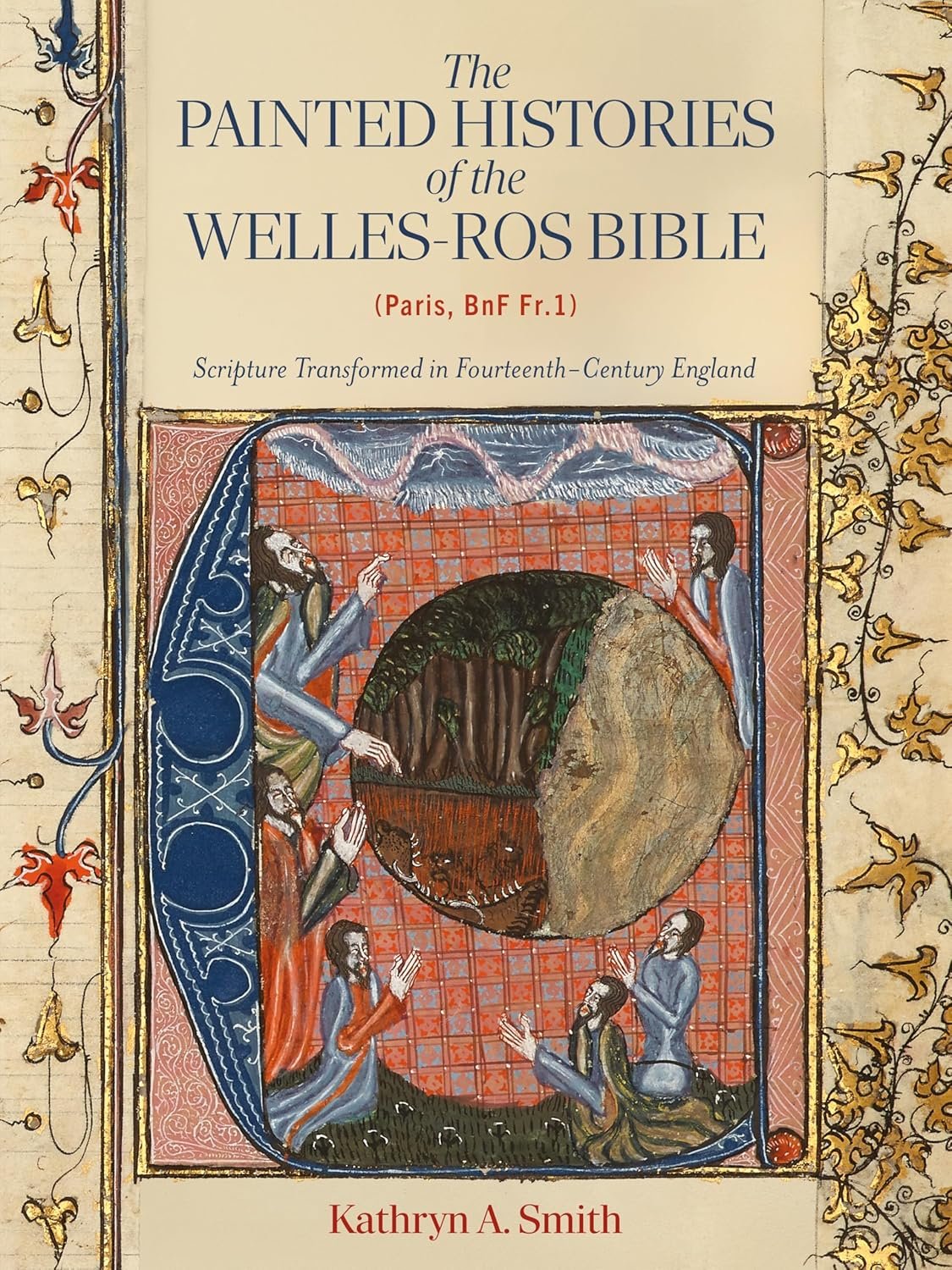
This week, I spoke with Dr. Kathryn A. Smith about the fascinating Welles-Ros Bible. Kathryn is Professor of Art History at New York University, the Series Editor of Studies in the Visual Cultures of the Middle Ages, and the author of many articles on medieval art, especially illuminated manuscripts. Her new book is The Painted Histories of the Welles-Ros Bible: Scripture Transformed in Fourteenth-Century England. Our conversation on the remarkable woman behind the Welles-Ros Bible, the circumstances under which it was made, and the ins and outs of translating the Bible in the Middle Ages is coming up right after this.
Well, welcome, Kathryn, to talk about the Welles-Ros Bible. This is actually a book that I hadn't heard of before, but it is so exciting, and it's so exciting to meet you. So, welcome.
Kathryn Smith:
Thank you so much, and it's great to meet you too. And thank you very much for having me.
Danièle Cybulskie:
It's my pleasure. Okay, so this is a really important Bible, and to understand its importance, we need to understand where and when we're talking about. So, where and when was this created?
Kathryn Smith:
Okay. Well, I mean, the where and the when have been great subjects of discussion because kind of in the earliest records about it, for a very long time, it was thought to have been said to have been made in France, actually, because it entered the French Royal Library rather early in its history. But I argue in the book that it was made in England, probably in London, and probably the commission was between about 1366 and '73, and that it probably was completed by about 1375. And these are English artists and English scribes that I – as far as I can see – and an English patron.
Danièle Cybulskie:
Right. So, it's found currently in France and you've traced it to London. How do you do something like this? For the people who've never had to trace a manuscript, how do you figure out where it might have been made?
Kathryn Smith:
Well, some of the legwork was done by scholars who went before me. The most important book, I think, of the 19th century, late 19th century, was a scholar called Samuel Berger, and he was actually a biblical and text scholar, and he was the first person to really publish the book in any depth, and he placed its text within what he called the history of the Anglo-Norman Bible. He was writing about translations of the Bible into French, whether Continental French, Medieval French, and later. And he included a chapter on the Anglo-Norman Bible; that is, translation of the Bible into French that was used in England between the Norman Conquest and the fifteenth century or so. So, he and a few scholars before him brought it to England, and he also was the one who discovered the heraldry – most of the heraldry – in it; the shields bearing family heraldry, the heraldry connected to four different families, all of whom were related by marriage. He didn't find one of them – that was found by another literary scholar, actually only a few years ago, scholar called Catherine Léglu. And she found this final shield underneath, kind of by looking at the back of a folio and seeing what we call show-through; that is, part of the paint and gilding showing through the parchment. So, these scholars are the ones who've helped situate the Bible. We've had a couple of art historians who've written about it, but in general, not very much had been written about it. So that was, for me, a big challenge, but also the fun.
Danièle Cybulskie:
Yes. So, you're looking at the illustrations and tracing the heraldry, and this is the detective work that it requires to figure out stuff like this. And yes, I think… I think this is always the question, like, how do you know where and when? And it can be something… not simple, but as basic as looking at the actual pictures and seeing what they show.
Kathryn Smith:
Yes. I mean, part of the writing the story, and of course, so much of it is, you know, hypothesis based on evidence, and a series of hypotheses based on evidence, both visual evidence, textual evidence, heraldic evidence, inscriptions, notes that maybe trace the history of a book's ownership – if you're lucky enough to find something like that. And part of the story of this book is that it was decorated with heraldry, but not on every page, only on selected pages. So, then you have to ask, well, why those pages? What's on those pages? It's the beginning of particular opening of particular books of the Bible. Of Old and New Testament, because it's a complete Bible, Christian Bible – or it was when it was originally made. It's lost its final few folios. Why are particular family shields placed on those pages in relation to particular images and particular biblical books? So, that was the first part of the interpretation, or trying to figure out what was going on. I kind of decided that there was probably a way of linking this family story from the beginning of the Welles family as barons in England, which comes at the late end of the thirteenth century, through all of the most important events in the family's life as the patron reconstructed it. Just like any history, History isn't just an arrangement of facts, and every history is the same. I mean, this is a very motivated book in terms of how it constructs this family history. And so, I see the patron and her clerical advisor as tying events in the family's history to big events in biblical history, English history, England's history in relation to the world, the Carmelite Order – I think the Carmelites had an important role in helping to achieve this project – and so part of it is linking the heraldry and the imagery, and then part of it is looking at the images and how they relate to the texts, how the text perhaps differs from other versions of the text, how the images differ or compare to other versions other depictions of those particular events, and deciding what's conventional and what's unusual and how to interpret what's unusual.
Danièle Cybulskie:
Yes, and this is why you need many years of expertise as well as the work of other scholars in order to do this. And I do want to get into the story of the patron because I think this is so important. But the first thing I want to get at before we do that is this is the second half of the fourteenth century where things are starting to be written – especially in England – things are starting to be written in English, and there's a lot of discussion about whether the Bible should be one of those things. And here we have a Bible that's written not only in French, but written in a regular language, a vernacular language at the end of the fourteenth century. This is the type of stuff that people say, you know, you could get burned for. So, tell us about this Bible and whether this is a complete anomaly or not.
Kathryn Smith:
No, it's – well, it's an anomaly in England in the sense that there are only four other manuscripts alongside this one that contain portions of the Anglo-Norman Bible – this particular Bible translation. But thinking Europe more broadly, or even thinking back in England's history, I mean, we have translations into Old English of portions of the Bible – not a whole Bible in English – and paraphrases of the Bible in English. And then in Europe more broadly, especially picking up in the thirteenth century, we have translations in France in the fourteenth century – partial translations, paraphrases – and in the thirteenth century, we have the Bible Historiale, which is basically a translation of the schoolbook known as the Historia Scholastica that's interleaved with translations from the Vulgate Bible into continental French. So, I think we have this picture of Bible translation as being utterly forbidden and suppressed throughout the Middle Ages. This is not the case. You know, [in] almost every European culture, I think you can find episodes of censorship, but they're generally local and temporary. And the one exception to that is the late fourteenth century, the first full translations of the Bible into English prose, the so-called Wycliffite Bibles, the earlier and later versions. There we do have real attempts to censor and restrict through legislation. But we have no evidence that in England, in the earlier fourteenth century, when perhaps the Anglo-Norman Bible reached its full form, that there were any attempts to censor or restrict it. And I kind of think, you know, it may be that people were just more interested in the French translations, you know, the ones that came from continental France, because we do have evidence that the Old French Bible, which is another Bible translation made in continental Europe, that it was known in England in the late thirteenth century. We have copies of – English patrons loved copies of the various versions of the Bible Historiale. So, there is really this very rich tradition of close biblical paraphrase, poetry, prose, and Bible translation, all over Europe.
Danièle Cybulskie:
Well, I think that this is important to establish, and I think that you're right in that this seems to me like worship of a French version of anything, or… if the French is a beautiful language where English is kind of grotty and we need to work towards liking it, appreciating it. Because as you're saying, there's translations in Old English, and then there's fewer in Middle English, and there's still discussion – a lot of discussion – in the fourteenth century about whether English is worthy of things. And so, I think that you're right, that this… probably having someone commissioning a Bible in French probably has something to do with sophistication, as well as being the language that maybe they're speaking at home.
Kathryn Smith:
French was actually used fairly widely in late medieval – later medieval England. Certain, like the maritime and legal professions and occupations used French, but it is very much associated with – especially early on – the aristocracy, and of course, it's still the language of the court. So, it would be a language that would've been learned in the fourteenth century by a young baron. They would have aspired to, and very likely used religious and devotional, and even husbandry books that might've been written in French. So, it's still very much… it still has cachet, it's still kind of the high-style administrative and religious vernacular in England at this time. But what's so interesting is, if I'm correct about when it was made, by the time it was finished, within a couple of years, we have the first full translation of the Bible into English. So, in a certain way, this book is practically – I don't want to say it's a dinosaur because I think it was valued, but there isn't anything else like it afterwards. So, it's this thing that exists, and we're lucky it exists.
Danièle Cybulskie:
We certainly are. And this is one of the things I personally love about the fourteenth century is this discussion about language and what it should be used for and what it can be used for. So, I wanted to make sure that these things were brought out because I think that there are some… people feel sort of like there are black and white rules about what you can do with a Bible at this point. And there is more flexibility as usual in history. As always.
Kathryn Smith:
Yes.
Danièle Cybulskie:
So, speaking of aristocracy, let's get to who may have commissioned this Bible because this person is fascinating. So, who is it that may have commissioned this?
Kathryn Smith:
Well, I believe based on the heraldic and pictorial evidence that it is a woman who at the time was a widow. Her name was Maud de Ros, or Maud de Rose, depending on how you pronounce her name. And she was a daughter – she was not an heiress, but she was the daughter, a child of two illustrious – fairly illustrious – baronial families. Ross, they were powerhouses in the north of England, in Yorkshire, but they had land all over the place. And then the Badlesmeres… her mother, Margery, was an heiress and she was one of four sisters who inherited quite a lot of land. And Maud was one of, I believe, four surviving children of that family, and she marries very young into the Welles family – John de Welles – and they are barons of a much less distinguished line. But this is something actually that was very common at this time in the fourteenth century, because you didn't want your oldest, wealthiest baronial families to accrue too much power. So, Edward III made a point of ensuring that, for instance, daughters of really old baronial families married some of the new men. So, it created loyalty for him among these new barons, and it checked the power of these other barons. And so, Maud gets married very early to John de Wells, and they have three children. And the Welles family, their origins go back to kind of northeast Lincolnshire. They acquire property in three other counties over the course of the centuries. And as I see it, based on, for instance, the stylistic evidence – that is the manuscripts that we know that were made that are closest comparisons stylistically, the arrangement of the heraldry and other imagery, interpreting some of the images – that Maud commissioned this when she was a widow. She never remarried, actually. Her husband dies in 1361, almost certainly of the second wave – during the second wave of plague. And as is customary, when the baron dies, the heir does not remain in the custody of the mother. It becomes a ward of the crown. So, her son and the heir to the Welles patrimony becomes a ward of the crown, as does the Welles patrimony. And she has a certain, you know, quantity of land as a dowry— a dower, I should say, not a dowry. But sort of five years, four or five years after her son and the Welles patrimony become wards of the crown, she gets the wardship of both of them. And that doesn't sound like a big deal. However, I will say that, you know, when I told that fact to two really important historians, the first thing that came out of their mouths was, “oh, she was a tough lady,” because It is absolutely not the case that widows could ever necessarily achieve control of their deceased husband's property or their children who were heirs. They could go into the custody of other people, and the custody of the land and custody of the child can be held by two different people. And it's very lucrative because you're getting all of the profits generated by that land. If you have custody of it. But she, in 1366 – somewhere in there – actually obtains custody of both her son and the Welles patrimony, and she holds on to them both until he reaches the age of majority, when he's twenty-one in 1373. So, I'm going to go with my historian colleagues and say she was a tough lady.
Danièle Cybulskie:
Yes.
Kathryn Smith:
And she commissioned this book.
Danièle Cybulskie:
Yes. And this was a time where there's a lot of shifting in the royal court, and so you'd have to be a tough lady to – get those elbows out to – make sure that you get what you need, because it is getting to be a time that is a bit tumultuous in Edward III's court. So, she decides she's going to commission this Bible. What for? What does she want to do this for?
Kathryn Smith:
I think she is interested in crafting, using an illuminated vernacular Bible to, of course, present the scriptural text in the vernacular for her son. And obviously, I think for a baron, you probably could not, you know, read the entire Bible in Latin, but you could very well read the Bible in Anglo-Norman French or Insular French. You certainly could do it with an advisor, a chaplain, or somebody like that. But I think what she does is she uses the illuminations… and no other manuscript of the Anglo-Norman Bible that we have – we have three that contain only the Book of Acts and one that has a portion of the Old Testament – none of them have illuminations, so I think she is using this vernacular Bible not only to give her son access to scripture, but to use the images to craft a history of the family and connect it to larger Christian salvation history, and to ensure that the history that's crafted in there kind of memorializes her role as she wants it to be remembered. She's making history with this and teaching him how to interpret the Bible, because many of the images can be interpreted in a variety of ways, you know, kind of a straight biblical exegesis, as morality, as kind of how do you deal with real-life situations that a fourteenth-century baron might have to deal with, contemporary politics if I'm right about some of the images. So, you know, part of my thinking in titling the book The Painted Histories of the Welles-Ros Bible is that there are many histories woven into this one book, and that was intended from the beginning. But one of those histories is the histories of the Welles barons set against – or enframed within – salvation history as Maud wanted it to be told, as she wanted the story to be told.
Danièle Cybulskie:
So, this begs the question, how was this put together? She didn't just go to the shop and buy a Bible. She had this commissioned in a way that, as you're saying, seems very specific, especially when it comes to the illumination. So, what are your thoughts about the circumstances under which this was created?
Kathryn Smith:
Yeah, I think there are many ways, many kind of… in terms of chronologies for the book, but the one that I favor is that she commissions it sometime between her attainment of the wardship of both her son and the patrimony and when she has to give them up, and she's creating it for him. But part of the problem here is that we're talking about commissioning a very ambitious book during the plague, and, you know, periods of – in between periods of plague, or, you know, various periods of plague. And, you know, this is a really tough subject from the point of view of trying to figure out what the actual impact, if any, of the plague was on artistic production. And it's a topic that is very much alive and continuing, has a kind of continuous tradition of debate in Italian art history, but in England, only a few scholars have really thought about it. So, it's kind of a challenge to think about, well, how might the plague have an impact on this book? And my feeling is that we do have evidence that many, many what we would call secular scribes and illuminators – that is, technically lay people, or people with some university education who are not members of religious orders – that, you know, a lot of them died. And the book trade, which was never as big in England at this time as it was in Paris, made it difficult to find artists and scribes. And I think Maud, who seems to have been very closely connected to the Carmelites in her life – and she ends up spending a certain number of her final years living at least part-time, if not full-time, at London Carmelites, the Carmelite monastery in London – I think probably she's got scribes, some of whom may have been Carmelites. The religious orders in England seem to have played a role in… they kind of acted as publishers or organizers of the creation of books. And we have, you know, sort of about five or six scribes. I never did quite figure out exactly all the scribes in the Old Testament. There are only two for the New Testament, and that I feel fairly confident about. And two illuminators who appear to have been laypeople and who included an image of themselves in the border ornament at the end of Lamentations and the beginning of the Book of Baruch that's very much keyed to the text, and that shows them kind of fighting over the bar border. Basically, my argument being they're fighting over who gets… who gets more money for this job. And I think that this is the way a lot of books were made, that you maybe had a clerical advisor or a religious order that served as a publisher and who brought together artisans, scribes, whether they're monastic scribes or lay scribes, lay artists, monastic artists, and acted as the coordinating organization, in essence, for the creation of the book. So, I think she was helped out that way, but, you know, she's nonetheless, you know, paying for this thing, which would have been extremely expensive.
Danièle Cybulskie:
Yeah. Well, we're going to get into images, I hope, in a second, and I think that having a relationship with the people who are creating it, maybe living on the grounds of Whitefriars, is going to give her the option to be able to discuss sort of in depth what's going to go in the initials, because they don't just get thrown in there. They have to be considered because they're a lot of work. And one of the things I think that you're getting at now that I really appreciated in your book is the argument that while there was a book trade in London at the time, there were professionals and then there were people who were scribing in the monastery, and that with the loss of professionals and with the loss of tenants and all of the people in England, that monastic scribes could use the work, and so having them sort of sub themselves out to do scribal work is, I think, an interesting hypothesis that you're working with and makes a lot of sense to me. So, if we go with a theory that you've presented where it could have been at least the scribal part, the text part, done by Carmelite friars, what sort of references do they have to work with? Because this is a big part of your book. They are writing a Bible, so they have to have exemplars to work with, not only for the text, but also for the illumination, even though that might be done by people outside of Whitefriars. What are they looking at to compare and create a Bible like this?
Kathryn Smith:
You mean from the textual point of view?
Danièle Cybulskie:
We can start with the textual point of view and then we can move to the illustration.
Kathryn Smith:
Well, you know, this is the big question because, you know, as I said, you would think that there is only one other substantial copy of a portion of the Anglo-Norman Bible. And the literary scholars who have worked on the text, most of… for all of them that I understand, the consensus is that Maud's revised version of the Anglo-Norman Bible was not made looking at that other manuscript copy. So, what could they have been looking at? I mean, they would have been perhaps looking at Latin study Bibles. They may have been aware of other translations out there and sort of thinking about them, but mainly whoever wrote the original Anglo-Norman Bible – and there's a lot of discussion about that. I mean, some scholars have said that they think something very much like the complete Anglo-Norman Bible, or a portion of it, dates as early as the very early thirteenth century or the late twelfth. I think the consensus these days is that [in] the early fourteenth century, we have the complete Anglo-Norman Bible, but we're missing so much that it's very unclear exactly how this text would've come together. How much of what Maud's chaplain, in consultation with Maud, was done from another version of the Anglo-Norman Bible is a big question. But yes, I think they would've been looking at study Bibles, study Bibles which would've had notes, glosses and things in them. They would have looked at other copies, other Vulgate copies, and they would have worked that way.
Danièle Cybulskie:
Well, it's such an interesting question and one of these many things about the medieval world that are probably always going to be unknowable, but to have a woman in discussion with people creating this Bible and having such input on such a foundational spiritual text is… not unheard of – I don't want to say unheard of – but it is phenomenal. It's a pretty amazing thing to have someone do this.
Kathryn Smith:
If I'm right about all of this, but it's very hard for me to see her as not deeply involved because when you think about it, I mean, just to get into the images, on the very first page of scripture in the upper right margin, there is an image of Maud, and she is making a gesture that echoes the gesture of God in the creation initial, and she's dressed just like him. And it's very hard for me to imagine an image like that not having originated in the patron saying, "Make me look like God," right? And she's a woman, right? I mean, there's something extremely audacious about an image of woman as creator in the upper right on the first page of scripture. So, you know, do you want to think of that image as having been devised by a male Carmelite? Or do you want to imagine that image as having been created on the order of a strong-willed, determined female patron? And it just seems to me that number two is the better option. But of course, when we think about spiritual advisors or chaplains, you know, on the one hand, they're male authorities. On the other hand, they're serving at the pleasure of their female patrons. The dynamic is not a simple male-female dynamic. She's the baroness, she has the advisor, and if she's not happy with her advisor, she'll go get another one, or she'll tell him to shape up. The dynamic is not as simple as just male and female. And again, I just can't imagine that image, that upper right on the very first page of scripture, showing Maud as a creator, as not having been generated by Maud herself in the sense of, "This is what I want."
Danièle Cybulskie:
Yeah. It's making me laugh because I'm thinking, like, "In the beginning was the Word, and the Word was Maud."
Kathryn Smith:
Oh, that's great. I wish I'd used that.
Danièle Cybulskie:
Because she is right up there. And as you say, you can see she's not a biblical figure per se, because she's got a contemporary hood on. Like, she looks like she's from the fourteenth century. Not the vague sort of togas that you see in other biblical illustrations, but yes, she's definitely there. So, let's talk about the illustrations then. So, your theory is that the illustrations were done by professionals, probably not people who are in the monastery – in Whitefriars. What do you think they are working with as exemplars? Because these pictures are sort of coming out of their own head, but they also are looking at reference pictures as well. So, what do they have in front of them?
Kathryn Smith:
Right. Well, I mean, a basic thing about artistic creation and production in the Middle Ages is that there's just a strong consciousness of tradition. So, I think we have to imagine artists as not people who – and I do say in the book and find some models that seem to me to be extremely close to the kinds of things that they may have been working with – but first of all, artists had amazing memory banks. I mean, I always think of them as the equivalent of London cabbies, you know, who have to study the map of London for three years. And, you know, then you ask them to go somewhere, and they can take you there, right? I think artists, even artists who, when we look at them, we think, well, they don't look terribly skilled, which is a kind of a way of thinking about artists that I try to avoid because that's kind of a conventional aesthetic judgments, which I don't really think apply very well. But they have incredible memory banks. They know how to make certain kinds of compositions. And they also have probably, you know, to some extent, they may have access to – perhaps if they're working at London Whitefriars or they're working with sketches created either by… I try to argue that Maud may have authored some sketches – probably her advisor had something to do with some of them. May have put particular models in front of them and said, "Do this, but then don't forget we're saying this," and then the artists take it from there. So, they have a model or two, but they also know how to make this image, this particular image. There's a part of that tradition that they know, and then they're creating it, they're doing it, they're working with these models. And the models could be… at a place like London, Whitefriars – it's in London. It's close to a lot of really important monasteries that have manuscripts, and some of the closest models that I've found for some of the images in the manuscript are in, for instance, glossed gospel books and Bibles from places like Canterbury, nearby in Essex, devotional manuscripts that we think were made in Essex. These are all places that are – St. Albans – close to London. So, it'd be very easy to either go and make a sketch or go look at something, or… you know, of course we've lost huge amounts of medieval material. It may well be that the connection I'm making between two images… there are many images in between those two images. There are examples of manuscripts that we just don't have, but some of them seem to be English traditions. And they've put their own spin on these English traditions, taking into account the wishes of the patron and the particularities of the family's history. So again, I see this as a very collaborative thing. I see Maud as very engaged. I see her advisor as engaged and probably the one who's most closely communicating, because, you know, it's quite likely that it would be beneath a baroness to actually directly communicate with artists. So, she's working with her advisor, but I don't see her as just kind of sitting back and saying, okay, you do this, or just letting it happen. You know, advisors know their advisees very well, and they know what they want, but everything about this book says that she had a hand in it in some real way.
Danièle Cybulskie:
Well, and this is one of the things that you pull out throughout the book, that this is a family Bible. So, when we think about family Bibles, these days we're thinking about writing everyone's name at the front, but this is sort of throughout – throughout the whole thing. So, what kind of stories do you see – in the illuminations especially – that spell this out as a family Bible?
Kathryn Smith:
Yeah, well, the images that are marked in some way by family heraldry tend to relate to things like inheritance – younger brothers succeeding older brothers. I mean, there's a lot of that in the Bible. That happens all the time. So, that's in itself, you know – that type of story is not uncommon. On the other hand, if you mark it and you represent it a certain way, the Wellses… at a certain point we get – very importantly – younger brothers succeeding older brothers who either didn't have children or who never married or whatever. So that's one kind of thing. Marriages. One particular image is related to the Prophet Elijah, and Elijah was very important to the Carmelites. Images that relate actually to land, not surprisingly, women and land, and then images also that seem to relate to a kind of a longing for the restoration of patrimony and inheritance. So, it's generally those types of images, with a few exceptions, that are marked by the family heraldry, and marriages as well. And it kind of brings in not merely Maud and her husband and the young John, 5th Baron Welles, but also the marriages of her parents, both of their parents – Welles, Ros, Badlesmere, and Bardolf. All of those families are in there in various combinations and permutations, and that includes, you know, female members of the family who I think are all represented by impaled arms, because women basically represented themselves through their marital arms, which pair the arms of their husbands' families and their fathers' families. So those are there, but then also there are images that I think are sort of more didactic at both an ethical level, at a moral level, at a spiritual level – images that offer interpretations of scripture according to, you know, authorities that were considered great authorities, whether Augustine or Bede, teaching you how to interpret scripture typologically, anagogically, morally, you know, so the various senses of scripture and images that seem to relate to me to the Hundred Years' War, which of course – eventually John de Welles serves the English during the Hundred Years' War with France, for many tours of duty – images that seem to relate to Carmelite history in some way, images that seem to be chosen because they relate to ideas about what it is a baron is supposed to do in the world. You know, you act as basically a judge in local… and politics, you raise armies, you witness charters and deeds and other kinds of things. You're basically the king's representative, in essence, administrative representative in the county; that is, the county you're most closely associated with. You know, you act as a – I don't want to say justice of the peace, that's not quite what I'm looking for, but – you know, you're involved in justice and administration as an authority within that county, a personage of importance. And images that seem to me to be about sexuality – sexuality, kind of from the early part of life to the later part of life, sort of the life cycle of a baron, politics in England. So, all of the images, at least as I read them – some of them I think could be read multiple ways, and that would be perfectly legitimate for any Bible, really – but I really do think that these images can be kind of classed into images that teach you life lessons, and images that teach you how to, in essence, experience visions and transcendent spirituality, sort of guide your spirituality in a certain way. So, I think the images are doing all of that and more, really, as they're designed, but in a highly personalized way.
Danièle Cybulskie:
Well, it's so interesting because you have a whole range of the ways that you can create a Bible – I mean, nowadays, of course, but also in the Middle Ages. Which ones are meant to be shown to other people and which ones are meant for private devotion? And this one, yes, a lot of money has gone into it and it's huge, as you mentioned, so it's not something they're going to hide away. But it also is a very personalized story that's meant to be looked at and read by the people that it's for.
Kathryn Smith:
Yeah.
Danièle Cybulskie:
So this is… this is something that makes it such an interesting piece of history.
Kathryn Smith:
Absolutely. And I – actually, in the book – I talk about, you know, sort of the senses of scripture that people understood as operating. You know, the literal historical sense of scripture – that is, as Christians interpreted the Bible – the literal historical sense, the typological sense – that is, you know, sort of what the realities and figures and personages of the Hebrew scriptures, or what Christians call the Old Testament, were fulfilled in the New – the moral – that is, you know, sort of how you interpret scripture as a kind of guide to moral life – and then relating to the future life. And I add on to that the personal sense of scripture, because I think what's happening in this Bible is just so highly personalized that I think what I'm seeing in many cases just can't be grouped under those four senses of scripture. And each of those four, for instance, typology, I mean, you can – Christians often interpreted things typologically in multiple ways, right? There were multiple typologies. So, it's not that there are only five senses of scripture. There are multiple ways of thinking morally about scripture. There are multiple ways of thinking anagogically about scripture. And I think there were probably multiple ways of thinking personally about some of these images. And one of them is, I think, the illustration for Obadiah, where I interpret the image two different ways. One as relating to Carmelite preaching for the Crusade and the other as related to the Hundred Years' War. And I think that on any given day, a Welles viewer could have seen either or both of those readings and others that I maybe don't know about in that image.
Danièle Cybulskie:
That's so true – that there are all sorts of layers that we are missing and we will never be able to touch.
Kathryn Smith:
Oh, it's, it's, it's… You know, it kills you. You know, you really want to find it all. But of course, the hunt is so much fun.
Danièle Cybulskie:
That’s exactly it. It's what keeps us coming back. It's exciting. But at the same time, you know, you will never know. It's always going to be out of reach. It's like the medievalist equivalent of Hades, right? It's always out of reach.
Kathryn Smith:
Absolutely. I mean, here I've written this three-hundred-and-something-page book, and you can't write a book like this under the impression that you're going to unlock lock the door and see everything. You just, you don't know. And you just are putting forward your best guess based on your reading of the evidence and you're creating a something like, this is how I see the dominoes falling. Right? And that's the best you can do.
Danièle Cybulskie:
Yes. Well, I think that all you can do, as you're saying, is make a best guess, but laying out the evidence is the best way to do that, which you've done so well in this book.
Kathryn Smith:
Thank you.
Danièle Cybulskie:
And before I let you go, I do want to come back around to a comment that you've made, because you've dedicated your career to art history, and you've made a passing comment about conventional judgments on medieval art. So, this is your moment to tell us, when we're looking at medieval art and it doesn't look like a sculpture done by Michelangelo, right, what should we be thinking about it? Should we be thinking like, this is just a dude with some crayons? What should we be thinking about when we look at art from the Middle Ages that is maybe line drawings, maybe simple drawings? What do you want us to be thinking about?
Kathryn Smith:
Well, I mean, my feeling about medieval art in general – because medieval art is endlessly varied – but medieval artists and medieval patrons always made choices. Sometimes working more abstractly was the appropriate choice. I mean, there is always the very practical end of things. It's like, well, who was available at this this time, and, you know, how did they work? But I think medieval artists were very flexible. They can move between more naturalistic and more abstract and more stylized modes. It tends to depend frequently on what exactly they're depicting and what's asked of them. And in many cases, I think with medieval art, less is more. I mean, you know, who needs three dimensions if you can say it in two? And the choices are meaningful. And again, these two artists – as I point out in the book – I mean, nobody wrote about the artists because I think early scholars would just say their work was bad, you know, that they were just not skilled. And I think you absolutely have to get away from thinking that way. Sometimes something very simple and abstract is the best way to accommodate multiple meanings, and sometimes something highly naturalistic is the best way to make a particular point about something. And so, medieval artists were perfectly capable of making choices based on what their patrons asked of them, based on the models that they might have known about, based on the requirements of the commission. And so, when you look at something, reserve judgment as to whether or not this satisfies your particular aesthetic tastes. I personally find, you know, medieval art enthralling, and I'm happy to have worked as long as I have on it, and especially English medieval art. I just think it's absolutely terrific.
Danièle Cybulskie:
Well, hopefully you've inspired more people to look at this stuff, to think deeply about the choices that were made, because the choices are made by people on a day-to-day, moment-to-moment basis back in the day creating this art. So, hopefully you've inspired more people to look more closely at medieval art.
Kathryn Smith:
There – yeah, there are a lot of great people looking medieval art out there, and it's a great field from that perspective. I mean, just really creative thinkers, maybe partly because of the nature of medieval art itself, you know, inspires real creativity of thought, so…
Danièle Cybulskie:
I love that. Well, thank you so much for sharing your enthusiasm with us and telling us all about the Welles-Ros Bible.
Kathryn Smith:
Thank you so much, Danièle. It was really a pleasure.
Danièle Cybulskie:
To find out more about Kathryn’s work, you can visit her faculty page at New York University. Her new book is The Painted Histories of the Welles-Ros Bible: Scripture Transformed in Fourteenth-Century England
March is perhaps the month most famous for a saint, so it seems fitting to end the episodes this month with some saintly wisdom. First up is a man who just has to be featured in an episode on the translation of the Bible, and that is St. Jerome. Jerome lived in the fourth and fifth centuries, and is one of the most famous of the Church Fathers, writing commentaries on just about everything. But what he’s most famous for is his translation of the Bible into Latin in an edition known as the Vulgate, which became the translation used by the Latin church in the Middle Ages. As Kathryn said, the Welles-Ros translators from today’s episode would have been working closely with Jerome’s words, as well as their other exemplars.
Jerome had plenty to say on Biblical topics, but he also delivered a beloved and very useful quote for all of us to live by, which is, “begin to be now what you will be hereafter”. That is, whatever you want your future self to be, start today.
You can find this quote from St. Jerome in the Loeb Classical Library edition of his Letters. Jerome’s feast day is September 30, and according to Encyclopedia Britannica, he is “the patron saint of Biblical scholars, librarians, students, translators, and archaeologists.”
And speaking of patrons, thank-you to all of you for supporting this podcast every week, by listening, sharing your favourite episodes, and becoming patrons on Patreon.com, where every week you can learn more about the topics covered in each episode in a special article written by yours truly. Without you, none of this would be possible, so you have all my love and appreciation. To find out how to become a patron, please check out patreon.com/themedievalpodcast.
For the show notes on this episode, a transcript, and a growing collection of the books featured on The Medieval Podcast, please visit medievalpodcast.com. You can find me, Danièle Cybulskie, on social media @5MinMedievalist.
Our music is by Christian Overton
Thanks for listening, and have yourself an awesome day.