



The Medieval Podcast uses affiliate links
Episode 330
As we wrap up the month, we have time to squeeze in one last love story. A tale packed full of potions, princesses, and even puppies, this one is right up there with Lancelot and Guinevere. It’s the story of Tristan and Isolde. This week, Danièle speaks with Thomas H. Crofts about the Middle English Sir Tristrem, how its author adapted the poem for a new audience, and the wild and wonderful story of one of medieval Europe’s favourite knights.
-
Danièle Cybulskie:
Hi, everyone, and welcome to episode 330 of The Medieval Podcast. I’m your host, Danièle Cybulskie.
As we wrap up the month, we have time to squeeze in one last love story. It’s a tale packed full of potions, princesses, and even puppies. As far as medieval romances go, this one is right up there with Lancelot and Guinevere: it’s the story of Tristan and Isolde.
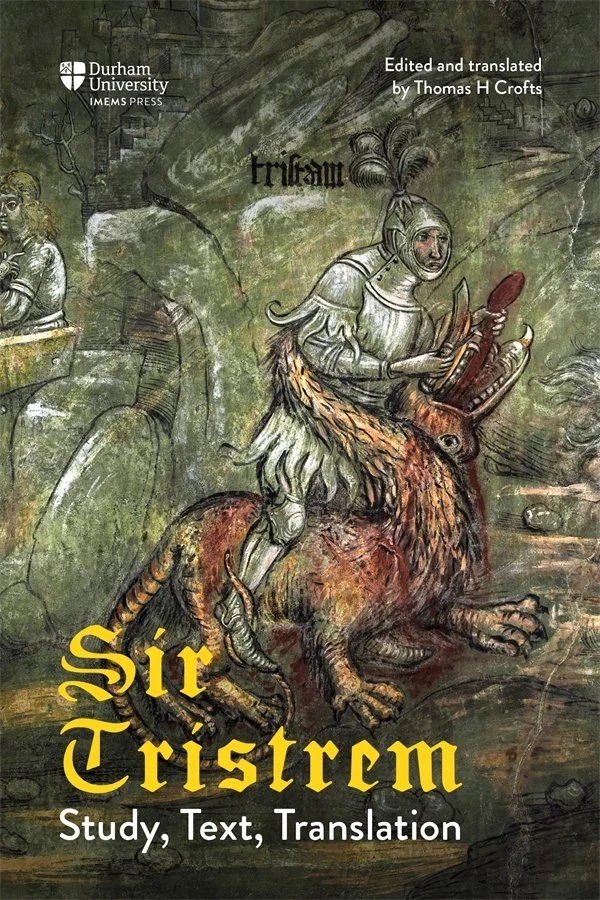
This week, I spoke with Dr. Thomas H. Crofts about the Middle English Sir Tristrem. Thomas is Professor of English at East Tennessee State University, and the author of Malory’s Contemporary Audience, along with articles on medieval poetry, as well as poetry of his own. His new book is Sir Tristrem: Study, Text, Translation. Our conversation on the special manuscript Sir Tristrem is found in, how its author adapted the poem for a new audience, and the wild and wonderful story of one of medieval Europe’s favourite knights is coming up right after this.
Well, welcome Thomas to talk about Sir Tristrem. This is exciting because we haven't done Arthurian literature here for a while, so welcome. It's great to have you here.
Thomas Crofts:
Thank you for having me. This is really an honour.
Danièle Cybulskie:
Thank you. That's nice of you to say. So, we're talking about an Arthurian romance and a particular one from a manuscript that is world famous that comes from the fourteenth century. But this isn't the first time that Tristrem's ever been heard of, right?
Thomas Crofts:
No, it's the earliest that he's been heard of in Middle English that we know of. But he's been a character in Anglo-Norman literature from before the twelfth century, but the major texts that we know him from in Anglo-French are those of Thomas of Britain and Béroul. In those texts, he is rightly the most famous.
Danièle Cybulskie:
Yeah, and those ones are actually really huge, which is something that becomes important when we come to your translation. It's like, we're talking, what? Something like almost 20,000 lines, right? A long story.
Thomas Crofts:
Yes, yes, like 18,000 lines. Thomas's text is fragmentary. Thomas's Tristan is the one that the Middle English poet translated. It's fragmentary, but from knowing the outlines of the story, you can triangulate the whole length of the poem, and it would have been 18,000 to 20,000 lines. It's huge.
Danièle Cybulskie:
Yeah, so this is a big story. It's a big tradition. So, when it comes to the Middle English translation that you're working with, this is something that people are already familiar with. This is a knight that they may have already cheered for in their literature, right?
Thomas Crofts:
Yes. Yeah, yeah, they know about him. And it's fascinating because there must have been other intermediary translations or versions in Middle English that are just lost. But he was a well-known character.
Danièle Cybulskie:
Right. And the one that we're talking about is a version called Sir Tristrem, and it's found in a manuscript called the Auchinleck Manuscript. And it's a manuscript that I actually am kind of familiar with because I did a whole course on it, if you can believe that, at the University of Toronto.
Thomas Crofts:
You may know more about it than me.
Danièle Cybulskie:
It was some time ago that I did it. It was for my graduate degree with – Alexandra Gillespie was the person who was teaching that class. So, this is a special manuscript. Tell us about the Auchinleck Manuscript.
Thomas Crofts:
Well, it dates from the 1330s, so it's the early-ish part of the fourteenth century. And it's probably the earliest, certainly the largest Middle English anthology. It's a little anachronistic to call it an anthology. The principle of compilation is not the same as what we would expect with the word anthology, but it's got an enormous number – an enormous range of Middle English texts, and most of them – and the reason it's famous largely is because of the number of romances that it contains. It contains the biggest number of romances, I think, of any single Middle English manuscript, and the earliest versions of a lot of them. So, it's very valuable that way, but it also – those translations are intermixed with texts of all kinds, histories, hagiographies, prayers, and many, many really delightful short texts scattered throughout.
One of the things that characterizes the Auchinleck most importantly for my purposes for this project was that it's… almost all the texts are translations. So, it belongs to a period in which translating into Middle English, mostly from French but also from Latin sources, becomes a real goal. To get texts that are literary monuments and cultural monuments from French and Latin into Middle English. And we're kind of used to things in Middle English having French sources, but this is really the earliest, biggest sort of push for this kind of thing to happen and for all these texts to be collected. So, it's almost like an anthology of – it's an early anthology of Middle English, and it's valuable that way, but it's also an early anthology of translation.
Danièle Cybulskie:
Yeah, and one of the exciting things about the fourteenth century in England is this sort of push towards translating things into Middle English so people can read them in their own languages, which is special. And one of the reasons that this is my favorite century is because there's this big push towards the vernacular. And like I said, the Auchinleck Manuscript was one that I studied because it was digitized at an early time when things were not getting digitized all that much. Can you tell us, having worked with it more recently than I have, what we know about who this might have been for? Do we have any new ideas about that?
Thomas Crofts:
Well, there's been no breakthroughs that I'm aware of that trace it faithfully to an individual household, but it's very likely, given the milieu in London and the group of individuals and skills and materials that allowed it to be copied in London, point to someone who is in the merchant class, but very wealthy in the merchant class. And it's not what you would call a deluxe manuscript that's got a great deal of illumination that would have run into the high expense with lots of gold and fancy full-page illustrations would have been. But I think it's very beautiful. But visually, it is, in terms of medieval manuscripts, relatively humble. It does have a series of miniature illustrations that accompanied each text, and in themselves they're quite small, but they're very beautifully executed. Most of them, as you also know, have been clipped out of the book by vandals over the years, so only a few of them remain. And they were really, you know, I would say worth the stealing. They were very well executed. But the expense, the materials, the size, and the kinds of texts that it contains point to not a royal or aristocratic library, but a merchant class library, but one that was a well-read library. I mean, a well-used, well-loved library.
Danièle Cybulskie:
Yes, well, this is important because, as we're saying, this is a story that is familiar to people already. So, that also implies that the person who's buying this manuscript, commissioning it, or otherwise getting hold of the copies that are in it, they're probably already familiar with the story, which means that they have some education of some kind, even if it's just storytelling. And I say “just”, but I do find romances are such an important part of medieval culture.
Thomas Crofts:
Absolutely. And, you know, I think you and I are probably romance – you know, we're in it for the romances. That's what – that's the fun part. But it's also very interesting that these romances are – they accompany a lot of different kinds of texts. And one of the things that I discovered in looking through it… and I got to sit with the manuscripts – not long enough to do, you know, forward and backward codicological comparisons. I did that with the digital facsimile – but how there are really correspondences between these texts across genres. You know, names recur, situations recur, and the compiler really had a keen sense of thematic pairing and even sequences of texts which might not be generically related. So, the story of King David, for example, comes right before the Tristrem and the Orfeo texts. And so, you have three harpers in a row, and then you can compare other things they do. David kills giants, Tristrem kills some giants. There's an adultery theme that sparks there. And so, the more you sit with it, the more you see that whatever the principle of compilation was – and I don't pretend to know exactly what it was – but whatever it was, it was very knowing, and it was meant to be a text that signaled back and forth between the different texts. I mean, a book that signaled back and forth between the contents. So that you had an idea that you were in the presence of a very carefully considered set of texts.
Danièle Cybulskie:
Right, exactly. It is a very special manuscript and one that it's a pleasure to revisit for this episode. Okay, so for people who are not familiar with the story of Tristrem – and it is told in different ways, you know, before this time, after this time – tell us about what happens in the story of Sir Tristrem. At least, this version of it.
Thomas Crofts:
Okay, well, the basic outline – there are a number of different versions of the story, but the basic plot which corresponds across the board is that Tristan is a young Cornish knight who, for one reason or another, is sent across the Irish Sea to collect this young Irish bride for his uncle Mark to marry. And on the way back from Ireland, he and Isolde, on shipboard, drink by accident – they get into this potion which her mother had sent with her to give to Mark so that they would fall in love. They were supposed to drink it on their wedding night. I'm sorry, I'm telling it kind of back and forth, but… So, their potion is there on the ship, but it's supposed to be drunk on the wedding night. While they're playing chess, they get thirsty, and Isolde calls for some wine, and her servant, Brengwain, accidentally brings out the love potion. And so, they drink it together on the shipboard, and thereafter, they are tragically and fatally and inescapably bound by love. And following this, either – depending on whom you're reading – if it's Béroul, hijinks ensue because it's sort of a trickster narrative of ways that they can schedule their trysts without Mark knowing it, or preferably, like, in the next room, so it's more impressive that they've tricked him. In the case of Thomas's version, which is the one that our poet has translated, it does have a certain amount of that, but it also has a sort of tragic conclusion in which they're both sort of isolated from society, even if within that society, as Isolde is pretty much a prisoner in Mark's castle. And they're only reunited at the moment of death, which, if you know Wagner's opera, that was the moment for him, the moment when he dies and she finds him just after death, kisses him, and then gives up the ghost, and their bodies are reunited in death. So, Thomas's version gives you all of that tragedy, and it's gorgeous. And thankfully, even though much of Thomas's text is missing, we do have that last scene. Sadly, in Sir Tristrem, we don't. The final page of our manuscript within the Auchinleck is torn out. So, you're reading along and you miss the last page of Sir Tristrem. But that's the conclusion it was bending toward. It's hard to know what our poet would have done with it, because the thing about the Tristrem poet is that he works with this tragic version of the tale, but he himself is by nature a comic poet – sorry, there's a truck outside – but he likes the sort of ingenuity that Tristan and Isolde have to exhibit to continue their affair, and he likes their cleverness, their ability to lie well. And of course, the stupidity of King Mark is an abiding joke in the entire tradition. But he also is bound to tell the story that ends in everybody dying. And so, it really pains me not to get to read how our poet would have cast that, how he would have tied it all together as a tragedy at the end.
Danièle Cybulskie:
Yeah, it really walks that medieval line between the courtly love tradition where adulterous love is okay if it's true love and nobody finds out about it, and that's all right. But even in the end, they can't get away with it because adultery is not okay. And we do see this in other courtly love romances like that of Lancelot, right? They never actually can make it in the end, but it does go on for a good long time in this one. It's pretty racy. There's a lot of times where they can get together in this version of the poem.
Thomas Crofts:
Yes, it happens in the original as well. Thomas's version is not devoid of the carnal aspect of it. Medieval writers, as we know, are much less prudish than we are when it comes to things like this. But one of the things about the Middle English poet, the poet of Sir Tristrem, is that he really was able to weave a great deal of comedy into even those scenes, and I think that it had a lot to do with the way the text was transmitted, which is performed. One of the things that I discovered about the poem that made me love it even more is that it really does seem to not just lend itself, but be designed for an oral and bodily performance. I think that if you read it without that in mind, it'll seem kind of choppy. It is very elliptical, it seems to race along really fast, and that's why a lot of critics dismissed it, thought of it as kind of a failed effort or a shabby version of something that used to be really, really great. But I think those moments in the poem that seem choppy or seem to race ahead, if we look at those as texts or as scripts for a performance instead of something to just be read straight through and assume that between stanzas, in between lines, there might have been pauses and certainly gestures, then it really comes to life. And I think that it acquits itself very well.
Danièle Cybulskie:
Well, just to give people some context, we talked about the original that this anonymous poet is working with being something like 18,000 lines long. And I think you counted the number of lines here as something like not quite 4,000 lines, so this is, like, a huge cut.
Thomas Crofts:
Yeah, it's massively cut down. I mean, there's a whole branch of medieval writing, and you know, there's a Latin name for every kind of writing, but there's what's called abbreviatio, where you skillfully abbreviate a text, you cut it down to a… for whatever reason, so that it'll fit into a sermon, or because it needs to be short enough to be read aloud, and this poet has done that, and it's an amazing job of it, because despite cutting it down so very, very much, he's maintained – he's kept every major episode. You don't miss out on anything. You get all your Tristan and Isolde, but just all kind of feverishly put together in a short space, which again, I think, speaks to its utility as a text to be performed.
Danièle Cybulskie:
Yeah.
Thomas Crofts:
And heard and seen.
Danièle Cybulskie:
Well, I think this is something that people are snobbish about, but it really does work for a certain kind of audience. It's like… it's making me think of something like taking the whole poem of The Odyssey and turning it into the movies that are coming out right now. You can't fit everything into it, and yet people do want a really fast clip of action, and they want an adventure story that hits all those marks, but… but can't possibly complete the entire poem. And that is what some audiences want. And so, what's wrong with giving people what they want, right?
Thomas Crofts:
Exactly. And this is – like we were saying – this is really kind of the beginning of Middle English literary culture. This is a hundred years before Chaucer, and that doesn't even seem like that much, but this is before you had poets with a personality like a Chaucer or a Gower that were professional poets. People in this era… there was plenty of Middle English literature, not all of it was written down, and it was not an industry… it was not necessarily a thing. And so, in fact, Sir Tristrem is probably one of the first French romances ever to be translated into Middle English. So, it didn't necessarily know what it was supposed to be yet. And one of the things that really fascinates me about this period, and this text in particular, is that there wasn't really a pattern for how these texts were to be translated, or to be performed, or to be anthologized. So, it was all kind of experimental, and it must have been a delight to hear someone recite this famous matter in Middle English, and to do so, as our poet and/or his reciters must have done, with a lot of comedy, a lot of direct contact, miming, I'm sure – some of it very vulgar, necessarily. And the achievement of this translation is just like what you said, that direct communication with the English-speaking audience who was getting its sort of first wave of romance in its own language.
Danièle Cybulskie:
Yes. And – sorry, just we can really hear the truck, so it's best to acknowledge it. We're just acknowledging there is a truck in the background. Can't do anything. It's – for the listeners – it's not you.
Thomas Crofts:
It was either trucks on campus or my dogs at home, so I probably chose wrong.
Danièle Cybulskie:
Well, here we are. So, let's talk about Tristrem as a knight, because he's somebody that I remember encountering – I probably encountered first in Malory. Malory really likes Tristrem – and I'm thinking about Tristrem in terms of Lancelot. Those two are always sort of put together, and it's like Tristrem is Lancelot but turned up to eleven, because Tristrem has all sorts of courtly abilities that people really would have found just like a Superman of a knight at this time. So, tell us a little bit about Tristrem as a guy, as a knight.
Thomas Crofts:
Yeah. So, Tristrem is – one of the things that's, again, across the board in every version – he's an orphan. So, he's born in obscurity, but also with some vengeance to carry out. So, that's the classic pattern for a lot of heroes. He is trained by his foster father in music, and the poets, especially Thomas – well, that section of Thomas's poem is missing, but other poets who translated Thomas before his texts got all fragmented tell us that he was educated in all of the kinds of music and all the kinds of dancing. So, he was a music and dance master. He was trained in hunting. He knew all the arts of hunting going back to the ancient Romans. And chess, he was an absolute master of chess. And these are the things that make you into an interesting man back in the day. And lest we forget combat, he knows all about all of the attributes of all the things expected of… of a young aristocrat. And so, when he meets Isolde, he's just this exciting ball of talent and impressive achievement and becomes her music teacher on first meeting her. So yeah, he's got skills, mad skills. And those skills extend seemingly naturally to just talking circles around people and being able to negotiate intrigue and sabotage. And he can see steps ahead of everybody else. And so, he's kind of a hero that way, too. He's really good at knowing when he's being stalked, knowing when he needs to dissemble. And so, he's got those skills, too, which of course are the skills that any medieval lover should also have.
Danièle Cybulskie:
Yes. Well, the chess thing really stands out to me, not only because I don't remember Lancelot learning chess – he was only good at one thing, and that was fighting – but chess actually is what gets Tristrem in trouble in the first place and gets him sort of on the path to his fate. He's just a chess prodigy, which I think maybe people are not expecting from a romance hero in the Middle Ages, but this is how it goes.
Thomas Crofts:
Yeah, I mean, chess was considered an aristocratic pastime, and so by the twelfth century when Thomas was writing – that's, again, our poet's source – it was highly developed, and it was brought over from Arabic culture. And you do find it once in a while. There's a wonderful scene in Chrétien [de Troyes] where Gawain is playing chess with a young lady and they're surprised and they begin throwing the chess pieces at their would-be assassins. It's terrific. And they were big marble hunks of chess piece, too, so that would've been painful. But what's kind of surprising about Tristrem's chess – yeah, he goes aboard a Norwegian merchant ship because he's looking at all their hawks and all their fine fabrics. It's shopping day. And he says, "Who wants to play chess with me?" And they play for money. It's gambling thing. And I looked it up and apparently it would've been unusual to play chess without a stake. People played chess for money regularly back in the day. So, when he said, "Who wants to play chess?" people immediately think of a sort of gambling scenario. One editor, Alan Lupack, calls him a chess hustler, which is not inaccurate because he fools all these Norwegian merchants and he wins all this money, an absurd amount of cash, all these hawks… And they catch on that they're being suckered, and so they kidnap him. And like you said, that's his first journey toward manhood. He's kidnapped by these merchants and then not thrown overboard, but taken off the ship because they blame him for the storm that they've sailed into, and they need to get this bad-luck captive of theirs off the boat. They dump him onto England, and that's how he completes this journey back to his family. King Mark is king of England in this poem.
Danièle Cybulskie:
Yeah, and then the other thing that is really interesting at the beginning of this manuscript – or at the beginning of this version of the poem – is that the attention of King Mark is drawn to him because he's great at dressing a kill. There's a really long passage about how these people, these English people, were no good at dressing their kills from their hunt, and Tristrem's like, I'll show you how to do it. And he's still a very young man, but this is what really gets the attention of the king, which is… I don't know, again, like a sideline, a side plot that you might not expect in the type of movie that you'd watch these days, you know?
Thomas Crofts:
Exactly. Like, we wouldn't have Tristan… like, a thirty-minute scene of dressing a deer. But this audience, that audience of our poet, would have been on the edge of their seats because this is… ways that you show your skill – not only show your skill, but in a sort of contest. He's on his way to meet King Mark, and he sees these… the royal huntsmen, dressing a deer in the forest, and he says, "What are you guys doing? You're just butchering it. What are you doing to this poor deer?" And they say, "Well, this is how we've always done it. If you want to try the way you do it, there's an undressed deer over there. Have at it." And he says, "All right," and he starts doing it, and everyone is staring, and he's just, you know… it would be the montage of somebody just doing something really kick-ass and everyone being impressed. And from then on, everybody dresses their deer the same way he does. And when they get back to town, yes, everyone runs out of the barbershop and runs out of the restaurant to see this deer that's never been – they've never seen a deer dressed this way. And then this continues when he gets to court. The first thing that happens when he gets to Mark's court, the court poet gets up to sing a song and Tristan says, "What are you doing? That's not a very good song. You're not playing that right." And so, there's another competition, which of course he wins – puts Mark's poet out of a job and becomes Mark's… this is before he knows that he's related to Mark, but he becomes a fixture in Mark's court because of his skill as a huntsman and as a harpist.
Danièle Cybulskie:
Yeah, he's just great at everything.
Thomas Crofts:Yeah.
Danièle Cybulskie:
Yeah. Well, one of the things I think is pretty cool about this story – and I don't know Tristrem as well as I know other knights, but he ends up killing the King of Ireland – I think it's Ireland in general – by hitting him in the head with his sword, and a bit of the sword breaks off. And actually, this is how he is discovered, because he ends up in Ireland in disguise, and this is how Isolde figures out who he is, which is sort of like this little forensic detail, which is quite interesting. And they don't forget about that in this version of it.Thomas Crofts:
No, it's nice. They like it. You know, when I told the outline before, I omitted that his first trip to Ireland, which is… King Mark is subject to depredations by the Irish who are just ravaging the coast. And he has to pay tribute to them. And one of Tristrem's first acts of heroism is to say, "Don't pay the tribute. I'll fight the giant that's come to collect the treasure and the children to take back to Ireland." And so, he's fighting this guy, Moraunt, and they get each other. They go off to an island to fight on this island in the Viking way, and Tristrem stabs him in the head or cleaves his skull such that the tip of his sword is stuck in his brain. But at the same time, Moraunt sticks his poisonous sword in Tristrem's thigh, and so they're both dying. Moraunt is dead first. They take him back to Ireland and we don't see him again. But Tristrem is so stricken from the poison of that sword, he's about to die, and he says to his uncle, "Put me in a boat. My wound is so smelly nobody can stand to be near me. Just give me my harp and put me in a boat and float me out." And so where does the boat take him? Ireland. But with his harping – he changes his name to Tramtrist, and with his harp, he charms the king and queen of Ireland and their daughter Isolde and teaches her music. And then he goes back to England – in Tristrem, Sir Tristrem, it's England instead of Cornwall – and tells King Mark how beautiful this daughter of the king and queen of Ireland is. Then he says, "Go back and get her. I want to see her. I want you to bring her to me." So, it's on his trip back to Ireland that he fights a dragon. Big dragon fight, very Hollywood dragon fight. And then he sees Isolde again, and she begins to think, "Hey, this guy looks familiar." And she figures out that he's Tristan, and she has got – she brings out this little jewel box, and she's got that fragment of sword in her box, and she takes it out and she fits it into his chipped sword. And there's this moment of – it's beautiful. There's this moment where his identity is known, her hatred for him springs into being. She grabs the sword and is about to kill him with it. It's very fast-moving. And actually, she and the mother both decide they're going to kill him. He's sitting in the bath at the moment, and they're about to do it, and the king comes in and stops them. But all the poets make a lot of hay with that fragment of sword. It’s quite beautiful.
Danièle Cybulskie:
It's such a nice little detective story in the middle of this romance, right? Where she figures it out on her own, which is kind of rare for a romance heroine to do: to be smart enough to figure that out, as well. You know, maybe we should have given her credit because she's a named heroine, which doesn't happen very often either. So, there is an enemies-to-lovers thing that happens because of this potion. And what's interesting, too, is that this potion seems to be a permanent one. And in so many other stories, the effects wear off, but not for these two. It is for life.
Thomas Crofts:
Yeah, it's for life. And the poet makes sure we know that. The very moment they drink it, he says, "Evil was the hour in which this drink was made. They would never recover." And they don't.
Danièle Cybulskie:
What I think is really kind of fun in this version of the poem – again, we're talking about like a really speedy version, and you had this wonderful quote in your book where you said, "Despite some dangerous curves, the poem as a whole stays remarkably controlled," which is true. You do think it's going to go way off the rails, but he does – the poet does – keep it under control. But it's fun that in such a short version, they also have things like Tristrem's hound also licks out the potion container, and still, every once in a while, he pops up as being, like, a super loyal, loving hound. And you know, you'd think that that would be something to cut when you're editing that much, but nope, the hound, the happy, happy hound is still in there. And in fact, there's some weird moments where it's like, Tristrem and Isolde loved each other a lot – and so did the dog.
Thomas Crofts:
Yes, yeah, oh, I know, I love that part. You could very easily have just edited out the dog, Hodain. But that's the moment when I was first reading this poem, I said, this guy is up to something because, yeah, it talks about how they drink the potion, they loved passionately, and you kind of forget about the dog, but the stanza mentions him at the very end. They love… “and they loved passionately, and so did Hodain.” And so, it's almost as if the three of them, having all had the potion, are in the same state of amorousness. But that was explained by some critics and readers as just a way of explaining why Hodain is so faithful to Tristan. Maybe that's what it was in some version, but our poet obviously lets the dog feel the full effects of the love potion.
Danièle Cybulskie:
Yes. Yeah, well, the dog thing is fun also because there's a point at which Tristrem – Mark is suspicious enough… I mean, it goes back and forth and back and forth, but there's one point where Mark is suspicious enough that Tristrem has to leave. And he takes out his sexual frustration on everyone. Like, he's just beating everyone up one after another. And as a prize, at one point, he gets a rainbow puppy. Oh, yeah.
Thomas Crofts:
Oh, yeah. Yeah. Peticrew.
Danièle Cybulskie:
They each have a dog that they can hang out with.
Thomas Crofts:
This is just my suspicion, but either the poet or someone the poet was writing for was a real dog person. Because the dogs have a lot of personality in this poem. And they don't just show up and then go away. They’re there the whole time.
Danièle Cybulskie:
Yes. That leads me to another favourite part that I had where it's just after he gets the rainbow puppy and he gives it to Ysoude as a present. And then Mark has figured out that they are definitely lovers and he brings them both before him and then he expels them together and they're like, okay! They just go off to a cottage together for a while with their dogs.
Thomas Crofts:
Exactly. This has happened a number of times. Like, things in this Tristan story tend to repeat. And that's why, like, there's so many trips to Ireland, so many trips to Brittany. And so many times where Mark catches them and says, "All right, you've gone too far this time." And you expect this to be the moment where they are put to death or something, but he says, "All right, I'm gonna – this is the ultimate punishment. You're banished. You have to go live in the forest." And it's the best time of their lives. It really is. In the middle of the poem, and they're alone together, nobody's bothering them, and the poet gives them a grotto to sleep in. They have their dogs. Tristrem and Hodain go hunting. They have fresh deer meat all the time, and they've never been happier.
But then Mark is hunting and he finds them again. And that's when they're sleeping next to each other in the grotto. Tristan has randomly laid his sword down between them – without significance, according to our poet. Just, that's where he put it. Mark sees them sleeping with the sword between them and says, "Oh my God, I was wrong the whole time. Their love is chaste and pure." And his knights go, "Yes. Their love was chaste and pure. Bring them back.” And so, again, you know, the most unlikely result, they're brought back into his affinity. Tristrem is given another job in the castle, and they can resort to each other as easily as before.
One thing I've heard that different poets are cagey about this in different ways, but there's a possibility that Mark has drunk the potion as well. There's this mysterious moment in Thomas's text where it's hard to tell whether on the wedding night there's any of that potion left, and whether Brengwain has given Mark some. If she did, that would explain Mark's constant forgiving Isolde for her obvious running around with Tristan, and it kind of makes him a bit of a pathetic figure. I'm not sure I think that's happening, because I don't think that that sense of forgiveness would include Tristan if that were the case.
Danièle Cybulskie:
There's a little vignette where the potion is brought to her – there's been a body swap where she's allowed her lady's maid, as we're saying, to lie with the king. She doesn't want to do it on the wedding night. And then she takes her rightful place, and the maidservant brings the potion. And I think it says something like she pours it out on the floor because she doesn't need it because she's got Tristrem. And you're like, what?
Thomas Crofts:
Yeah. Yeah.
Danièle Cybulskie:
This is maybe not the best idea. I mean, the dog has licked it. Maybe she doesn't want to have it again.
Thomas Crofts:
Maybe that's right, yeah. But that whole body swap on the wedding night has a very wonderful sort of fairy tale aspect of it. But it also leads to intrigue because one of the things that our poet brings out is this sort of paranoia that comes into Isolde after they've successfully hoodwinked Mark, everything is fine. She says, "Wait a minute, Brengwain – she slept with Mark. She might spill the beans." And she's weirdly jealous that – she doesn't care about Mark, but she's weirdly jealous that her maid has slept with him. So, she decides to kill her. So, there's this weird murder plot. She has knights take her out into the forest to execute her. But Brengwain is so wise that she's able to – with her arguments and her speeches – turn things around, get back into Isolde's good graces. Thank goodness, because she’s very useful to the plot.
Danièle Cybulskie:
Well, that's a wild moment because Ysoude has sent her out to be executed, and then the knights come back and they say, "We had a message from her," and then… so, it's like, "Oh, well, she's loyal after all. Bring her back to me, and if you don't bring her back to me, I'm going to have you drawn and quartered," which is a little unfair because they were just doing what they were told. Fortunately, they didn't do what she asked the first time, but it's fairly early in the poem in relative terms, and so it leaves you wondering: Ysoude… is she all there? Because that’s a wild incident.
Thomas Crofts:
That's a good point. I think in Tristan and Isolde stories especially, one of the things that's great about them is that she's a fully-fledged character. I mean, she comes from very early Celtic storytelling. And so, her heritage is that of a healer, of a possible witch or something that in early Irish tales women were. She is every bit as sharp as Tristan in these tales. She has to be. She's not just furniture. And she's a little different in each version, but she's always sort of like a full partner in the adventure. And she, like Tristan, is also subject to irrational periods and rages. And she, like Tristan, has a gift for speech. They're both great at this kind of doublespeak that gets them out of trouble. They're both great at giving someone a tongue-lashing when they need it. They're both very eloquent. So, I think that's one of the things that attracts me to the whole Tristan tradition, but this text in particular. She's not a fading violet of a heroine. She's out there fully part of the drama, psychologically, as well as instrumental to the plot.
Danièle Cybulskie:
Yeah, because as you say, she has to be very, very wise and very canny at times, which you don't always see. And she is the last one to die in the tragedy, which – if people are thinking of Romeo and Juliet's final scene, you're on the right track because it does look like that at the end.
Thomas Crofts:
Very much so, yeah. They die in an embrace. Tristan has already died having uttered her name four times. She gets there just after, throws herself on top of him, kisses him, breathes her last breath into his face, and perishes right there. His body is laid out on a big marble table or something, so she's there – her corpse is now displayed, as well. It's too much.
Danièle Cybulskie:
Yeah. And if you're Shakespeare, why not pick that up? Because…
Thomas Crofts:
That's absolutely right.
Danièle Cybulskie:
Absolutely. So, for a story that has so many iterations, so many versions of it, one of the things that really comes through in your book is your love for this poem and your love for Tristrem. So, as we come to the end of our time, tell us a little bit about why you love this version so much and why everyone should read it.
Thomas Crofts:
Hmm. One of the reasons goes back to what I was saying before about this being so early in the tradition, it being a poem that lived its best life as something in performance and something that connected directly with an audience in their own vernacular. It's not high literature, and they wouldn't even have known the category. It's storytelling and it's performance, it's drama. And the immediacy of it is what I like the most.
And this is a bit whimsical, I think, but at one conference I gave a paper and I compared the Tristrem poet to a punk rocker. I thought he's kind of like Johnny Rotten in his ability to switch registers. You know, Johnny Rotten can roll his Rs and sound like an evil genius, or he can sound like a Cockney street fighter. The Tristrem poet can equally, within his vernacular, switch codes like that. And I think I also said something about the beat of the poem being just kind of so bumpy that it was like punk rock, and no one really bothered… except my friend Claudio came up afterwards and said, "No, it's not the Sex Pistols, Thomas, it's the Ramones."
Danièle Cybulskie:
Yeah.
Thomas Crofts:
But my point is that there's something direct – there's something about the poem not entering the discourse through any sort of rarefied category of high literature or of education, especially the associations of French – the social associations of French literature, the refinements, the aristocratic refinements of French literature – very street-level, direct expression. And just like coming across a street musician who blows you away, it's right there. And that's what I liked about it immediately. And then researching more about it, I began to see that twentieth-century critics, especially, thought of it as kind of a failure. And I decided, no, it's – I thought in some way I needed to rise to the defense, because I think it is really special. And I think if you read it – my book contains a modern English translation – the Middle English that it's written in is wonderful. It's about a hundred years before Chaucer, so it might be thorny if you're just starting in your Middle English, or just coming from Chaucer. It needs… there's some adjustments required there. But the translation hopefully gives you an idea of how the story is told with a directness and relative informality that makes the audience a participant.
Danièle Cybulskie:
Well, I mean, your translation of this is facing page. So, for people who are not familiar with Middle English – and this is a Yorkshire dialect, I think you've said, as well – this is tricky, but you can read it facing page and really see how… well, Middle English is so beautiful. I just love it. And so, to see this together is great.
Thomas Crofts:
So, I'm really, really delighted and feel just like it was a privilege to work with the Durham University IMEMS Press because it's an unusual format to have the monograph that's a study and then get to have the entire text with a translation between the same covers. So yeah, I couldn't be happier that they let me do that.
Danièle Cybulskie:
Well, this is the season of romance. So, if people have not come across the Tristan and Isolde story, this is their moment.
Thomas Crofts:
It is a great time to get acquainted with Tristan and Isolde. And this one is fast, too. You can read it to your honey in an evening, and he or she doesn't have to sit for several days while you read the tale. It's practical that way.
Danièle Cybulskie:
Perfect.
Thomas Crofts:
And conducive to adventure.
Danièle Cybulskie:
Yes. Well, on that note, thank-you so much, Thomas, for coming on and introducing us to Sir Tristrem. Thank-you so much.
Thomas Crofts:
Well, thank you, Danièle, for having me. It's just been a delight.
Danièle Cybulskie:
To find out more about Thomas’ work, you can visit his faculty page at East Tennessee State University. His new book is Sir Tristrem: Study, Text, Translation.
As Thomas mentioned, the Middle English Sir Tristrem from the Auchinleck Manuscript is based on another, earlier version of the story, by Thomas of Britain. So, it seems fitting to end this with a quote from Thomas of Britain about the reasons behind his telling of Tristan. Thomas says, “He give[s] to all lovers greeting, to the wretched and the amorous, to the jealous and the desirous, to the blithe and the despairing, to all those that will hear these verses… that they might have thereof great solace [despite] change, [despite] wrong, [despite] pain, [despite] tears, [despite] all the wiles of love.”
You can find Thomas of Britain’s Tristan translated by Roger Sherman Loomis on the Internet Archive at archive.org.
And before we finish with all this love, my love to all of you for being here each week, listening, sharing, and becoming patrons on Patreon.com. I’m looking forward to seeing the Hardcore History Buffs live on Friday, February 27th at 1pm for my monthly Ask Me Anything. If you’re interested in these livestreams, or the weekly articles expanding on each episode, please check out patreon.com/themedievalpodcast.
For the show notes on this episode, a transcript, and a growing collection of the books featured on The Medieval Podcast, please visit medievalpodcast.com. You can find me, Danièle Cybulskie, on social media @5MinMedievalist.
Our music is by Christian Overton
Thanks for listening, and have yourself a wonderful day.