The Crusader Storm with Nicholas Morton




The Medieval Podcast uses affiliate links
Episode 361
If there’s one topic that continually draws people to the Middle Ages, it’s the Crusades. Templars, assassins, nomadic horse archers, in what is at times a very hostile environment makes for a history that regularly turns on a knife edge. But the story of the Crusades is much bigger, geographically, culturally, and politically than the same old stories would suggest. This week, Danièle speaks with Nicholas Morton about the wider world of the Crusades, the cultural and technological exchange it led to, and the importance of some forgotten individuals from this moment in history.
-
Danièle Cybulskie:
Hi, everyone, and welcome to episode 361 of The Medieval Podcast. I’m your host, Danièle Cybulskie.
If there’s one topic that continually draws people to the Middle Ages, it’s the Crusades. Templars, assassins, nomadic horse archers, in what is at times a very hostile environment makes for a history that regularly turns on a knife edge. But the story of the Crusades is much bigger, geographically, culturally, and politically than the same old stories would suggest.
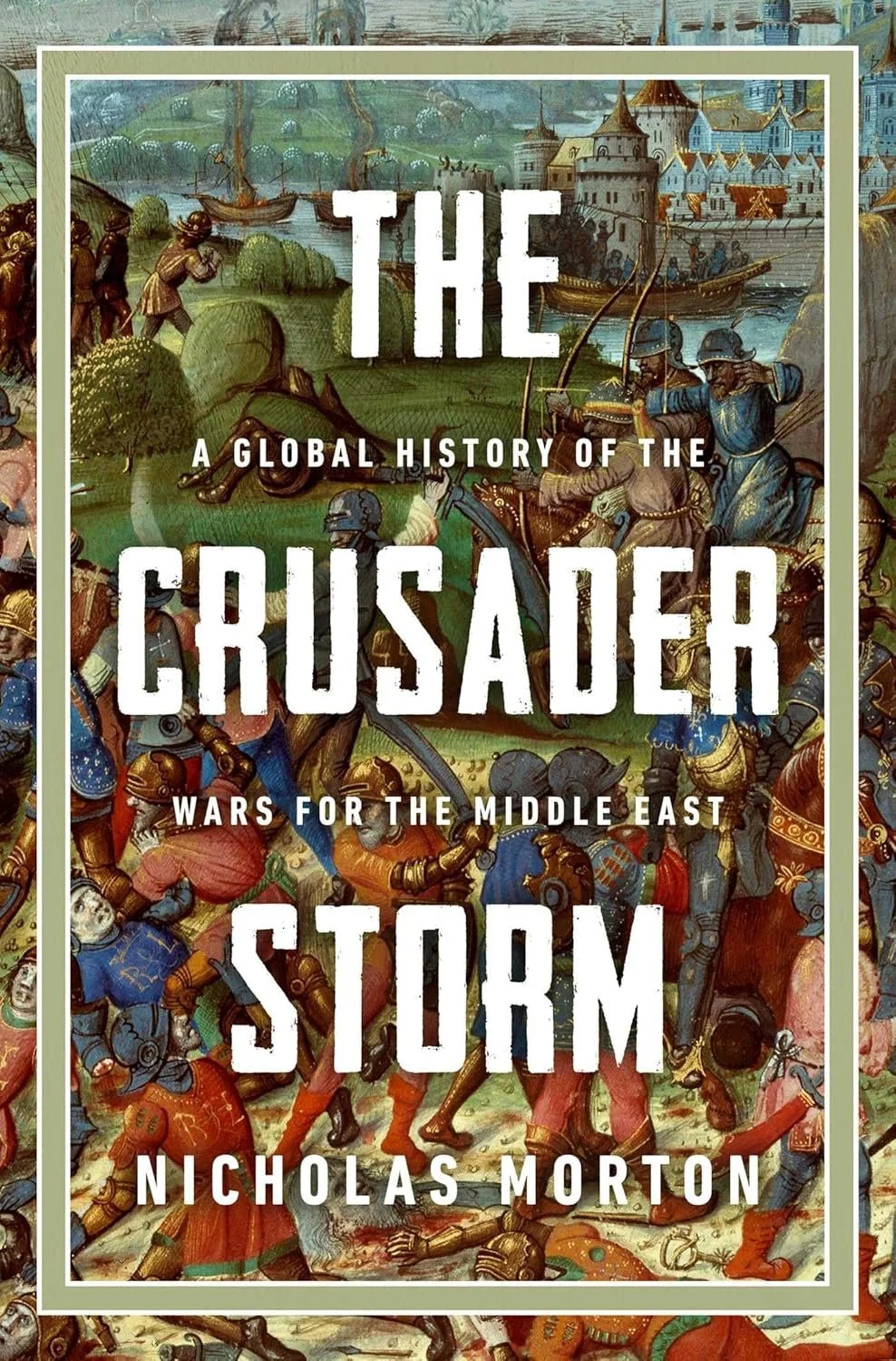
This week, I spoke with Dr. Nicholas Morton about the first century of the crusades. Nic is an associate professor at Nottingham Trent University, and the author of many books, including The Crusader States and Their Neighbours: A Military History, 1099-1187, and The Field of Blood: The Battle for Aleppo and The Remaking of the Medieval Middle East. You may remember him from the last time he was on the podcast, speaking about his book, The Mongol Storm: Making and Breaking Empires in the Medieval Near East. Nic’s new book is The Crusader Storm: A Global History of the Wars for the Middle East. Our conversation on the wider world of the Crusades, the cultural and technological exchange it led to, and the importance of some forgotten individuals from this moment in history is coming up right after this.
Welcome back, Nic. It's so nice to see you. Your smiling face. I've seen you on Instagram, but we haven't chatted in a while, so this is nice. Welcome back.
Nicholas Morton:
Yeah, it's great to catch up, Danièle.
Danièle Cybulskie:
So, you have a brand-new book out, and I think it's – it seems to be going well. There's a lot of buzz about it, which is excellent. I always love to see my friends win. So, congratulations on the new book.
Nicholas Morton:
Thank-you very much, and thank-you for having it on the shelf behind you.
Danièle Cybulskie:
Yes. Yes, I wanted to make sure that other people can see it, because this is kind of an experimental video that I'm going to be putting on Patreon. So, we'll… we'll see how this goes. I think we look great. Don't you think? We look great.
Nicholas Morton:
Absolutely. Yeah.
Danièle Cybulskie:
Okay. So, Nic, your new book is on the Crusades. And as you know – we were just talking about this before we came on – there's a lot of books on the Crusades. So, every time I speak to someone about this topic, I have to ask: what is it that drew you to writing this book on the Crusades? Because it feels like you always want to bring something new to it. What did you want to bring to this?
Nicholas Morton:
Yes. So, I mean, there's a whole… there's a whole series of things to say here, but the big one is that the Middle East is complicated. It's complicated right now, obviously. It's also very complicated in the past. And so, you've got Georgians, Armenians, Byzantines. Yes, you've got the Crusaders. You've got Arabs, Turks, Kurds. You've got Sunni and Shia Muslims, various different communities. You've got Jews. You've got Zoroastrians. There's so many different cultures. in the Middle East. And yet, so many histories of the Crusades tell us the history from one perspective – from the Crusader perspective commonly, or from the Islamic perspective – as if there's just one perspective. But of course, there are so many different Islamic views on the Crusades. So, what I wanted to do was to explore the history of the Crusades from lots of different perspectives. What do the events of this era look like from through the eyes of a Syrian archbishop, or the vizier of the Fatimid Empire, or the mother of the Turkish ruler of Damascus, or a Kurdish general, or a Crusader princess? What we're doing in this book is looking at the events of this period through a whole series of different cultural views, but focusing on individuals from those cultures, and then they act almost like guides through these events so that you get to see where their cultural perspective's coming from. But at the same time, they reoccur. So, there's someone you can follow through these events, as well. So, that's what I'm trying to achieve. But the other sort of the big area here is that the Crusades are often sort of – the one thing everyone thinks they know about the Crusades is that this is what happens in the medieval Middle East. This is the era of the Crusades, like there's nothing else going on. But in fact, the Crusades aren't even nearly the biggest thing taking place in this time. You've got the Seljuk invasions out of Central Asia that saw the establishment of a huge empire from the borders of the Central Asian Steppe country all the way through to the Mediterranean. Compared to that, well, the First Crusade conquered three cities.
Danièle Cybulskie:
Yeah.
Nicholas Morton:
Which kind of gives you a sense of perspectives. So, I'm making the point the Crusades aren't the biggest show in town. There are other things going on, as well. But that if we understand how the Crusades fit within all these other events that are taking place, suddenly you get a greater sense of the whole and it all begins to work together. And you see how each different culture – each different sort of major development that's taking place – shapes all the others. So, it's a rounded global view of the… of the Middle East at this time, which is why I called it that.
Danièle Cybulskie:
Yes. Well, and it works really well with your previous book, which was The Mongol Storm. So, now we have The Crusader Storm. And I think that – I mean, I've read a lot of books on the Crusades. It's not my specialty, but I've read a lot of books on it by this point. And I still was learning a lot of things because, as you say, you know, you don't always get the perspective of what… what the Byzantine Empire is doing at this point. So, one more question about scope here before we get into the nitty-gritty. You've worked on about a hundred years here – just one century – when we know that the Crusades extend beyond that. So, you went basically from the beginning when the Christians conquer Jerusalem to when Saladin does. And why did you decide to sort of cut it off at that point? Because at that point, you know, there's a lot of Crusaders who are just getting started. Why did you end there?
Nicholas Morton:
Yeah, so – I mean, with all these things, you've got to work out exactly how much you can sort of reasonably squeeze into a book.
Danièle Cybulskie:
Mmhmm.
Nicholas Morton:
Mongol Storm was my first sort of storm book, a multi-perspective history that went from about 1218 through to 1323. So, kind of, sort of the thirteenth century. Crusader Storm stops in 1187. So, they don't quite join up. But I thought about including what comes next – essentially the Third and Fourth Crusades – but I wonder if there's scope for a book on those specifically. Maybe the two together. I felt it would be a bit like sort of stretching it too far to go all the way from the First Crusade up to the point where Mongol Storm starts. So, yeah, maybe there's scope for something in the future there.
Danièle Cybulskie:
Yes. Well, I mean, I would welcome another book from you always, but you know, you're stopping at a point and then starting at a point, like… In that middle space, as you're saying, is the story that more people are familiar with, which makes this current book so valuable. So, let's start where you start, which is in 1097 with the Seljuks. What's happening in the Middle East and further at this point?
Nicholas Morton:
Yeah. So, I mean, this is –
Danièle Cybulskie:
A big question.
Nicholas Morton:
It's a great question, but it's one of my favorite questions to answer because I've got a view on the Crusades – I've got a view on the Middle East during the medieval period – which is that one of the biggest factors, at least as big – possibly bigger, dare I say it – than interfaith conflict, is the struggle between nomadic peoples and agricultural peoples. Because, I mean, let me ask you, Danièle, have you ever run down the street screaming, the nomads are coming?
Danièle Cybulskie:
No, that's not something that I have done, but I do live in Canada. We don't have a lot of – I mean, we have people who have moved around a lot, but I wouldn't say it's the same as the Steppe people, which you might be talking about now.
Nicholas Morton:
Yeah. So, in Eurasia, Steppe invasion is an ongoing threat that carries on, really, ‘til the seventeenth century. We can think of the Huns and the fall of Rome. We can think of the Mongols, obviously. And in the twelfth century, which is the period I'm looking at, we're looking at the aftermath of another massive invasion from the Central Asian Steppe by a nomadic group of peoples called the Seljuk Turks. And in the decades before the First Crusade, the Seljuk Turks invade out of Central Asia, sweeping through Persia, modern-day Iran, Iraq, Syria, applying enormous pressure on the Byzantine Empire, and ultimately to the Mediterranean seaboard. Just to sort of go back to the comparison I made earlier that the Crusaders in the First Crusade only took three cities – that does just put things in perspective a bit. We tend to think of this as the era of the Crusader Knights because that sort of epitomizes the Crusades. It's not. This is the era of the nomadic… of the nomadic societies. They're the ones conquering everything, whereas agricultural societies like Western Christendom, really, it's… it's very sort of marginal. A little bit of territory taken there, a little bit of territory lost there. It's much smaller. But yeah, the Middle East was conquered several decades before the First Crusade by the Seljuk Turks. And in that process, they overthrew and suppressed all sorts of different communities. Before they arrived, it had been the Abbasid Caliphate across much of the area. And the various Arab governors and leading Arab, or Kurdish, or Bedouin families who used to rule much of the Middle East, they're now suppressed under Turkish rule. But they're ready to rebel. And then you've got the Seljuk Turks expanding beyond the Muslim world into the eastern districts of the Byzantine Empire, Anatolia, Asia Minor, modern-day Turkey. And that war's ongoing. So, when the Crusaders arrive, it's a war zone. The Seljuk Turks have conquered much of the Middle East, and they're continuing to apply pressure on what's left. And what's left is really the Byzantines clinging on to the western tip of Anatolia, and the Fatimid Empire, a Shia Islamic empire in Egypt.
Danièle Cybulskie:
Yes.
Nicholas Morton:
So, it's a war zone, and the Crusaders are very interested in the fact it's a war zone. And so, they see opportunities here. Perhaps they can make an alliance with the Fatimid Empire in Egypt. They have no objection at all to forming treaties with non-Christians. They also begin working with various Bedouin groups. I suspect – my best guess is – the Bedouin, who of course are also nomads, have lost much of their grazing to the incoming Turks, and the Crusaders provide an alternative. The Armenians would be another example. Lots of other factions who have lost significantly during the Seljuk invasions, who are willing, then, to ally with the Crusaders. And the Crusaders, for their part, are willing to ally with them. Now, almost immediately then, we start messing with the basic idea of the Crusades, which is the one thing everyone thinks they know about them, which is that this is a very, very simple, straightforward situation of a Christian-Islamic clash. In fact, during the First Crusade, and in later wars, there are plenty of occasions where you have Christians and Muslims on both sides. There is undoubtedly an underlying conflict, and there is a great deal of brutality. I'm not in any way going to try and play down the fact that the Crusaders sacked Jerusalem in 1099 in an incredibly bloody siege. But there are complications here that also need to be acknowledged.
Danièle Cybulskie:
Yes, absolutely. I was thinking as you were speaking about: if we picture this as maps, right? And it's like they're painted one color, and then they get painted another color. It seems simplistic, like we are… we are taught, because this is very complicated and it's fair to teach people at first in a very simplistic way before we learn the nuances. But that sort of… that sort of red-colored map, or yellow-colored map, really doesn't get at the fragility of these empires. And that's… that's something that really comes out in your book is that these are very fragile. So, you have a call for crusade, you have the Franks – which is what we're calling the Crusaders in your book and what they were called at the time – coming in. What made them successful in this first wave?
Nicholas Morton:
Yeah, so the First Crusade… I mean, the First Crusade is interesting because it's completely ridiculous.
Danièle Cybulskie:
Yeah.
Nicholas Morton:
From a military perspective, it should never have worked. I'm not quite sure what was going through the papacy's head when it thought that it could ask what is essentially a series of farming communities to produce an army, march a thousand miles through hostile terrain, and then take and hold Jerusalem with no access to maritime supply lines – at least not directly from Jerusalem, because it's inland. And even… and even if when they conquer ports, they're still hundreds of miles from Christendom's nearest outpost. So, from a pragmatic military perspective, this should never have worked. And of course, in most cases, the First Crusade didn't work, because most of the First Crusade armies got slaughtered. It's just the last one that didn't. So, what we're looking at here is Crusaders going to the Middle East on this bizarre escapade. I mean, nothing like this has ever been tried before – not seriously. And they kind of… kind of sort of make it work from a practical perspective. And you're quite right, the big question is, how on earth could that happen? Now, often you hear people saying, well, they didn't meet much resistance because the Seljuk Turks who are the region's dominant power are embroiled in civil war. And that's true. They are embroiled in civil war. But the Crusaders do still meet significant resistance because every Turkish governor near to their line of march tries to stop them. I think desperation goes some way to explain it. They've got nowhere else to go. There's no way back for them once they've got so deep into northern Syria. So, they've either got to make it work, or it's not going to work at all. But as I mentioned, they've also got allies. And they're willing to make those alliances. Because there are plenty of people who would like to see the Seljuk Turks being driven back. And notably, when the Crusaders talk to the Fatimid Empire in Egypt about their possible alliance – it doesn't come off. The talks eventually break down. But the Crusaders' best offer to the Fatimids is that they will help them to reconquer every city they have ever lost to the Seljuk Turks, if in return, they can have Jerusalem. So, they know that their strongest play here is to help the Fatimids to recover their position, given their substantial losses to the Seljuks.
Danièle Cybulskie:
Yes. Well, I mean, this is something that I think is a surprise to people who are used to this Crusade narrative, where it's, you know, “clash of civilizations”. We always say this in quotation marks. But this is not the case at all, because, you know, the enemy of my enemy is my friend.
Nicholas Morton:
Yeah. I mean, without doubt, there is an underlying conflict. When a Christian or Muslim army takes a city, there's plenty of co-religionists who will give that a cheer because it's the expansion of territory under their religion's domain. But yeah, there's a lot more complicating things going on. And even the nature of war, it's different. One of my favorite stories, if you'll allow me to share it –
Danièle Cybulskie:
Of course.
Nicholas Morton:
Right, so it's twelve years after the First Crusade, and a large army has left one of the northernmost Crusader states called the Principality of Antioch. And they're trying to besiege and conquer one of the very few towns that's still under Arab rule in Syria called Shaizar. And the Antiochene Franks – their attack goes horribly wrong for them, and they can't make it stick. They can't take the town. And so, eventually their leader, called Tancred, thinks, okay, we're going to have to pull out. And so, in the dead of night, when they think they've got the best chance of not being pursued, the Antiochene army tries to withdraw to its own territory. Now, of course, for the rulers of Shaizar – the Banu Munqidh – this is great. They've got a Crusader army in full retreat. Can they turn that retreat into a rout?
Danièle Cybulskie:
Mmhmm.
Nicholas Morton:
And so, their own forces pursue the Crusading army, trying to turn their retreat into a rout. And there's a great deal of fighting in the dead of night until one Crusader knight takes a step out from the ranks and holds off the oncoming forces of Shaizar to enable his fellows to escape. Now, so far, this story won't be a big surprise to most listeners. Christian army. Muslim town. They're fighting. What happens next needs a lot more attention though, because a few days later, when he's had a chance to recover, that knight who held off the pursuers – who should arrive outside the gates of Shaizar? But there he is. Knock on the door. Hello. I really – I thought your warriors fought tremendously well in the last battle. Could I come and train with you for a while? And the Banu Munqidh – the Arab rulers of Shaizar – said, well, yes, of course you can. Come in! Train with us. So, for a few days, he enjoyed their hospitality. And then he went. Now, within that story, it captures something. And I think… I think the biggest thing to take… take from that is when we talk about war and conflict, we can't assume we know what that means. Because that kind of scenario, that just will not happen in the modern day. I mean, there's lots of wars going on at the moment, sadly. But just to pluck one out of the air, let's say the Ukraine-Russia conflict, for example. Imagine that happening. Just, okay, we finished fighting for the moment, we'll go and spend some time socializing together, and then we'll carry on fighting afterwards. It wouldn't happen.
Danièle Cybulskie:
Yeah.
Nicholas Morton:
It would look odd. It might even look like treason. In the medieval period, this makes perfect sense because warfare is – yes, it can be about conquering towns, expanding territory, all the things that we might think of when we think of warfare. But of course, it's also about displaying your masculinity.
Danièle Cybulskie:
Yeah.
Nicholas Morton:
This is the forum. The battlefield is the forum where you show your courage and your valour, and your mercy, and your loyalty. And all these things are intrinsic, not just to Crusader ideas of masculinity, but also to many Muslim paradigms of masculinity, as well. They have a great deal in common. Not just on the battlefield, they also enjoy things like falconry, chess, lots of… lots of areas. They like their horses, and rearing horses to be effective in battle, and all these things. There's a lot of points of reference which they share, and the battlefields where they do that. So, campaigns or sort of long, drawn-out wars involving no real gains or losses on either side, these aren't pointless.
Danièle Cybulskie:
Yeah.
Nicholas Morton:
Because the ongoing cycle of skirmishes and raids allows them to continually display why they are – and why they should be – set aside from other people, because they are the aristocratic warriors of their society. And that's something they've got in common. And so, in that kind of context, yeah, we can fight one day and we'll feast the other. And so, we've got a situation where massacre and brutality can take place in one scenario. And yet socialization is also possible at the same time. It's almost like an exceptionally brutal contact sport. But there we go.
Danièle Cybulskie:
Yes, it reminds me so much of all the martial artists I've met over the last decade of doing martial arts where you get beaten by someone and then you want to learn from them. It’s not all that strange when you think of it in terms of something like a combat sport. And also, there is the pragmatism that I think you're getting at, here. If you get beaten by someone, you want to learn from that person. I mean, this knight seems to not have been beaten. He seems to have gotten back to his, his camp, which works well enough for him that he can come back and ask these questions. But there's a certain amount of pragmatism that you get at in the book, as well, when it comes to things like technology. So, do you want to address that for us?
Nicholas Morton:
Yeah, no, this is something I love about the medieval Middle East because it's fascinating, the entire region, and that is just how much changes hands.
Danièle Cybulskie:
Mmhmm.
Nicholas Morton:
And so, you've got chess. Chess is the game to play at this time. Of course, that's arrived from India a couple of centuries beforehand. They're in the process of transitioning from vellum – or sort of scraped animal skin – in terms of their writing materials, to paper, which has arrived from China. At the end of our period, the magnetic compass has arrived, again from China. You've got gold and ivory coming from sub-Saharan Africa, and people are making artwork with it. And that same artwork is splicing Byzantine, Islamic, local – sort of all sorts of local – workshops, Western European, artistic influences from everyone. You can see that in the artwork they're producing. And then my all-time favorite one: food. Everyone loves talking about food. They're sharing recipes. We've got an Egyptian cookbook where they have recipes for Georgian flatbreads, and Turkish recipes. There's even a Frankish roast – or Western European roast – but there we go. Sugar's taking off, and Western Europe's acquiring a sweet tooth, and the aristocrats of this region – whether they're Western European, Eastern Christian, or Islamic – they're eating… they're eating a great deal of spices that are, of course, arriving from Southeast Asia via the spice routes. If you were to go back in time and be invited to a meal by the Knights Hospitaller, you'd be eating from a service of Chinese porcelain because that's also arrived.
Danièle Cybulskie:
Yeah.
Nicholas Morton:
Likewise, if you were to… if you were to need medical attention and to go to the hospital in Jerusalem – which the Hospitallers run – you would be admitted for medical care whether you are of any religion. And the doctors that would treat you would also potentially be from any religion because the Hospitallers employ people from – they're interested in medical expertise, they're not particularly interested in your religious background. And so, all of this, all of these influences are taking place at the same time. It's a very small area of land. But at the same time, a lot is changing hands. And can I risk another story?
Danièle Cybulskie:
Of course.
Nicholas Morton:
So, alright. So, let me ask you then, Danièle:
Danièle Cybulskie:
Uh-oh.
Nicholas Morton:
Here we go.
Danièle Cybulskie:
Okay.
Nicholas Morton:
Would you like to know what to do if you're bitten by a leopard?
Danièle Cybulskie:
Of course. Although that – again, this is not likely to happen to me in Canada, but I'd love to know.
Nicholas Morton:
I don't think Canada… leopard bites. It's perfectly true, yeah. But I should preface this by saying that there is absolutely no genuine medical advice that I'm about to offer here, so –
Danièle Cybulskie:
Don't try this at home.
Nicholas Morton:
If you are bitten by a leopard, according to a twelfth-century Syrian author, the thing you've got to worry about, obviously, is that hordes of mice will want to urinate on the wound. This is just common. I'm just telling you what you already know. This is obvious.
Danièle Cybulskie:
Yeah.
Nicholas Morton:
Yeah. So, what you've got to do – the remedy for this is as soon as you get bitten, you get on a boat and you go out onto a lake or something, because the mice can't follow you there.
Danièle Cybulskie:
Although the rats tend to follow people onto boats. I don't know.
Nicholas Morton:
Well, this author's convinced that the boat's the way to go, but perhaps he's got that fear in mind because the sort of… the second redundancy level that he's built in is that you should then peg cats by their leashes all the way around the lake. So, that they can also deter the mice.
Danièle Cybulskie:
Okay.
Nicholas Morton:
Yeah, but even that, it's not foolproof. It's because what the mice might do is they might find a local pomegranate tree and then hollow out the pomegranate and then paddle it to the… to the boat to get onto your wound in order to urinate. And they're going to be determined.
Danièle Cybulskie:
Wow.
Nicholas Morton:
Okay, so it's a curious story, but I am getting to a point here.
Danièle Cybulskie:
Okay, I'm trusting you.
Nicholas Morton:
Oh yes, we're going somewhere with this. So, yeah, this story emerges in Syria. I think… It's not supposed to be taken particularly seriously, I don't think, but it's a sort of story or legend that's told. It's also told at a monastery near Bristol in England.
Danièle Cybulskie:
There you go. I mean, these stories get a long way, which is something that I really appreciate about your book, as well, is pointing this out. So, who's telling this in Bristol?
Nicholas Morton:
It's just to the east. A place called Malmesbury, just to the east of Bristol. Someone called William of Malmesbury, who's a monastic author. But my point is, this is just one example among many – and I could pick on many more serious examples – of things changing hands. Knowledge, technologies, recipes, stories – it's all taking place. And another vein to the whole technology side of this that I really wanted to bring out in the book is when the papacy thought, you know what? Let's get Western Christendom's armies to march for a thousand miles into hostile terrain and then try and take and hold a city and do that in perpetuity.
Danièle Cybulskie:
Mmhmm.
Nicholas Morton:
What the papacy hadn't thought about – but of course, the people who then went to try and do it, they did have to think about it – is a million and one practical challenges involved in making that stick.
Danièle Cybulskie:
Yeah.
Nicholas Morton:
And so, by taking on that kind of challenge, you can actually see how people are thinking, okay, so the First Crusade took Jerusalem – how are they going to keep it? And then what do we need to make that work? And one of the things they need is boats. So, at the time of the First Crusade, you can probably get a boat in Western Christendom that can transport maybe two hundred or three hundred people – talking now about sort of end of the eleventh century: 1190s, so – 1090s – about that sort of time. By the time we get to the 1160s – and I should point out that Western European, Islamic, and Eastern Christian sources are consistent on this point – you've got ships that can transport over 1,500 people.
Danièle Cybulskie:
Mmhmm.
Nicholas Morton:
So, the… The massive advances in maritime architecture that implies. That's all simply to get people out in larger numbers to the Crusader States. And there, too, that's not just technology that remains static, that’s technology that spreads, because we hear about Islamic states then hiring – the example in my mind is where they're hiring a Sicilian maritime architect. And we can spin this round. Western Europe's learning a great deal from the Muslim world, and the Eastern Christian world, as well, particularly in medicine.
Danièle Cybulskie:
Mmhmm.
Nicholas Morton:
And Antioch, in the north, becomes a major crossroads for medical practitioners. Again, there's an English… an English traveler called Adelard of Bath who goes to Antioch specifically because he wants to find out what medicine's being – what the latest knowledge is. But I can think of examples from all sorts of different Islamic cities and Eastern Christian cities. And again, that information is changing hands at a furious rate.
Danièle Cybulskie:
Yes. And I mean, one of the things that is definitely changing hands is military information. We were just talking about this a second ago, but even the counterweight trebuchet is coming out of this time, or having rounded towers, or even more concentric circles in your fortifications, so that you have a better chance of withstanding a siege engine. And while we're on sort of military tactics – we were talking about nomads a minute ago. Can we talk about sort of the difference in tactics and what people are learning from each other? Because this really changes how, well, how the military on both sides – and I say both sides as if there are two, but you know what I mean – how things work for the Franks, how things work for the local people. Can you tell us a little bit about the tactics?
Nicholas Morton:
Sure. So, the Crusader states' most common opponent are various Turkish leaders. And although those leaders exist in different constellations of alliances, and sometimes they're allied with the Franks or Crusaders, they tend to fight in a similar way. And so, battles tend to take the form of quite fixed, rigid ranks of Frankish soldiers. And so, you should imagine lines of infantry quite closely packed, big shields to keep off the nomadic Turkish horse archers, spears and crossbows – again, to hold them back. And then behind that serried rank of shields, spears, and crossbows, you've got the cavalry. And what the cavalry is waiting for is, it's waiting for a chance when its opponent is in a big enough block so the infantry can divide, and out go charging all these heavily armored knights looking to impact against their opponent's formation. And if their opponents do let themselves get into a cluster, and they are then hit by a charging formation of Crusader knights, they will probably lose. So, the game plan for the Franks is: tough formation, repel attack after attack by nomadic light cavalry archers, and then wait for your chance for the cavalry to be unleashed. And if they can make that work, they win. Spinning things round now, if you are a Turkish commander, you have a very different set of objectives. You are equipped with very large numbers of light cavalry archers. You cannot meet the Crusader knights in hand-to-hand combat because they're much more heavily armoured, and that's what they specialise in.
Danièle Cybulskie:
Mmhmm.
Nicholas Morton:
Your mounted cavalry, what they're really good at is hit and run. Gallop up to within fifty or sixty metres of a Crusader army, loose a few volleys of arrows, and then get out of there before anyone can come and get you. And the way you make that work, if you're a Turkish commander, is to circle around a Frankish army, cut their logistics, cut their supply lines, wait for them to get hungry, run out of ammunition, and then just wear them down.
Danièle Cybulskie:
Mmhmm.
Nicholas Morton:
And that can work really well. And eventually, if you apply enough pressure for long enough, the Frankish commander might do something stupid, or his troops might panic, and then you've got them. So, very different approaches to war. And there's all sorts of stratagems that both sides try. The Franks realize that Turkish bowstrings are water-soluble – or, they get saggy in the rain. So, they like to fight in the rain. High wind is also bad for archery. Flip things around, Turkish commanders realize that Crusader knights in marshy ground have a tendency to sink.
Danièle Cybulskie:
Mmhmm.
Nicholas Morton:
So, fight them in marshes. There's all sorts of ways of doing this. And also, Turkish commanders and Frankish commanders, they begin to adapt to each other's strengths. So, Crusading armies, or Frankish armies, they begin to recruit Turkish light cavalry archers of their own, called turcopoles, to sort of compensate for what they recognize as a weakness in their own sort of military setup.
Danièle Cybulskie:
Mmhmm.
Nicholas Morton:
On the other side of the battlefield, Turkish commanders – and also, subsequently, Kurdish commanders, once Saladin's taken control, because Saladin is in large, large part a Kurdish commander leading Turkish troops – he substantially increases the number of heavy cavalry in his army because he's seen how effective they are. He knows they work for the Franks, so why wouldn't he develop the same thing? So, they're learning and they're innovating. And of course, the prize goes to whoever can do it more decisively first.
Danièle Cybulskie:
Yes. Well, we're talking about Saladin, and of course, he's legendary for his tactics. And one of the things that you brought out in the book is this learning, because when he defeats the Franks at the Battle of Hattin, this is, in part, because he knows what they're going to do next. And so, he baits them – and not just in the usual way where you have the horse archers who are poking at people, but he baits them to come out of where they are because of ideological reasons, right?
Nicholas Morton:
Yeah. It's a very dramatic denouement and also another reason why to end the book at that point, because it's a bit like a film: it's the big battle at the end, I suppose. But yeah, so imagine a sort of very wide, rolling valley with quite a steep, sort of scarp-like slope to the north. And you've got Saladin's army to the east, laying siege to a stronghold called Tiberias – town. And far west, about forty kilometers away, you've got the Frankish encampment of the Kingdom of Jerusalem's army. Now, this is the great set-piece battle. And Saladin has to… he has to have a battle. Because his various allies and supporters – he's been promising them for years that he will strike a decisive blow against the Crusader States, and he hasn't. In fact, he's lost quite a lot. And yet, he's built his empire on the promise that he will strike this decisive blow. Spin things round. In the Frankish camp, you've got King Guy of Lusignan. He's an unpopular king. Lots of the nobility don't like him. He has to have a victory, too. And so, Saladin invades the Kingdom of Jerusalem, lays siege to the town of Tiberias. And he knows what this is going to do to Guy, because it is a fundamental fact in the relationship between a king and the nobility, that if a stronghold is besieged, that king will march to its aid. And so, Saladin knows this, and that allows Saladin to pick his battlefield. Now, as is famously known, the area between Tiberias and the Crusader camp – and this is July, and they're all wearing chainmail, so it's going to be pretty hot – there's not much water. There's a little bit of water in some places, but not enough for an entire army. But that's okay, because the Franks have been in the Middle East now for about ninety years. They know how to fight. They've been campaigning year on, year off. In some cases, they've survived several days by just the water they carry with them. So, they know what they're doing. And they know another thing, too, which is if they form their army into what's called a fighting march, which is basically a massive Roman tortoise – so, shields all the way down the side, the army arrayed into three big squares, with the horses in the centre being protected by the knights and their grooms – they know no one can stop them, because no one has ever successfully blocked a fighting march, ever. Well, no, they did it once. That was about forty years previously, when a bad… a badly-formed fighting march was routed. But they've done this tens of times. They know Saladin can't stop them. So, the idea is leave early in the morning while it's still cool, and then plough your way through the light cavalry ranks of Saladin's army and reach Tiberias. And they make good progress. They get about half the way before it really – the day really starts to heat up. And to begin with, Saladin gives them the battle they're expecting in the light cavalry trying to wear them down. And so, they're probably thinking, yeah, this is – it's a lot of pressure, but actually, it's more or less what we were expecting. And I suspect that's on purpose for Saladin. He doesn't want to stop them. The idea is not to stop the Frankish army, it's to slow them down. Stop them getting to Tiberias and the Sea of Galilee, and therefore an unlimited supply of water, by the end of the day. And so, he forces them to encamp about two thirds of the way to Tiberias, at a place called Mascana. And the following day, and after a hellish night for the Frankish army where Saladin's been lighting fires and plowing smoke into their encampment and parching their throats – they can't get enough water – they're still in fighting shape. But Saladin's about to try his major innovation. Which is that for the first time ever, he is going to try and stop an advancing Frankish army in its tracks. Nothing about light cavalry sort of dancing around the edges and wearing them down. He's going to block them, which means meeting them head-on in hand-to-hand combat. And he's been building up his reserves of troops that will do that for years. It helps that the Frankish army is a bit weakened. And so, when the Frankish army sets off on the second day – the 4th of July – for Tiberius, that's when Saladin tries to block their advance, and he's successful. They're then forced to take refuge, ultimately, in a waterless Bronze Age fort called the Horns of Hattin, which is where the name comes from. And that's where the army is routed. And so, the key innovation is that Saladin is willing to try, for the first time, actually stopping a Frankish fighting march in its tracks. And of course, that, in a sense, that sort of technical description lacks the drama of sort of what's going on. In its core, that's what he's doing. And that's the big risk he's taking. Is he going to be able to make this work? And as it turns out, the answer is yes.
Danièle Cybulskie:
Yes. And I think that there are so many little things that you've pulled out in your description of the battle – now and in the book – where often, the Franks are not given credit for having fought for so long that they anticipate going long stretches without water, and you do give them credit for that, for – for understanding their enemy, for understanding what it's like to march – but also giving Saladin credit for saying, if I besiege this town, they are coming for me. They're definitely going to do it. And interestingly, the person who was supposed to be in charge of Tiberias says, don't do that. That's a bad idea. But they can't help themselves. This is what they do. And so, I really think that you've brought out so much of the learning that sometimes gets missed, I think.
Nicholas Morton:
Yeah. Saladin's interesting because sometimes when you read accounts of the Battle of Hattin, you can get the impression that what's being discussed here is a second-rate general, aka Saladin, defeating a third-rate general, aka Guy of Lusignan. So, this is a sort of battle of mediocrities. And I really don't think that's true. I think Saladin is a super – he's always a better politician than he is a field commander. But he is also an extremely good field commander. And Guy – I mean, people talk about Guy like, obviously ridiculous. Or you get these sort of armchair enthusiasts saying, I'd never have behaved that way.
Danièle Cybulskie:
Yeah.
Nicholas Morton:
Guy knows exactly what he's doing. And the whole sort of, well, of course, the Franks are from Western Europe, they don't understand about the Middle East. They've been there for ninety years – they're in their fourth or fifth generation, in some cases. They know the area very well, and they're fighting on their own territory.
Danièle Cybulskie:
Yes.
Nicholas Morton:
They do know what they're doing. So, I think we're looking at a battle between two first-rate commanders who are actually very, very competent. In the endgame, of course, it was Saladin who came out on top. Because he realized that he now possessed the tools to unlock some of the Franks' biggest weaknesses.
Danièle Cybulskie:
Yes. Yes, absolutely. And one of the things – one of the reasons you avoid a battle like this is because you don't know how it's going to go. It's always going to be a coin toss, no matter how prepared you are, which is something that the more you learn about the Middle Ages, the more you realize.
Nicholas Morton:
Yeah. No, people don't like fighting battles. You're absolutely right. Too big a risk. And of course, the extent of that risk becomes clear immediately afterwards, when you see just how much the Kingdom of Jerusalem loses after they – after the Kingdom of Jerusalem collapses via Saladin's victory. Within eighteen months, the entire kingdom's been reduced to a single city. So, in some ways, this is Exhibit A in why you don't fight big battles. But of course, the reason they did – again, they're not doing this because they haven't thought it through.
Danièle Cybulskie:
No.
Nicholas Morton:
They're doing this because both Saladin and Guy are desperate. They've got to have a victory to silence their own internal critics.
Danièle Cybulskie:
Yes. Well, at the risk of being cliché and sticking with Saladin, when everyone wants to do this when they're talking about the Crusades, I want to talk about Saladin as a figure when it comes to shaping this whole region, as you're talking about, because Saladin's ascent doesn't just… doesn't just lead to the conquest of Jerusalem – which it does – but it also leads to the end of the Fatimid Empire, which is gigantic. So, can you tell us about Saladin's place in sort of the greater politics of the Middle East at this moment – and Egypt?
Nicholas Morton:
Yeah. No, that's a great question. And that brings out sort of, again, the complexities that are going on here. Because again, it's not simply about the Crusader States and their Turkish – or later on Kurdish – opponents. There's other conflicts going on. And one of the biggest is between various branches of Shia Islam and Sunni Islam. And so, in the sort of 1160s, you've got a powerful Turkish ruler in Syria called Nur al-Din. And both Nur al-Din and the current King of Jerusalem, called King Amalric, they both realize that Egypt is vulnerable. Egypt is by far and away the wealthiest bit of territory anywhere in the Middle East – far more so than the Crusader States, far more so than Nur al-Din's empire. It's the crossroads for the spice routes, silk routes, amber routes, and the trans-Saharan gold routes, and the Mediterranean trade. They all go through there. And you've got the Nile Delta and all its agricultural crops, as well. So, the wealth there is astonishing, and the Fatimid Empire – a Shia Islamic empire – is in the throes of a major civil war. And the various factions involved in that civil war in Egypt, they make the critical mistake of anyone ever fighting a civil war, which is to ask for outside help.
Danièle Cybulskie:
Mmhmm.
Nicholas Morton:
Because the big danger if you ask for outside help is that people will say yes. And then – and then, they will intervene, and then they won't go. And that's basically what you've got. You've got various Fatimid factions. Sometimes they're allied with the Crusader States, sometimes they're allied with Nur al-Din. But Nur al-Din's general is a Kurdish commander called Shirkuh. And Shirkuh eventually, after many years of campaigning, is successful in conquering Egypt. But he dies almost as soon as he's done it. And his nephew takes power in his place, and his nephew is Saladin. So – and it's under a very early phase in Saladin's reign that he then announces the Sunni rule over formerly Shia-ruled Egypt. And so, within the context of the Sunni-Shia struggle, that is an absolutely essential moment. I might also point out there are all sorts of other conflicts across Syria, or the Jazeera. The Jazeera is the area of land between the Tigris and the Euphrates River. There's all sorts of other conflicts. And of course, the other famous one is the role played by the Nizari.
Danièle Cybulskie:
Yes.
Nicholas Morton:
Also known as the Assassins. And they, too – they're intensively persecuted in the Seljuk Empire under various Turkish rulers later on. And there's always a danger that they will end up murdering someone or other, but they, too – they're engaged in a struggle for survival, often against Sunni authorities who are looking to eradicate them. And indeed, Saladin himself has a very difficult relationship with the Assassins, who tried to murder him on many occasions. So, again, this just brings out the multi-sidedness of this. In fact, if you'll forgive me sort of a bit of a slight digression: I once tried to count the number of factions involved in the broader sort of chessboard of the Middle East from this era. And I just gave up at fifty. I just – I wasn't getting near the end. It just began to feel pointless, really. It's complicated. There's so many things going on.
Danièle Cybulskie:
Well, that's the interesting thing about reading your book is like, when we say it's only ninety years – or it's not even quite a century – there are moments in the book where you're like, wait, this person is still alive? And really, there are people that are alive throughout this whole period, but there's so much turnover and there's so – such a big cast that, at times, you think that maybe you've gone several centuries because there are so many people involved. But really, it's all happening at the same time. And so, it's important to sort of understand this nexus of all of the things happening. We haven't even talked about Byzantium. We're running out of time. We haven't talked about Byzantium, we haven't talked about the Armenians – but you talk about this in the book because these are also hugely important factors when it comes to the pressure – say… say you're just looking at the Franks – the pressure that is on these few towns that they have from outside. It's not just, you know, the usual suspects.
Nicholas Morton:
Yeah. And yes, I mean, one of the ways I sort of navigate through this complexity is, as I mentioned, to try and pick on individuals. But so often these individuals – one of the features that really came out to me as I was writing the book, is just how young they are.
Danièle Cybulskie:
Yes.
Nicholas Morton:
When films – or Netflix series, or whatever – when they depict medieval stuff, medieval events… I mean, yes, you might have some young characters, but often there's quite a strong cohort of sort of forty-to-sixty-somethings – men, often, with very big beards.
Danièle Cybulskie:
And mullets.
Nicholas Morton:
But the cast in this book is – I mean, you do have a few older characters, but for the most part, they're young. And so, I think part of the process of getting your head around what's going on here is to imagine a leading cast where people with significant power are in their late teens, or early twenties. And of course, we can't necessarily sort of match our own experience in our late teens and early twenties to what it would have been then. At the same time, when you're younger, things look different and –
Danièle Cybulskie:
Yes.
Nicholas Morton:
The world can look like a different place. And I think that it is important to remember we're dealing with people who are still absolutely rammed with hormones and adrenaline. And that is also a factor in what's taking place, here.
Danièle Cybulskie:
Yes. And the thing about teenagers and people in their early twenties is it's very easy – and I say this from my own experience – to see the world in black and white, and to see risk as being worth it for ideological reasons. When you do see a lot of people – in the Middle Ages and now – when they get to their sixties being like, I don't know if it's worth it. But when you're young, you want to go for it.
Nicholas Morton:
You're invulnerable. You're going to live forever.
Danièle Cybulskie:
That's right.
Nicholas Morton:
Until that crossbow bolt takes you out your throat. But yes.
Danièle Cybulskie:
That's not funny, but it's also like, we have all been – I mean, there might be people who are younger than nineteen or twenty listening to this podcast – but for the rest of us, we've all been there. We understand what it's like to feel like, yeah, I'm going to lay it all on the line and not really think about the risks as being real risks. At the same time, I do think that – I worry about painting people from the Middle Ages as being naïve in ways where they know a lot more about tactics and the region than just calling them teens would give them credit for. But at the same time, yeah, you're right. The youth of the people involved is an important factor.
Nicholas Morton:
And of course, you mature faster.
Danièle Cybulskie:
Yes.
Nicholas Morton:
So, you reach adulthood at fourteen. And the scope you've got that would be typically given to a teenager today to sort of experience life and develop slowly, that's much more curtailed in this period. So, yeah. But nonetheless, the biological clock is the biological clock. But the other balancing factor here is that most rulers who have got at least a shred of common sense will surround themselves with older and wiser heads who'll be able to say, well, actually, I wouldn't do that. But –
Danièle Cybulskie:
That's right.
Nicholas Morton:
Some don't.
Danièle Cybulskie:
Some don't. And sometimes when you have entire generations wiped out, everybody's the same age when it comes to the people in an inner circle. Okay, I want to be respectful of your time. We are running out of time because you have things to do. So, as we wrap up, what do you want people to think about? Because I do think that the… the conversation about the Crusades is getting to be more nuanced widely. It's not just the way people were talking about it thirty years ago. What do you want people to think about when they think about the Crusades?
Nicholas Morton:
Yeah. So, I mean, this is becoming a bit of a recurring theme with me, really, which is an underlying suspicion of what I would describe as neat history. History that can be captioned very simply and very easily. In so many contexts – I mean, people might be able to find examples where that works – but in so many contexts, human beings are messy.
Danièle Cybulskie:
Yeah.
Nicholas Morton:
They say one thing, they do another. They lie, they make stuff up, they change their mind. They wake up in the morning, and they've had a bad night's sleep, and they make a bad decision – not because of all these ideological or political factors, but because they're in a bad mood, and they didn't sleep well. All of this contributes to the chaotic mess that is human relations. And we can throw all sorts of other factors into the mix, as well, into that. And so, I wanted to write a book in which I don't try and sort of reduce everything into a very easy-to-remember sort of slogan, as it were. And I think one of the slogans that I particularly want to focus on is the idea of Crusades: Christian Versus Muslim War.
Danièle Cybulskie:
Yeah.
Nicholas Morton:
Or interfaith conflict, whichever you like. Yes, there is an underlying conflict. But that's just one thread within a much wider panorama of what's taking place. And yes, it is more complicated to engage with other factors, but it's also more interesting. Once you tease out the other themes, the other things that are happening, suddenly this new landscape and panorama opens before you, and you see all these interconnections that hadn't been there before. And I find that fascinating. It's been keeping me going for over a quarter of a century. So, yeah. I find it fascinating.
Danièle Cybulskie:
Yeah, same here. The closer we get to that human experience, the more interested I am. And this is something that is coming out throughout your work, your past work, and your current book. How do people find out more about your work? Because you're doing courses, you're on the internet. Tell people how to find your work.
Nicholas Morton:
Yeah, sure. So, you can find out my books from my university website. Just type in Nicholas Morton, Nottingham Trent University. I've got various articles I've written available on academia.edu. Again, I'm sure Amazon will be very happy to supply you with copies of my book, but [I’m] also on social media, most of them. I've got a YouTube channel, the handle is @MedievalNearEast, but on most social media platforms, typing in Nicholas Morton and then one of my book titles will probably find me fairly quickly.
Danièle Cybulskie:
Thanks so much, Nic, for being here. It's a pleasure to talk to you about this, especially because you are a person who has so much enthusiasm for the topic. Thanks for being here.
Nicholas Morton:
It's my pleasure.
Danièle Cybulskie:
As Nic said, you can find his work through a quick Google search, or start with his faculty page at Nottingham Trent University. His new book is The Crusader Storm: A Global History of the Wars for the Middle East.
As we saw today, one of the most important figures of the crusading period was Saladin, or Salah ad-Din Yusuf ibn Ayyub, and his reputation for sound wisdom was legendary in the Middle East and beyond. I came across this quote which was attributed to Saladin in a later crusader account, that of Jean de Joinville. In a discussion between Joinville and a Muslim emir about people who renounce their faith under pressure, the emir quotes Saladin as having said, “never did one see a bad Christian become a good [Muslim], or a bad [Muslim] become a good Christian.” Whether or not Saladin actually said this, it definitely rings true. It’s the person you are on the inside who dictates how well you show up in the world.
This comes from the translation of Jean de Joinville’s chronicle by Sir Frank Marzials.
Thanks, as always, for being here, listening, sharing your favourite episodes, letting the ads play, and especially becoming patrons on Patreon. As you heard earlier, Patrons have the option this week of watching my chat with Nic as a little experiment with how this podcast might look on video. So, if you’re interested in checking it out, please visit patreon.com/themedievalpodcast
For the show notes on this episode, a transcript, a list of the books featured on The Medieval Podcast, and more, please visit medievalpodcast.com. You can find me, Danièle Cybulskie, on social media @5MinMedievalist.
Our music is by Christian Overton.
Thanks for listening, and have yourself an amazing day.